
Gum with nicotine can help some adults manage withdrawal while they stop smoking, but it works only when the strength, timing, and chewing technique fit the person's nicotine use. It isn't a harmless piece of candy or a complete quit plan. The practical details matter, especially for people who develop nausea, hiccups, jaw discomfort, or cravings that the gum doesn't seem to control.
Empire Medical Wellness Editorial Team
Published October 3, 2026
Updated October 3, 2026
Table of Contents
- What Nicotine Gum Is and Why People Consider It
- How Nicotine Dependence and Nicotine Gum Work
- How Nicotine Gum Compares With Other Nicotine Products
- Choosing a Strength and Using the Chew-and-Park Technique
- What the Evidence Says About Quit Rates and Combination Use
- Why Nicotine Gum Often Fails in Real Life
- Side Effects, Interactions, and When to Ask a Clinician
- When Physician-Led Outpatient Support Makes a Difference
What Nicotine Gum Is and Why People Consider It
Nicotine gum is an FDA-approved, over-the-counter nicotine replacement therapy, or NRT. It delivers nicotine through the lining of the cheek instead of through cigarette smoke. That makes it a flexible option for adults who want to address cravings as they occur without inhaling tobacco smoke.
Nicorette was the first nicotine replacement product approved by the U.S. FDA, in 1984. Nicotine replacement therapy had been developed earlier, in 1971, by Ove Fernö at the Swiss firm AB Leo. Those milestones help explain why nicotine gum remains a familiar part of smoking-cessation care rather than a newly tested wellness product. The FDA's history of drug regulation provides historical context for its place in modern treatment.
Most widely available nicotine gum comes in 2 mg and 4 mg strengths, including Nicorette and generic nicotine polacrilex products. The right choice depends on current nicotine exposure, how soon a person uses nicotine after waking, previous attempts to quit, and medical factors. A package label can provide general direction, but it can't evaluate a person's heart rhythm, oral health, other nicotine products, or prescription medicines.
This article focuses on the questions that usually determine whether gum helps in real life:
- How does the gum deliver nicotine?
- What makes the chew-and-park technique different from ordinary chewing?
- When might a patch and gum be used together?
- Which side effects should prompt routine clinical advice or urgent help?
- Why do some people stop using gum before it has a fair chance to work?
For adults considering physician-led addiction medicine care, the central issue isn't whether gum works. It's whether the treatment is being used safely, consistently, and as part of a plan that also addresses triggers and learned routines.
How Nicotine Dependence and Nicotine Gum Work
Nicotine dependence has both a physical and behavioral component. Repeated nicotine exposure can create strong associations between nicotine and ordinary events, such as driving, finishing a meal, taking a work break, or feeling stressed. When nicotine levels fall, cravings and withdrawal symptoms can make those cues feel unusually urgent.
Nicotine gum doesn't reproduce the rapid delivery of a cigarette. Instead, chewing releases nicotine that is absorbed through the buccal mucosa, the moist lining inside the cheek. This slower route can provide nicotine without smoke exposure while giving the user control over when a piece is used.
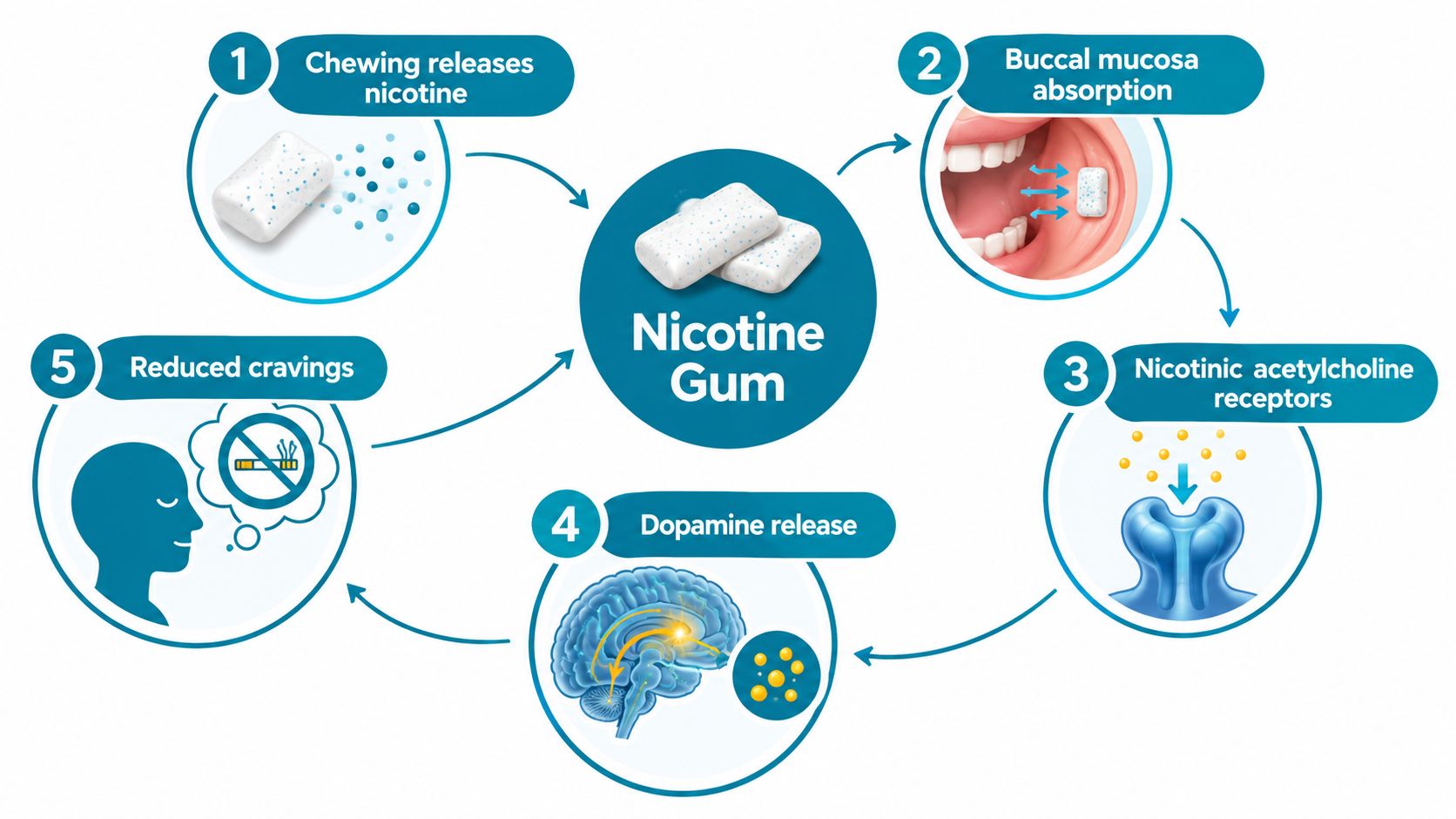
Why delivery speed changes the experience
Cigarettes deliver nicotine quickly through the lungs. Gum acts more gradually, so a person who expects the same immediate sensation may decide too soon that it isn't working. The goal is different. NRT reduces the intensity of withdrawal and gives the person an alternative response to a craving, while behavioral support helps change the routines that keep nicotine use going.
The gum's effect also depends on technique. Slow chewing followed by resting the gum against the cheek allows nicotine to move into the bloodstream. Chewing continuously or swallowing nicotine-rich saliva changes how much nicotine is absorbed and can increase stomach-related symptoms.
NRT includes products such as patches, lozenges, nasal sprays, and inhalers, depending on the product and regulatory status. Prescription options, including varenicline and bupropion, work differently and may be considered when NRT alone hasn't been effective or isn't a good fit. A clinician can compare these choices in the context of a person's health history and current nicotine use. The addiction medicine services offered by Empire Medical Wellness are one setting where that broader assessment may be discussed.
Practical rule: Gum is most useful when it reduces withdrawal enough for you to work on the cue, routine, or situation that normally leads to nicotine use.
How Nicotine Gum Compares With Other Nicotine Products
Different nicotine products create different trade-offs. Combustible cigarettes expose a person to smoke and its toxic mixture. Vapes do not involve combustion, but they still deliver nicotine and expose the user to aerosol constituents. Neither smoking nor vaping should be treated as risk-free.
FDA-approved NRT products are designed as cessation aids. They separate nicotine delivery from tobacco smoke, which is why nicotine replacement is considered far safer than continuing to smoke. That safety distinction doesn't mean nicotine is risk-free. Nicotine can affect heart rate, and using more than one nicotine product requires attention to the person's total exposure and symptoms.
| Product | Toxic exposure | Delivery speed | Clinical role |
|---|---|---|---|
| Combustible cigarette | Tobacco smoke contains harmful combustion products, in addition to nicotine | Rapid | A source of dependence and toxic smoke exposure, not a cessation treatment |
| E-cigarette or vape | No tobacco combustion, but aerosol exposure and nicotine dependence remain concerns | Often rapid, depending on the device and use pattern | Not the same as FDA-approved NRT; cessation planning should account for the specific product |
| Nicotine patch | Delivers nicotine gradually through the skin | Slow and steady | May provide background withdrawal control |
| Nicotine gum | Avoids smoke exposure and delivers nicotine through the cheek | Faster than a patch, but slower than inhaled nicotine | An on-demand NRT option for cravings and withdrawal |
Gum is sometimes paired with a patch because the two delivery patterns address different problems. The patch can provide a steady baseline, while gum can be used for breakthrough cravings. Combination treatment should match current use and clinical context rather than being improvised from several packages.
A patch may suit someone who wants a routine that doesn't require responding to each craving. Gum may appeal to someone who wants more control or who needs help during predictable trigger situations. The nicotine patch treatment overview explains why these products are often considered as different tools rather than interchangeable versions of the same treatment.
The point isn't to rank products for every person. It's to identify the delivery pattern that can be used consistently without creating avoidable side effects or confusion.
Choosing a Strength and Using the Chew-and-Park Technique
The two common strengths are 2 mg and 4 mg. Strength selection should reflect the person's typical nicotine exposure and dependence pattern, not a preference for a stronger product. Clinicians may ask how soon nicotine is used after waking, how frequently it is used, whether a previous quit attempt caused marked withdrawal, and whether vaping or other nicotine products are also involved.
The infographic below shows common product-selection prompts. It shouldn't replace the product label or a clinician's assessment, particularly when a person uses multiple nicotine products or has cardiovascular, dental, jaw, or pregnancy-related concerns.
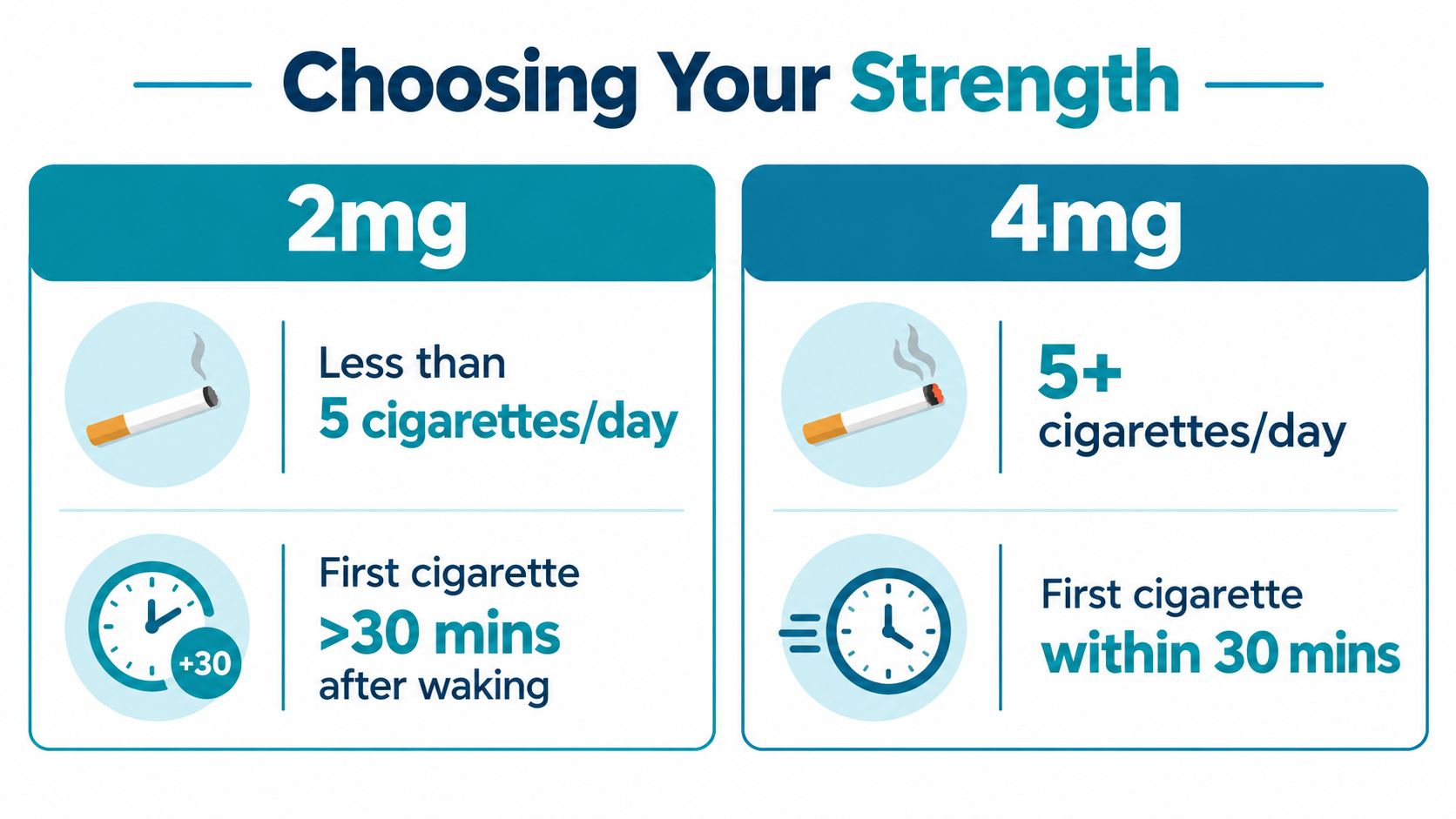
The technique that prevents many problems
Nicotine gum isn't meant to be chewed like ordinary gum.
- Begin slowly. Chew until you notice a peppery or tingling taste.
- Park the gum. Rest it between the cheek and gum so nicotine can pass through the mouth lining.
- Wait briefly. After about a minute, resume slow chewing until the taste returns.
- Move the location. Alternate sides of the mouth to reduce irritation.
- Continue for about 30 minutes. The CDC's nicotine gum instructions describe the chew-and-park method and explain why swallowing nicotine-rich saliva can cause problems.
Continuous chewing is a common mistake. It can release nicotine too quickly, increase swallowing, and contribute to nausea, hiccups, or heartburn. A person who dislikes the taste may chew faster, which often makes tolerability worse rather than better.
A label and safety checklist
- Follow the product directions. Current labeling for a 4 mg product says not to exceed 24 pieces per day. Older CDC specialist guidance described different daily limits for 2 mg and 4 mg gum, so the current label and clinical advice should control for the product being used. The DailyMed nicotine polacrilex label contains product-specific directions.
- Avoid food and beverages around use. Don't eat or drink for 15 minutes before or while chewing, particularly when using acidic drinks that can interfere with absorption.
- Don't swallow the gum. Wrap used pieces and place them in the trash. Nicotine can make children and pets sick, even from discarded pieces.
- Record what happens. Note cravings, withdrawal, slips, correct use, and symptoms rather than relying on memory.
- Ask before combining products. A patch, gum, lozenge, vape, cigarette, or pouch can change total nicotine exposure.
The nicotine gum technique guide offers a product-focused review of the same basic method. The embedded demonstration may also help make the difference between ordinary chewing and chew-and-park easier to visualize.
What the Evidence Says About Quit Rates and Combination Use
Nicotine gum has an unusually long clinical history for an over-the-counter cessation product. Across major evidence reviews, licensed NRTs, including gum, are associated with roughly a 50% to 60% increase in the chance of quitting compared with control conditions. A WHO review reported an odds ratio of 1.63 for gum specifically, while another WHO evidence summary covering 56 trials and 22,581 participants estimated an odds ratio of 1.49 for nicotine gum versus control. These findings are summarized in the WHO evidence review of nicotine replacement therapy.
Those figures describe evidence across studies. They don't predict an individual outcome, and they don't mean that gum works equally well when used incorrectly or inconsistently.
| Intervention | Approximate effect versus control | Best-suited context | Key source |
|---|---|---|---|
| Licensed NRT, including gum | About 50% to 60% higher chance of quitting | Adults using NRT as part of a cessation attempt | WHO evidence review |
| Nicotine gum alone | About 8% one-year continuous abstinence across the reviewed gum evidence base | A population-level estimate, not an individual forecast | WHO evidence review |
| 4 mg gum versus 2 mg gum | Relative risk of 1.43 in five studies involving 856 participants | Higher-dependence groups studied in the evidence | Cochrane findings summarized by WHO |
| Gum plus patch versus one NRT form | 15% to 36% greater likelihood of quitting | People who need both baseline and breakthrough withdrawal control | Cochrane findings summarized by WHO |
Higher-dose gum outperformed lower-dose gum in the cited studies, but strength still needs to be considered alongside side effects, other nicotine sources, and medical history. More nicotine isn't automatically better. A pharmacokinetic study reported that 6 mg gum released 4.94 mg of nicotine and produced higher exposure than lower-dose gum, with a steady-state average plasma nicotine concentration of 37.4 ng/mL for 6 mg versus 27.1 ng/mL for 4 mg. The nicotine monograph and pharmacokinetic information provides that dose-response detail.
Counseling remains central. Gum can reduce the physical pressure of withdrawal, but it doesn't remove the cue to vape during a commute, smoke after dinner, or use nicotine during stress. A practical plan combines medication technique with behavioral support, tracking, and a response to slips.
Why Nicotine Gum Often Fails in Real Life
Nicotine gum often fails for reasons that have little to do with whether nicotine replacement can work in principle. The person may chew continuously, swallow the nicotine, choose a strength that doesn't match their exposure, dislike the taste, or stop as soon as the first uncomfortable symptom appears.
The technique problem is especially common. Continuous chewing can increase nausea, hiccups, heartburn, and mouth discomfort. Gum that stays in one place can irritate the cheek or gum. A person may then use fewer pieces than intended, experience more cravings, and conclude that the product has no value.
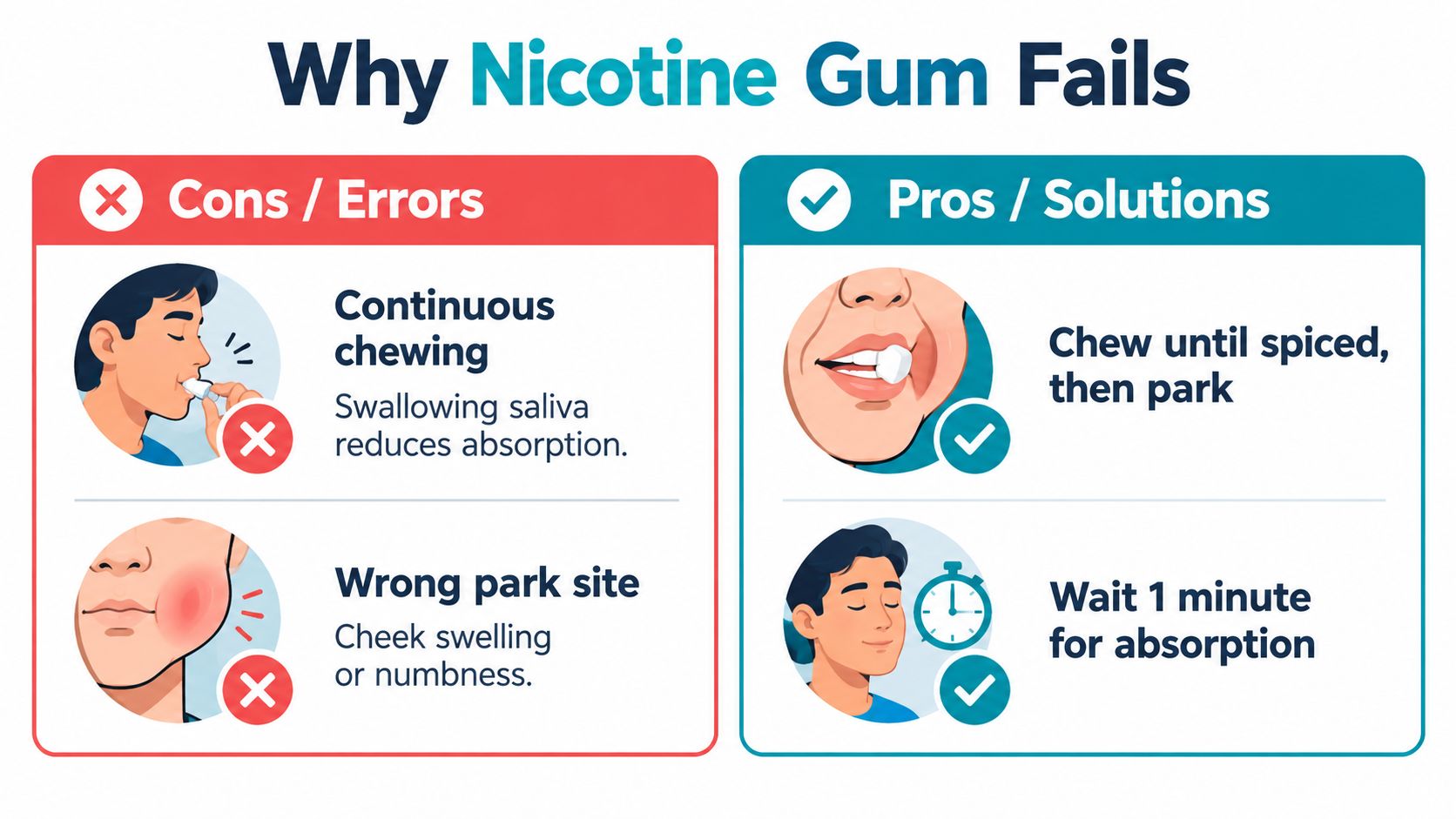
Adherence is part of the treatment
A study of nicotine gum adherence found that only 36.6% of participants adhered to recommended gum doses, compared with 71.8% adherence to counseling. That difference suggests why a person may need more than an over-the-counter package. The peer-reviewed adherence study supports a practical conclusion: instructions are easier to follow when the treatment plan accounts for taste, schedule, triggers, side effects, and follow-up.
Some people also expect gum to reproduce the immediate reinforcement of smoking. It won't. Its slower delivery is part of its safety advantage, but it may feel less satisfying at first. That gap can lead to underuse or a return to cigarettes or vaping.
A trigger plan makes the slower delivery more workable:
- Identify the cue. Write down the situation, such as coffee, driving, alcohol, or work stress.
- Choose a replacement action. Use water, a brief walk, paced breathing, or a non-nicotine oral substitute.
- Use medication correctly. If gum is part of the plan, use the chew-and-park method rather than chewing continuously.
- Plan for a slip. One lapse doesn't erase progress. Record what happened and discuss recurring slips with a clinician.
- Get behavioral support. A practical resource on changing routines is Kohru's habit-breaking guide, which can complement, but not replace, medical cessation care.
The product label also can't account for an unstable heart condition, dental disease, pregnancy, medication interactions, or simultaneous use of several nicotine products. Those situations call for individualized advice rather than trial and error.
Side Effects, Interactions, and When to Ask a Clinician
The most common problems with nicotine gum are often local or gastrointestinal. Jaw soreness, mouth irritation, excess saliva, hiccups, nausea, and heartburn can occur. Some symptoms result from chewing too quickly or swallowing nicotine rather than allowing it to absorb through the cheek.
A person who develops mild symptoms should review the technique and product directions, then contact a clinician or pharmacist if the symptoms persist. People with dentures, temporomandibular joint problems, significant dental disease, or ongoing mouth irritation may find gum difficult to use or may need another form of NRT.
Conditions that deserve advance review
Ask a qualified clinician before using nicotine gum if you have:
- A recent heart attack, unstable angina, or a serious heart rhythm problem.
- New or unexplained palpitations, chest symptoms, or a history of significant cardiovascular disease.
- Active mouth, tooth, jaw, or temporomandibular joint problems.
- Pregnancy or breastfeeding.
- A plan to use cigarettes, vapes, pouches, patches, lozenges, or other nicotine products at the same time.
- Prescription medicines or medical conditions that make nicotine exposure more complicated.
Nicotine can increase heart rate. The MedlinePlus nicotine gum safety information describes oral, dental, gastrointestinal, and cardiovascular concerns that may make self-directed use inappropriate.
Seek urgent help: Severe chest pain, confusion, repeated vomiting, marked weakness, severe palpitations, trouble breathing, or symptoms that suggest nicotine poisoning require urgent medical attention. Call emergency services when symptoms are severe or rapidly worsening.
Routine follow-up is different from an emergency. A same-week appointment is reasonable for persistent nausea, jaw pain, mouth irritation, recurring hiccups, troubling heartburn, or difficulty controlling cravings. Emergency services are appropriate for severe chest symptoms, confusion, breathing problems, or suspected poisoning. Keep unused and used gum away from children and pets, and dispose of used pieces in a closed trash container.
When Physician-Led Outpatient Support Makes a Difference
Over-the-counter access is convenient, but convenience doesn't equal personalization. A physician-led outpatient visit can review the pattern of nicotine use, time to first use, withdrawal symptoms, triggers, previous treatment attempts, other nicotine products, oral health, cardiovascular history, pregnancy status when relevant, and current medications.
That assessment can inform a discussion about 2 mg versus 4 mg gum, a patch-and-gum approach, another NRT form, or a prescription non-nicotine treatment such as varenicline or bupropion when clinically appropriate. Follow-up can focus on side effects, correct technique, cravings, tobacco- or vape-free days, slips, and whether the plan remains safe and workable.
Behavioral support isn't an optional extra. Medication can reduce withdrawal, while counseling and structured follow-up help a person respond to cues, manage stress, and recover from lapses without treating them as a total failure. Adults who have tried NRT without success, have medical conditions that complicate self-treatment, or want a structured plan can review addiction medicine specialist care with a qualified clinician.
Sources
FDA history of nicotine replacement regulation; World Health Organization evidence review of nicotine replacement therapy; CDC guidance on nicotine gum technique; DailyMed nicotine polacrilex labeling; MedlinePlus drug information; peer-reviewed adherence research.
Empire Medical Wellness offers confidential, physician-led outpatient addiction medicine assessment, evidence-based treatment planning when clinically appropriate, and follow-up for adults who want structured support with nicotine cessation. Visit Empire Medical Wellness to learn more about the practice and request information about care.
This article is educational and isn't personal medical advice.