
21.2 million Americans had a substance use disorder, yet only about 3,171 physicians held formal addiction medicine or addiction psychiatry certification in the U.S. That gap is why an addiction medicine specialist matters, the specialty is built for careful medical assessment, treatment planning, and follow-up when substance use has become complex.
Table of Contents
- Understanding the Addiction Medicine Specialist Role
- What Addiction Medicine Covers
- Training Pathways and Board Certification
- Outpatient Services and Medication Strategies
- Generalist Care versus Specialist Care
- How to Find and Choose a Specialist
Understanding the Addiction Medicine Specialist Role
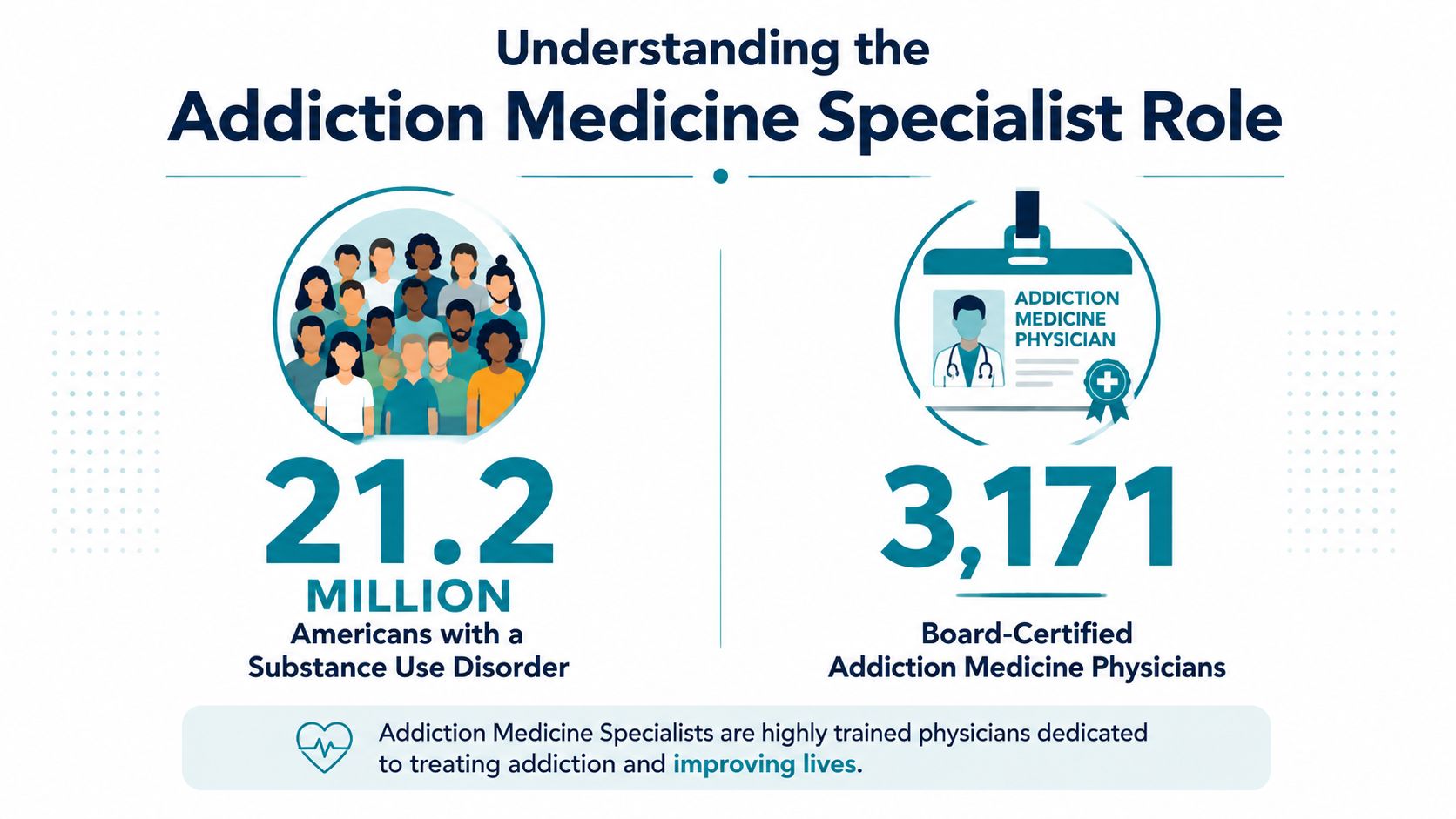
An addiction medicine specialist is a physician who has completed a base residency and then added formal training in addiction care. The specialty exists because substance use disorders are common, yet clinicians with this training are still scarce, a gap that has been noted in U.S. workforce discussions for years AAMC report.
The role is broader than a single appointment or a one-time prescription. A specialist evaluates the medical picture, matches treatment to the person's current stage of illness, and keeps reassessing as symptoms, risk, and stability change over time ASAM competencies. That kind of follow-up matters because substance use problems often change shape, especially when relapse, withdrawal, pain, anxiety, or other diagnoses are part of the picture.
Practical rule: if a substance use concern is changing, relapsing, or complicated by other medical or mental health issues, a specialist's value is often in the structure of the follow-up, not just in the first prescription or first conversation.
The specialty is a recognized medical subspecialty focused on prevention, evaluation, diagnosis, treatment, and recovery NIDA on the subspecialty. In plain terms, the work is built for cases where the problem is medically real, behaviorally complicated, and unlikely to be resolved by advice alone.
In day-to-day practice, that can mean helping someone who needs medication for alcohol use disorder, someone with opioid withdrawal after surgery, or someone whose stimulant use is affecting sleep, mood, and blood pressure. It can also mean sorting out whether the main issue is substance use, another mental health condition, or both.
The specialty often includes care coordination as well. Many addiction medicine physicians work alongside primary care, psychiatry, emergency medicine, pain management, and therapy services, so the treatment plan fits the person's actual needs instead of forcing every problem into one office visit. For patients looking for that kind of coordinated care, the approach described by Empire Medical Wellness reflects how specialist-led treatment can be organized in practice.
A useful way to measure the importance of the role is to compare need with supply. The number of trained addiction medicine physicians remains small relative to the number of people affected, which is one reason patients often have to search carefully for the right clinician.
What Addiction Medicine Covers
Addiction medicine covers more ground than many people expect. The field addresses prevention, evaluation, diagnosis, treatment, and recovery for substance use disorders and related conditions, including alcohol, nicotine, prescription medication misuse, and situations where the diagnosis is not yet clear.
More than medication
A specialist does not only decide whether medication is appropriate. The work also involves understanding neurobiology, substance pharmacology, epidemiology, and the psychosocial and medicolegal effects of substance use. That broader base matters because the same pattern of use can mean different risks in different patients.
The specialty is built around longitudinal assessment. Diagnosis is only the starting point. Re-assessment, treatment matching, and care across a continuum can include early intervention, harm reduction, outpatient care, inpatient care, and residential settings when needed. It works more like ongoing case management than a one-time intervention.
The best outpatient addiction care often looks ordinary from the outside. It is careful history-taking, repeated follow-up, and adjustment over time when the clinical picture changes.
That matters because substance use disorders are not static. Withdrawal risk can rise or fall, psychiatric symptoms can shift, and recovery stability can change with stress, access to support, or medical complications. A patient may need a different level of care next month than they needed last week.
Specialist-led treatment also depends on coordination. Many addiction medicine physicians work alongside primary care, psychiatry, emergency medicine, pain management, and therapy services, and that is the kind of physician-led care described by physician-led care. The goal is to fit the plan to the person's actual needs, rather than forcing every problem into one office visit.
What it is not
Addiction medicine is different from general primary care, even though the two often overlap. Primary care can screen, counsel, and start treatment, but a specialist has additional training for more complicated decisions, including when outpatient management is unsafe and escalation is needed. That is a difference in clinical scope, not just in title.
It is also not crisis-only care. A one-time detox visit or a brief conversation can help, but neither replaces an ongoing plan for monitoring, relapse prevention, and coordination with other clinicians when authorized. The specialty is often most useful for people whose needs keep changing rather than staying simple.
Training Pathways and Board Certification
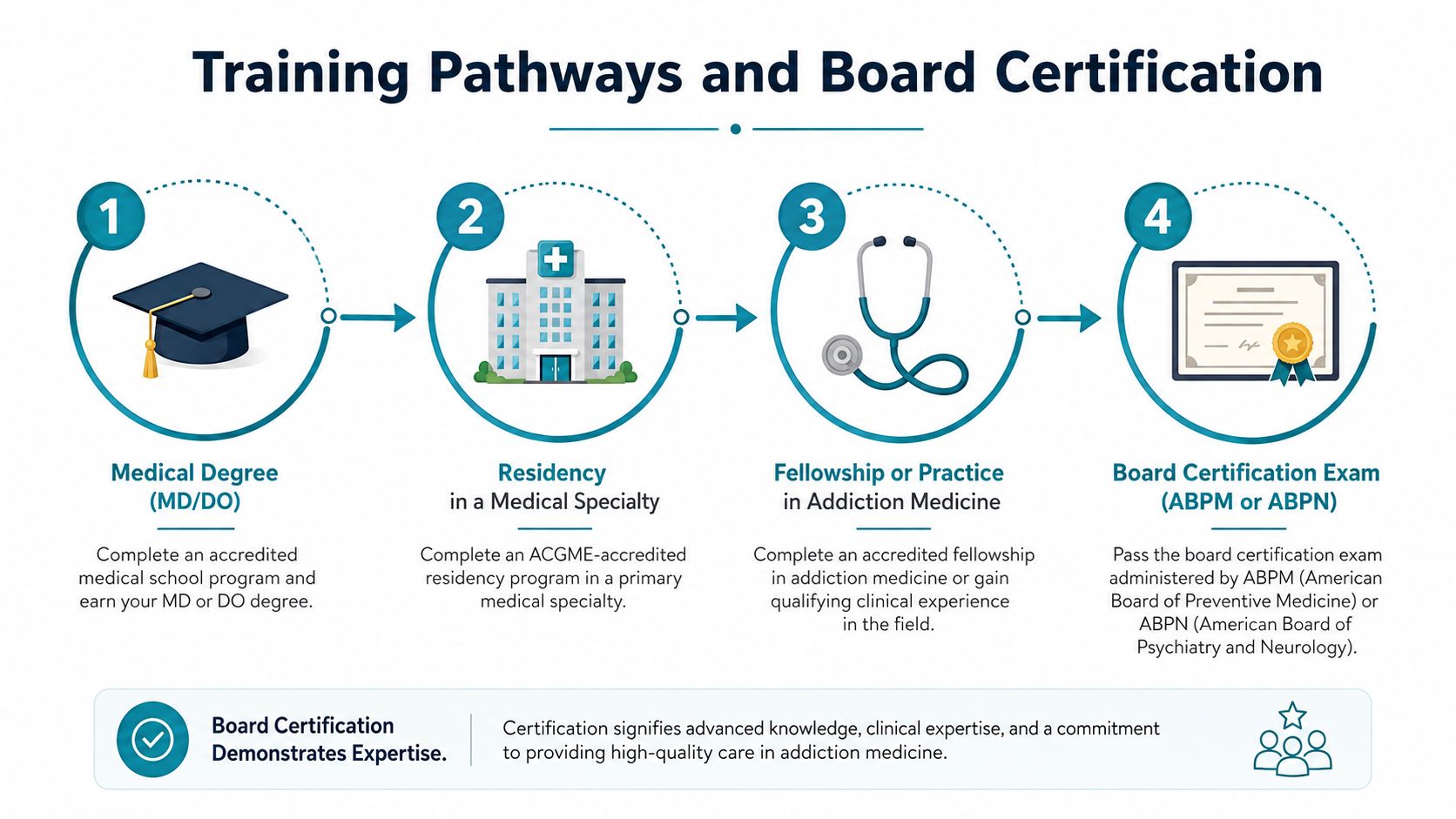
Most addiction medicine physicians begin with medical school, then residency in a primary specialty such as family medicine, internal medicine, or psychiatry. After that foundation, they pursue addiction-focused training and complete examination-based certification, which is one way to show formal preparation in the specialty.
How to verify credentials
In the U.S., addiction medicine is recognized as an ABMS subspecialty, and ABPM certification has required fellowship training for exam eligibility after 2022. That is why fellowship training is a practical marker to check when you review a clinician's background. You can also look for physician-led clinics and care models, including physician-led care, because the training path is often reflected in how treatment is organized.
The training pipeline is still relatively small. A peer-reviewed review reported that, by the 2020 to 2021 academic year, there were 83 accredited addiction medicine programs with 149 fellows, and 3,282 addiction medicine certificates had been awarded in total peer-reviewed review. The same review noted that 1,275 certificates, or 38.8%, went to ABPN diplomates. That overlap with psychiatry is real, but it does not define the whole field.
The training path matters because the work is specific. Specialists are expected to manage acute substance withdrawal, interpret drug testing in context, and recognize psychiatric and physical complications of addiction. Those are the situations where a general approach can become too blunt.
A separate workforce analysis found that among physicians with addiction medicine training, prescription volume and MOUD prescribing increased over time, with the 1+ MOUD prescribing rate rising from 83.9% in 2017 to 87.7% in 2021. That does not tell you everything about quality, but it does show that trained physicians increasingly use evidence-based medication care in practice.
What to look for: medical degree, residency training, fellowship training when applicable, and current board certification in addiction medicine or addiction psychiatry.
Outpatient Services and Medication Strategies
A physician-led outpatient addiction visit usually begins with a confidential medical assessment, not a lecture. The clinician asks about substances used, timing, withdrawal symptoms, co-occurring mental health concerns, other prescriptions, medical conditions, and past treatment history. From there, the plan may include monitoring, recovery planning, and coordination with outside clinicians or programs when that is useful and authorized.
What happens after the first visit
The most important part of outpatient specialist care is often follow-up. A specialist re-checks symptoms, reviews safety issues, and adjusts the plan as the patient's situation changes. That matters when withdrawal risk, sleep, mood, or craving patterns shift over time.
The term medication-assisted treatment is often used in public conversation, but in physician settings it is more precise to think in terms of medications used alongside counseling and behavioral therapies. The point is not medication alone, but medication as part of a broader treatment plan when it is clinically appropriate.
A specialist also has to think about safety. That includes recognizing acute withdrawal, reading drug test results in context, watching for polysubstance risk, and deciding when a higher level of care is needed. Those decisions are part of outpatient medicine, even though they can feel unfamiliar to people who only associate addiction treatment with detox or rehab.
A hypothetical example makes the difference clearer. A patient comes in with alcohol-related concerns, insomnia, anxiety, and a medication list that already includes treatment for another medical condition. A general visit might focus on one problem at a time. A specialist visit is more likely to connect the medication list, withdrawal risk, mood symptoms, and follow-up plan into one coordinated strategy.
A second example is medication review after a change in symptoms. Someone may report more cravings, worse sleep, or side effects from a prescription that once seemed fine. A clinician who works through a mental health medication review can sort out whether the issue is the dose, the timing, an interaction, or a new clinical problem that needs a different response.
Coordination matters
Outpatient addiction care works best when the clinician can coordinate with a therapist, primary care physician, or other treating professional, when the patient authorizes it. That coordination can reduce confusion about who is managing what, especially when a person has both substance-related and non-substance-related health needs.
Medication decisions also benefit from a clear record of what has already been tried. A careful outpatient approach tracks which medications helped, which caused side effects, and which symptoms changed after treatment began. That kind of review is useful when the plan needs to be adjusted without losing sight of the larger picture.
Generalist Care versus Specialist Care
A generalist and an addiction medicine specialist can both help, but they usually work at different levels of detail. The better fit depends on how complex the situation is, how much treatment history is already involved, and whether the patient needs ongoing medical oversight over time.
| Aspect | Generalist Provider | Addiction Medicine Specialist |
|---|---|---|
| Training depth | Broad medical training, with screening and basic treatment skills | Residency first, then extra addiction-focused training and certification |
| Scope of practice | Can identify concerns and begin care | Can assess, diagnose, re-assess, and match treatment across settings |
| Typical appointment structure | Often problem-focused and brief | Often structured around longitudinal follow-up and monitoring |
| Medication management | May initiate standard treatment or refer | Can choose medication strategies, monitor adverse effects, and interpret testing in context |
| Coordination with other care providers | May refer when care becomes complex | Often coordinates with outside clinicians or programs when authorized |
Generalist care is often enough for straightforward screening or an early conversation about substance use. A specialist becomes more useful when the picture includes withdrawal management, medication complexity, co-occurring psychiatric or medical illness, or uncertainty about diagnosis. For readers who want a closer look at medication management, this is often where specialty care adds the most structure.
The common misconception is that addiction medicine is only for opioid use disorder or detoxification. That view is too narrow. The field also addresses alcohol, nicotine, prescription medication misuse, and difficult diagnostic questions, including cases where mental health symptoms and substance use overlap, as described by ABAM physician overview and NIDA.
A patient does not need to be in crisis to benefit from specialist review. Often, the best time to involve a specialist is when the situation is complex but still stable enough for thoughtful outpatient planning.
Neither pathway is universally better. A generalist may be the right starting point for simple concerns, while a specialist may be the better fit when care needs to be more coordinated, more medically detailed, or more closely monitored. The main goal is to match the clinician's training to the patient's actual problem.
How to Find and Choose a Specialist
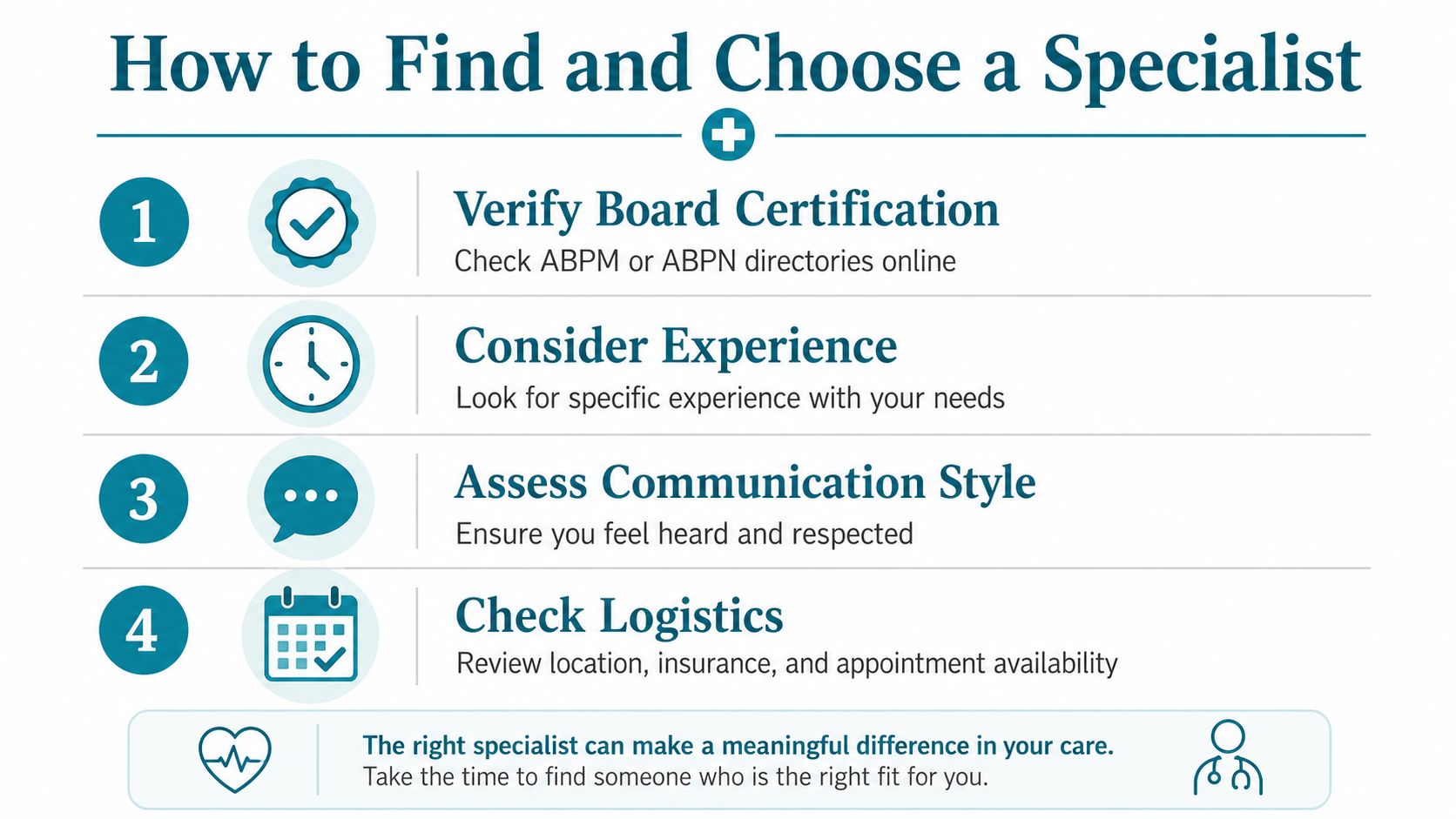
A useful first check is whether the physician's certification is current in the relevant board directory, such as ABPM or ABPN. From there, look at the kind of care the clinician provides. A title alone does not tell you whether the practice is built around confidential outpatient assessment, follow-up, medication management, or coordination with other clinicians.
Questions worth asking
- Training: Did the physician complete fellowship training in addiction medicine, and what is their primary residency background?
- Clinical focus: Do they routinely manage alcohol, nicotine, prescription medication concerns, or do they focus on only one substance category?
- Medication approach: How do they decide when medication is appropriate, and how do they follow patients after the first prescription?
- Coordination: Will they communicate with your therapist, primary care clinician, or another treating professional if you authorize it?
- Office workflow: How are follow-up visits scheduled, and what monitoring do they use when care needs to continue over time?
A strong specialist should be able to explain the plan in plain language. You should leave the conversation knowing what the office is treating, what it is not treating, and what follow-up looks like. If the answers feel vague, rushed, or mostly promotional, keep looking.
For readers comparing physician-led private practices, Empire Medical Wellness services show how outpatient care can be organized across different medical needs while keeping each concern distinct. That helps when you want a clinician who takes evaluation and monitoring seriously without assuming every problem belongs in the same bucket.
Practical fit matters too. The right clinician still has to match your daily reality, including location, appointment format, and how the office handles ongoing follow-up. Care works better when the plan is realistic enough to continue, much like a treatment regimen that only helps if the patient can keep it going.
Empire Medical Wellness offers physician-led outpatient care with a careful, nonjudgmental approach to addiction medicine, along with related medical evaluation and medication management when appropriate. If you're researching whether specialist care fits your situation, visit Empire Medical Wellness to learn more about the practice's approach to assessment, follow-up, and coordinated outpatient care.
Frequently Asked Questions
What is an addiction medicine specialist?
It's a physician with additional training in the prevention, evaluation, diagnosis, treatment, and recovery of substance use disorders and related conditions.
Do I need a specialist if I'm not in crisis?
Not necessarily, but specialist care can help when the situation is medically complex, recurrent, or overlapping with other health concerns.
Is addiction medicine only about medication?
No. Medication can be part of care, but the specialty also includes assessment, monitoring, recovery planning, and coordination with other clinicians.
How do I verify board certification?
Check the ABPM or ABPN directories and confirm that the physician's certification and training are current.
Can an addiction medicine specialist treat alcohol concerns too?
Yes. Alcohol-related care is a major part of the specialty, along with other substance-related concerns.
Sources: ABAM physician certification overview, NAM discussion of access barriers
This article is educational and not personal medical advice. If substance use is causing immediate danger, call emergency services or go to the nearest emergency department now.
Pingback: Opioid Withdrawal Manifestations: Symptoms, Timeline, and Care - Empire Medical Wellness