
Metabolism is the process of generating energy from nutrients, and basal metabolic rate typically accounts for about 60% to 70% of total daily energy expenditure. Calculators estimate rather than measure it, and most factors that shape weight-related care can be assessed through a thoughtful medical evaluation.
Popular advice often treats metabolism as a switch that is either “fast” or “slow,” then promises a food, supplement, or routine that will reset it. That framing creates confusion. A person's metabolic rate is measurable in some settings, but many everyday numbers used in weight management are estimates based on personal information and mathematical models.
A careful evaluation also looks beyond calorie formulas. Weight trends, activity, sleep, medicines, symptoms, body composition, and relevant health conditions can all change the clinical picture. The purpose isn't to blame a person for weight change or to search for a single hidden defect. It's to understand which factors can be assessed, which can change, and which require medical interpretation.
Byline: Empire Medical Wellness Editorial Team
Published: October 4, 2026
Updated: October 4, 2026
Table of Contents
- What Metabolism Actually Means
- How Metabolism Relates to Weight
- Factors That Change Metabolic Rate
- What a Metabolic Assessment Involves
- A Hypothetical Example of Symptoms Worth Evaluating
- Common Metabolism Myths and What Evidence Says
- Supporting Metabolic Health and When to Seek Evaluation
- Sources
What Metabolism Actually Means
Metabolism is the process of generating energy from nutrients. The body uses that energy for breathing, circulation, temperature control, chemical balance, movement, repair, and thought, as described by the National Institute of Diabetes and Digestive and Kidney Diseases.
A useful distinction comes first. Metabolism refers to the broad set of chemical processes that keep the body functioning. Metabolic rate refers to how quickly the body uses energy. The two terms are related, but they aren't interchangeable.
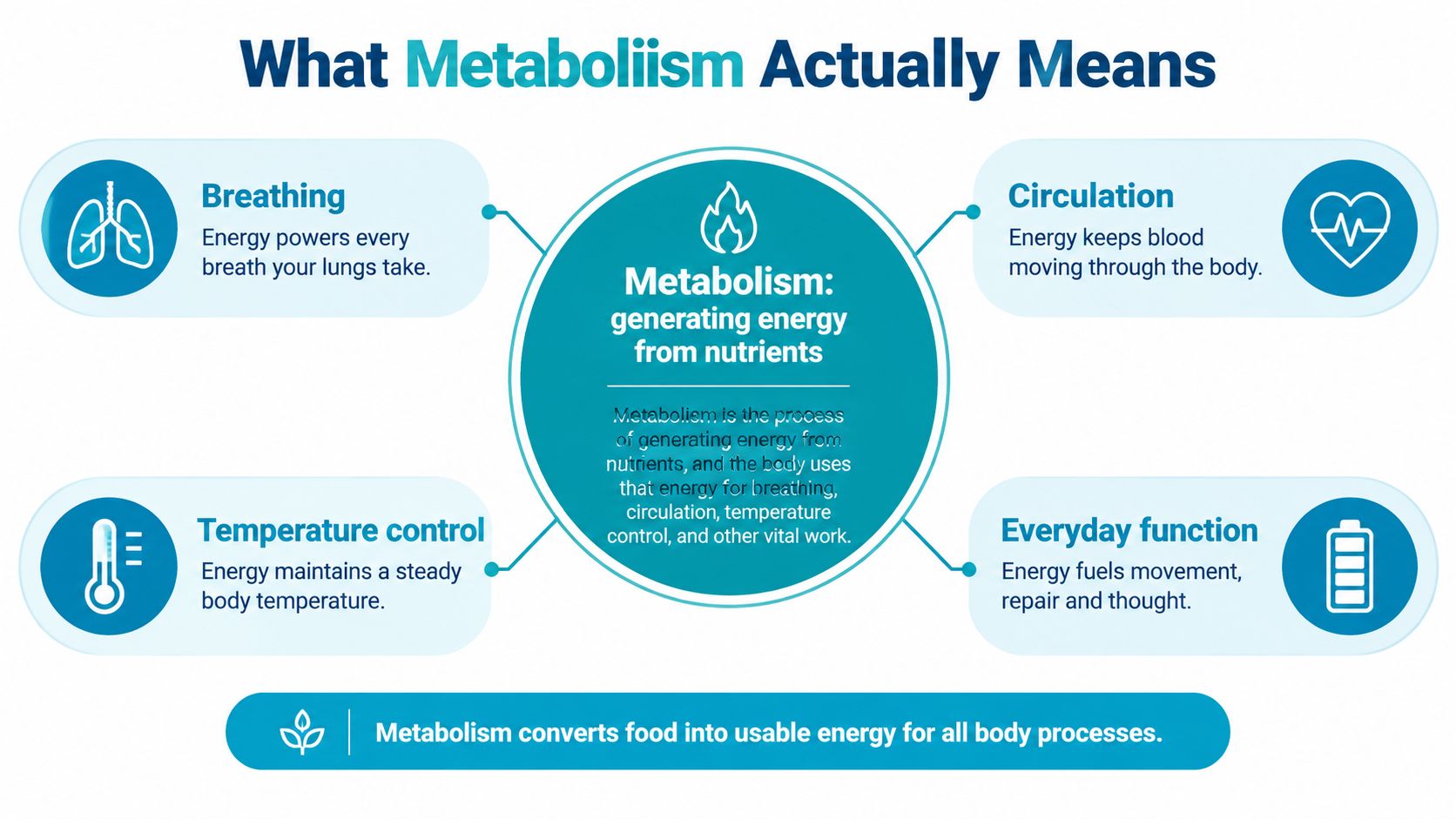
Four parts of daily energy use
Basal metabolic rate, or BMR, is the energy the body needs at rest for essential functions such as breathing, circulation, and cell repair. Standardized BMR measurement requires controlled conditions, including fasting, rest, a thermoneutral environment, and measurement shortly after waking. In practical terms, BMR commonly represents about 60% to 70% of total daily energy expenditure, although some references place the range at 50% to 80%, depending on activity level and physiology, according to Cleveland Clinic.
Resting metabolic rate, or RMR, is closely related to BMR but is usually measured under less strict conditions. RMR reflects the energy needed while resting, but the testing conditions may not meet every formal requirement used for BMR. In clinical discussions, the terms are sometimes used loosely, even though the measurements aren't identical.
The thermic effect of food is the energy used to digest, absorb, and process nutrients. It contributes to daily energy use, but it isn't a separate metabolism that can be switched on through a special ingredient.
Activity thermogenesis is energy used for movement. Exercise is one part. Everyday movement, such as standing, walking around, and changing position, also contributes. Those activities may vary substantially from one day to the next.
A household analogy helps. BMR or RMR resembles the electricity required to keep a home's refrigerator, alarm system, and basic systems running. Total daily energy expenditure resembles the full monthly electricity bill, which also includes cooking, laundry, lighting, and other changing demands. The baseline matters, but it doesn't explain every variation in total use.
A routine discussion of metabolism may also touch on the science of NAD+ for energy, but cellular energy pathways shouldn't be confused with a clinical measurement of calories burned. For readers exploring related cardiometabolic concepts, metabolic syndrome is a separate medical topic involving a combination of health risks, not a synonym for metabolic rate.
Online calorie calculators apply equations to information such as age, body size, sex, and activity. They can help create a starting estimate, but they don't diagnose a slow metabolism, identify a disease, or measure a person's actual energy expenditure.
How Metabolism Relates to Weight
Weight changes reflect the interaction between energy intake, energy expenditure, and the body's stored energy. When intake is low relative to immediate needs, the body can use stored fat as an energy source, as NIDDK explains in its overview of metabolic testing.
That description is useful, but it isn't a moral scorecard. Weight regulation involves physiology, appetite signals, activity, sleep, medicines, health conditions, environment, and other influences. NIDDK describes obesity research as an effort to understand the mechanisms that affect weight gain, weight loss, and long-term weight maintenance, rather than treating weight as the result of willpower alone. The NIDDK research program on metabolism, energy, and obesity provides that broader framework.
Why maintenance can require reassessment
After weight loss, RMR commonly falls beyond what body-composition changes alone would predict. Researchers describe this response as metabolic adaptation or adaptive thermogenesis, according to a review in the Postgraduate Medical Journal.
Several implications follow. A calorie estimate created before weight change may not remain accurate during maintenance. Energy needs may need to be reassessed over time. Two adults with similar weight changes may also show different RMR responses, so one person's experience cannot establish another person's metabolic rate.
A plateau can therefore reflect normal adaptation and changing energy needs. It doesn't prove that a person has failed, and it doesn't prove that hormones are the cause. It also doesn't mean further progress is impossible. The useful response is a more careful review of the current pattern, not a promise of a metabolic reset.
Practical rule: A changing weight trend is information about the current balance of intake, expenditure, and physiology. It isn't evidence of a character flaw.
A person may encounter commercial language such as find your metabolism stack while researching weight management. Such language shouldn't replace an evaluation of medicines, symptoms, activity, sleep, and relevant medical conditions. No single product can establish why weight changed or predict how a specific adult will respond.
Factors That Change Metabolic Rate
Metabolic rate varies because the body's energy needs vary. Some influences are fixed or difficult to modify. Others can change over time. A responsible evaluation considers the whole pattern rather than treating one factor as the answer.
Body and life stage
Age affects energy use. Basal metabolism is highest during childhood and puberty, tends to remain relatively steady through early adulthood, and gradually declines with age, according to Britannica's overview of BMR and resting energy expenditure. This pattern doesn't mean every older adult has a clinically meaningful metabolic problem.
Body composition also matters. Lean tissue generally requires more energy at rest than fat tissue. Larger bodies often have higher absolute resting energy expenditure because body size and fat-free mass increase the amount of tissue that needs energy. A person's sex, height, weight, and body composition therefore influence estimates, but those inputs still don't turn a calculator into a diagnostic test.
Health and daily conditions
Thyroid hormones help regulate many body processes, so symptoms and thyroid testing may be relevant when the clinical history supports evaluation. A thyroid blood test assesses thyroid function. It doesn't directly tell a person how many calories the body burns.
Medicines can affect appetite, weight, fluid balance, or activity. The medication history should include prescription drugs, over-the-counter products, and relevant changes over time. A medicine may be clinically necessary even when it complicates weight management, so the right response is review with a qualified clinician, not self-directed stopping.
Sleep affects appetite regulation, energy, and daily behavior. Eating patterns influence energy intake and the thermic effect of food. Physical activity affects expenditure through both structured exercise and ordinary movement. These factors are potentially modifiable, but “modifiable” doesn't mean easy, immediate, or identical for every adult.
Some factors are also contextual. Stress, pain, mobility limits, work schedules, and access to food or safe activity can shape routines without reflecting a lack of effort. A medical history should make room for those realities.
A resource on resistance exercise for weight loss may help explain one type of activity, but exercise advice still needs to fit a person's health status, abilities, and goals. No routine can guarantee a particular change in metabolic rate.
What a Metabolic Assessment Involves
A thoughtful obesity-medicine assessment usually begins with the person's story, not a calculator. The sequence below is an educational framework, not a description of a proprietary protocol or a promise that every item will be used in every visit.
Establish the weight timeline and goals. The clinician reviews when weight began changing, what has happened since, previous efforts, current concerns, and the person's goals. The pattern over time is more informative than a single measurement.
Review daily influences. Eating patterns, physical activity, sleep, medicines, symptoms, and relevant health history help identify factors that may affect weight or energy. The review should remain nonjudgmental. Its purpose is to find useful information, not to assign blame.
Assess health risks. Blood pressure, glucose-related concerns, lipids, and other health markers may be considered when clinically relevant. A discussion of insulin resistance can be useful when the history or available findings raise that question, but insulin resistance isn't established by appearance or by a calorie calculator.
Choose tests when clinically indicated. Testing should answer a clinical question. More testing isn't automatically better, and a normal result doesn't invalidate a person's experience.
What history and tests can and cannot show
| Question | Useful information | What it cannot prove |
|---|---|---|
| What does the weight trend show? | Direction, timing, plateaus, maintenance periods, and how weight changed in relation to life events or treatment | The exact resting metabolic rate or a single cause of weight change |
| What does activity history show? | Structured exercise, everyday movement, mobility barriers, and changes in routine | The precise number of calories used each day |
| What does medication history show? | Potential effects on appetite, weight, energy, sleep, or activity, along with timing of changes | That a medicine is the only cause of weight change or should be stopped |
| What do symptoms show? | Whether concerns such as fatigue or cold intolerance justify evaluation for a possible contributor | That metabolism is “broken” or that a specific disease is present |
| What does thyroid testing show? | Thyroid function that may help explain compatible symptoms when interpreted clinically | The number of calories burned or a universal “slow metabolism” result |
| What do estimated energy needs show? | A starting model for intake and activity planning that can be revisited as circumstances change | A permanent calorie requirement or a measured metabolic rate |
TSH, or thyroid-stimulating hormone, is commonly the initial thyroid blood test. Abnormal results require interpretation and may lead to additional testing, such as free T4, depending on the clinical context. These tests assess thyroid function, not the number of calories a person burns, as explained by NIDDK's thyroid diagnostic testing information.
Estimation versus direct measurement
A modeled calorie estimate uses personal inputs and a mathematical formula. The NIDDK Body Weight Planner estimates changing calorie and activity needs for adults, but it isn't a direct measurement of metabolic rate and excludes pregnancy and breastfeeding.
Indirect calorimetry is different. This specialized test estimates energy expenditure by analyzing oxygen consumption and carbon dioxide production under controlled conditions. It can provide a direct measurement of resting energy expenditure in an appropriate setting. A routine weight-management evaluation can still provide substantial clinical information without being the same as indirect calorimetry.
A Hypothetical Example of Symptoms Worth Evaluating
Hypothetical teaching example, not an Empire patient: An adult reports weight gain together with fatigue and cold intolerance. The combination doesn't establish a thyroid disorder, and it doesn't prove that metabolism is broken. It does create a reasonable clinical question that may deserve evaluation.
A physician might review the timing of the symptoms, changes in medicines, sleep, eating patterns, activity, and other health concerns. Thyroid testing may be considered when the history supports it. Results could reveal a treatable contributor, or they could be normal. Neither outcome can be assumed without testing and interpretation.
The clinical lesson
The useful decision is to investigate compatible symptoms rather than prescribe a so-called metabolic booster. Symptoms can have multiple explanations, and a normal test can be helpful information even when it doesn't provide the answer a person expected.
The example also shows why a weight trend alone isn't enough. Weight can change while thyroid function is normal. Fatigue can occur for reasons unrelated to thyroid function. Cold intolerance can be meaningful in one context and less specific in another.
Symptoms should prompt a question, not a conclusion.
A physician-led evaluation can connect the symptom history with medications, sleep, nutrition, activity, and relevant testing. That approach respects the person's concern without turning a common phrase, “slow metabolism,” into a diagnosis.
Common Metabolism Myths and What Evidence Says
The most persistent myth is that one calculator number is a permanent calorie requirement. A calculator can offer a starting estimate, but energy needs change with body size, activity, body composition, health status, and weight change.
The NIDDK Body Weight Planner separates the intake needed to reach a weight from the intake needed to maintain it. It also models changing activity and body weight rather than treating one number as fixed. The Planner is designed for adults and excludes pregnancy and breastfeeding.
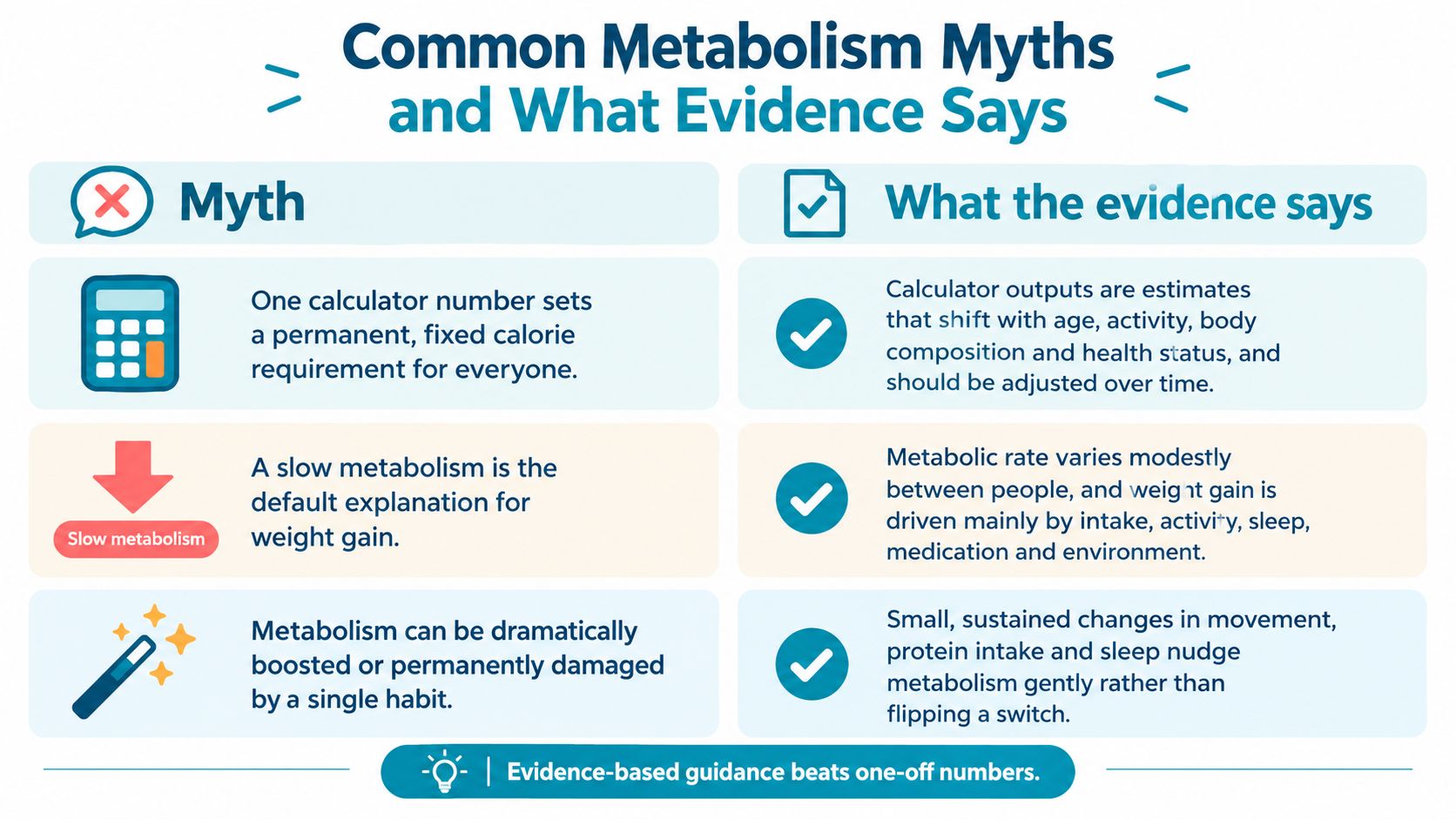
A two-column illustration
| Starting plan | Reassessment after weight change |
|---|---|
| Use available information to create an estimated intake and activity framework. | Review the new weight trend, activity, appetite, sleep, medicines, and health factors. |
| Treat the estimate as a starting point, not a diagnosis. | Re-estimate needs when the current pattern no longer matches the earlier assumptions. |
| Focus on a sustainable plan rather than a dramatic promise. | Adjust the plan with clinical guidance when needed, without assuming a hormonal cause. |
The second myth says that a slow metabolism is the default explanation for weight gain. The physiology is more nuanced. Larger bodies generally have higher resting energy expenditure, and age-related metabolic decline is modest until very late life, according to the evidence summary in CNN Health's discussion of metabolism and weight-loss myths. Weight gain can reflect the interaction of intake, activity, sleep, medication, environment, body composition, and adaptive changes.
The third myth promises a shortcut that will dramatically boost metabolism or permanently repair it. No reset can be promised. Movement, eating patterns, sleep, and clinically appropriate treatment may support health, but they don't flip a biological switch or guarantee a particular weight outcome.
Readers researching eating patterns may also encounter intermittent fasting. That phrase describes an eating schedule, not a diagnosis or a universal metabolic solution. Its suitability depends on the person's health history, medications, preferences, and goals.
Supporting Metabolic Health and When to Seek Evaluation
Metabolic health is supported by consistent care rather than a dramatic reset. Regular physical activity can contribute to energy expenditure and physical function. Adequate sleep helps support daily energy, appetite regulation, and the ability to follow a routine. Eating patterns that are workable over time can be more useful than rigid rules that cannot be maintained.
General education still has limits. An adult with pain, mobility restrictions, diabetes, cardiovascular disease, sleep concerns, or other medical conditions may need a more individualized plan. A qualified physician can help determine which changes are reasonable and whether a symptom or health marker needs further evaluation.
Medication decisions require clinical context
FDA-approved long-term prescription medications for overweight and obesity include orlistat, phentermine-topiramate, naltrexone-bupropion, liraglutide, semaglutide, and tirzepatide, according to NIDDK's medication overview. These medicines work in different ways, including reducing hunger, increasing fullness, or reducing fat absorption.
That list doesn't mean every medicine is appropriate for every adult. Medication selection, safety review, monitoring, and follow-up belong in a conversation with a qualified physician. Adults shouldn't start, stop, or change a prescription based on an online metabolism claim.
Commercial pages may describe science-backed choices for faster metabolism, but supplement marketing isn't a substitute for evaluating symptoms, medications, thyroid function, energy needs, or weight trends. A product claim also shouldn't be treated as proof that a person has a particular metabolic condition.
When an evaluation may help
A physician-led obesity evaluation may be reasonable when:
- Weight changes are concerning: A persistent change, difficult plateau, or repeated regain deserves a respectful clinical review rather than self-blame.
- Symptoms accompany weight change: Fatigue, cold intolerance, medication changes, sleep disruption, or other concerns may justify discussion.
- Past efforts haven't lasted: A clinician can review what happened during loss and maintenance without assuming that effort was the problem.
- Long-term planning matters: Adults considering or using anti-obesity medication may benefit from monitoring and a maintenance strategy.
- The cause feels unclear: A structured history can separate what is measured, what is estimated, and what requires further testing.
Empire Medical Wellness offers physician-led obesity medicine that may include medical and metabolic assessment, review of weight history and relevant health factors, individualized planning, medication when clinically appropriate, monitoring, and long-term maintenance planning.
Adults seeking a careful review of weight history, symptoms, medicines, and estimated energy needs can visit Empire Medical Wellness to learn about physician-led obesity evaluation. The practice can help clarify which questions may be answered through routine assessment and which may require targeted testing. This article is educational and not personal medical advice.
Sources
- National Institute of Diabetes and Digestive and Kidney Diseases, Metabolic Testing
- National Institute of Diabetes and Digestive and Kidney Diseases, Metabolism, Energy Balance, and Obesity Research
- National Institute of Diabetes and Digestive and Kidney Diseases, Thyroid Diagnostic Testing
- National Institute of Diabetes and Digestive and Kidney Diseases, Body Weight Planner
- Cleveland Clinic, Basal Metabolic Rate
- Britannica, BMR and REE Energy Balance
- Postgraduate Medical Journal, Resting Metabolic Rate and Adaptive Thermogenesis
- National Institute of Diabetes and Digestive and Kidney Diseases, Prescription Medications for Overweight and Obesity