
Most advice about naltrexone starts with the idea that a monthly shot beats a daily pill. That's not what the evidence shows. The injection isn't a stronger naltrexone, and it isn't automatically better at reducing cravings or heavy drinking. The difference is delivery, approved use, and how quickly medication coverage can be started or stopped.
Oral naltrexone and extended-release injectable naltrexone contain the same active medicine, an opioid antagonist. An antagonist blocks opioid receptors without producing any opioid effect or high. The pill is swallowed on a repeated schedule the person controls, commonly once a day. The injection forms a depot, a slow-release deposit in muscle, given by a qualified clinician about every four weeks. Both are naltrexone, but they aren't interchangeable for every diagnosis, and this article doesn't choose a medicine, dose, or start date for anyone.
Table of Contents
- Same Medicine With a Different Job
- Oral Pill and Monthly Injection Side by Side
- Blockade Withdrawal Risk and Monitoring
- What the Drinking and Opioid Trials Actually Show
- Missed Doses Delays and Lost Coverage
- Which Route Fits Common Situations
- Visit Fees Pharmacy Bills and Access
- Questions to Bring to a Physician Visit
Same Medicine With a Different Job
The injection is not a stronger version of the pill. Both forms contain naltrexone and work the same way once the medicine reaches the brain. What changes is how it gets there and how long it stays.
A depot is a deposit of medicine placed in muscle that dissolves and releases gradually. That design means one administration provides medication exposure for roughly a month, and it largely bypasses the liver's first-pass processing that a swallowed pill goes through. The practical result is a steadier drug level between visits. But steadier exposure is a delivery feature, not proof of superior craving control or relapse prevention.
The approved uses are where the two products split. Oral naltrexone is available for treatment of alcohol use disorder. The extended-release injection is approved for alcohol dependence when someone can abstain in an outpatient setting before treatment begins, and for preventing return to opioid dependence after detoxification. SAMHSA states plainly that only the long-acting injectable formulation is FDA-approved as a medication for opioid use disorder. Oral naltrexone may block opioid receptors, but it is not FDA-approved for that indication.
That approval split explains a lot of the confusion online. A person reading about naltrexone for opioid use disorder might assume the pill and shot are equal options. They are not. For alcohol use disorder, both routes are approved when their conditions are met. For opioid use disorder after detoxification, the injectable form is the approved treatment path. The naltrexone overview explains the medicine's mechanism in more detail.
No one should start, stop, or switch naltrexone alone. If opioids are still in the body, naltrexone can trigger sudden, severe withdrawal symptoms. That risk applies to both forms. The comparison table below lays out the rest.
Oral Pill and Monthly Injection Side by Side
The fastest way to compare these options is to separate the medicine from the delivery system. Naltrexone is an opioid antagonist, meaning it attaches to opioid receptors and blocks certain opioid effects. The pill and the injection use that same antagonist. The injection releases it slowly from a muscle depot, which is a store of medicine in muscle that gradually enters the bloodstream.
That difference changes the practical experience. A pill asks for a daily decision. An injection reduces daily dosing decisions for several weeks. Neither feature proves that one form controls craving or supports recovery better for every person.
| Question | Oral pill | Extended-release injection |
|---|---|---|
| Active medicine | Naltrexone, an opioid antagonist | Same antagonist, released from a muscle depot |
| How it is taken | Swallowed on a repeated daily schedule the person controls | Intramuscular injection about every four weeks by a qualified clinician |
| Metabolism | Passes through the liver first | Bypasses first-pass metabolism, with a steadier level between visits |
| Alcohol indication | FDA-approved for alcohol use disorder | FDA-approved for alcohol dependence if the person can abstain outpatient before starting |
| Opioid use disorder | Not FDA-approved for opioid use disorder | Only the long-acting injection is FDA-approved to prevent relapse after detoxification |
| If it is stopped or missed | That period of coverage is lost, and the medicine can be stopped relatively quickly | The depot keeps releasing and cannot be promptly removed |
| Main practical upside | Noninvasive when a daily routine holds | Fewer medication decisions for about a month |
| What it does not guarantee | Effect on days the pill is skipped | Better craving control or recovery than a pill that is actually taken |
First-pass metabolism means the liver processes a swallowed dose before the medicine circulates through the body. The muscle depot largely skips that step, which helps explain the steadier level between visits. SAMHSA's medication guide describes the injection as a depot that releases medicine gradually and reduces the need for daily dosing.
A useful analogy is a phone battery. A daily pill is like charging every night. The injection is like a battery designed to last for weeks. One is not automatically better. The right choice depends on whether daily charging is realistic and how quickly the person may need the medicine's effect to stop.
Vivitrol is the U.S. brand name for extended-release injectable naltrexone. Product labeling describes a specific injectable regimen and a commonly used oral regimen. Dosing decisions belong with a clinician, who can account for the approved indication, medical history, opioid timing, and the person's ability to follow the treatment plan.
Blockade Withdrawal Risk and Monitoring
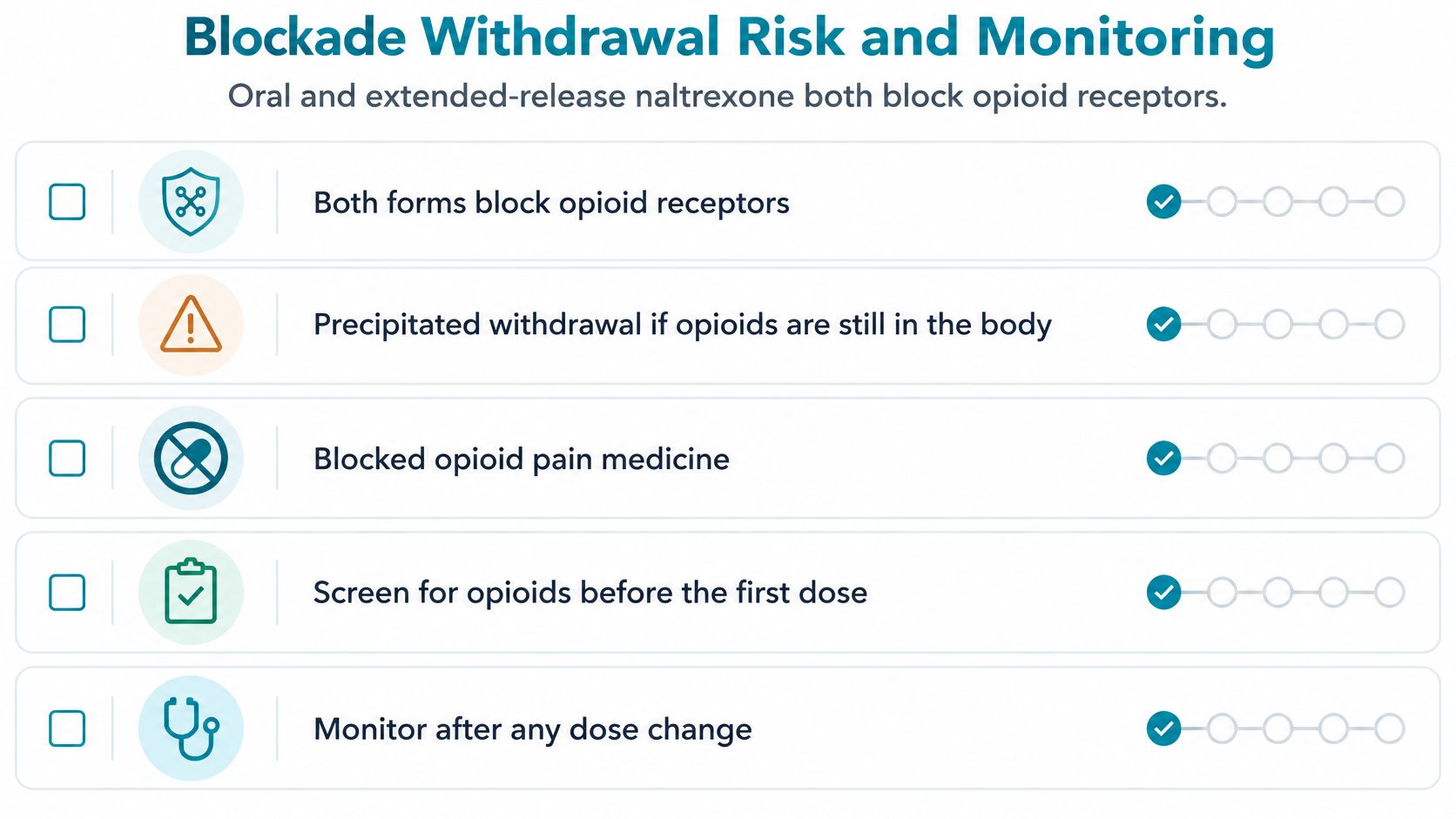
Both forms of naltrexone block opioid receptors. Either one can trigger precipitated withdrawal if opioids are still in the body. Precipitated withdrawal means symptoms start suddenly because the antagonist occupies the receptors, not because the person chose to stop using. The distinction matters: the body isn't naturally clearing opioids, the medicine is shoving them aside all at once.
Either form can also block opioid pain medicine. After an intramuscular depot is given, that blockade cannot be taken back promptly. A pill can be stopped today. An injection keeps releasing for weeks. That single difference drives most of the safety planning.
A clinician decides whether someone has been opioid-free long enough, using history and testing described on the current FDA label. Liver disease and acute hepatitis are label cautions, so the reader should ask which blood tests apply to them. The practice's precipitated withdrawal guide explains why timing and screening matter before the first dose.
Side effects named by the FDA label and MedlinePlus can include nausea, headache, dizziness, fatigue, anxiety, and sleep changes with either route. The injection can also cause pain, swelling, hardness, or other reactions at the site, and rare serious injection-site problems need urgent care. Neither product treats an overdose.
Routine follow-up covers use or craving, side effects, mood, other medicines, pregnancy plans, and upcoming dental or surgical care. Suspected overdose, severe withdrawal, allergic symptoms, chest pain, fainting, or trouble breathing is emergency care. Call 911 and name the product and the last dose date.
What the Drinking and Opioid Trials Actually Show
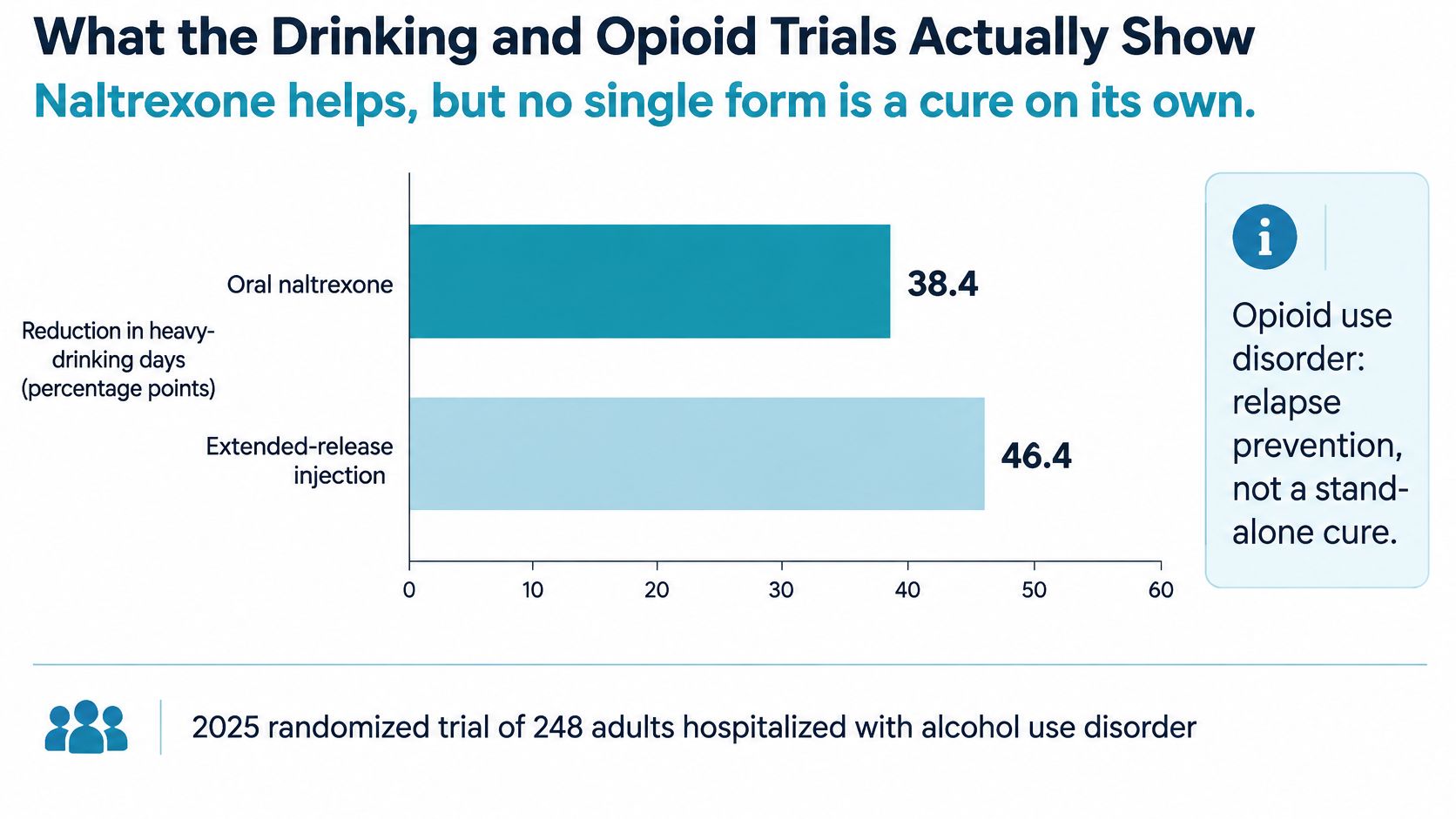
The headline result from the newest trial runs against the marketing assumption. In a 2025 randomized trial of 248 adults hospitalized with alcohol use disorder, heavy-drinking days fell by 38.4 percentage points with oral naltrexone and 46.4 percentage points with the extended-release injection over three months. Both groups improved substantially. The gap between them was not statistically significant.
The JAMA Internal Medicine trial is the closest thing to a direct head-to-head test of the "shot works better" idea, and it produced no clear winner on drinking outcomes. The injection delivers the same antagonist in a depot formulation, meaning a slow-release store of medicine placed in the muscle. Same drug, different schedule. A systematic review discussed alongside that trial found greater treatment persistence with the injection in some studies, yet no consistent reduction in hospitalizations or emergency-department use.
Evidence Snapshot for Naltrexone Route Comparisons
| Evidence | Outcome | Oral naltrexone | Extended-release injection | How to read it |
|---|---|---|---|---|
| 2025 randomized trial, 248 hospitalized adults with alcohol use disorder, three months | Change in heavy-drinking days | Down 38.4 percentage points | Down 46.4 percentage points | Both improved; difference not statistically significant |
| 2024 secondary analysis after hospital discharge, three months | Adherence to assigned dosing | A smaller share met the adherence bar | A larger share met the adherence bar | Adherence only; visit-completion rules differed by group |
| 24-week open-label trial paired with behavioral naltrexone therapy | Completed treatment | A minority finished | A majority finished | Among people still in treatment, opioid-use outcomes were similar |
| Systematic review discussed with the 2025 trial | Persistence and acute-care use | Daily treatment can work when taken | Greater persistence in some studies | No consistent reduction in hospitalizations or emergency visits |
Reading these rows well means separating what the trials measured from what they did not prove. They measured drinking days, adherence, and treatment completion. They did not prove the injection prevents hospital stays, guarantees abstinence, or outperforms a pill taken consistently.
A randomized trial works like a test track: conditions are controlled, so results show what the medicine can do rather than what an ordinary week allows. The 24-week opioid trial is a good example. Its higher completion rate for the injection came bundled with intensive behavioral therapy, a level of support that differs from typical outpatient life.
The practical reading is narrow. The trials show both routes can work, and they show adherence tends to favor the injection. Which of those matters more depends on the person. The medication-assisted treatment overview places both options within the wider treatment picture, where medication is one part of a larger plan rather than the whole answer.
Missed Doses Delays and Lost Coverage
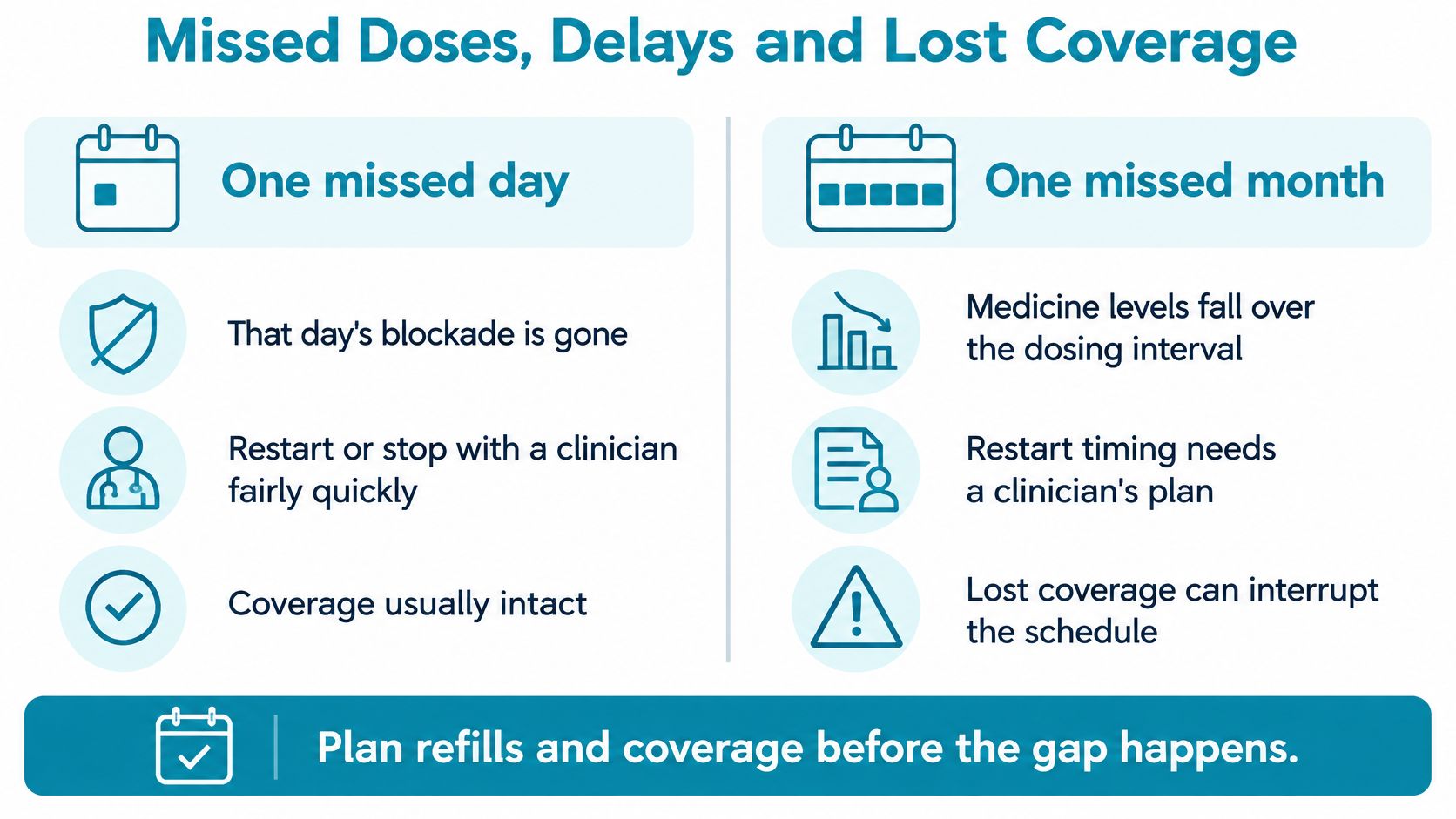
Skipping one pill removes protection for that day. The person can often restart or stop with a clinician relatively quickly. Skipping one month of injections is different. After an injection is given, medicine continues releasing whether the person wants it to or not. It cannot be taken back if side effects, a procedure, or a change in goals appears.
Delaying the next injection creates a coverage gap, especially if the appointment, payment, or a clinician who can administer it is unavailable. This 2025 analysis frames the trade-off directly: a missed pill means that day's blockade is gone, while an injection continues releasing medication and cannot be promptly removed if adverse effects occur.
The opioid safety piece is the part that often catches patients off guard. Naltrexone creates a period of opioid blockade followed by heightened overdose vulnerability if tolerance has fallen and a person returns to opioids. Someone who returns to a previous opioid amount after time away can face a much higher overdose risk.
A person facing surgery, dental work, or emergency pain treatment needs the date of the last dose shared with every clinician involved. A pill can be stopped sooner. A depot cannot be removed, so planning has to happen around it. This article does not give a washout schedule, a catch-up dose, or instructions to remove or replace an injection. Those are clinical decisions for a physician.
Routine follow-up covers side effects, use, and the next appointment. Suspected overdose, severe withdrawal, trouble breathing, chest pain, or collapse is emergency care. Call 911 and say naltrexone was used.
Which Route Fits Common Situations
Each of these situations turns into a question for a clinician, not a personal recommendation. The goal is to bring the right question to the visit.
| Situation | Route question to raise | Why it belongs in the visit |
|---|---|---|
| Alcohol use disorder and a reliable daily routine | Could the pill be a fit if I take it consistently? | Drinking outcomes were similar when both forms were studied |
| Alcohol use disorder with missed daily medicine | Is monthly administration practical for me? | The injection may improve coverage, not guarantee better recovery |
| Opioid use disorder after detoxification | Is the extended-release injection the approved option? | Oral naltrexone is not FDA-approved for opioid use disorder |
| Still physically dependent on opioids | What assessment comes before any naltrexone? | Starting too soon can precipitate withdrawal; this is not a home detox |
| Surgery, dental care, or likely opioid pain treatment | How long would blockade last? | A pill can be stopped sooner; a depot cannot be removed promptly |
| Transportation, cost, or scheduling barriers | Which missed-dose problem is more likely? | A skipped pill and a missed injection create different gaps |
For alcohol use disorder, either approved route may be reasonable when its requirements are met. In the 2025 trial of 248 hospitalized adults, heavy-drinking days fell 38.4 percentage points with oral naltrexone and 46.4 points with the injection over three months, and the difference was not statistically significant. A pill that is taken can match the injection. Missed daily doses are the usual reason to ask whether monthly administration is practical.
For opioid use disorder, only extended-release injectable naltrexone is FDA-approved, and only to help prevent relapse after detoxification. Oral naltrexone is not an approved treatment for opioid use disorder and is not a home detox.
Consider a clearly hypothetical adult who did well on a daily pill and then stopped it during a chaotic month. That scenario illustrates the key question: does the person's life support a daily decision, or would one monthly visit hold up better? The illustration doesn't predict an outcome for anyone.
Addiction medicine care at Empire Medical Wellness begins with a confidential assessment of the person's current situation, medical risks, previous treatment, medications, and goals. When detoxification, residential treatment, or another level of support is clinically appropriate, the practice can help coordinate the next step with trusted treatment partners. Outpatient alcohol treatment is one setting where this comparison comes up often.
Visit Fees Pharmacy Bills and Access
Cost depends on the route and on who bills the charge. Oral naltrexone and the extended-release injection can differ in pharmacy cost, administration fees, and insurance rules. Copays, coupons, and prior-authorization outcomes depend on the individual pharmacy and insurer, so those details should be confirmed directly with them.
Access also has a timing component. The pill requires a prescription and a daily routine. The injection requires a qualified clinician and a site that can give it about every four weeks. A break in prescribing, payment, transportation, or administration creates a coverage gap. A missed monthly visit leaves a longer gap than one skipped pill.
Empire Medical Wellness is private-pay, physician-led outpatient care. Visit fees are private-pay. Laboratory testing, pharmacy costs, imaging, treatment programs, and services from outside clinicians or facilities are billed separately by those organizations. Questions about visit fees, medication costs, or laboratory charges are handled by contacting the practice directly. The fees page and the addiction medicine service page carry the current details.
An initial addiction medicine evaluation is confidential and outpatient. It begins with an assessment of the person's current situation, medical risks, previous treatment, medications, and goals. Evidence-based medication can be part of addiction medicine care when clinically appropriate with monitoring and follow-up. A visit does not guarantee a prescription, and recommendations are individualized. Empire Medical Wellness prescribes FDA-approved medications when a medical evaluation supports their use.
Questions to Bring to a Physician Visit
These eight questions follow the order a visit might use them. Bring a medicine list and the dates of recent opioid or alcohol treatment. Do not bring a requested dose.
Which diagnosis is being treated, and which form is approved for it? Oral and injectable naltrexone have different approved uses.
Does recent opioid exposure make naltrexone unsafe right now? Starting too soon can trigger severe withdrawal.
How will alcohol or opioid goals be measured? Drinking days, craving, and use all need a clear tracking method.
What liver history or other medicines change the choice? Naltrexone has cautions that a clinician must review.
How would pain, dental work, or surgery be handled? A pill and a depot create different waiting periods.
What would a missed pill versus a delayed injection mean? The coverage gaps are not the same size.
Who would prescribe, administer, and monitor it? The pill and the injection involve different workflows.
What are the visit, laboratory, and pharmacy bills? Separate organizations bill separate charges.
At an initial addiction medicine evaluation with Dr. Chhatpar, the patient receives an explanation of appropriate treatment options and next steps. Evidence-based medication can be part of care when clinically appropriate, and an appointment does not guarantee a prescription. Recommendations are individualized. The first appointment guide walks through what to expect, and the addiction medicine specialist page profiles the physician's training and approach.
This article was written by the Empire Medical Wellness Editorial Team and is educational, not personal medical advice. Urgent danger belongs with emergency services, not an appointment request.
Empire Medical Wellness offers private, physician-led outpatient addiction medicine care grounded in confidential assessment, individualized recommendations, and ongoing monitoring. If you are weighing naltrexone injection vs pill for alcohol or opioid recovery, a visit can clarify which approved option fits your medical history, daily routine, and treatment goals. Schedule a conversation at Empire Medical Wellness to discuss the next step.