
A person may reach the same decision after a difficult morning, a concerned conversation, or another attempt to cut back: Is outpatient alcohol treatment enough, and is it safe to begin there? Outpatient care can provide physician assessment, medication management when appropriate, monitoring, recovery planning, and coordination without a residential stay. The first step, however, is a clinical assessment of safety, not choosing a setting from an online checklist.
Table of Contents
- What Outpatient Alcohol Treatment Means
- How Clinicians Decide the Right Level of Care
- Comparing the Main Outpatient and Adjacent Settings
- Medication Options in Outpatient Alcohol Care
- What a Physician-Led Outpatient Evaluation Looks Like
- The Medication Access Gap Most Guides Ignore
- When Outpatient Care Is Not the Right Setting
- A Practical Framework for Your Next Step
What Outpatient Alcohol Treatment Means
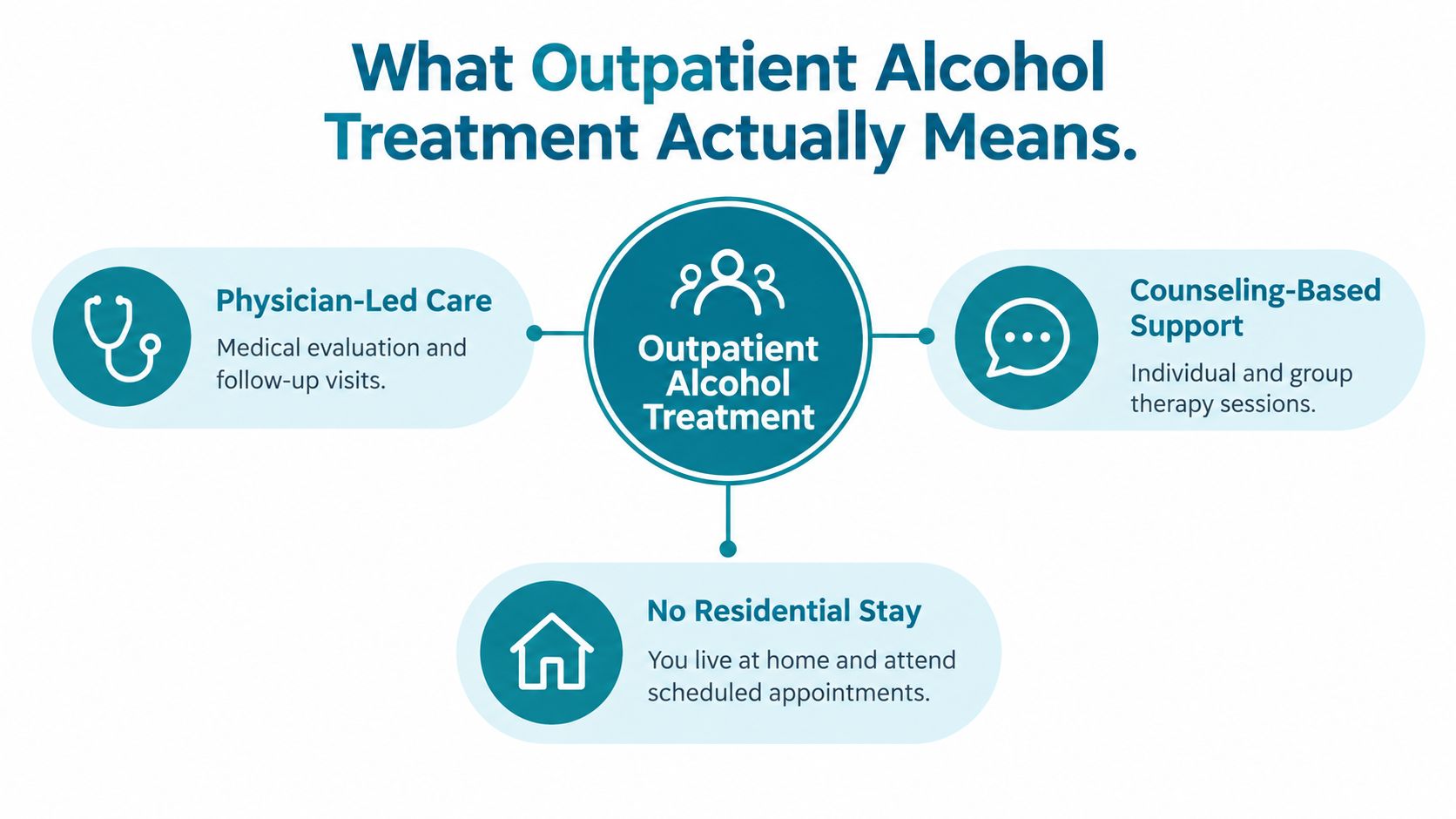
Outpatient alcohol treatment lets a person receive care while continuing to live at home. Depending on clinical needs and the program, care may involve medical assessment, counseling, medication management, monitoring, recovery planning, and coordination with other clinicians or programs. The National Institute on Alcohol Abuse and Alcoholism's overview of alcohol treatment types notes that many people begin treatment for alcohol use disorder with outpatient counseling from a treatment program, therapist, or physician.
Outpatient care is a treatment structure, not a promise that home-based care is safe for everyone. In a national survey, 1,460,706 clients were receiving substance-use treatment on March 29, 2019, and 93% were in outpatient care. The survey covered substance-use treatment broadly, not alcohol alone, but it shows how common nonresidential treatment is. SAMHSA's 2019 treatment survey also describes outpatient care as compatible with home, work, and family responsibilities.
Ongoing treatment is different from withdrawal management
These terms describe different clinical needs.
Ongoing alcohol-use-disorder treatment addresses drinking patterns, cravings, health effects, recovery skills, and the risk of returning to alcohol use. It may include counseling, medication, follow-up visits, mutual-support groups, and coordination with other programs.
Withdrawal management supports the body after alcohol use is reduced or stopped. Withdrawal can become medically serious, so the appropriate setting depends on symptoms, past withdrawal, medical and psychiatric conditions, available support, and access to urgent help.
A person might be suitable for ongoing outpatient treatment but need another setting to manage withdrawal. Completing withdrawal management also does not, by itself, treat the underlying alcohol-use disorder. Outpatient care works best when the level of monitoring matches the person's medical risk and available support.
Practical rule: Outpatient care is a clinical decision about safety and support, not simply the most convenient appointment format.
Adults considering private physician-led care can review Empire's addiction medicine care. The practice offers outpatient medical assessment and follow-up. It is not a detoxification facility, residential program, or emergency service.
How Clinicians Decide the Right Level of Care
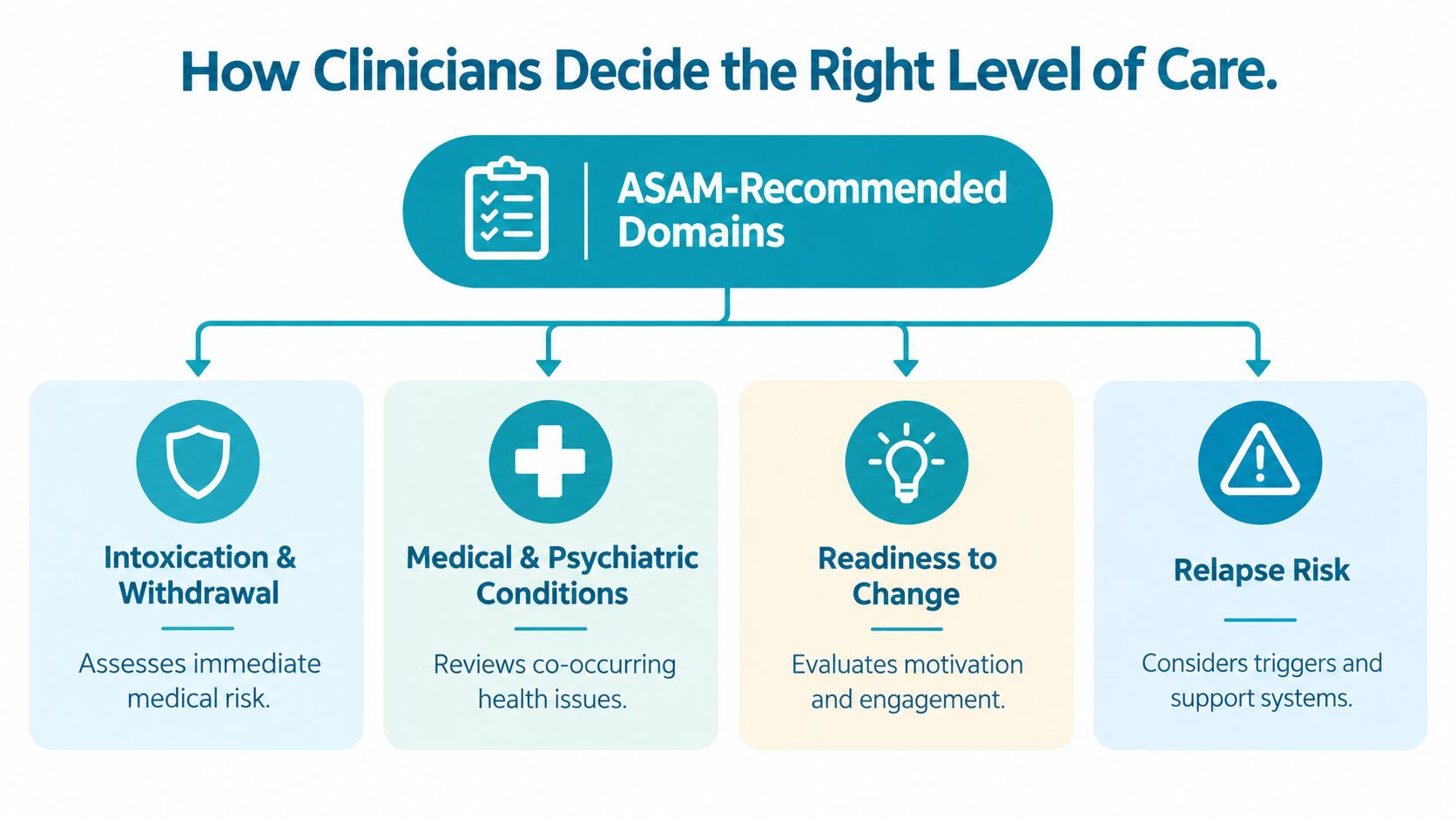
A clinician choosing outpatient alcohol treatment looks beyond privacy or appointment preference. The question is whether the person's medical and recovery needs can be managed safely without residential admission. The American Society of Addiction Medicine recommends weighing several dimensions together and selecting the least intensive setting that can manage risk safely. That decision can change if symptoms worsen, the person cannot follow the agreed plan, or treatment is not helping.
The clinical domains that matter
The assessment commonly examines:
- Withdrawal risk: Current symptoms, recent drinking pattern, and previous withdrawal complications help determine whether ambulatory care is reasonable.
- Medical conditions: Liver disease, cardiovascular problems, seizure history, pregnancy, medication interactions, and other biomedical concerns may require a different setting.
- Emotional and cognitive complications: Severe anxiety, depression, confusion, suicidal thoughts, psychosis, or impaired judgment can increase the need for supervision.
- Readiness and engagement: Goals, understanding of treatment, ability to attend appointments, and willingness to follow the plan affect whether outpatient care is workable.
- Relapse or continued-use risk: Cravings, access to alcohol, previous treatment responses, and the likelihood of drinking during care help determine monitoring needs.
- Recovery environment: Housing, transportation, family or other support, work demands, and access to urgent help can make outpatient treatment safer or less safe.
ASAM distinguishes Level 1 ambulatory withdrawal management, which does not include extended on-site monitoring, from Level 2 care, which adds extended monitoring and may use intensive outpatient or day-hospital infrastructure. A clinician may recommend more support when withdrawal risk, medical complexity, psychiatric symptoms, or the home environment exceeds what routine office care can safely handle. ASAM's alcohol withdrawal guideline describes this risk-based approach.
Access barriers are part of the decision
People may delay care because they are uncertain about treatment, concerned about stigma, facing practical obstacles, or trying to manage alone. In the 2019 National Survey on Drug Use and Health, approximately 7.2% of people aged 12 and older with past-year alcohol use disorder received any alcohol treatment, compared with approximately 7.3% of adults. NIAAA's alcohol facts and statistics clarifies that “any treatment” covered multiple settings, so these figures do not describe outpatient care alone.
Employment or professional requirements may create a separate administrative need. A return-to-duty compliance help resource can explain workplace processes, but it cannot replace medical assessment of withdrawal risk or treatment needs.
A focused discussion of symptoms and diagnosis can clarify terminology without encouraging self-diagnosis. Empire's overview of DSM-5 substance-use-disorder criteria is educational and does not substitute for a clinician's evaluation.
Comparing the Main Outpatient and Adjacent Settings
The word “outpatient” describes care delivered without residential admission, but it doesn't identify one uniform service. Physician-led office care, counseling-focused treatment, intensive outpatient programs, and partial hospitalization differ in structure and supervision. Residential or inpatient care removes the person from the home environment and provides a higher level of containment.
The table below is an orientation tool, not a self-placement guide.
Outpatient and Adjacent Settings at a Glance
| Setting | Typical Support | Supervision | Questions to Ask |
|---|---|---|---|
| Physician-led office-based outpatient care | Medical assessment, medication evaluation when appropriate, monitoring, recovery planning, and coordination | Scheduled medical follow-up without residential supervision | Who performs the medical assessment? Are FDA-approved alcohol-use-disorder medications considered when appropriate? What happens if symptoms worsen? |
| Counseling-focused outpatient care | Individual or group counseling, behavioral strategies, education, and recovery support | Scheduled counseling contact, with medical care provided separately when available | Is a physician involved? How are medical concerns handled? Can the program coordinate with outside clinicians? |
| Intensive outpatient program | More structured behavioral and recovery support than routine outpatient care, often with multiple treatment components | Repeated program contact while the patient lives at home | What clinical needs does the program manage? Is medication evaluation available or coordinated? What is the escalation plan? |
| Partial hospitalization or day program | Highly structured daytime treatment with medical, psychiatric, and therapeutic support | More intensive daytime observation, without overnight residential admission | How does the program respond to withdrawal or psychiatric risk? What support exists outside program hours? |
| Residential or inpatient care | Treatment in a supervised living or hospital environment, with access to more continuous support | Residential or hospital-based supervision | Is the setting medically equipped for the person's risk? How will continuing care be arranged after discharge? |
Physician-led outpatient care isn't the same as an intensive outpatient program. A medical practice may assess health risks, consider medication, monitor response, and coordinate with an IOP or therapist. It may not provide the repeated group programming or daily structure that an IOP offers.
Counseling remains an important part of treatment for many adults, but counseling and medical treatment answer different questions. A person seeking behavioral strategies may benefit from learning about a guide to CBT therapy, while a physician evaluates medication suitability, withdrawal risk, medical conditions, and monitoring needs. These services can complement each other when coordination is authorized and clinically appropriate.
A useful question for any program is, “Who handles the medical part of treatment if medication, withdrawal risk, or a new health concern becomes relevant?”
The right setting isn't the one with the most appealing label. It is the setting equipped to manage the person's actual clinical and environmental risks.
Medication Options in Outpatient Alcohol Care
Medication can support outpatient alcohol treatment, while counseling and recovery work address other parts of change. NIAAA identifies three FDA-approved medications that can help people reduce or stop drinking and prevent a return to drinking: naltrexone, acamprosate, and disulfiram. NIAAA's overview of alcohol-use-disorder treatment explains how these options may be used with behavioral treatment or mutual-support participation.
The three approved medications
- Naltrexone reduces alcohol's reinforcing effects. It comes as a daily oral medication or an extended-release injection. A physician reviews the person's medical history, current medications, treatment goal, and ability to use the chosen formulation safely.
- Acamprosate supports abstinence by reducing symptoms associated with prolonged abstinence. It is taken three times daily, so adherence and kidney-related considerations need discussion before treatment.
- Disulfiram discourages drinking by causing an unpleasant reaction if alcohol is consumed. It may suit some people when the treatment goal and monitoring arrangements support that approach.
All three medications are nonaddictive, but suitability still depends on the individual. Selection involves reviewing hepatic and renal considerations, contraindications, other prescriptions, pregnancy status when relevant, drinking goals, and the ability to attend follow-up. The prescribing conversation should cover adverse effects, changes that would prompt reassessment, and how response will be tracked.
Maintenance treatment is not withdrawal treatment
Medication for acute withdrawal differs from medication for ongoing alcohol-use-disorder treatment. Benzodiazepines are first-line for moderate-to-severe withdrawal, while gabapentin or carbamazepine may be considered for selected patients with mild withdrawal or lower complication risk. These decisions require medical judgment and are not instructions for home treatment.
Starting medication establishes follow-up care. Later visits may address drinking, cravings, withdrawal symptoms, side effects, adherence, laboratory information when indicated, and whether outpatient treatment remains appropriate. Information about naltrexone in outpatient treatment can help a patient prepare questions, but a clinician must determine whether the medication fits that person's situation.
What a Physician-Led Outpatient Evaluation Looks Like
An adult arriving for a private physician-led evaluation may feel uncertain about what must be disclosed. The visit is intended to establish a clinical picture, not to assign blame. A physician may ask about alcohol quantity and pattern, the last drink, previous attempts to stop, withdrawal symptoms, seizures, medical conditions, psychiatric history, current medications, allergies, sleep, work, housing, support, and treatment goals.
The assessment may include a physical evaluation or telemedicine assessment when clinically suitable. The physician considers whether outpatient care can safely address the immediate situation, whether medication may be appropriate, and whether a higher level of care or urgent evaluation is needed. Laboratory review may be relevant when indicated, but testing doesn't replace a careful history and risk assessment.

What the plan may include
A plan can include:
- A treatment focus: reducing drinking, pursuing abstinence, addressing cravings, or clarifying the next level of care.
- Medication discussion: consideration of an FDA-approved option when clinically appropriate, with review of risks and follow-up.
- Monitoring: reassessment of symptoms, drinking, cravings, adverse effects, and treatment response.
- Recovery planning: identifying counseling, mutual-support, family, workplace, or community resources that fit the person's goals.
- Coordination: communication with an outside therapist, treatment program, or other clinician when useful and authorized.
The practice's first addiction medicine appointment can be a place to ask how assessment, follow-up, and coordination work. Empire Medical Wellness provides physician-led outpatient addiction medicine care, including assessment, medication management when appropriate, monitoring, and recovery planning. It doesn't operate an IOP, inpatient or residential program, detox facility, or psychotherapy program.
A physician-led office visit also can't provide continuous observation at home. If the assessment identifies a risk that exceeds outpatient capacity, the safer recommendation may be urgent evaluation or a more structured treatment setting.
The Medication Access Gap Most Guides Ignore
A person may call an outpatient alcohol treatment program and discover that counseling is available, while medication evaluation is not. A 2025 analysis of national facility data found that 9.9% of mental-health-focused outpatient facilities offered medications for alcohol use disorder, although 73.6% reported treating substance-use conditions. Among facilities offering both mental-health and substance-use treatment, fewer than half provided medication for alcohol use disorder. The 2025 analysis in JAMA Network Open shows why the label “outpatient” does not by itself describe the medical services available.
Access can also fall short at the patient level. In the same national data, 1.9% of people with alcohol use disorder received medication for alcohol use disorder. This does not mean medication is appropriate for everyone. It means prospective patients should ask whether a clinician can assess medication options, rather than assuming that every outpatient program provides physician-led care.
Questions worth asking before enrollment
- Physician involvement: Does a physician or other qualified prescriber participate in assessment and follow-up?
- Medication availability: Are FDA-approved medications for alcohol use disorder considered when clinically appropriate?
- Withdrawal boundaries: Does the program assess withdrawal risk and explain where people can receive more intensive management?
- Coordination: With authorization, can the team communicate with a therapist, primary-care clinician, or higher level of care?
- Monitoring: How does the team review side effects, adherence, cravings, continued drinking, and treatment response?
Access is also shaped by readiness and practical barriers. NIAAA reports that among people with alcohol use disorders who recognized a need for treatment, approximately 65% said they were not ready to stop drinking or believed they could manage on their own. 59% reported barriers such as cost, insurance, transportation, or limited access. A respectful conversation can clarify options without pressuring someone into a decision. The first workable step may be information, privacy, medical guidance, or help connecting with care.
When Outpatient Care Is Not the Right Setting
Alcohol withdrawal can become dangerous, and routine outpatient treatment isn't the same as detoxification or emergency management. Symptoms such as seizures, marked confusion, hallucinations, severe tremor, or persistent vomiting require urgent or emergency evaluation rather than waiting for a routine booking. NIAAA notes that some withdrawal can be managed in an outpatient detoxification setting, while people at risk for life-threatening symptoms may need intensive inpatient detoxification. NIAAA's clinical resource on alcohol-use-disorder risk and recovery describes the range of withdrawal symptoms and the need for medical assessment.
No online checklist can determine whether a person can safely stop drinking outside a supervised setting. Prior withdrawal history, medical and psychiatric conditions, current medications, drinking pattern, support, and access to urgent help all affect the decision.
A person shouldn't attempt an at-home taper, follow dosing instructions from an article, or suddenly stop alcohol based only on this guide. A fuller discussion of symptoms is available in the guide to manifestations of alcohol withdrawal. If severe or rapidly worsening symptoms are present, emergency services or an emergency department are more appropriate than routine outpatient scheduling.
A Practical Framework for Your Next Step
The next step depends on the immediate clinical question:
- Ongoing treatment: If the concern is cravings, continued drinking, relapse risk, or recovery planning without signs of dangerous withdrawal, a confidential outpatient medical assessment may clarify options.
- Withdrawal evaluation: If alcohol use is being reduced or stopped, the person needs medical guidance about the appropriate level of withdrawal management. Ambulatory care isn't automatically safe.
- Medication access: Any program under consideration should be asked whether a physician evaluates patients and whether FDA-approved alcohol-use-disorder medications are available when indicated.
- Escalation: Severe withdrawal symptoms require urgent or emergency care, not a routine appointment.
People comparing care plans may also find a care plan guide for Australian practices useful for understanding how structured planning can organize goals and follow-up, although local U.S. clinical decisions must come from a qualified clinician.
For practical details about private-pay appointments, fees, and scheduling, readers can review how Empire's care model works and schedule an appointment. This article is educational and isn't personal medical advice.
Empire Medical Wellness offers physician-led outpatient addiction medicine assessment, medication management when appropriate, monitoring, recovery planning, and coordination with outside care. Adults considering outpatient alcohol treatment can visit Empire Medical Wellness to learn more about the practice and request an evaluation.
Byline: Empire Medical Wellness Editorial Team
Published: October 15, 2026
Updated: October 15, 2026