
Precipitated withdrawal is a rapid worsening of opioid withdrawal when buprenorphine, or an opioid blocker such as naloxone, is given while a full opioid agonist is still active. In one emergency-department study, documented cases were uncommon. Uncommon in a study, though, is not the same as unlikely for any one person.
Why do studies report low rates while some people remember a very difficult treatment start? Documented events, self-reported symptoms, and fentanyl exposure each measure something different, so neither "rare" nor "likely" is a personal forecast. A hard start is also not proof that treatment failed. Those distinctions help adults weigh the evidence alongside real experience.
Table of Contents
- What Precipitated Withdrawal Means
- How Often Studies Find It
- Why a Partial Agonist Can Displace a Full Agonist
- How It Differs From Ordinary Withdrawal
- When Sudden Symptoms Need Urgent Care
- Questions to Raise Before a Medication Change
- Plan Outpatient Follow-Up After the Crisis
What Precipitated Withdrawal Means
Precipitated withdrawal describes a sudden medication-triggered drop in opioid effect in someone whose body has adapted to opioids. The word precipitated means brought on abruptly. It doesn't mean that withdrawal was inevitable or that the person did something wrong.
A full opioid agonist is a medicine or substance that strongly activates opioid receptors. Heroin, fentanyl, and methadone are examples. Buprenorphine works differently: it attaches tightly to these receptors but activates them only partly.
SAMHSA's Buprenorphine Quick Start Guide explains that buprenorphine can displace full agonists such as heroin or methadone and trigger withdrawal. For conventional initiation, SAMHSA advises that objective signs of withdrawal should be present before the first dose. Objective signs are findings a clinician can observe, rather than a feeling alone.
A sudden change rather than a gradual decline
In a hypothetical example, an adult begins an opioid-treatment transition while the earlier opioid still has a substantial effect. A new medicine takes its place at the receptor but supplies less activation. The nervous system experiences an abrupt reduction instead of a gradual decline as the earlier opioid wears off.
A simple comparison is a tightly fitting replacement key that turns a control only partway. How firmly the key fits and how far it turns are different properties. Buprenorphine's tight fit doesn't mean it produces the same effect as the opioid it replaces.
The central distinction: Precipitated withdrawal concerns a sudden change in opioid signaling, not a judgment about the person receiving care.
Opioid blockers, including naloxone and naltrexone, can also bring on withdrawal when physical opioid dependence remains. However, emergency overdose reversal and a planned medication transition are different clinical situations. Fear of withdrawal must not delay emergency overdose treatment.
What an explanation can and can't establish
Recognizing the mechanism doesn't establish what caused a particular person's symptoms. Clinicians still need the medication history, recent opioid exposure, symptom pattern, and examination.
Useful education separates study definitions, medication effects, urgent symptoms, and prevention discussions. It doesn't supply a dose, a universal waiting-hour rule, or instructions to start, stop, or change medication.
How Often Studies Find It
How often does a buprenorphine start trigger precipitated withdrawal? Studies disagree, and the disagreement is the lesson. Documented events in emergency departments, self-reported experiences in surveys, and cohorts selected for fentanyl exposure each measure something different. No single percentage describes the risk in every setting.
Published estimates answer different questions
| Source and setting | People | What was counted | Reported figure |
|---|---|---|---|
| 28 U.S. emergency departments, 2023 | 1,200 adults; about 70% reported fentanyl | Clinical Opiate Withdrawal Scale increase of at least 5 points within 2 hours | 9 people, 0.76%; 0.24% in the West to 1.44% in the Midwest |
| Low-dose initiation with follow-up, 2024 | 118 attempts with follow-up | Precipitated withdrawal during low-dose starts | 10 attempts, 8%; 3 cases, or 3%, without known protocol deviation |
The gap between these counts and what people report elsewhere follows a pattern. Hospital cohorts that required a positive fentanyl test have described higher shares than broad emergency-department counts. Surveys of people entering addiction treatment describe still higher rates of severe withdrawal after a buprenorphine start that followed fentanyl closely. A strict scoring definition produces a small number. Asking people whether they ever had a very hard start produces a larger one.
Why the definitions change the answer
A prospective study establishes its assessment process before events occur. A retrospective study looks back through existing records. A survey asks people to describe their experience, sometimes well after the event.
Each method answers a useful question, and each counts a different thing. In the emergency-department study, an event meant a clinician-observed rise of at least five points on a structured scoring tool within two hours. In a survey, an event can mean remembered severe sickness at any point after the start. Both capture real suffering. They measure it through different windows.
The Clinical Opiate Withdrawal Scale, commonly called COWS, organizes withdrawal findings into a clinical score. It isn't a home test that authorizes medication decisions. A study's assessment window also isn't a guarantee about when symptoms must begin or end.
The receptor sequence behind these events is illustrated below.
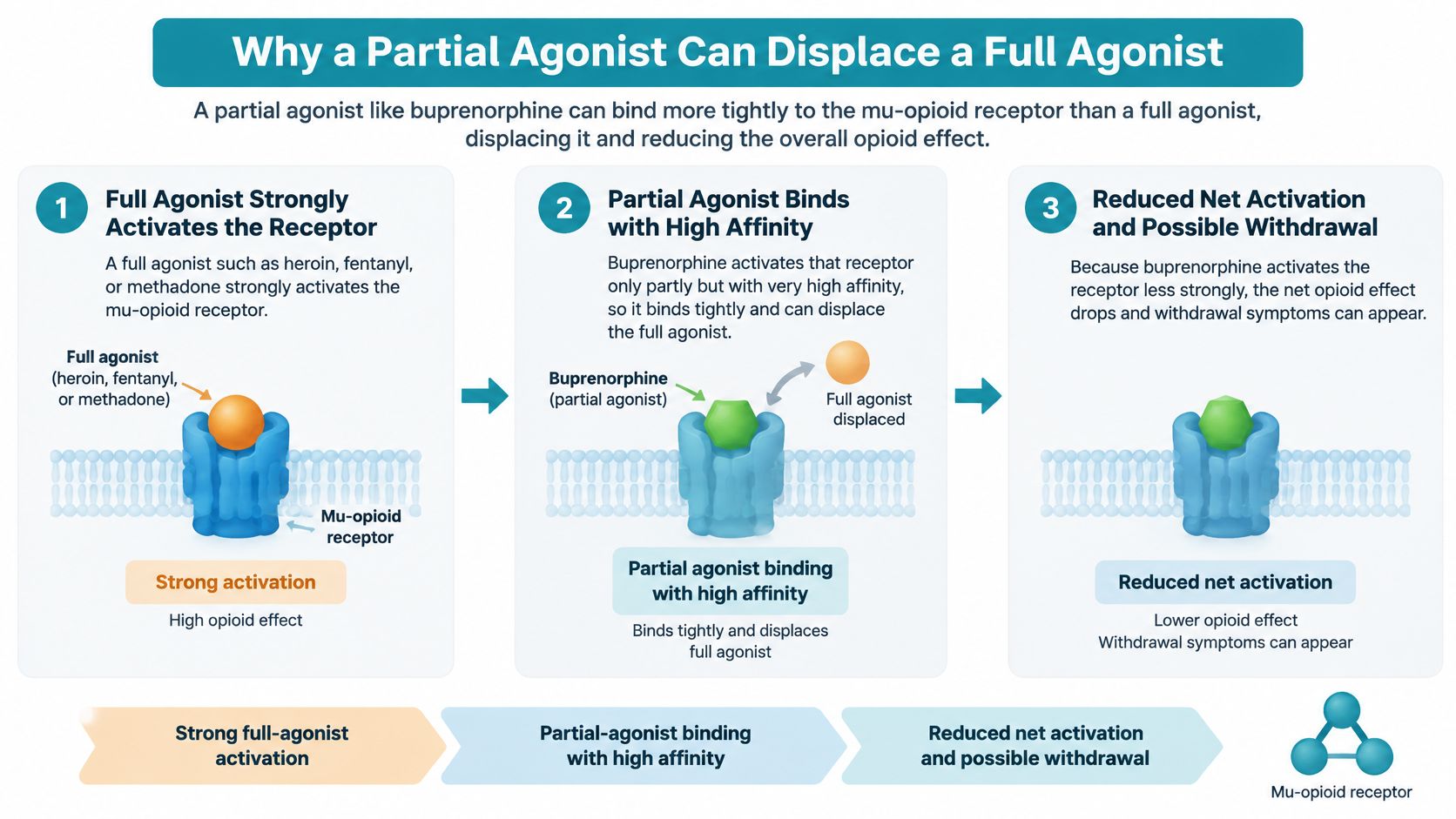
A sudden drop in receptor activation can look identical to ordinary withdrawal in a chart. That ambiguity is one more reason recorded counts vary between studies.
Population estimates aren't individual predictions. A documented rate in one setting and a far higher self-reported rate in another are both real findings about different measurements, and neither forecasts one person's transition. A difficult start gives the care team information to adjust the plan. It says nothing final about whether treatment can work.
Why a Partial Agonist Can Displace a Full Agonist
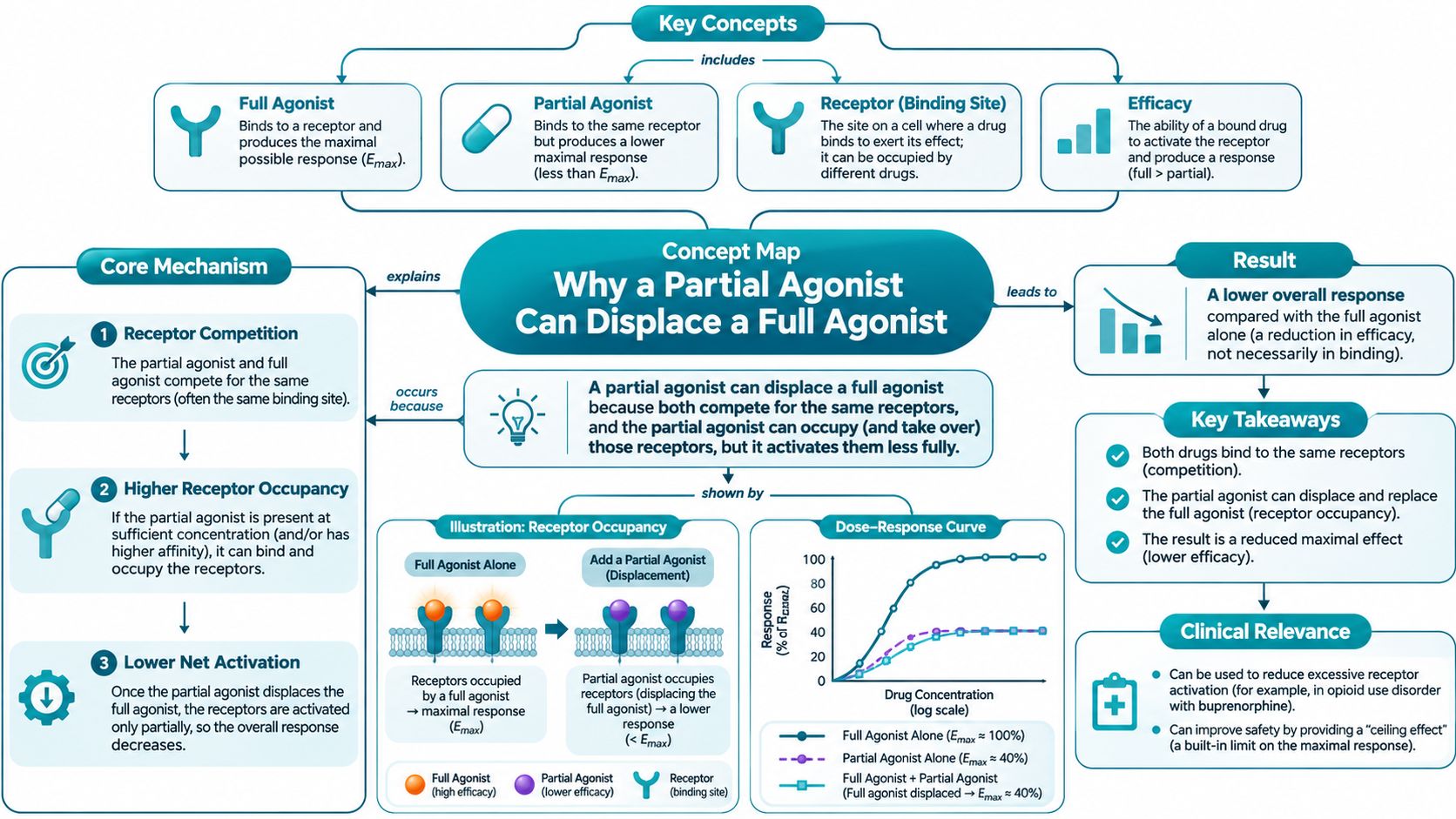
Affinity means how strongly a substance binds to a receptor. Agonist activity means how much it activates that receptor. These properties explain why a medicine can bind more tightly while producing less opioid effect.
The sequence involves distinct receptor roles:
- Full agonist activation. Heroin, fentanyl, or methadone strongly activates the mu-opioid receptor, a major receptor involved in opioid effects.
- Partial agonist replacement. Buprenorphine has high affinity but partial agonist activity. It can replace a full agonist while providing less activation.
- Antagonist blockade. Naloxone blocks opioid receptors rather than replacing the earlier opioid effect. That makes overdose reversal different from planned buprenorphine initiation.
The relationship between binding and activation is illustrated below.
Why fentanyl complicates the clock
Fentanyl's tissue distribution and prolonged elimination can make elapsed time an incomplete guide to remaining opioid effect. A person's recollection of the last exposure is useful, but it doesn't measure receptor activity.
In a survey of people entering addiction treatment, buprenorphine use within 24 hours of fentanyl was associated with greater odds of self-reported severe withdrawal, with an odds ratio of 5.20 and a 95% confidence interval of 1.98 to 13.68. Exposure within 24 to 48 hours remained associated with increased odds, with an odds ratio of 3.35 and a 95% confidence interval of 1.24 to 9.09.
Those are associations, not a waiting schedule. An odds ratio compares groups; it doesn't give an individual's probability.
A 2024 hospital and emergency-department cohort found adjusted odds ratios of 5.12 for body mass index of 30 or higher versus under 25, and 8.37 for urine fentanyl concentrations of at least 200 ng/mL versus under 20 ng/mL. These population-specific findings don't allow risk to be judged from appearance or a single laboratory result.
What the clinician combines
The assessment includes recent opioids, observed withdrawal signs, possible fentanyl exposure, other substances, pregnancy, and medical risks. No isolated clock reading substitutes for that assessment.
The FDA prescribing information available through DailyMed warns that sublingual or parenteral buprenorphine can precipitate withdrawal before other opioid effects have subsided. The practice's buprenorphine information offers related background, rather than an individualized initiation plan.
How It Differs From Ordinary Withdrawal
| Question | Ordinary opioid withdrawal | Precipitated withdrawal |
|---|---|---|
| Typical onset | Builds as opioid effects fall, often over hours | Abrupt worsening after a displacing medicine; clinical studies assess changes soon after administration |
| Driver | Less full-agonist effect over time | A partial agonist or blocker replaces or blocks a full agonist while dependence remains |
| Common symptoms | Yawning, tearing, runny nose, sweating, gooseflesh, aches, nausea, diarrhea, enlarged pupils, anxiety, and insomnia | The same symptom family, with a sudden change after the new medicine |
| Course | The pace reflects the opioid involved and the person's circumstances | Can become intense quickly; duration isn't a fixed clock |
| What it means | Withdrawal physiology during a gap in opioid effect | A treatment complication requiring assessment, not proof of failure or a dosing error |
Similar symptoms, different sequence
The symptom list alone doesn't distinguish the two. Both can involve restlessness, muscle and joint aches, stomach cramps, nausea, vomiting, diarrhea, watery eyes, sweating, gooseflesh, enlarged pupils, anxiety, and difficulty sleeping.
The sequence gives the clinician more useful information. Ordinary withdrawal develops as the earlier opioid's effect declines. Precipitated withdrawal involves a noticeable worsening after a medicine changes receptor activation.
The practice's overview of opioid withdrawal manifestations provides broader symptom context. A symptom checklist still can't determine the cause of a particular episode.
A sudden change after medication deserves assessment. It doesn't establish the diagnosis by itself.
Why feeling worse doesn't identify the cause
Withdrawal may already be progressing when a person receives medication. Medication side effects, dehydration, other substances, or a separate illness can also complicate the picture. A clinician considers these possibilities rather than assigning every difficult start the same label.
A transition involving methadone requires a different history from naloxone given during an overdose. The name of the last medicine and the reason it was administered are essential details. Similar discomfort doesn't make those situations interchangeable.
A difficult initial dose also doesn't establish that someone took an incorrect amount. It doesn't prove that the person misunderstood instructions or that buprenorphine can never be useful.
Duration requires reassessment, not a promise
A fixed recovery timeline can create false reassurance. Symptom intensity and duration reflect the medication involved, prior exposure, hydration, other health conditions, and the care required.
The useful distinction is therefore pattern plus clinical assessment, not a countdown. When symptoms worsen suddenly, the next decision concerns the appropriate level of care, not whether the experience fits an online description perfectly.
When Sudden Symptoms Need Urgent Care
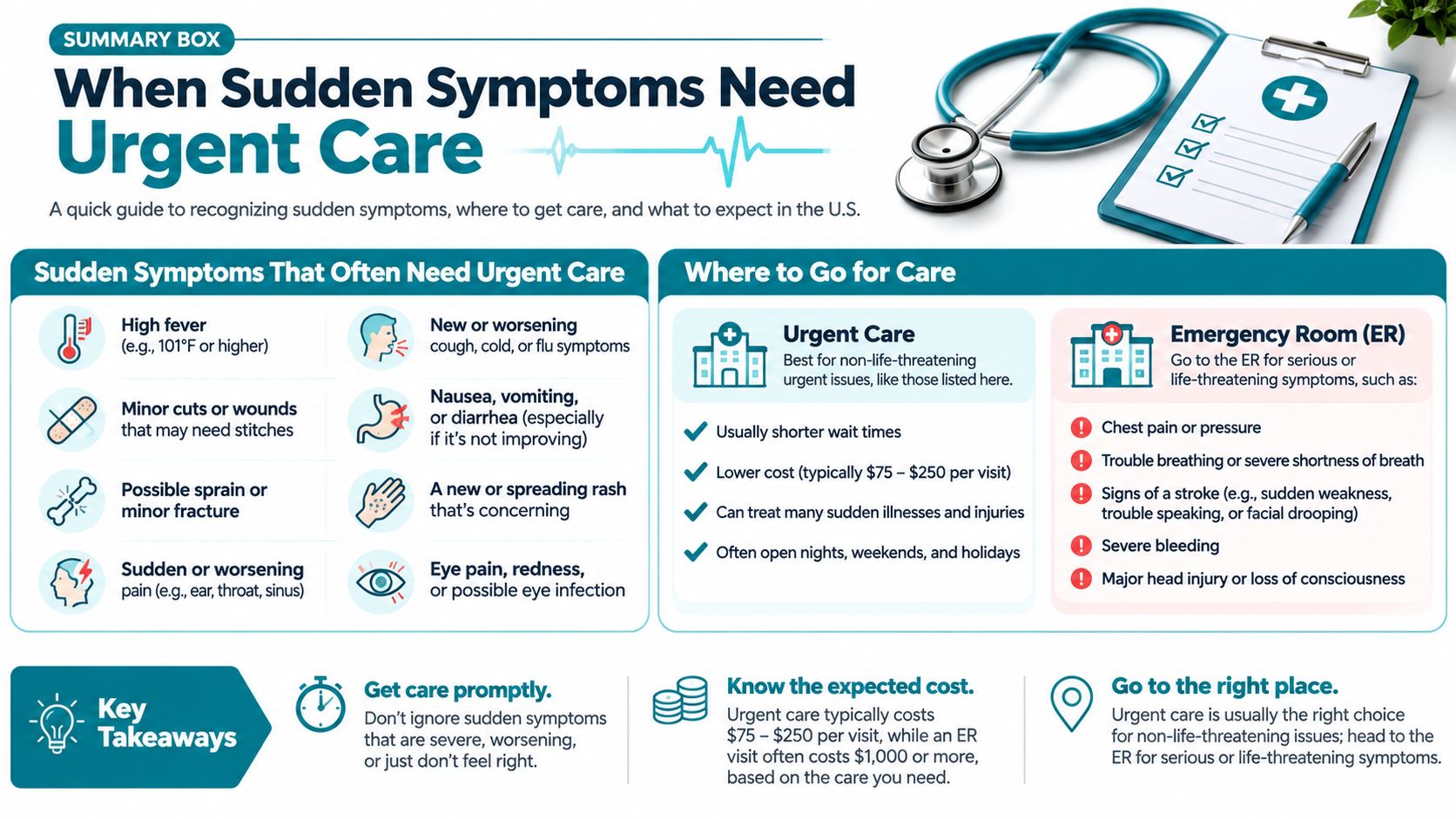
Worsening symptoms after an initial buprenorphine dose warrant prompt contact with the prescribing or on-call clinician. Symptoms after naloxone given for suspected overdose require continued emergency assessment. Apparent withdrawal doesn't establish that the overdose danger has passed.
A person who is alert, breathing comfortably, able to sip fluids, and without emergency warning signs should contact the treating clinician the same day. If that clinician can't be reached and symptoms are severe or worsening, urgent in-person assessment is appropriate.
Emergency warning signs
Emergency services take priority for any of the following:
- Breathing or alertness changes: Trouble breathing, rapidly worsening sedation, inability to remain awake, or severe confusion.
- Chest or neurological symptoms: Chest pain, fainting, or seizure.
- Severe fluid loss: Uncontrolled vomiting with inability to keep fluids down.
- High-risk circumstances: Pregnancy with severe symptoms or any immediate danger.
For immediate danger, 911 is the appropriate emergency contact. For suicidal thoughts or emotional crisis in the United States, the 988 Suicide and Crisis Lifeline provides crisis support; immediate physical danger still requires emergency services.
The distinction between withdrawal and overdose is especially important when consciousness or breathing changes. The practice's drug overdose information provides related education, but an informational page can't assess an emergency.
Medication decisions belong with the treating clinician
Clinical management may include monitoring, assessment of hydration, symptom-directed treatment, and reassessment of the medication transition. Additional buprenorphine is a recognized clinician-directed response in some cases after buprenorphine initiation. It isn't a self-treatment instruction, and this article provides no amount or repeat-dose sequence.
Safety boundary: A routine appointment must never replace emergency assessment for breathing problems, altered consciousness, or other dangerous symptoms.
A hard start isn't proof of treatment failure
Documented events and remembered experiences answer different questions. The clinical evidence summary indexed in PubMed describes multicenter trial rates of 0.6% with extended-release buprenorphine and 0.8% with sublingual buprenorphine. It also describes a 2023–2025 cross-sectional study in which 29% of people with prior buprenorphine treatment reported precipitated withdrawal, with 67% of those reports involving outpatient starts.
These measures shouldn't be collapsed into one estimate. A remembered difficult experience matters even when it doesn't match a trial's case definition. After reassessment and stabilization, continued treatment may remain an appropriate option.
Empire Medical Wellness provides outpatient care, not emergency-department services. Later coordination of another level of care is separate from responding to an immediate crisis.
Questions to Raise Before a Medication Change
Prevention begins with a clinician-supervised transition plan. For conventional initiation, observed withdrawal signs help inform readiness. They reduce uncertainty but don't eliminate every risk.
SAMHSA's federal opioid-treatment-program guidance recognizes reports of precipitated withdrawal with standard buprenorphine initiation, particularly following fentanyl exposure. It also describes individualized low-dose initiation as an alternative strategy.
Low-dose initiation, sometimes called micro-induction, introduces buprenorphine gradually under a prescriber's direction. The earlier opioid plan also remains under clinical supervision. This approach isn't risk-free, and its name shouldn't be interpreted as permission to improvise a schedule.
A discussion checklist for the visit
A useful preparation sheet records questions rather than self-selected medication instructions:
- Recent exposure: Which opioids were used, when, and whether fentanyl exposure is known or possible.
- Other substances: Alcohol, sedatives, nonprescribed medicines, and supplements.
- Medical considerations: Pregnancy, pregnancy plans, liver disease, and other significant conditions.
- Previous transitions: What happened during any difficult medication start, including which symptoms appeared and which medicine preceded them.
- Readiness assessment: Which objective findings the clinician will assess.
- Treatment approach: Whether conventional initiation, low-dose initiation, methadone through a certified opioid treatment program, another medication strategy, or referral is appropriate.
- Contact plan: Who handles worsening symptoms after hours and which findings require an emergency department.
An opioid blocker such as naltrexone involves a different transition decision. A qualified clinician determines readiness rather than relying on a general online waiting period.
What an outpatient assessment addresses
Empire Medical Wellness begins addiction medicine care with a confidential outpatient assessment of the person's current situation, medical risks, previous treatment, medications, and goals. An updated medication list, including supplements and noticed side effects, helps make that discussion specific.
The practice's guide to a first addiction medicine appointment offers preparation context. Its addiction medicine service information and explanation of an addiction medicine specialist's role address related care questions.
When detoxification, residential treatment, partial hospitalization, or intensive outpatient care is appropriate, Empire Medical Wellness can help coordinate the next step. Those levels of care aren't provided by the practice itself.
Plan Outpatient Follow-Up After the Crisis
Emergency stabilization comes before outpatient scheduling. Once immediate danger has been addressed, follow-up can focus on understanding the event, reviewing the medication history, and establishing a clear contact and monitoring plan.
A follow-up visit is also where the event gets interpreted rather than just treated. The conflicting rates discussed earlier reflect different ways of measuring the same problem: documented events in a study setting, self-reported symptoms in surveys, and cases involving fentanyl exposure each describe a different slice of experience. A difficult start does not establish that a medication approach failed, and that context matters when deciding whether to retry, adjust the dose or timing, or change strategy.
Empire Medical Wellness is a private-pay, physician-led outpatient medical practice providing addiction medicine care. At the initial evaluation, patients receive an explanation of appropriate treatment options and next steps. Evidence-based medication may be part of care when clinically appropriate. An appointment doesn't guarantee a prescription.
Information to bring forward
A useful follow-up record includes:
- The sequence: Recent opioid exposure, medication names, and when symptoms changed.
- Care received: Emergency or hospital discharge information and any documented treatment.
- Current medicines: An updated list, including nonprescription products and supplements.
- Unanswered questions: Monitoring needs, after-hours contacts, and the next treating clinician.
Background on medication-assisted treatment can support an informed discussion without establishing eligibility for a particular medicine.
Visit information
Details about payment and visit processes belong on the fees and how visits work page. For a non-emergency evaluation, the appointment scheduling page provides the next administrative step.
This article is educational, not a diagnosis or personal medical advice. Discussion of a treatment doesn't mean that Empire offers it or that it's appropriate for every patient.
Empire Medical Wellness offers confidential, physician-led outpatient addiction medicine assessment and follow-up. Adults seeking a non-emergency discussion of an opioid-treatment transition can visit Empire Medical Wellness to learn about evaluation and next steps; immediate danger requires emergency care rather than an appointment.