
What makes medication assisted treatment different from taking a medication on its own?
Medication assisted treatment uses FDA-approved medicines, together with counseling and recovery support, to treat opioid use disorder or alcohol use disorder. Medicine choice is individualized and made with a clinician after review of history, current condition, safety considerations, and goals.
Why can the same medicine fit well for one person and be difficult to start for another? Opioid and alcohol decisions follow separate paths. For opioids, recent use, withdrawal timing, dispensing rules, and access to follow-up often shape the choice. For alcohol, medical risks and continuity needs play a larger role.
Empire Medical Wellness Editorial Team
Editorial date: October 8, 2026
Table of Contents
- What Medication Assisted Treatment Means
- Medications Used for Opioid and Alcohol Use Disorder
- How Start Conditions and Setting Shape the Choice
- Why Many People Do Not Start Medication
- Alcohol Treatment Options and How Strong the Evidence Is
- Monitoring, Continuity and When to Seek Urgent Care
- Questions to Bring and Your Next Step
What Medication Assisted Treatment Means
Medication-assisted treatment, often shortened to MAT, describes medical treatment that combines medication with behavioral and recovery support. For opioid treatment, clinicians increasingly use medications for opioid use disorder, or MOUD, to emphasize that medication is treatment itself, not merely an accessory.
Opioid use disorder and alcohol use disorder are medical conditions involving patterns of use that continue despite harm. Neither diagnosis is a judgment about character. A clinician assesses the pattern, its consequences, and the person's medical needs rather than making assumptions from appearance or a single disclosure.
What the evidence establishes
The National Institute on Drug Abuse medication overview links methadone and buprenorphine treatment with lower overdose and mortality risk than receiving no medication, along with better treatment retention. These medicines reduce withdrawal and cravings, which can help people remain engaged in care.
A Swedish clinical study summarized in that overview compared ongoing buprenorphine maintenance with brief withdrawal treatment followed by placebo. Both groups received psychosocial support, but ongoing maintenance produced substantially fewer treatment failures. The important distinction was continued medication treatment, not whether counseling was available.
Core distinction: Completing withdrawal management doesn't mean the underlying substance use disorder has been treated.
Why treatment may continue
Withdrawal management, sometimes called detoxification, addresses the immediate period after substance use stops or decreases. Ongoing addiction treatment addresses a broader problem, including cravings, return to use, medical risks, and daily functioning.
A useful analogy is blood pressure treatment. A medicine may keep a chronic condition steady while it's being taken, rather than act like a single course that permanently ends the problem. That doesn't mean everyone needs the same treatment duration.
The appropriate medicine and duration depend on the condition being treated, previous treatment response, safety considerations, and personal goals. Continued treatment is a clinical decision, not evidence that recovery has failed.
Medications Used for Opioid and Alcohol Use Disorder
FDA-labeled uses, mechanisms and monitoring focus
This comparison distinguishes treatment roles. It doesn't provide dosing instructions or establish eligibility for any individual.
| Medication | Labeled use | How it works | Monitoring focus |
|---|---|---|---|
| Methadone | Opioid use disorder, generally delivered through opioid treatment programs | Long-acting opioid agonist that reduces withdrawal and craving | Heart rhythm, including the QT interval; sedation; breathing risks with other sedatives |
| Buprenorphine tablet or film | Opioid use disorder | Partial opioid agonist that eases withdrawal and craving with less opioid effect than full agonists | Sedation, drug interactions, treatment response, and misuse risk |
| Buprenorphine extended-release injection | Opioid use disorder | Long-acting partial opioid agonist delivered by injection | Injection-site reactions, response, and attendance at scheduled visits |
| Naltrexone tablet | Alcohol use disorder and blockade of externally administered opioids | Opioid antagonist that blocks opioid effects; doesn't control opioid withdrawal | Liver-related safety and opioid-free status before starting |
| Naltrexone extended-release injection | Alcohol use disorder and prevention of relapse to opioid dependence after opioid detoxification | Extended-release opioid antagonist | Injection-site reactions and opioid-free status before starting |
| Acamprosate delayed-release tablet | Maintenance of alcohol abstinence in people abstinent when treatment begins | Acts on brain signaling; its exact therapeutic mechanism isn't fully understood | Kidney function and treatment response |
Labeling distinction: Oral naltrexone's labeled opioid-blockade indication shouldn't automatically be described as off-label opioid treatment. The exact formulation, indication, and prescribing context matter. A qualified clinician should confirm current product labeling before prescribing.
The NIDA opioid treatment overview identifies methadone, buprenorphine, and naltrexone as FDA-approved medications for opioid use disorder. Their differences are practical as well as pharmacological: they don't all relieve withdrawal, have the same start requirements, or come from the same treatment setting.
Medicines that activate or block opioid receptors
An agonist activates a receptor, a protein through which a medicine produces an effect. Methadone is a full opioid agonist. Buprenorphine is a partial agonist, meaning it activates opioid receptors less fully.
That distinction doesn't make either medicine appropriate for unsupervised use. Both require a medical assessment, careful attention to other substances and medications, and follow-up. Empire's buprenorphine information provides a related topic for readers comparing treatment approaches.
An antagonist blocks a receptor rather than activating it. Naltrexone belongs to this group. It isn't interchangeable with medicines that relieve opioid withdrawal, even though all may be discussed during an opioid-treatment evaluation.
Alcohol medicines address a different treatment goal
Acamprosate supports maintaining abstinence from alcohol. Naltrexone can also be considered for alcohol treatment, but its suitability changes when opioid exposure or opioid pain treatment is involved.
Disulfiram is another FDA-approved alcohol treatment. It works differently, by producing an adverse reaction when alcohol is consumed, so clinicians discuss its requirements and risks separately.
A comparison chart can organize questions, but it can't identify the best medication for a particular person. Current product labeling, organ function, other medicines, treatment goals, and the ability to attend follow-up remain essential parts of that decision.
How Start Conditions and Setting Shape the Choice
The practical starting point can matter as much as the medication name. Someone currently experiencing opioid withdrawal needs a different assessment from someone who has already completed withdrawal management and is considering relapse-prevention treatment.
The following visual summarizes how treatment settings influence access.
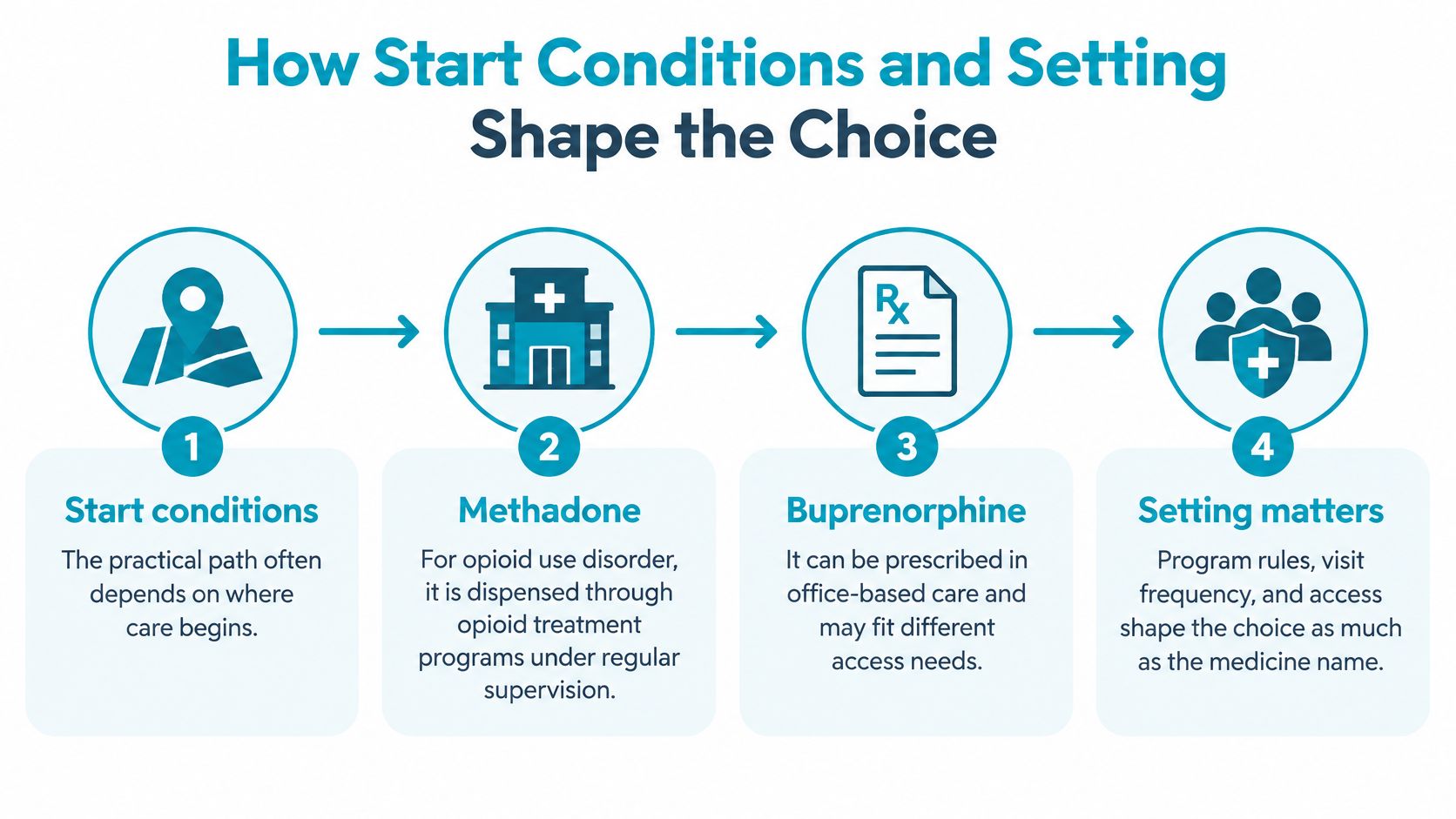
A clinical evaluation sequence
- Review current use and withdrawal. The clinician establishes what substances were used recently and whether withdrawal symptoms are present.
- Review the medical picture. This includes previous treatment, current prescriptions, supplements, and pregnancy status when relevant.
- Identify safety concerns. Sedation, breathing concerns, and medication interactions may change the available options.
- Discuss preferences and feasibility. A clinically reasonable medicine still needs a workable plan for obtaining it and attending monitoring visits.
- Agree on follow-up. The plan should identify the next contact and what to do if problems arise before then.
These are common evaluation elements, not a fixed protocol. A clinician may add or change steps. Medication eligibility depends on age and individual medical needs, so an option discussed for adults shouldn't automatically be applied to adolescents.
Start conditions and where each medicine is given
| Medication | Start condition | Where it is usually given | Administration |
|---|---|---|---|
| Methadone | Supervised start under opioid treatment program rules | Opioid treatment program | Liquid or tablet dispensed under program rules |
| Buprenorphine tablet or film | Clinical evaluation, prescription, and an appropriate initiation plan | Prescriber visit, then pharmacy | Dissolved under the tongue or placed as a film according to product instructions |
| Buprenorphine extended-release injection | Clinical evaluation and product-specific eligibility assessment | Clinic visit | Injection according to the product label |
| Naltrexone tablet | Opioid-free status confirmed before starting | Prescriber visit, then pharmacy | Tablet on the clinician's prescribed schedule |
| Naltrexone extended-release injection | Opioid-free status confirmed before the first injection | Clinic visit | Monthly injection |
| Acamprosate delayed-release tablet | Kidney function assessed and alcohol-treatment start conditions reviewed | Prescriber visit, then pharmacy | Tablet according to the label and prescription |
The NIDA medication administration infographic describes key formulation and access differences, including methadone treatment programs, buprenorphine formulations, and naltrexone's opioid-free start requirement.
Starting naltrexone while opioids remain in the body can trigger withdrawal. Buprenorphine initiation also requires an individualized clinical plan rather than a self-directed switch from another opioid.
For readers exploring the condition rather than a particular formulation, Empire's opioid treatment information provides related context.
Practical rule: A treatment choice needs both a safe starting plan and a realistic way to continue receiving care.
Why Many People Do Not Start Medication
A person may recognize a problem and still hesitate to arrange an evaluation. Some believe they should manage alone. Others aren't ready to stop or reduce use, can't find time, or worry about reactions from family members, employers, or others.
The SAMHSA discussion of the 2025 National Survey on Drug Use and Health identifies these barriers and reports that 15.7% of people with past-year opioid use disorder received medication for it, while 2.6% of people with alcohol use disorder received medication for alcohol use.
Access is more than willingness
Cost, transportation, appointment requirements, and difficulty finding a prescriber can prevent treatment even when someone wants it. Uncertainty about what an appointment involves can create another obstacle.
In a separate reporting period, NIDA reported that approximately 2.5 million U.S. adults had opioid use disorder in 2021, but only 22% received medication treatment in the preceding year. Its access summary also describes substantial gaps in correctional settings, with fewer than half of U.S. jails and fewer than 10% of state prisons providing all three approved opioid medications.
The WHO's global estimate describes about 64 million people living with drug-use disorders, with fewer than 10% accessing treatment. These populations and measures aren't interchangeable, but they reinforce an important point: treatment gaps can reflect unavailable care, not a person's decision to decline it.
An assessment isn't a commitment
At Empire Medical Wellness, addiction medicine care begins with a confidential outpatient assessment of the patient's situation, medical risks, previous treatment, medications, and goals. The initial conversation can clarify options without requiring agreement to a medication beforehand.
Useful administrative questions include:
- Privacy: How does the published privacy policy describe records, communication, and authorized coordination?
- Time and access: What appointments and pharmacy arrangements would the proposed plan require?
- Cost: What expenses need clarification before treatment begins?
- Level of care: Is routine outpatient care appropriate, or is more intensive support needed?
Confidential care shouldn't be interpreted as an absolute promise that information can never be disclosed. Privacy practices and applicable exceptions should be understood through the practice's published policy.
Outpatient medication care also isn't the same as detoxification, inpatient treatment, or residential care. An evaluation helps determine which setting fits the person's current needs.
Alcohol Treatment Options and How Strong the Evidence Is
Alcohol treatment medicines generally address reducing drinking, maintaining abstinence, or preventing return to drinking. They shouldn't be mistaken for a plan to manage potentially dangerous acute alcohol withdrawal.
The treatment gap is substantial. The National Institute on Alcohol Abuse and Alcoholism reports that in 2024, 2.5% of the estimated 28.0 million U.S. people aged 12 or older with past-year alcohol use disorder received medication for alcohol use, approximately 697,000 people. That population includes adolescents and adults, rather than adults alone.
Established options and individual response
Naltrexone and acamprosate are established FDA-approved options, but their treatment roles differ. A clinician considers whether the goal is reducing drinking, sustaining abstinence, or supporting recovery after withdrawal management.
Approval doesn't mean every eligible person will benefit equally. Treatment response, adverse effects, and the ability to take or receive the medicine as prescribed all affect whether a plan remains useful.
Disulfiram requires a separate discussion about alcohol exposure, adverse reactions, and the person's ability to follow the treatment plan. It isn't just another craving-reduction medicine.
Off-label doesn't mean equally established
Off-label use means prescribing an FDA-approved medicine for a use outside its approved labeling. Some clinicians use anticonvulsant medicines, including topiramate or gabapentin, for alcohol use disorder.
Neither is FDA-approved for this indication. Their evidence and place in treatment aren't identical, so describing both as uniformly ineffective, uniformly established, or interchangeable would be misleading. Any discussion should explain the reason for considering the medicine, the evidence supporting that particular use, and its safety requirements.
A prescribing decision should distinguish an established treatment option from an alternative being considered for a specific clinical reason.
Combined alcohol and opioid use changes the conversation. Because naltrexone blocks opioid effects, the clinician needs to know about opioid use, prescribed pain medicines, and anticipated medical procedures.
Factors that deserve review
- Liver health: Existing disease and other medicines may affect the safety discussion.
- Kidney function: This is particularly relevant when considering acamprosate.
- Other medications: Prescriptions, over-the-counter products, and supplements belong on the medication list.
- Mental health: Co-occurring symptoms and treatments may require coordinated care.
Empire's outpatient alcohol treatment information provides a related starting point for understanding outpatient evaluation. A descriptive discussion of medication options doesn't establish that every medicine is offered by the practice.
Monitoring, Continuity and When to Seek Urgent Care
Routine follow-up examines more than whether substance use has stopped. Clinicians review response, side effects, cravings, use patterns, withdrawal symptoms, and daily functioning to determine whether the plan remains appropriate.
At Empire Medical Wellness, when medication is appropriate, follow-up assesses response and tolerability and determines whether treatment needs adjustment. Reporting difficulties helps inform care; it isn't a reason to hide symptoms or missed medication.
The following checklist highlights the difference between routine monitoring and a disruption that needs prompt attention.
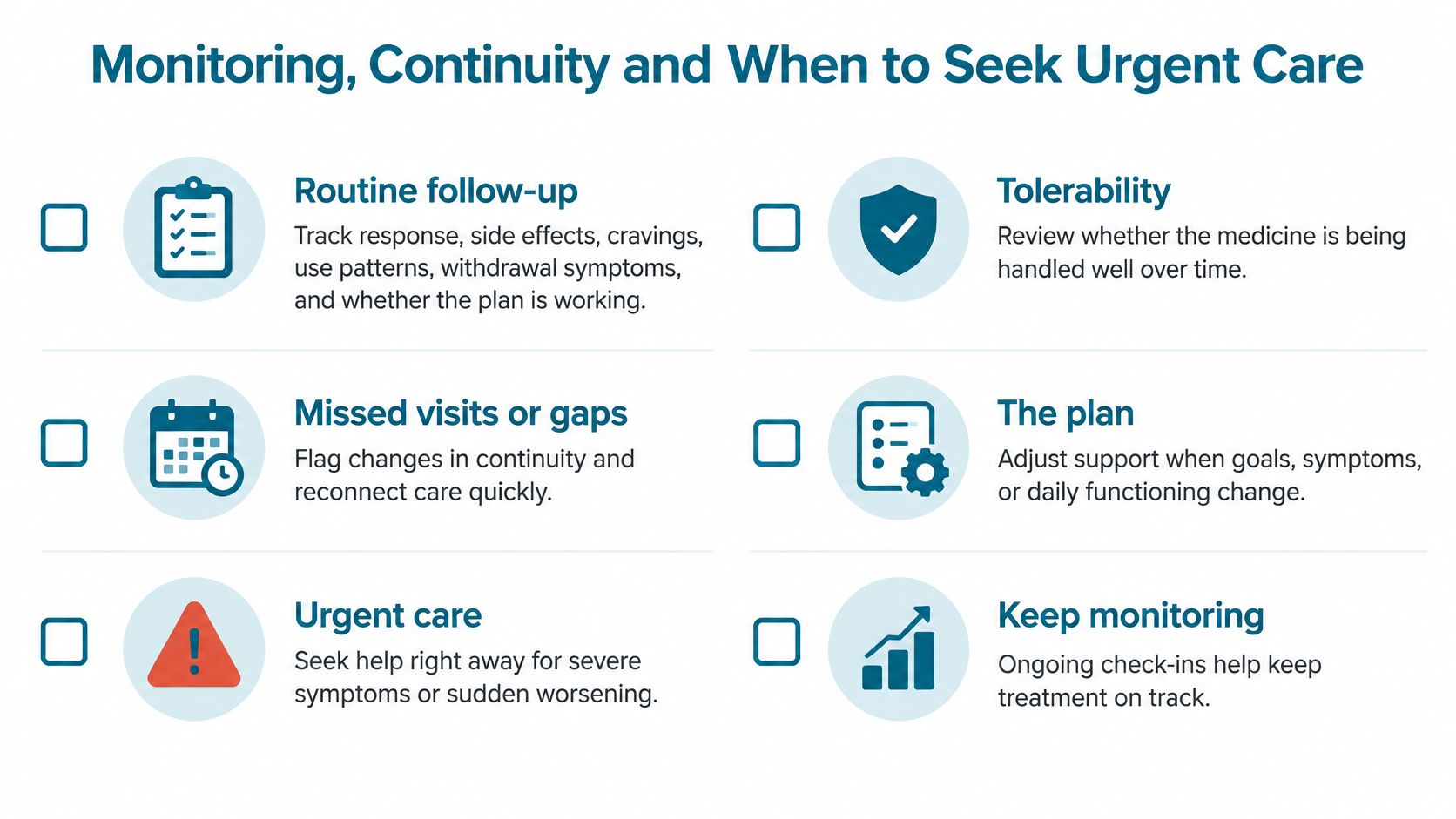
A continuity plan before a disruption
- Keep an accurate medication list. Include the prescriber, pharmacy, allergies, and other prescribed or nonprescribed substances.
- Identify authorized backup arrangements. Confirm which clinician or pharmacy can help rather than assuming another location can dispense the medicine.
- Save the contact route. Record the number to use after a missed appointment, delayed refill, or unexpected closure.
- Plan access to visits. Transportation or telehealth, when available and appropriate, should be arranged before the appointment.
- Coordinate transitions. Before hospital, jail, or program discharge, request a clear handoff and medication plan.
The WHO opioid agonist maintenance treatment guidance emphasizes uninterrupted availability across community and closed settings. Medication interruptions can cause withdrawal and destabilization, and return to opioid use after tolerance has fallen can increase overdose vulnerability.
A missed dose or gap shouldn't prompt an unsupervised restart, dose change, or substitution. The prescriber needs to determine the appropriate next step.
Routine care versus urgent or emergency situations
| Situation | Routine care | Urgent or emergency care |
|---|---|---|
| Side effects that are bothersome but not dangerous | Message the clinic or arrange follow-up | Seek prompt assessment if symptoms worsen or become severe |
| Cravings or use returning | Arrange prompt follow-up | Contact the clinic the same day if use is escalating or unsafe; immediate danger requires emergency help |
| Medication interrupted, missed, or delayed | Call the prescriber or clinic the same day | Seek urgent assessment for severe withdrawal or an interruption that can't be safely resolved |
| Breathing trouble, extreme drowsiness, or unresponsiveness | Not appropriate for routine care | Call 911 immediately; use available naloxone for suspected opioid overdose |
| Chest pain, fainting, or a racing or irregular heartbeat | Not appropriate for routine care | Seek emergency assessment; call 911 for severe symptoms or immediate danger |
| Thoughts of self-harm or suicide | Don't wait for a routine appointment | Call or text 988 for crisis support; call 911 for immediate danger or inability to stay safe |
Naloxone is an emergency medicine for suspected opioid overdose. It doesn't replace ongoing addiction treatment or emergency assessment.
Severe alcohol withdrawal also requires medical attention rather than a routine follow-up slot. Empire's alcohol withdrawal information provides related educational context, not a home detoxification protocol.
The distinction is straightforward: stable concerns belong in follow-up, while breathing trouble, unresponsiveness, or immediate danger require emergency help now. A routine scheduling request isn't an emergency response system.
Questions to Bring and Your Next Step
A productive first conversation starts with fit, not a drug name. Opioid and alcohol decisions follow different paths, and for opioids the safest choice often depends on start conditions, where the medicine is dispensed, and how steady follow-up can be. Bringing clear details helps the clinician match those practical factors to the evidence.
The accompanying image illustrates a medication discussion. It doesn't identify an Empire clinician or patient.

Think through these questions before the visit. They separate well-established uses from limited, mixed, or off-label proposals.
Approval and evidence: Which options carry FDA labeling for the condition being treated, and would any suggestion be off-label?
Starting requirements: Must treatment begin after a period without use, in a clinic, or after withdrawal has started?
Monitoring: What symptoms, lab tests, or visits will track response and safety?
Interactions: How could the medicine affect current prescriptions, supplements, or pain care?
Response plan: What happens if it does not help or causes side effects?
Continuity: Who handles missed doses, supply gaps, travel, or a change in care setting?
Support around medicine: Is counseling or another recovery support recommended, and who provides it?
Changing needs: What signs suggest outpatient care is no longer enough and a higher level of support fits better?
A current medication list, prior treatment history, and notes on schedule or transportation make answers more specific. Written notes also make the plan easier to follow at home.
What an initial evaluation can clarify
Empire Medical Wellness is a private-pay, physician-led outpatient practice. At the initial addiction medicine evaluation, the patient receives an explanation of appropriate treatment options and next steps. A visit does not guarantee a particular medication, and recommendations are individualized.
The practice's first addiction medicine appointment information describes how to prepare for that discussion. Patients can review current fees and the care process on the fees and care process page, and appointment options plus applicable telehealth availability can be checked through the scheduling page.
Principal references include the NIDA medication overview, opioid overview, medication infographic, and treatment-access report, NIAAA alcohol treatment statistics, WHO opioid agonist maintenance guidance, and SAMHSA survey discussion. CDC's medication-assisted treatment resource provides additional federal context.
This article is educational and is not personal medical advice. A routine appointment does not replace emergency care. Immediate danger requires emergency services rather than waiting for an outpatient response.
Empire Medical Wellness offers confidential outpatient addiction medicine assessment, individualized treatment planning, and medication treatment with monitoring when clinically appropriate. Adults considering how medication might support recovery can visit Empire Medical Wellness to learn about the practice's care approach and appropriate next steps.