
Does addiction treatment require stepping away from work, or can medical care fit around a job? Many adults continue working during treatment, and outpatient care may fit a work schedule when a medical evaluation finds it appropriate. The level of care depends on medical risks and the support needed, not only on available hours.
For working adults, care intensity is only part of the planning. Shift patterns, appointment timing, privacy, and safety all matter too. A confidential outpatient evaluation at Empire Medical Wellness begins with a review of the patient's current situation, medical risks, previous treatment, medications, and goals. Dr. Chhatpar explains appropriate options and next steps, which may include coordinating with outside treatment professionals when useful and authorized.
By Empire Medical Wellness Editorial Team
Published October 8, 2026 · Updated October 8, 2026
Table of Contents
- Care Levels and the Weekly Time Each One Requires
- Warning Signs That Need Faster Medical Care
- How to Schedule Treatment Around Your Shifts
- Privacy, Information Sharing and Employer Contact
- Planning Relapse Prevention Around Work Stress
- Choose the Care Level and Book a Confidential Evaluation
Care Levels and the Weekly Time Each One Requires
Employment and addiction treatment aren't unusual companions. In its analysis of 2008–2012 survey results, SAMHSA's report on full-time workers estimated that 10.8 million full-time workers aged 18–64, or 9.5% of that group, had a past-year substance use disorder. These historical figures describe a population, not anyone's diagnosis or present-day treatment needs.
A substance use disorder is a medical condition involving substance use that causes significant problems or impairment. Holding a job doesn't rule it out, and needing treatment doesn't automatically mean residential care is necessary.
Addiction care levels and typical weekly time
The comparison below uses familiar ASAM care-level labels to distinguish increasing structure. ASAM stands for the American Society of Addiction Medicine. Exact program hours and current placement terminology should be confirmed with the evaluating clinician rather than treated as universal scheduling rules.
| Care level | Typical weekly time | Role of Empire Medical Wellness |
|---|---|---|
| Outpatient, ASAM Level 1 | Scheduled visits; total time is set by the treatment plan | Medical evaluation, medication when clinically appropriate, monitoring and follow-up |
| Intensive outpatient, ASAM Level 2.1 | Repeated treatment sessions across the week; obtain the program's written schedule | Not provided by the practice |
| Partial hospitalization, ASAM Level 2.5 | Substantial daytime programming; confirm attendance and travel requirements | Not provided by the practice |
| Residential or inpatient, ASAM Levels 3 and 4 | Around-the-clock structured care | Not provided by the practice |
| Withdrawal management, also called detoxification | Monitoring intensity and duration are determined by withdrawal risk and clinical assessment | Not provided by the practice |
Weekly hours alone don't establish the right level. Previous withdrawal, overdose history, medical conditions, psychiatric concerns, and the ability to remain safe outside appointments all belong in the assessment.
Empire Medical Wellness provides confidential, physician-led outpatient addiction medicine, including assessment, medication when clinically appropriate, monitoring, and recovery planning. When detoxification, residential treatment, partial hospitalization, or intensive outpatient care is appropriate, the practice can help coordinate the next step.
Comparing the actual commitment
The calendar should include more than appointment time. Transportation, pharmacy visits, outside counseling, recovery supports, and any required monitoring can affect whether a plan fits a working week.
For alcohol-related concerns, the practice's explanation of outpatient alcohol treatment offers related context. A description of outpatient care shouldn't be read as a recommendation that every person can safely use it.
Decision rule: The useful first question is which level the clinician recommends and why. Scheduling comes after that safety decision.
Warning Signs That Need Faster Medical Care
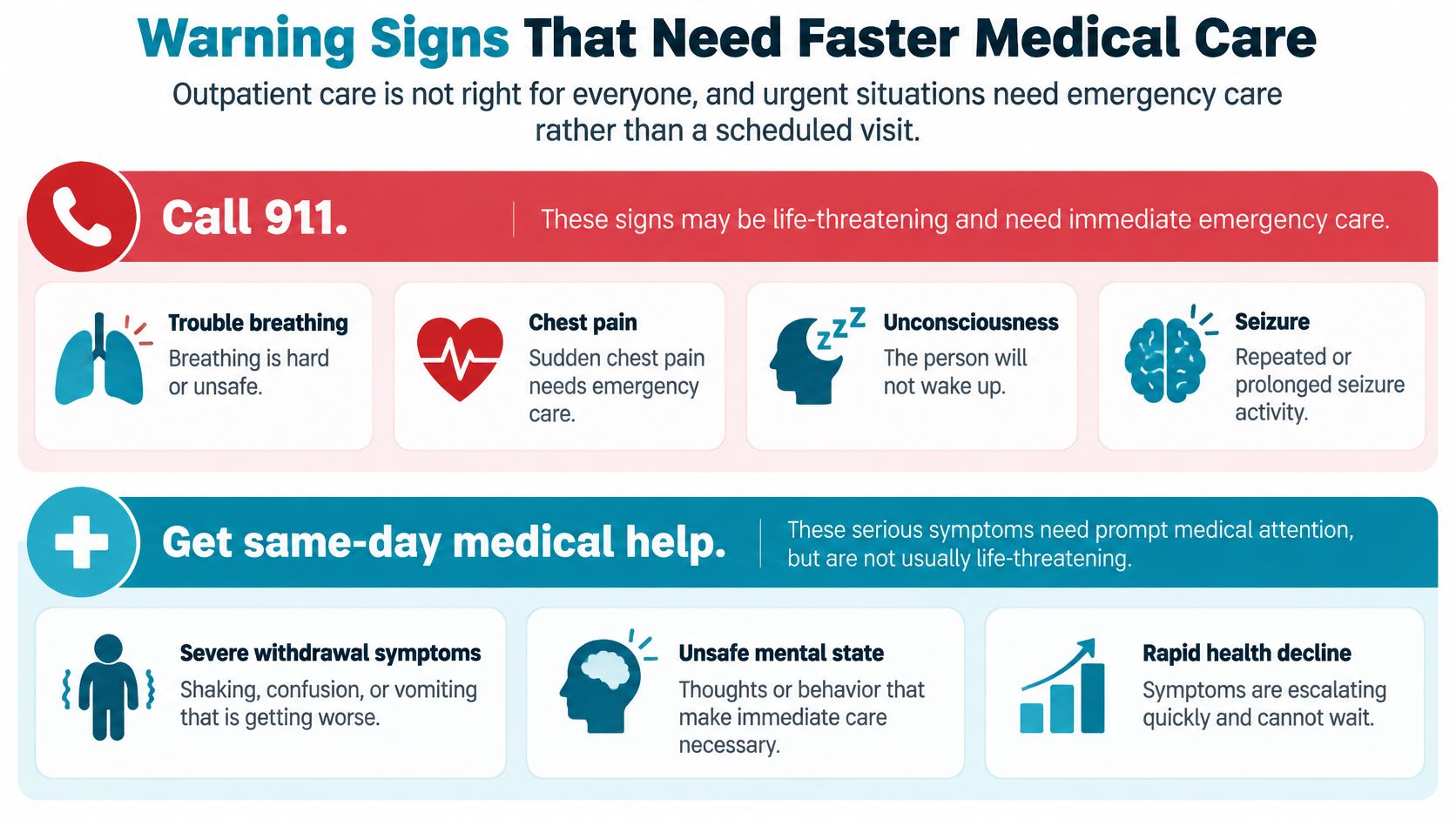
Outpatient care isn't right for everyone. Urgent symptoms need emergency assessment rather than a scheduled appointment. SAMHSA's guidance on integrating substance use services identifies severe withdrawal risk, overdose risk, acute intoxication, serious medical complications, and an unsafe home environment as reasons a higher level of care may be necessary.
Emergency care now
Call 911 or go to the nearest emergency department for:
- Unresponsiveness: A person cannot be awakened or is unusually hard to wake.
- Breathing problems or suspected overdose: Breathing is slow, has stopped, or appears unsafe. Give naloxone if available when an opioid overdose is suspected, and call 911.
- Chest pain or a seizure: These shouldn't wait for an outpatient response.
- Immediate suicide risk: Thoughts of suicide with a plan or intent require immediate help. For a mental-health crisis, call or text 988, the Suicide and Crisis Lifeline; immediate danger requires 911.
Confusion, rapidly worsening symptoms, or an unsafe mental state shouldn't be minimized because an infographic places some symptoms in a same-day category. The severity and immediate danger determine the response.
Prompt clinical contact
Contact the treating clinician promptly for hard-to-manage cravings, worsening withdrawal symptoms, medication side effects, missed follow-up, or a return to substance use. Escalating withdrawal needs same-day assessment, and severe symptoms may require emergency care.
A return to use is information the clinician needs, not a reason to avoid contact. It may change the appropriate setting or support level rather than merely the appointment date.
The medical review should also account for driving, equipment, heights, transportation, and shift patterns. A useful first-visit question concerns whether possible drowsiness, dizziness, or slowed reactions could affect those duties and which work-safety precautions warrant discussion.
The practice's information about alcohol withdrawal provides additional context, but online reading can't establish whether withdrawal is safe to manage outside a monitored setting.
How to Schedule Treatment Around Your Shifts
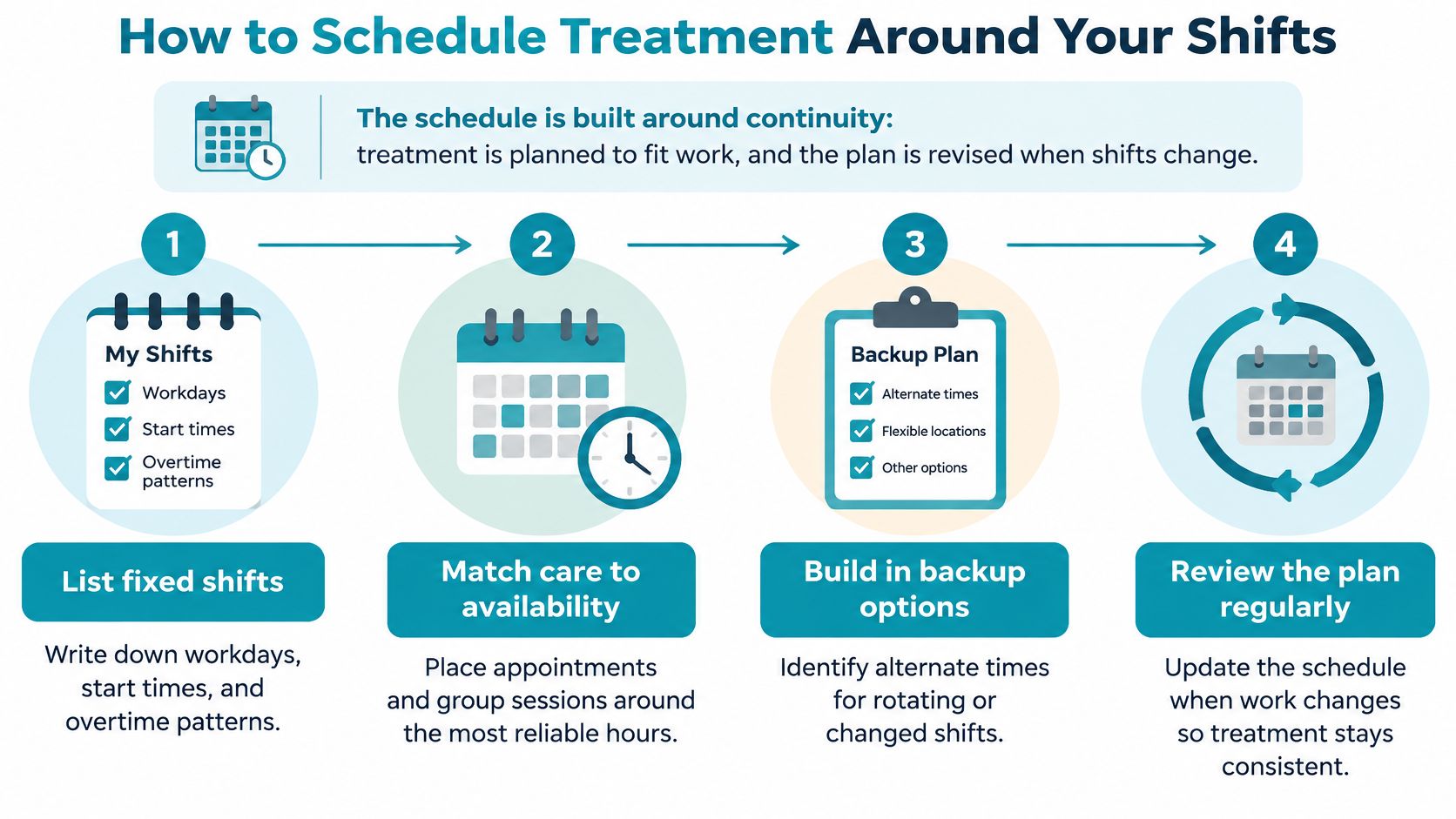
A sustainable schedule protects continuity, meaning care remains connected over time rather than becoming a series of isolated appointments. The plan should be revised when shifts, travel, or treatment needs change.
A practical scheduling procedure
Map fixed commitments. List shifts, likely overtime, commuting, and travel days for the next eight weeks as a planning exercise. Leaving out travel time can make an apparently open appointment window unusable.
Mark reliable attendance windows. Identify periods that don't overlap with critical tasks or safety-sensitive duties. Booking during a recurring deadline creates an avoidable conflict, even when the calendar technically shows space.
Check available appointment formats. Ask scheduling staff about early-morning, late-day, or telehealth appointments appropriate to the person's location and needs. Telehealth shouldn't be assumed to permit attendance from a vehicle, shared workspace, or unsupported jurisdiction.
Clarify the follow-up plan. At Empire Medical Wellness, follow-up frequency and appointment length are based on the treatment plan, medication needs, and progress. Assuming the initial schedule will remain unchanged can leave too little flexibility for later decisions.
Account for medication-related attendance. Pickup, monitoring, and program visits belong on the same calendar. NIDA's guide to medications for opioid use disorder describes treatment pathways with different scheduling demands, including methadone pathways that may involve daily observed dosing through approved programs; the actual requirements must be confirmed with the treating program.
Choose discreet reminders and a backup. Use a personally controlled phone or calendar, and identify a trusted person who can help with rescheduling if desired. A work-managed calendar can expose more information than intended.
Agree on the missed-visit procedure. Establish whom to contact when a shift runs late and how the next appointment will be arranged. Waiting until work becomes quieter can interrupt follow-up.
Protect sleep as well as appointment time
Rotating shifts deserve explicit discussion because fatigue may complicate attendance and the safety review. The practice's overview of circadian rhythm can help frame questions about sleep timing.
Follow-up visits build on previous decisions, assess response, address obstacles, and adjust treatment when needed. Appointment availability should be confirmed when booking, and no calendar arrangement replaces urgent evaluation.
Privacy, Information Sharing and Employer Contact
Clinical confidentiality and employer-facing disclosure are separate questions. A private medical appointment concerns the care relationship. A leave request, workplace drug test, shared device, or employer communication involves another information channel.
Concerns about those channels are understandable. In a 2025 employee study published in the peer-reviewed literature, 33% believed an employer would be more likely to seek ways to fire an otherwise good employee who requested opioid-use treatment, while 73% reported privacy concerns about workplace prevention programs. These were reported beliefs and concerns, not measured probabilities of job loss.
Privacy checkpoints for working patients
| Checkpoint | Decision to make | Who can answer |
|---|---|---|
| Appointment reminders | Choose phone, text, or portal, and whether messages name the practice | Practice scheduling staff |
| Telehealth sessions | Choose a private room, headphones, and a time when others cannot overhear | Practice scheduling staff |
| Medication pickup | Choose a pharmacy and timing that fit shifts and privacy needs | Treating clinician and pharmacy |
| Workplace drug testing | Check policy and whether prescribed medications need documentation | Employer HR office, testing administrator, or treating clinician |
| Employer contact | Decide whether workplace communication is needed and review any written authorization | Treating clinician before a release is signed |
| Records and sharing | Identify which clinicians should receive information and what each needs | Treating clinician |
Headphones don't prevent others from hearing the patient's side of a conversation. A closed room, private connection, and personally controlled device offer a more practical starting point than taking a visit from a workplace break room.
Medication storage also deserves planning. The clinician and pharmacist can discuss appropriate storage without assuming that a shared locker, desk drawer, or vehicle is suitable.
Authorized coordination isn't automatic employer involvement
Empire Medical Wellness's addiction medicine evaluations are confidential outpatient evaluations. When appropriate and authorized, the practice can coordinate with therapists, primary care clinicians, treatment programs, and other professionals involved in care.
For planned coordination, the patient should review the recipient, purpose, information covered, and duration of any authorization. Authorizations can be changed or revoked through the applicable process, but that doesn't retrieve information already shared. Confidentiality also has legal exceptions, so an absolute promise that information can never be disclosed would be misleading.
The practice's Notice of Privacy Practices is the appropriate place to examine its stated privacy practices. Questions about a particular release should be settled before signing it.
Coordination can support individualized care without making treatment a guaranteed cure. SAMHSA's treatment-options guidance describes benefits from medication combined with counseling or behavioral therapies, including retention and employment-related functioning; medication evidence is particularly strong for opioid use disorder and shouldn't be generalized to every substance or treatment.
Workplace policy still needs separate checking. A 2025 HRCI survey of 1,536 HR professionals, conducted in 2024 found that only 13% of participating employers reported substance-use treatment and recovery policies.
Privacy planning reduces avoidable disclosure. It doesn't guarantee that treatment or medication will never affect workplace requirements.
A short written preference list can identify the approved contact number, voicemail wording, reminder channel, pharmacy, authorized recipients, and any employer contact the patient wishes to discuss. HR can explain workplace policy; an employment attorney can address individual job-rights questions.
Planning Relapse Prevention Around Work Stress
A work-focused prevention plan needs to name actual situations rather than rely on a general intention to avoid substance use. An alcohol-centered client event, an overnight shift alone, and access to controlled substances present different planning problems.
Employment can support recovery, but the conditions of work matter. In supported-employment evidence cited by SAMHSA's guide to employment and recovery, the supported cohort averaged 8.4 competitive-employment days per month versus 7.3 in the comparison cohort, a difference of about 1.1 days (p < 0.001). That finding concerns a particular support approach, not an expected result for an individual reader.
A work-specific prevention method
- Protect treatment time. Establish a realistic work-and-recovery schedule before accepting optional overtime.
- Name high-risk situations. Include alcohol-centered events, isolation, fatigue, workplace conflict, and access to substances when relevant.
- Write the first response. A contingency plan should identify whom to call, what to do when cravings rise, and how to handle a missed shift.
- Consider suitable supports. Authorized vocational or peer-recovery services may address obstacles that a medical visit alone doesn't resolve.
- Agree on review indicators. Attendance, days worked, punctuality, safety incidents, substance use, and medication tolerability can make follow-up more concrete.
Pitfalls that deserve attention
Taking on overtime to demonstrate reliability can leave little room for appointments or rest. Another mistake is assuming that good job performance proves treatment is no longer necessary.
Disclosure deserves similar care. A patient may benefit from discussing a scheduling need without sharing a diagnosis broadly, subject to the actual workplace process and applicable requirements.
A lapse, meaning a return to substance use, should prompt clinical review rather than blame or an automatic conclusion that treatment has failed. The practice's explanation of what relapse means offers related perspective.
Co-occurring medical and mental-health concerns also belong in that review. Follow-up should examine response, obstacles, and needed adjustments as job demands change, rather than using attendance at work as the only measure of progress.
Choose the Care Level and Book a Confidential Evaluation
How can you compare the care needed with the time and privacy considerations of a working week? Use the first visit to discuss your circumstances, medical risks, previous treatment, medications, and goals, then review appropriate options and next steps. A care-level label is a starting point for that conversation, not a self-diagnosis.
First-visit planning aid
Use the middle column to prepare notes. The details can help make the discussion more specific.
| Planning item | Your notes | Why it matters |
|---|---|---|
| Work hours and fixed commitments | Shifts and overtime for the next eight weeks | Helps identify workable visit windows |
| Safety-sensitive duties | Tasks involving driving, equipment, or heights | Gives context for the medical discussion |
| Transportation | Commute and travel days | Affects visit timing |
| Medication history | Prescriptions, over-the-counter products, and supplements | Supports review of your medical history |
| Prior treatment | Dates, settings, and what did or didn't help | Informs discussion of appropriate care |
| Privacy preferences | Reminder channels, pharmacy, and contact preferences | Helps you prepare questions about communication |
| Employer questions | Questions about policy or testing | HR or an employment attorney can address workplace rules |
Questions for the clinician
- Care level: Is outpatient care appropriate given my history and current situation?
- Medication: Which options may be appropriate, what monitoring would they involve, and are any uses FDA-approved or off-label?
- Next steps: If another level of support is appropriate, how could the practice help coordinate it?
- Follow-up: How will appointment frequency depend on my treatment plan and progress?
- Cost: What are the practice's fees, and what should I ask my health plan about coverage?
An EBRI-reported 2025 employer survey found substance-use treatment coverage in 67% of surveyed large-employer health plans, compared with 97% for mental-health services. These survey figures do not establish what an individual plan covers.
For details about the practice, read the addiction medicine overview and addiction medicine specialist page. The fees and care process explains practical arrangements. The initial evaluation includes an explanation of appropriate treatment options and next steps. Medication may be part of care when clinically appropriate, but an appointment does not guarantee a prescription.
Empire Medical Wellness provides confidential, physician-led outpatient addiction medicine assessment, individualized planning, and follow-up. Adults considering care can book a confidential evaluation through the appointment scheduling page.