
In most of the United States, a psychologist cannot prescribe medication. Exceptions exist for psychologists who complete specific additional training and hold a prescribing credential under the applicable state rules.
But does the title on a clinician's profile establish authority to prescribe during a particular visit? Not necessarily. The useful distinction is between a psychology license, an added prescribing credential, and authorization to treat a patient in the place where that patient is physically located.
Table of Contents
- Where a Psychologist Can Prescribe Medication Today
- Psychologists, Psychiatrists and Primary-Care Physicians Compared
- How Psychologists Earn Prescriptive Authority
- Why Prescribing Requires Medical Training and Monitoring
- Questions to Bring to a Medication Evaluation
- Frequently Asked Questions
- Finding and Verifying a Prescriber Before You Book
Where a Psychologist Can Prescribe Medication Today
A psychology doctorate does not, by itself, authorize prescribing. Prescriptive authority is the legal permission to issue prescriptions, and it is separate from permission to practice psychology. The American Psychological Association's guidance on pharmacological issues identifies specially qualified psychologists in New Mexico, Louisiana, and certain U.S. military settings as exceptions to the usual division between psychological and medical practice.
The jurisdiction list needs careful interpretation. A law allowing a prescribing pathway does not mean every psychologist in that jurisdiction can prescribe, that every medication is permitted, or that a particular clinician has completed the pathway.
States and jurisdictions where psychologists may hold prescriptive authority
The historical dates and general requirements below are documented in a peer-reviewed review of psychologist prescribing authority, which identifies New Mexico in 2002, Louisiana in 2004, Illinois in 2014, Iowa in 2016, Idaho in 2017, and Colorado in 2023, along with related authority in Guam. Psychiatric Times' discussion of prescribing legislation identifies Utah's 2024 law as making it the seventh state to allow appropriately trained psychologists to prescribe psychotropic medication.
| Jurisdiction | Year authority began | Key documented requirement or verification needed |
|---|---|---|
| New Mexico | 2002 | Graduate psychopharmacology education, supervised practicum, national examination, and conditional prescribing supervision |
| Louisiana | 2004 | Postdoctoral master's degree in psychopharmacology; consultation and consensus with the patient's primary-care physician before prescribing |
| Illinois | 2014 | Additional prescribing authorization under state education, supervised experience, and scope rules |
| Iowa | 2016 | Additional prescribing authorization under state education, supervised experience, and scope rules |
| Idaho | 2017 | Additional prescribing authorization under state education, supervised experience, and scope rules |
| Colorado | 2023 | Additional prescribing authorization under state education, supervised experience, and scope rules |
| Utah | 2024 | Appropriate additional training and authorization under state law |
| Guam | Enactment year not established in the cited review | Related prescribing authority enacted; confirm current credential and scope with the regulator |
| U.S. military settings | No single start year established in the cited guidance | Qualified psychologists may prescribe under applicable military credentialing and practice rules |
This is a historical reference, not a live licensing determination. Sources published at different times may list different jurisdictions. They may also describe legislation without establishing whether an individual psychologist currently holds an active prescribing credential.
Before relying on a row, a patient should check the relevant licensing board's current rules and public license record. The useful details are the credential's exact name, its status, any supervision conditions, and the medication classes covered.
Practical rule: A state's permission to create a prescribing pathway is not proof that a particular psychologist can write a prescription.
Psychologists, Psychiatrists and Primary-Care Physicians Compared
| Clinician | Typical training | Can prescribe psychiatric medication | Typical role in medication care |
|---|---|---|---|
| Licensed psychologist without a prescribing credential | Doctoral degree and state psychology license | Not on the basis of a psychology license alone | Assessment, psychotherapy, diagnostic input, and care coordination |
| Credentialed prescribing psychologist | Doctorate plus postdoctoral psychopharmacology education, supervised preparation, and examination | Only where authorized by applicable law | Assessment and prescribing within authorized scope, with physician collaboration where required |
| Psychiatrist, MD or DO | Medical degree and psychiatry residency | Yes, subject to licensing and prescribing rules | Diagnostic evaluation, medication selection, and ongoing management |
| Primary-care physician, MD or DO | Medical degree and primary-care residency | Yes, within professional scope and applicable rules | Initial evaluation, medication decisions, follow-up, and specialist referral |
A professional's title alone does not establish prescribing authority. A psychologist may hold a doctorate without being a physician. A psychiatrist is a physician with specialty training in psychiatry.
Psychologists who do not prescribe can still contribute useful information to medication care. Assessment, observations during therapy, and changes in functioning may help an authorized prescriber understand a patient's needs. Selecting medication, issuing a prescription, and overseeing medical monitoring are separate responsibilities.
What the table cannot establish
A professional workforce study on prescribing psychologists describes prescribing pathways as subject to jurisdiction-specific education, credentialing, collaboration, and scope restrictions. It also discusses routes in certain federal systems, including the Department of Defense, U.S. Public Health Service, and Indian Health Service.
Telehealth does not remove jurisdictional boundaries. The rules where the patient is physically located during the visit can affect whether a clinician may provide care. If you are traveling or have moved, confirm that the clinician is authorized to see you in your current location.
A physician-led practice does not necessarily provide psychiatric specialty care. Empire Medical Wellness is physician-led, and Dr. Chhatpar is not a psychiatrist. The practice offers mental health evaluation and medication management; this does not mean that psychotherapy or every professional role in the table is available there.
How Psychologists Earn Prescriptive Authority
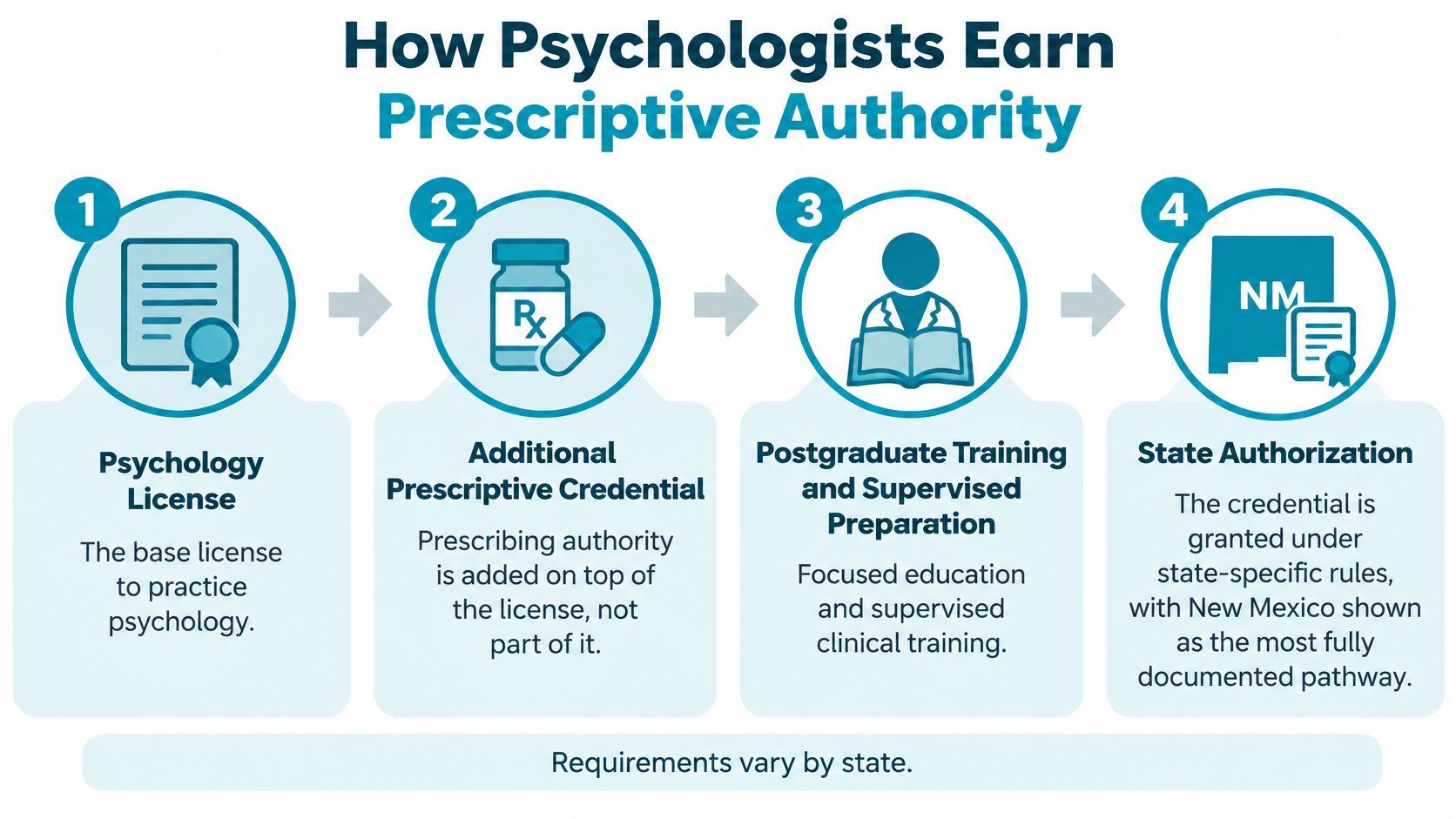
Prescribing is an added credential, not an automatic extension of a psychology license. The extra preparation concerns clinical psychopharmacology, the study of how medicines affect mental processes and the body.
New Mexico's documented pathway
The following sequence illustrates the pathway described in the APA's account of New Mexico's prescribing requirements: at least 450 hours of didactic instruction, a 400-hour supervised practicum involving at least 100 patients, a national examination, and eligibility to seek two-year conditional prescribing certification. These are documented requirements from that account, not a substitute for checking current board rules.
Establish the underlying psychology qualification. The applicant completes the required doctoral preparation and holds a state psychology license. This establishes the professional foundation before the applicant seeks permission to prescribe.
Complete specialized classroom education. Psychopharmacology instruction provides a foundation in medication effects and medical considerations. Recognizing a psychological symptom alone isn't enough to determine whether a medicine is appropriate.
Develop judgment under supervision. The practicum adds supervised patient care to classroom learning. The purpose is to apply knowledge while an experienced supervisor can assess decisions and identify gaps.
Pass the national examination. An examination provides a formal assessment of prescribing-related knowledge. Passing it is a credentialing requirement, not permission to disregard other licensing conditions.
Apply for conditional prescribing certification. The conditional stage introduces prescribing under the required oversight. An applicant cannot treat completion of education as equivalent to unrestricted authorization.
Maintain the required primary-care collaboration. The documented New Mexico pathway includes a collaborative relationship with patients' primary-care physicians during and after the conditional period. That relationship connects medication decisions with the patient's broader medical care.
Why one state's pathway is not a national standard
Other jurisdictions establish their own education, clinical experience, collaboration, and credentialing requirements. A requirement described for New Mexico should not be assumed to apply in Louisiana, Illinois, or another jurisdiction.
Patients don't need to audit a clinician's entire education record. They do need confirmation that the appropriate regulator has granted the relevant credential and that its conditions cover the proposed care.
Completion of a training program and possession of an active prescribing credential are different facts. The regulator's record establishes the latter.
Why Prescribing Requires Medical Training and Monitoring
Medication management involves physical responsibilities beyond recognizing emotional or behavioral symptoms. Psychotropic medicines, meaning medicines that affect mental processes, can also affect other body systems.
The APA's description of prescribing-psychologist preparation explains the additional medical education and supervised experience involved. That preparation addresses concerns such as blood pressure, heart rate, metabolic measures, seizure threshold, sedation, and interactions with other medicines or substances.
A driving instructor checks the road, the car, and the mirrors, not only the driver's skill. Similarly, a prescriber evaluates the patient's medical circumstances, the proposed medicine, and the follow-up plan, not only whether symptoms resemble a particular diagnosis.
What a careful medication process includes
- Medical context. The evaluation considers relevant health conditions and earlier treatment experiences.
- Medication reconciliation. The clinician checks what the patient takes, including prescriptions, over-the-counter products, and supplements.
- Contraindications and interactions. A contraindication is a reason a treatment may be unsafe or unsuitable. An interaction occurs when another medicine or substance changes a treatment's effects.
- Appropriate monitoring. The plan identifies any examinations, measurements, or laboratory checks that are clinically indicated.
- Escalation and referral. The patient knows who handles concerns that fall outside the clinician's scope or require another level of care.
Not every medicine requires the same monitoring. A useful plan names what will be checked and why, rather than treating all psychiatric medication as one category.
General information about antidepressants and medication discussions can help frame questions. It cannot establish which medicine is suitable for an individual or replace the current prescribing information for a particular product.
Routine follow-up and urgent concerns
A treatment that isn't helping or a bothersome, nonurgent side effect deserves contact with the prescriber and an appropriate follow-up plan. Patients should not independently start, stop, or change medication based on general educational material.
Chest pain, trouble breathing, fainting, new severe confusion, or signs of a severe allergic reaction require urgent medical assessment. Call 911 for an immediate medical emergency. Thoughts of self-harm warrant prompt crisis support through the 988 Suicide and Crisis Lifeline, available by calling or texting 988 in the United States; immediate danger calls for 911.
A scheduled outpatient appointment must never delay emergency care. This discussion does not provide drug-specific warnings, which must be checked against the medicine's current labeling.
Questions to Bring to a Medication Evaluation
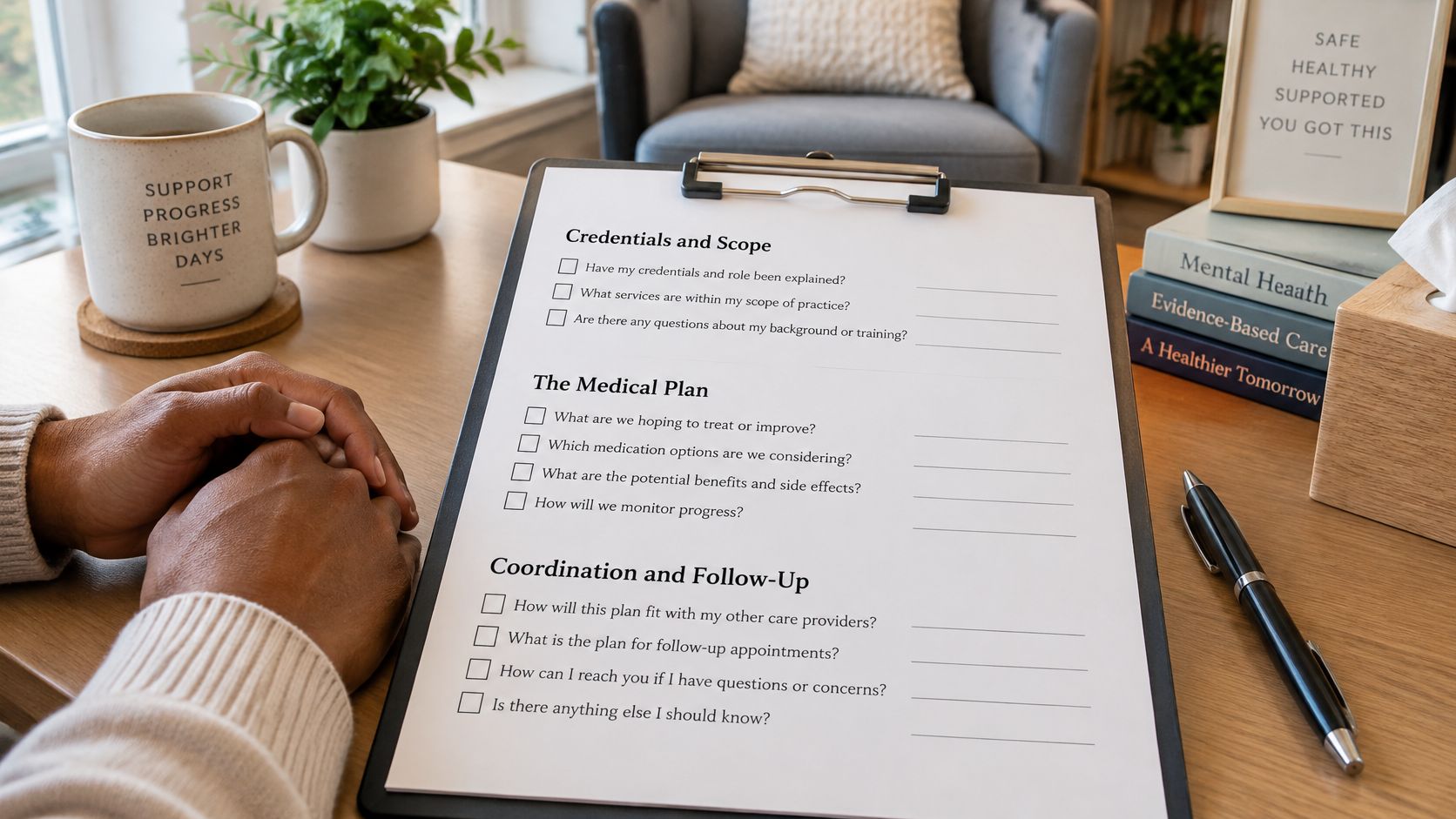
A planning sheet can turn a broad concern about medication into a focused discussion. Its purpose is to record explanations and unresolved questions, not to select a treatment before an evaluation.
Planning aid for a medication evaluation
| Question to ask | Why it matters | Notes |
|---|---|---|
| Is the clinician licensed to prescribe where the patient will be during the visit, and under what credential? | Establishes authorization for the actual appointment | _____ |
| Which medicines could address the concern, and is each proposed use FDA-approved or off-label? | Clarifies the regulatory status and supporting evidence | _____ |
| What history is needed, including medicines, supplements, pregnancy plans, and alcohol or other substance use? | Helps identify interactions and reasons a treatment may be unsuitable | _____ |
| Which side effects warrant routine contact, and which require urgent care? | Establishes clear action thresholds | _____ |
| What monitoring is expected, and how will its timing be decided? | Makes the follow-up responsibilities explicit | _____ |
| Who manages concerns between visits, and how will coordination with the therapist or primary-care clinician work? | Identifies responsibility and communication routes | _____ |
| What happens if the medicine isn't helping or is poorly tolerated? | Sets realistic expectations for reassessment | _____ |
Credentials and scope establish who can make the prescribing decision. A patient can record the credential name, regulator, and any restrictions without needing to interpret the entire licensing statute.
The medical plan should distinguish potential benefits, uncertainties, and safety requirements. Off-label use means use outside the FDA-approved labeling, such as a different indication; it does not, by itself, establish that a treatment is appropriate or inappropriate. Current FDA prescribing information and MedlinePlus are useful resources for discussing a named medicine with a qualified clinician.
Coordination and follow-up establish who does what after the visit. A clear plan includes a contact route, responsibility for monitoring, and permission to communicate with other treating professionals when useful.
The psychiatric medication management worksheet offers another way to organize the conversation. At Empire Medical Wellness, requesting an appointment does not guarantee a prescription or a particular treatment.
Frequently Asked Questions
Does getting medication mean stopping visits with a psychologist?
Not necessarily. A patient can authorize communication between a psychologist and a qualified prescriber while continuing psychological care, with each professional's responsibilities kept clear.
The arrangement should identify who handles prescriptions, who receives monitoring results, and which clinician should receive a concern between appointments. Coordination is a practical arrangement, not an assumption that both professionals share every responsibility.
Is a primary-care physician an appropriate starting point?
A primary-care physician can often be a starting point for common mental health concerns. A specialist evaluation may be more appropriate when diagnostic questions are complex, previous treatment has not helped, or the clinician determines that additional expertise is needed.
These are clinical judgments rather than fixed rules based solely on a symptom label. The patient's history, current functioning, medical conditions, and prior responses all inform the next step.
Can a telehealth appointment include medication prescribing?
A telehealth appointment may include a prescribing evaluation when the clinician has the necessary authorization for the patient's location and the proposed care. The fact that an appointment is available online doesn't establish that every patient location or medication is covered.
Travel plans should be disclosed before the appointment rather than after the visit begins. A mailing address and the patient's physical location during a visit are not necessarily the same.
A medication evaluation is a decision-making appointment, not a commitment to issue a prescription.
For readers weighing whether to pursue an evaluation, the discussion of medication for mental illness and its potential advantages and limitations can help organize questions without predetermining the answer.
Finding and Verifying a Prescriber Before You Book
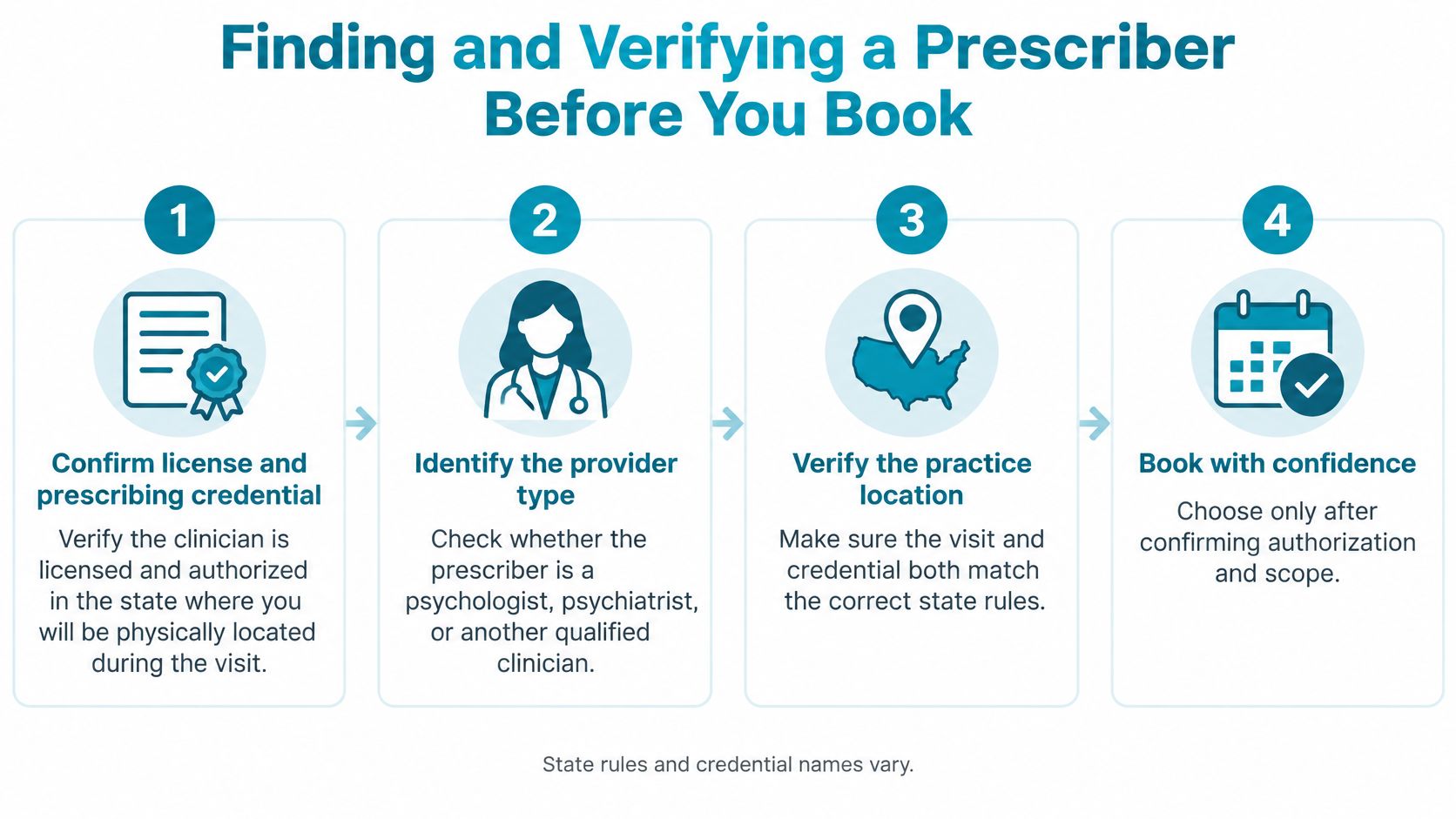
Before booking, verify three things: the clinician's authority, who will make the prescribing decision, and whether that authority applies where you will be during the appointment. A directory listing or professional title alone may not answer all three.
Check the license and prescribing authority. Use the relevant licensing board's public records to look up the clinician by full professional name. Confirm that the license is active and check for any prescribing credential or conditions relevant to the care you are seeking.
Confirm who will evaluate you. Ask whether the appointment is with a psychologist, psychiatrist, primary-care physician, or another clinician. For a physician-led practice, verify the treating clinician rather than assuming a specialty from the practice's description.
Ask how coordination works. If you have a therapist or primary-care clinician, find out whether records can be shared with your written authorization. Relevant records can help inform an evaluation.
Gather useful information. Prepare an accurate medication list, relevant records, and a description of your concerns and how they affect daily life. If you do not know a previous diagnosis or medication response, say so rather than guessing.
The HRSA Behavioral Health Workforce Brief for 2025 discusses workforce shortages and access barriers, including geographic distribution. Planning ahead can help with logistics, but an appointment is not a substitute for urgent assessment when safety is at risk.
Preparing for physician-led outpatient care
Empire Medical Wellness is a private-pay, physician-led outpatient practice offering mental health evaluation, medication review, and ongoing medication management when appropriate. Patients can seek mental health care independently of the practice's other service areas.
The initial mental health appointment reviews symptoms, medical and treatment history, current medications, daily functioning, and goals. Sleep, substance use, and lifestyle are considered when they affect diagnosis or treatment response.
The mental health medication review page explains the review visit, while the fees and appointment process page provides practical planning information. For an anxiety-focused evaluation, see how anxiety medication decisions are assessed.
Recommendations are individualized, and a visit does not guarantee a particular medication. Confirm current availability and permitted patient locations through the appointment scheduling page.
This article is educational and is not personal medical advice. For immediate medical danger, call 911. For suicide or emotional crisis support in the United States, call or text 988 rather than waiting for a scheduled appointment.
Empire Medical Wellness offers private, physician-led outpatient mental health evaluation, medication review, and ongoing medication management when appropriate. Visit Empire Medical Wellness to learn about its approach and consider an evaluation with questions about prescribing responsibility, monitoring, and follow-up.