A late-night mind, punishing mornings, and energy that seems to arrive at the wrong time can make ordinary schedules feel impossible. A circadian rhythm is the body's internally generated, approximately 24-hour timing system that coordinates sleep, alertness, hormone release, temperature, and other functions. It isn't a preferred bedtime, a matter of discipline, or the same thing as poor sleep hygiene.
For adults balancing work, caregiving, metabolic concerns, or rotating shifts, timing matters. Light, darkness, meals, activity, and sleep all provide information to the body's clock. Understanding that system can help a person describe patterns more accurately and decide when a physician's evaluation may be useful.
Table of Contents
- What a Circadian Rhythm Is and Why It Matters
- The Biology Behind the Clock
- How Light Resets the Clock
- Circadian Health Versus Sleep Hygiene
- Shift Work, Wearables, and Misalignment
- A Seven-Day Diary and Shift-Work Checklist
- When to Talk With a Physician and What to Ask
What a Circadian Rhythm Is and Why It Matters
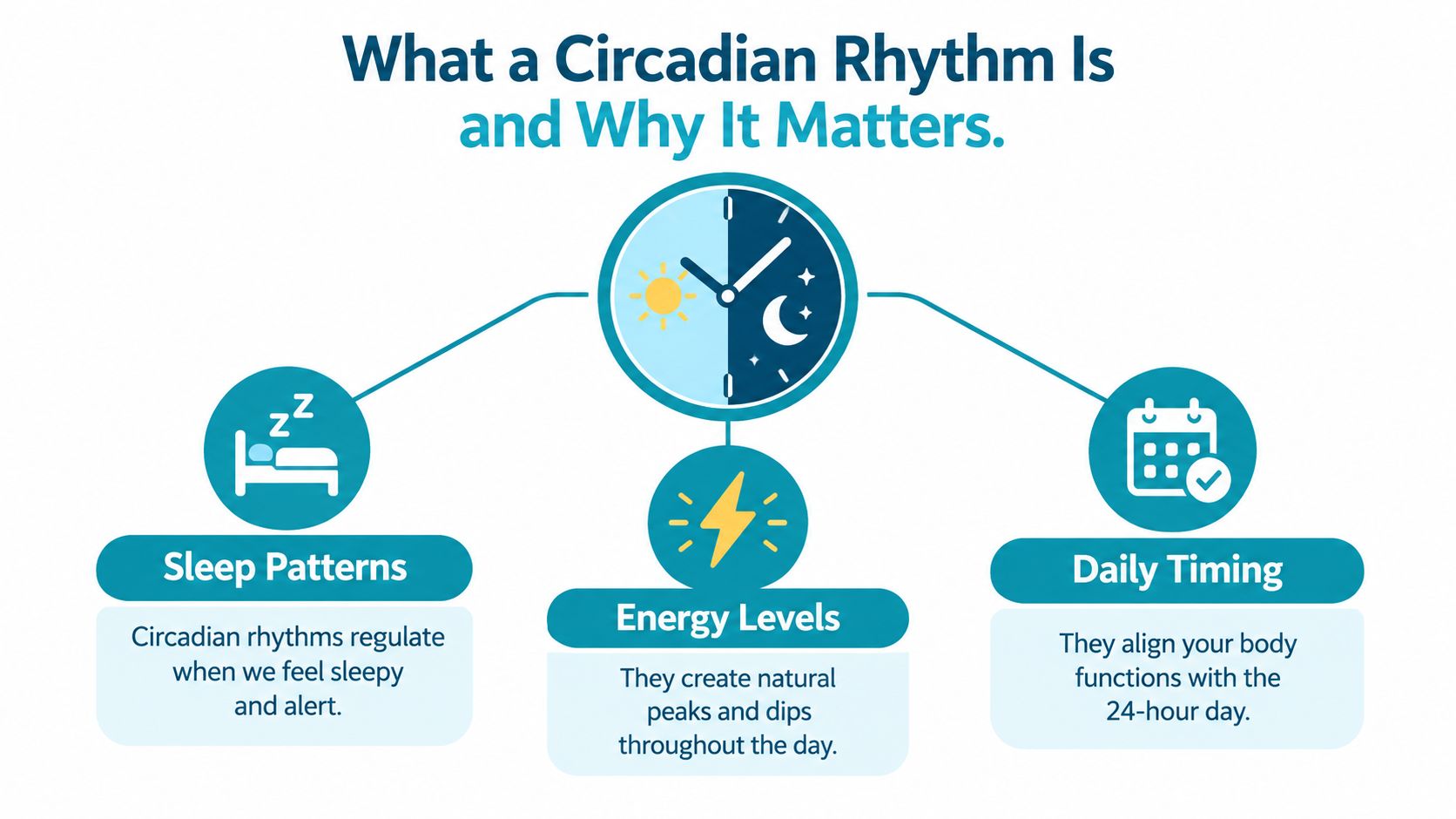
A circadian rhythm is an approximately 24-hour cycle that coordinates physical, mental, and behavioral changes. Proteins encoded by thousands of genes help drive these rhythms, while light and darkness provide the strongest external timing signals, as described by the National Institute of General Medical Sciences.
The phrase circadian rhythm refers to biological timing, not just sleep. The system influences when a person tends to feel alert or sleepy, how body temperature changes, and when hormonal signals rise or fall. Food intake, stress, physical activity, social surroundings, and temperature can also influence the clock, although light and darkness remain especially powerful cues.
A clock is different from sleep pressure
Sleep pressure builds the longer a person stays awake. Circadian timing, by contrast, affects whether the body is biologically prepared for sleep at a particular time. Someone may feel exhausted but still struggle to fall asleep if the internal clock is signaling wakefulness.
That distinction helps separate a possible circadian problem from a sleep-hygiene problem. A person who drinks caffeine late, uses bright screens in bed, or sleeps in an uncomfortable room may need to address sleep-supportive habits. A person who sleeps for a reasonable duration but consistently becomes alert late at night and cannot wake comfortably for required obligations may need a closer look at timing.
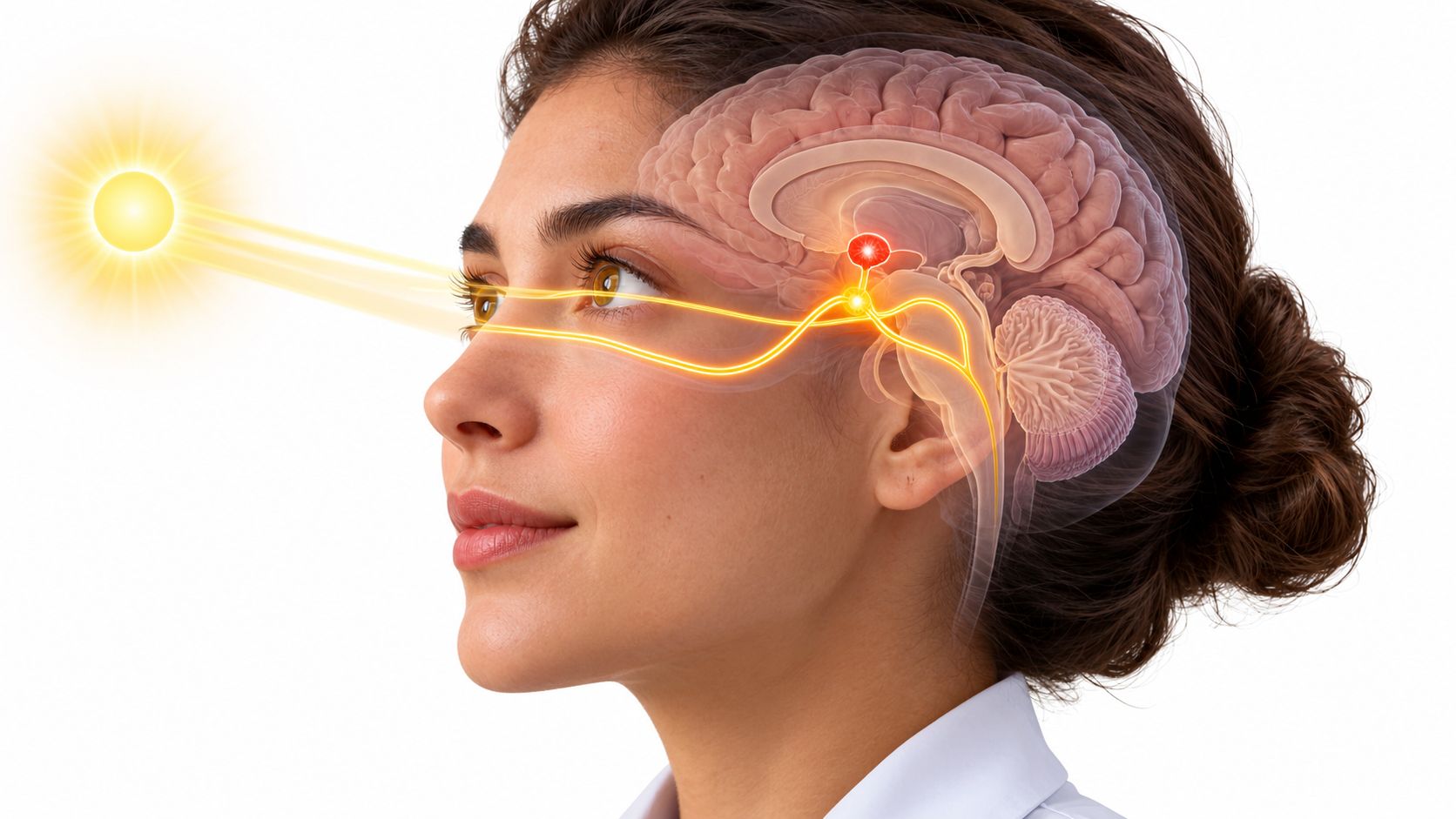
The brain's central pacemaker is the suprachiasmatic nucleus, or SCN. Located in the hypothalamus above the optic chiasm, it receives information related to environmental light and helps synchronize internal timing with the external day and night. Foundational lesion studies showed that damaging the SCN in animal models disrupted normally recurring rhythms, supporting its role as a central circadian pacemaker (Journal of Biological Rhythms review).
Why timing matters beyond bedtime
A schedule can provide enough hours in bed yet still place sleep, meals, and activity at biologically difficult times. That matters for adults considering physician-led care for metabolic concerns, because circadian timing can interact with glucose regulation and meal patterns. Readers seeking broader context about metabolic risk factors can review metabolic syndrome and its health implications.
General sleep-supportive habits still have value. A practical overview of sleep tips from SouthShore Fine Linens can help with environmental and behavioral basics, but those suggestions shouldn't be treated as a substitute for evaluating a persistent timing problem.
The Biology Behind the Clock
The SCN works as a central coordinator, but it doesn't operate in isolation. Light reaching the eyes gives the brain information about the external day. The SCN then helps coordinate signals throughout the body, including the timing of melatonin, a hormone associated with biological night and sleep readiness. The National Institute of Child Health and Human Development explains that darkness normally supports melatonin production, while light reduces or stops that signal from the pineal gland.
Temperature and melatonin reveal internal timing
The body's core temperature follows a daily pattern. In humans, it typically varies by about 1°C across the day, tends to be higher during daytime, declines at night, and reaches its lowest point approximately 1.5 to 2.5 hours before natural awakening (CDC circadian physiology reference).
Melatonin follows a contrasting pattern. In people synchronized to a normal day and night schedule, it usually begins rising around 2 hours before habitual bedtime, reaches its highest concentration during the biological night, commonly between midnight and 5:00 a.m., and then falls rapidly toward morning (CDC circadian physiology reference).
These patterns show why circadian timing isn't the feeling of becoming tired. Body temperature, melatonin, alertness, and sleep propensity are coordinated physiological processes. Researchers and clinicians can use melatonin onset and the minimum of core body temperature as biological markers when estimating circadian phase.
Why the same bedtime can feel different
The timing of sleep relative to these internal markers can affect sleep onset, sleep efficiency, sleep duration, and the timing of rapid-eye-movement sleep. A person may therefore experience different results from the same bedtime after travel, shift changes, irregular light exposure, or altered meal timing.
Circadian timing also connects with metabolic regulation. Readers exploring how glucose handling can be affected by broader health factors can review information about insulin resistance. That connection doesn't mean that a circadian pattern diagnoses a metabolic condition. It means that timing can be clinically relevant when a physician considers sleep, meals, activity, and metabolic health together.
How Light Resets the Clock
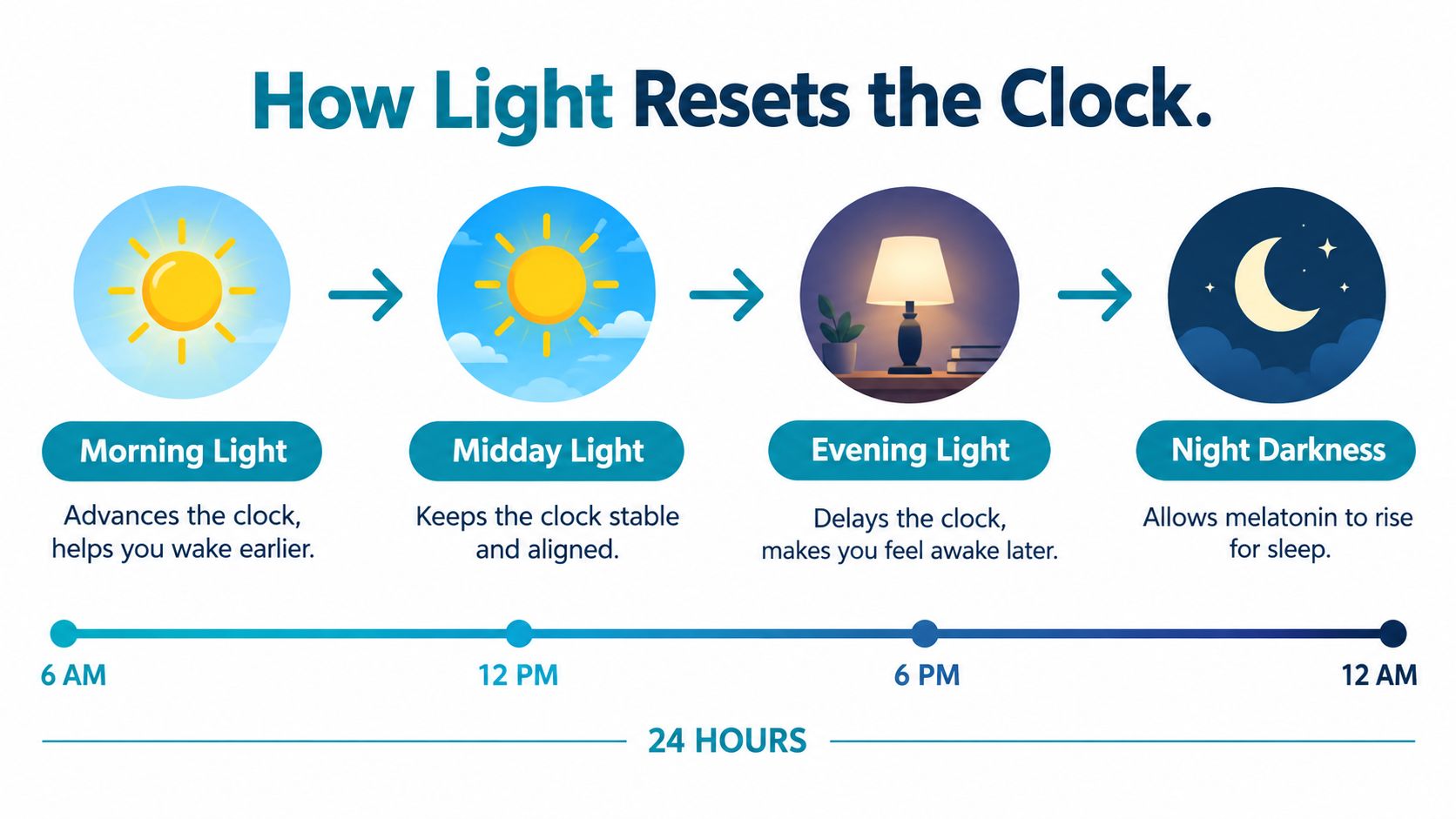
Light is the dominant environmental synchronizer of the human circadian pacemaker. Its effect depends on when it reaches the eyes, as well as its intensity, wavelength, duration, and pattern. The same light exposure can have different effects at different biological times.
The phase-response curve describes this in practical terms. Light during the biological evening or early night generally suppresses melatonin and delays the internal clock. Light during the late biological night or morning tends to advance it. A systematic review also found that long-wavelength light around 631 nanometers and intermittent exposure can produce circadian-resetting responses, so warm-looking or dim-looking light isn't automatically biologically neutral (systematic review of light and circadian phase shifting).
Earlier and later shifts
Morning light combined with reduced bright light in the evening can help shift an excessively late sleep schedule earlier. Evening light and morning darkness can promote a later schedule (circadian light systematic review).
That principle is useful, but it isn't a universal prescription. The appropriate timing depends on a person's current rhythm, wake time, work demands, light environment, and health conditions. A person working overnight may need a different plan from someone with a conventional daytime schedule.
Practical rule: Light timing should be considered in relation to the person's internal rhythm, not treated as a one-size-fits-all instruction.
Screens are one part of the picture, not the whole picture. Bright indoor lighting, outdoor exposure, commuting, and fragmented light during a night shift can all contribute to the total pattern. People also differ in how strongly they respond.
Mood and sleep can influence each other, but a circadian pattern doesn't establish a mental-health diagnosis. Adults seeking information about physician-led evaluation can review adult mental-health care as a separate clinical service area.
Circadian Health Versus Sleep Hygiene
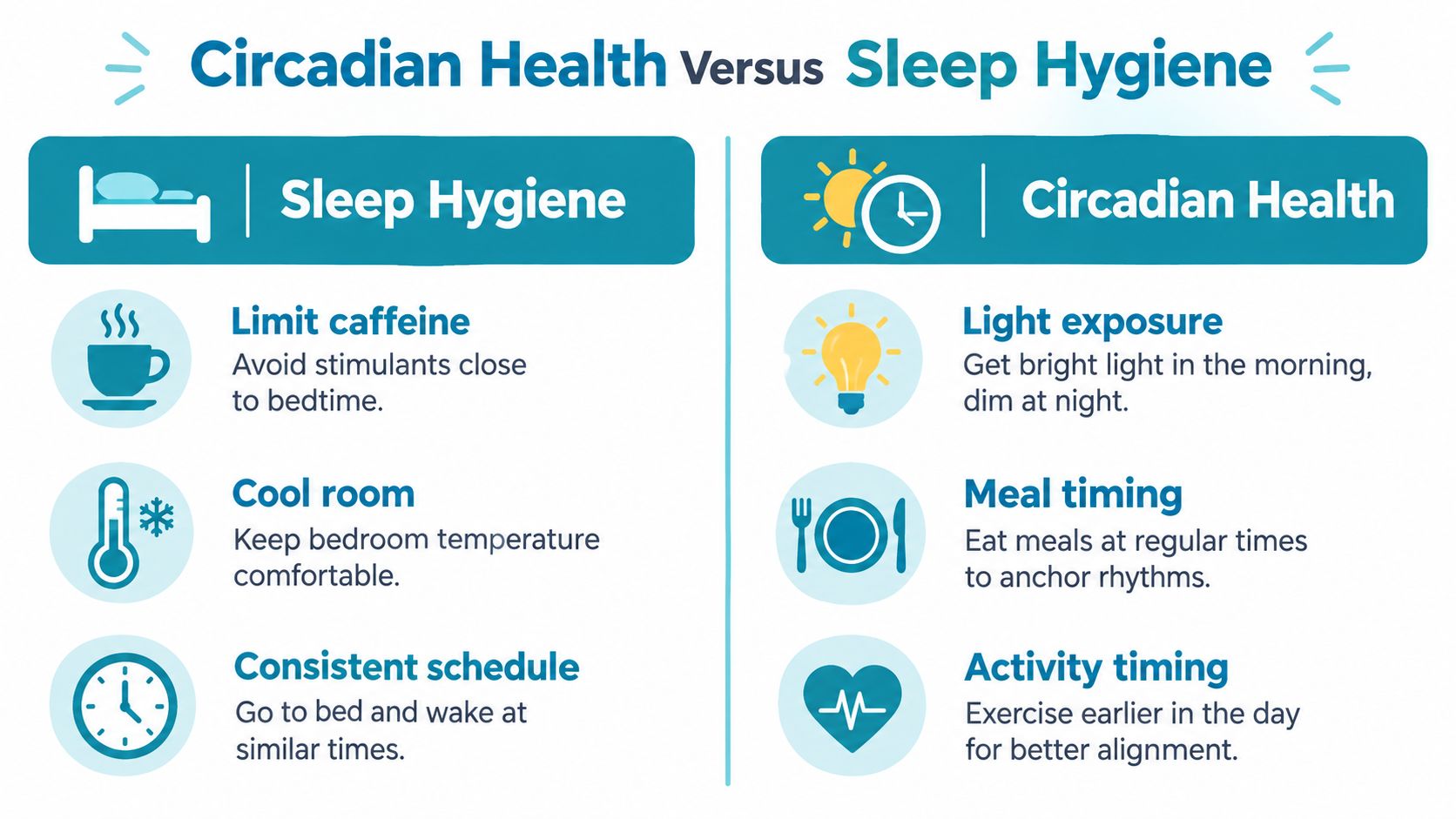
Sleep hygiene and circadian health overlap, but they answer different questions. Sleep hygiene concerns conditions and behaviors that make sleep easier. Circadian health concerns whether light, meals, activity, and sleep occur at biologically workable times.
| Area | Main question | Examples |
|---|---|---|
| Sleep hygiene | What conditions support sleep? | Limiting late caffeine, using a comfortable room, reducing disruptive noise |
| Circadian health | Does the schedule align with internal timing? | Regular light exposure, protected darkness, stable meal timing, consistent work and sleep periods |
How the distinction helps
Consider a person who usually spends enough time in bed but falls asleep much later than intended and struggles to wake for work. A comfortable bedroom may not resolve a clock that is running later than the person's obligations.
Now consider someone who becomes sleepy at a suitable time but remains awake after late caffeine, stimulating activity, or bright light exposure. That pattern may call for attention to sleep-supportive behaviors rather than a complex circadian intervention.
These examples aren't diagnoses. They show why the same complaint, “poor sleep,” can have different contributors. A diary can help separate timing patterns from environmental barriers.
Meal timing belongs in the circadian discussion because food is one of the signals that can influence peripheral clocks. That doesn't make a restrictive eating pattern appropriate for everyone. Adults considering intermittent fasting should discuss health conditions, medications, nutritional needs, and daily obligations with a qualified clinician.
A natural-sleep resource such as how to sleep better naturally may offer general behavioral ideas. Those ideas can support sleep, but they shouldn't be presented as a guaranteed way to shift the biological clock.
Shift Work, Wearables, and Misalignment
Rotating schedules place circadian biology in direct conflict with work requirements. A night-shift worker may need alertness during the biological night and sleep during daylight, while a rotating worker repeatedly changes the timing of both. Travel across time zones and irregular caregiving schedules can create similar challenges.
NIOSH cites a nationally representative worker sample in which short sleep was reported by 61.8% of night-shift workers, compared with 35.9% of daytime workers (CDC and NIOSH shift-work information). These figures describe a population pattern, not an outcome for every night worker.
Why misalignment can affect metabolism
Circadian misalignment can impair metabolic regulation independently of getting too little sleep. In a controlled randomized crossover study of 26 adults, researchers found adverse effects on insulin action, insulin release, melatonin, and high-sensitivity C-reactive protein. Another study reported that circadian misalignment itself increased post-meal glucose by 6% (ClinicalTrials.gov study record).
The reason is biologically coherent. The SCN coordinates behavioral timing, while peripheral clocks in organs such as the liver and pancreas help regulate glucose handling. When sleep, light exposure, and meals move out of phase, insulin secretion, insulin sensitivity, and food intake may become less synchronized.
An earlier main meal also produced greater reductions in weight, body mass index, HOMA-IR, and fasting insulin than a later dinner-focused pattern in a 12-week randomized trial involving 80 women with overweight or obesity (ClinicalTrials.gov study record). This finding is population-specific and doesn't make meal timing a standalone treatment or guarantee weight change.
What wearables can and cannot show
Wearables can collect movement, heart rate, skin temperature, and light-exposure information over time. They may help reveal patterns for discussion with a clinician, especially when paired with a sleep and work diary.
They don't directly prove internal circadian phase or diagnose a circadian rhythm disorder. Interpretation becomes less reliable when light exposure is fragmented, schedules are irregular, or a person works rotating shifts. A 2025 observational study of healthcare night-shift workers using multiple wearables found that sleep duration changed across shifts, while sleep quality did not show the same pattern. Associations between light exposure and sleep were limited and partly contradicted established expectations (2025 wearable study).
Metabolic concerns linked with irregular schedules can be discussed within a broader metabolism-focused medical evaluation, without treating wearable data as a diagnosis.
A Seven-Day Diary and Shift-Work Checklist
A short diary can turn a vague complaint into a pattern that a physician can evaluate. The format below is illustrative, not a diagnostic tool. It can be completed on paper or in a basic notes application without assuming that a wearable accurately measures circadian phase.
Seven-Day Circadian Diary Template
| Field | What to Record | Why It Matters |
|---|---|---|
| Sleep timing | Approximate time trying to sleep, estimated sleep onset, final wake time | Shows whether sleep timing is stable or drifting |
| Naps | Start time, end time, and whether the nap was planned | Helps identify daytime sleep pressure and schedule effects |
| Work shifts | Day, evening, night, or rotating shift; start and end time | Places sleep and alertness in the context of work demands |
| Caffeine | Type and approximate time of each serving | Identifies stimulation close to intended sleep |
| Main meals | Approximate timing of the largest meals and snacks | Shows whether food timing changes across workdays |
| Morning light | Outdoor light exposure after waking, if any | Adds context about a major environmental timing cue |
| Evening light | Bright indoor light, screens, or commuting exposure before intended sleep | Helps identify late light signals |
| Alertness | Periods of strong alertness, sleepiness, or unplanned dozing | Connects subjective function with timing |
| Symptoms | Headache, mood change, difficulty concentrating, or other concerns | Gives the physician context for clinical assessment |
The diary doesn't need perfect precision. Consistent observations are often more useful than trying to reconstruct an entire month from memory.
Shift-work discussion checklist
Before a visit, a shift worker can record:
- Schedule pattern: Whether shifts are fixed, rotating, forward-rotating, or unpredictable.
- Recovery days: How sleep changes on days away from work.
- Light constraints: Whether the workplace is brightly lit, dim, or inconsistent, and how daylight affects the commute.
- Meal constraints: Whether meals are available during the shift and whether the main meal occurs overnight.
- Family obligations: Childcare, caregiving, appointments, or household responsibilities that limit sleep timing.
- Safety concerns: Near-misses while driving, unintentional dozing, or impaired concentration.
- One feasible adjustment: A realistic change that fits the person's obligations, rather than an ideal schedule that cannot be maintained.
A diary supports a medical conversation. It doesn't replace assessment, testing, or evaluation for other causes of daytime impairment.
A fictional planning example can remain simple. A rotating-shift worker records sleep timing and daytime alertness for seven days, then brings the schedule constraints to a clinician. The example doesn't assign weight loss, an energy score, or a guaranteed response to any intervention.
When to Talk With a Physician and What to Ask
Persistent daytime sleepiness deserves attention, especially when a person has adequate opportunity for sleep but remains impaired. Falling asleep unintentionally, struggling to function safely during or after a shift, or experiencing severe shift-work-related impairment are reasons to seek professional evaluation.
Irregular schedules can also coincide with changes in appetite, weight, glucose regulation, or other metabolic markers. These changes don't prove that circadian misalignment is the cause, but they give a physician a reason to review sleep timing, meals, medications, work demands, and relevant medical history together.
Questions that make a visit more useful
A patient may ask:
- Could the timing of sleep and alertness suggest a circadian rhythm problem, or should other causes be considered first?
- How should the work schedule and days off be included in the assessment?
- Could medications, caffeine, mood symptoms, breathing during sleep, or another health condition be contributing to daytime impairment?
- Would a sleep diary be useful, and what information should it include?
- Are wearable estimates relevant to the discussion, or are they too limited for this schedule?
- If light or melatonin is discussed, how will timing and safety be individualized?
- Should meal timing or metabolic markers be reviewed alongside sleep timing?
No universal one-day reset exists. Morning light isn't automatically the right intervention for every person, and melatonin timing matters. Taking it at an inappropriate time may shift sleep timing in the wrong direction, so a supplement shouldn't be treated as a general recommendation (CDC NIOSH circadian clock training).
An initial physician consultation can clarify whether the pattern reflects a circadian timing issue, another sleep concern, a medical condition, or several factors together. Empire Medical Wellness offers physician-led outpatient evaluation and individualized care for adults, including obesity medicine and adult mental-health evaluation and medication management, but no specific circadian testing or wearable-integration service is assumed here.
Empire Medical Wellness provides private-pay, physician-led outpatient medical care for adults, with individualized evaluation and follow-up when metabolic or mental-health concerns overlap with sleep and daily timing. Adults in New York, New Jersey, Connecticut, Pennsylvania, or Virginia can visit Empire Medical Wellness to review current services and determine whether an appointment is appropriate.
Byline: Empire Medical Wellness Editorial Team
Published: October 15, 2026
Updated: October 15, 2026
Sources
- National Institute of General Medical Sciences, Circadian Rhythms
- CDC, Circadian physiology reference
- Systematic review of light and circadian phase shifting
- CDC and NIOSH, Shift Work and Long Hours
- ClinicalTrials.gov, meal timing and metabolic outcomes
This article is educational and isn't personal medical advice.