
Relapse means returning to substance use after a period of abstinence, and it warrants prompt reassessment. Among people treated for a substance use disorder, 40% to 60% relapse at some point, but relapse isn't inevitable, safe, or proof that earlier recovery efforts were wasted.
An adult who has been doing well may use again after a stressful event, a missed appointment, an interruption in treatment, or a gradual loss of support. The next step isn't shame or secrecy. It's a calm review of immediate safety, treatment access, warning signs, and the level of support needed now.
Byline: Empire Medical Wellness Editorial Team
Published: October 4, 2026
Updated: October 4, 2026
Table of Contents
- What Relapse Means in Addiction Recovery
- Lapse Versus Sustained Relapse Versus Recurrence
- The Stages of Relapse as a Process
- What to Do Next When Relapse Happens
- Reduced Tolerance and Overdose Risk After Return to Use
- A Hypothetical Example of Adjusting the Plan
- Evidence-Based Relapse Prevention and When to Reassess
What Relapse Means in Addiction Recovery
After months of recovery, an adult may use alcohol or another drug again following stress, isolation, a missed appointment, or a change in treatment access. Relapse means a return to substance use after an attempt to stop, often after a period of abstinence. The term applies to alcohol and other drugs, including opioids, stimulants, and sedatives.
A return to use is a clinical signal, not a moral verdict. Like a warning light on a dashboard, it prompts an examination of the current plan, support system, environment, health status, and access to care. The National Institute on Drug Abuse explains that relapse does not mean treatment has failed. Treatment may need to resume, change, or become more intensive, as described in its guidance on treatment and recovery.
| Situation | Thoughtful next step |
|---|---|
| Immediate danger, overdose symptoms, severe intoxication, or suicidal thoughts | Seek emergency help now |
| A return to use without immediate danger | Contact the treating team promptly |
| Stable enough for planning | Revisit prevention skills, supports, and follow-up |
Earlier progress still matters. Time spent abstinent, learned coping skills, improved relationships, and previous treatment engagement remain part of the person's recovery history. Clear language also helps distinguish a brief lapse from a sustained relapse, which may require a different response.
A return to use can reduce tolerance after abstinence. The person's former amount may therefore carry greater overdose risk, particularly with opioids or sedatives.
The word relapse has related meanings in other medical settings. In depression and general medicine, it can describe symptoms or illness returning after improvement, with definitions varying by condition. Readers seeking historical context may review the De Quincey annotated reading on smry, while using modern medical guidance for care decisions.
Adults seeking confidential, physician-led outpatient support can learn more about addiction medicine care. Each return to use warrants individualized assessment.
Lapse Versus Sustained Relapse Versus Recurrence
A return to use doesn't always look the same. Some clinical discussions use lapse for a brief, temporary episode and relapse for a more sustained return to the target behavior. Other medical sources use relapse broadly for a return of symptoms or substance use. The distinction helps clinicians understand what happened without forcing every event into one category.
A lapse can mean a single, brief episode after abstinence, followed by renewed engagement with recovery. A sustained relapse describes continued use across multiple occasions, especially when it begins to affect health, daily functioning, treatment attendance, or recovery goals. Recurrence is a broader clinical term for the disorder returning as a recognizable syndrome, although the exact meaning and timeframe can vary by condition.
A practical comparison
| Feature | Lapse | Sustained relapse | Recurrence |
|---|---|---|---|
| Pattern | A brief or isolated return to use | Repeated or continuing use | A broader return of the disorder or symptoms |
| Main clinical question | What happened, and what support can interrupt it? | What is maintaining the pattern, and does treatment need to intensify? | Does the person again meet the relevant diagnostic pattern, and what care is appropriate? |
| Possible impact | May have limited immediate disruption, but still carries risk | May disrupt functioning, relationships, health, or treatment engagement | May involve the wider features of the substance-use disorder |
| Typical response | Review triggers and reinforce the safety plan | Prompt reassessment, closer monitoring, and treatment changes may be needed | Diagnostic and treatment reassessment, including consideration of a different level of care |
| What it doesn't mean | It doesn't erase prior progress | It isn't a character judgment | It isn't proof that recovery is impossible |
The table is a framework, not a tool for self-diagnosis. The amount used, substance involved, timing, medical history, co-occurring symptoms, and access to support all matter. A person who returns to use once may still face an emergency, while another person with repeated use may need a structured outpatient review rather than an assumption about the next treatment setting.
People sometimes recognize the pattern through understanding self-sabotage patterns, but “self-sabotage” can oversimplify addiction. A clinician should also look at withdrawal, cravings, sleep, pain, mental health symptoms, medication interruptions, housing, work demands, and exposure to substances.
For adults who use alcohol, Alcoholics Anonymous resources may be one possible source of peer support. Peer support can complement, but doesn't replace, medical assessment when substance use returns.
The Stages of Relapse as a Process
Relapse often develops as a process rather than a single surprise event. A commonly used model describes emotional relapse, mental relapse, and physical relapse. These stages aren't a prediction, and they don't assign blame. They give a person and a treating team language for noticing risk earlier.
Emotional relapse can occur without substance use. Sleep may deteriorate, self-care may decline, emotions may remain bottled up, and the person may isolate from supportive people or skip routines that previously helped. Irritability, anxiety, low mood, and exhaustion can weaken coping even when the person still wants recovery.
Mental relapse involves an internal conflict. The person may bargain with the recovery plan, remember past substance use selectively, think about how use could happen, or feel increasing tension between wanting relief and wanting to remain abstinent. Recognizing these thoughts is a reason to contact support, not evidence of failure.
Physical relapse is the return to substance use. Once it occurs, the priority becomes immediate safety and a prompt treatment review. The person may need help interrupting the sequence before use becomes more frequent or medically dangerous.
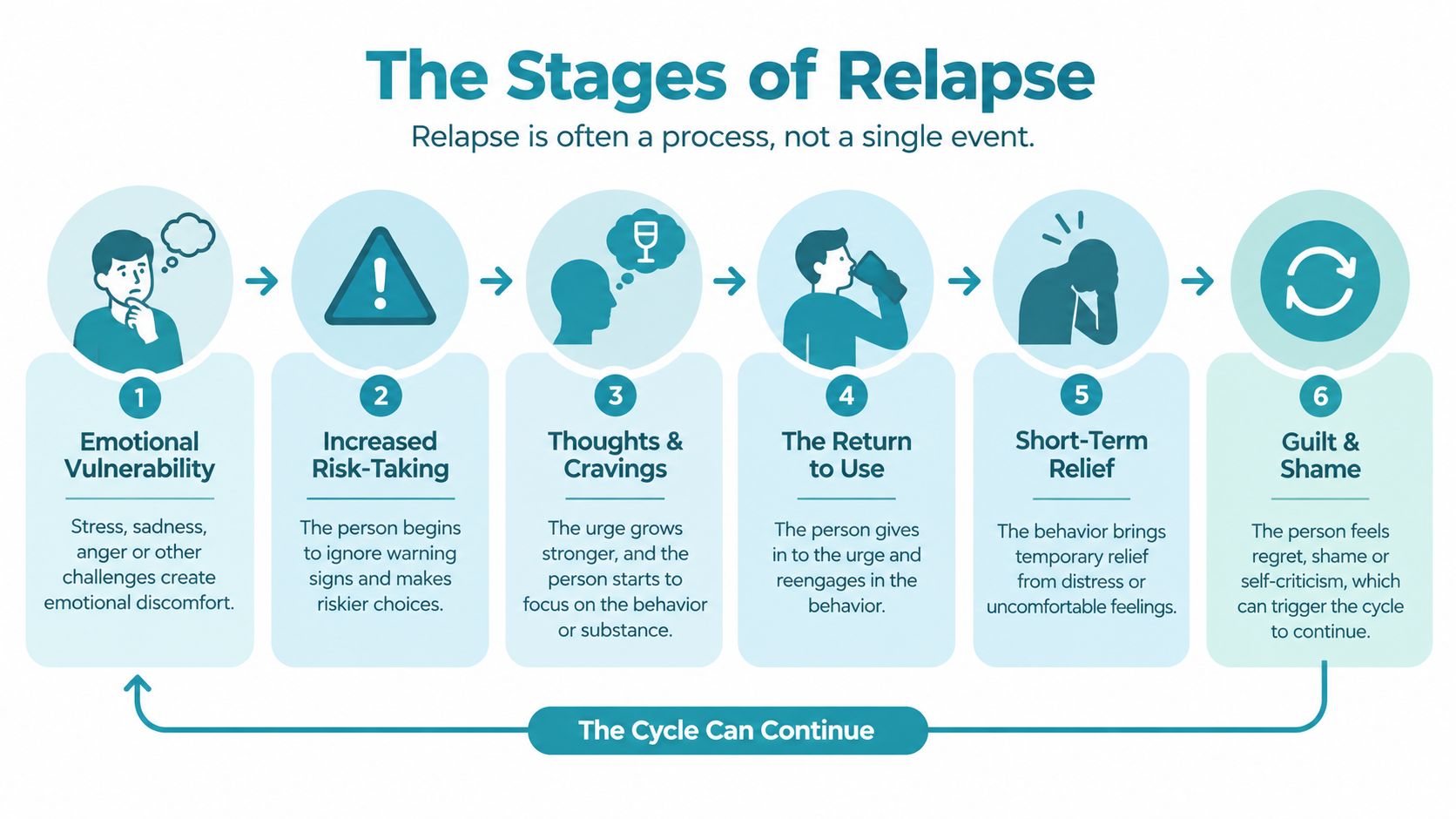
Early warning signs can often be addressed through coping-skills work, contact with a peer or support person, and a clinician check-in. That doesn't guarantee that substance use won't occur, but it creates more opportunities to respond before risk escalates.
A certified addiction professional may also help coordinate recovery support, depending on the person's treatment setting and local availability. The useful question isn't “Why couldn't the person control it?” It's “What changed, and what support is needed before the next decision point?”
What to Do Next When Relapse Happens
The first response should match the level of danger. A return to use may require emergency care, a same-day call to a treating clinician, or a planned review of prevention and follow-up. These actions can overlap.
Three-tier action plan
| Tier | When to use it | Specific action |
|---|---|---|
| Emergency now | Suspected overdose, severe breathing difficulty, inability to wake, suicidal thoughts, seizures, hallucinations, severe agitation, or withdrawal with chest pain | Call 911 or go to the nearest emergency department. If opioid overdose is suspected, use naloxone when available and follow emergency instructions. Don't wait for an appointment request. |
| Contact the treating team promptly | Any return to use, especially involving opioids, sedatives, alcohol, medication interruption, worsening cravings, or co-occurring symptoms | Contact the prescribing clinician or addiction specialist promptly. Report what substance was used, when it was used, the amount if known, missed medication or appointments, and symptoms. |
| Revisit prevention and follow-up | The immediate danger has been addressed, but warning signs, access barriers, or treatment gaps remain | Arrange a reassessment to review triggers, coping skills, peer support, monitoring, treatment access, and whether a different level of care should be considered. |
The emergency tier comes first when breathing, consciousness, safety, or severe withdrawal is involved. A suspected overdose is a medical emergency. Emergency services are more appropriate than waiting for a routine outpatient visit.
For a prompt clinical review, the person doesn't need a perfectly organized explanation. Useful information includes the substance involved, the timing, medication interruptions, physical symptoms, sleep changes, mood symptoms, and whether someone trusted is available for support. Clinicians can use that information to consider whether treatment should resume, change, or become more intensive, consistent with NIDA's treatment guidance.
A physician-led outpatient appointment may focus on treatment access and safety rather than punishment. The discussion can include whether appointments became difficult to attend, whether medication was interrupted, whether cravings changed, and whether outside counseling or a higher level of care should be coordinated. Outpatient care isn't emergency detoxification or inpatient treatment, and a clinician may recommend emergency or other specialized services when outpatient care isn't sufficient.
Adults can review addiction medicine specialist care as one possible outpatient medical resource. The appropriate response depends on the substance, the person's health, the pattern of use, and current risks.
Reduced Tolerance and Overdose Risk After Return to Use
After abstinence, tolerance can fall. This is especially dangerous with opioids. A person may return to an amount that previously seemed familiar, while the body is less adapted to its effects. Breathing can slow or stop, particularly when opioids are combined with alcohol, benzodiazepines, or other sedating substances.
The risk isn't limited to people who believe they have fully returned to use. A brief lapse can still be medically dangerous. NIDA notes that relapse can be dangerous or fatal for some drugs, especially opioids, which is why a return to use should trigger a safety review rather than waiting to see whether the pattern continues.
If a person can't be awakened, is breathing abnormally, or may have overdosed, someone nearby should call 911 immediately and use naloxone if it's available.
A person shouldn't be left alone during a suspected overdose. Emergency responders should be told what may have been taken, if that information is known. Naloxone can reverse an opioid overdose, but emergency evaluation remains necessary because its effect may not last as long as the opioid involved.
Adults and household members can review information about naloxone access and overdose response. A treating clinician can also discuss whether naloxone is available, where it's kept, and how household members can recognize an emergency. This isn't a recommendation to manage an overdose without emergency services. It's a reason to prepare before an emergency occurs.
A Hypothetical Example of Adjusting the Plan
Hypothetical example: An adult with opioid use disorder has been receiving buprenorphine maintenance and has experienced a long period of stable remission. An employer changes the work schedule to rotating night shifts. Therapy attendance becomes difficult, medication timing becomes inconsistent, sleep worsens, and the person becomes more isolated from mutual-help meetings. After missed doses, the person returns to opioid use briefly and then stops.
This example doesn't establish what treatment should be changed or how. It shows what information a clinician would need before making a decision.
Information that changes the review
The treating physician would want to clarify:
- Recent exposure: What opioid or other substance was used, when, and whether other sedating substances were involved.
- Medication continuity: Which doses were missed, whether appointments were interrupted, and whether access changed.
- Tolerance and safety: Whether the person had been abstinent long enough for tolerance to fall and whether naloxone is available.
- Daily structure: How night work affected sleep, meals, transportation, privacy, and contact with support.
- Current symptoms: Cravings, withdrawal, depression, anxiety, suicidal thoughts, confusion, or other urgent concerns.
The clinician might discuss toxicology screening, medication continuity, changes to the treatment schedule, sleep support, renewed peer contact, and more frequent follow-up. Depending on the assessment, the team might also coordinate behavioral care or discuss whether a more structured treatment setting is needed.
Those possibilities aren't instructions for self-directed medication changes. A person shouldn't alter buprenorphine, split doses, stop treatment, or seek detoxification without clinical guidance. The useful lesson is that the work schedule, missed medication, reduced tolerance, sleep disruption, and loss of support may all change the plan.
A written plan can name warning signs, a treatment contact, and the next review point. The example should stop there. No sobriety duration or clinical outcome can be assumed from it.
Evidence-Based Relapse Prevention and When to Reassess
Relapse prevention works best when it combines several forms of support rather than relying on willpower alone. Cognitive-behavioral approaches can help a person identify triggers, examine high-risk thoughts, practice coping responses, and plan what to do when cravings or emotional distress increase. NIDA describes evidence for cognitive-behavioral treatment approaches that reduce substance use and improve psychosocial functioning.
Medications may also be appropriate for some substance-use disorders. For opioid use disorder, clinicians may consider medications such as buprenorphine, methadone, or naltrexone. For alcohol use disorder, options can include naltrexone, acamprosate, or disulfiram. Suitability depends on the person's diagnosis, medical history, current substance use, other medications, pregnancy status when relevant, and treatment goals. A reader shouldn't start, stop, or change any medication based on a general list.
Monitoring can take different forms. A treating team may use follow-up conversations, medication review, toxicology testing, symptom assessment, and coordination with behavioral or peer support. Monitoring should inform care, not serve as a substitute for a therapeutic relationship.
Prevention strategies and reassessment triggers
| Strategy or trigger | What it involves | When to reassess |
|---|---|---|
| Coping-skills training | Identifying triggers, managing cravings, practicing alternatives, and planning for high-risk situations | When cravings intensify, coping strategies stop working, or warning signs become more frequent |
| Medication treatment | Reviewing whether an evidence-based medication is appropriate, effective, tolerated, and accessible | After return to use, medication interruption, new side effects, or a meaningful change in risk |
| Regular follow-up | Tracking symptoms, use patterns, safety concerns, treatment engagement, and barriers to attendance | When appointments are missed or the person has difficulty maintaining the current plan |
| Peer and behavioral support | Mutual-help groups, recovery coaching, counseling, or coordination with outside clinicians when authorized | When isolation increases or the current support network no longer matches the person's needs |
| Social stability review | Examining work schedules, housing, transportation, relationships, sleep, and access to medication | When a life change disrupts treatment routines or increases exposure to triggers |
| Escalating symptoms or use | Assessing repeated use, severe cravings, withdrawal, worsening mental health symptoms, or safety concerns | Promptly, with emergency evaluation when symptoms suggest immediate danger |
A physician-led reassessment is appropriate after a return to use, but it can also happen before use resumes. Missed appointments, escalating cravings, worsening depression or anxiety, unstable housing, work-related barriers, and renewed contact with high-risk environments all deserve attention.
The practical goal is continuity. A clinician can review medication options, coordinate behavioral therapy or outside treatment, adjust monitoring, and revise the written recovery plan. That plan should identify warning signs, a treatment contact, and a next review point. It should also state what requires emergency services rather than a routine appointment.
Empire Medical Wellness offers physician-led outpatient addiction medicine care that can include medical assessment, evidence-based treatment when clinically appropriate, monitoring, recovery planning, and coordination with outside clinicians or programs when useful and authorized. Adults considering a return to care can visit Empire Medical Wellness to review the practice's services and determine whether an outpatient evaluation fits their needs.
Sources
- National Institute on Drug Abuse treatment and recovery guidance, page dated July 2020, checked October 3, 2026.
- NIDA information on understanding drug use and addiction.
- NIDA treatment topic guidance.
- National Library of Medicine review on relapse prevention.
- Peer-reviewed NIH review of lapse and relapse.
This article is educational and isn't personal medical advice.