
Alcohol Anon usually means Alcoholics Anonymous, or AA, a free peer-led 12-step fellowship that can be used alongside clinician-led treatment as added support, not a medical service itself. AA can help some people pursue abstinence and maintain recovery, but it doesn't replace assessment for withdrawal risk, medications, or other medical concerns.
You may be searching after a difficult conversation, an uncertain drinking pattern, or a first attempt to find help privately. The useful question isn't only “Does AA work?” It's also whether a particular meeting feels safe and suitable, whether you need medical evaluation, and how peer support could fit with ongoing outpatient care.
Table of Contents
- What Alcohol Anon Means and How This Guide Helps You Decide
- Understanding Alcoholics Anonymous and How Meetings Work
- What Research Shows About AA Benefits and Limitations
- Anonymity Confidentiality and What to Expect at Your First Meeting
- How to Find AA Meetings In Person and Online
- Alternatives and Complements to AA for Alcohol Support
- Safety Planning Standard Drinks BAC Limits and When to Seek Care
- Next Steps With Confidential Physician Led Support
What Alcohol Anon Means and How This Guide Helps You Decide
Alcohol anon is an informal search term for Alcoholics Anonymous. AA is a peer-support, 12-step program for people who are quitting or cutting back on drinking. The National Institute on Alcohol Abuse and Alcoholism, or NIAAA, describes AA as something people may use alongside clinician-led treatment, rather than as a substitute for medical care. Read NIAAA's overview of treatment for alcohol problems and finding help.
That distinction matters. A meeting can provide connection, shared experience, encouragement, and a recovery routine. A physician-led visit can address health history, withdrawal risk, medications, mental health, laboratory concerns, and coordination with other treatment. These roles can overlap in a person's recovery plan, but they aren't interchangeable.
Practical rule: A meeting can support recovery. It can't determine whether stopping alcohol suddenly is medically safe.
AA also doesn't require you to disclose your identity publicly. People commonly use first names, listen without speaking, and decide for themselves whether to return. Still, a peer meeting isn't the same as a medical setting with professional privacy duties. If you need to discuss sensitive health information, medication interactions, pregnancy, severe withdrawal symptoms, or suicidal thoughts, a qualified clinician is the appropriate setting.
This guide follows a practical decision path:
- Understand the fellowship: Learn what AA meetings are, how they developed, and what newcomers may experience.
- Read the evidence carefully: Separate findings about abstinence from findings about general drinking reduction.
- Protect your safety: Recognize withdrawal warning signs and understand why blood-alcohol estimates aren't driving clearance.
- Compare options: Consider behavioral care, medications, and other mutual-support formats if AA isn't a good fit.
- Coordinate care when useful: Explore Empire's outpatient addiction medicine care if you want private physician-led assessment, monitoring, recovery planning, or authorized coordination with outside providers.
You don't have to choose between peer support and medical care. You can also decide that AA isn't right for you and pursue another evidence-based path.
Understanding Alcoholics Anonymous and How Meetings Work
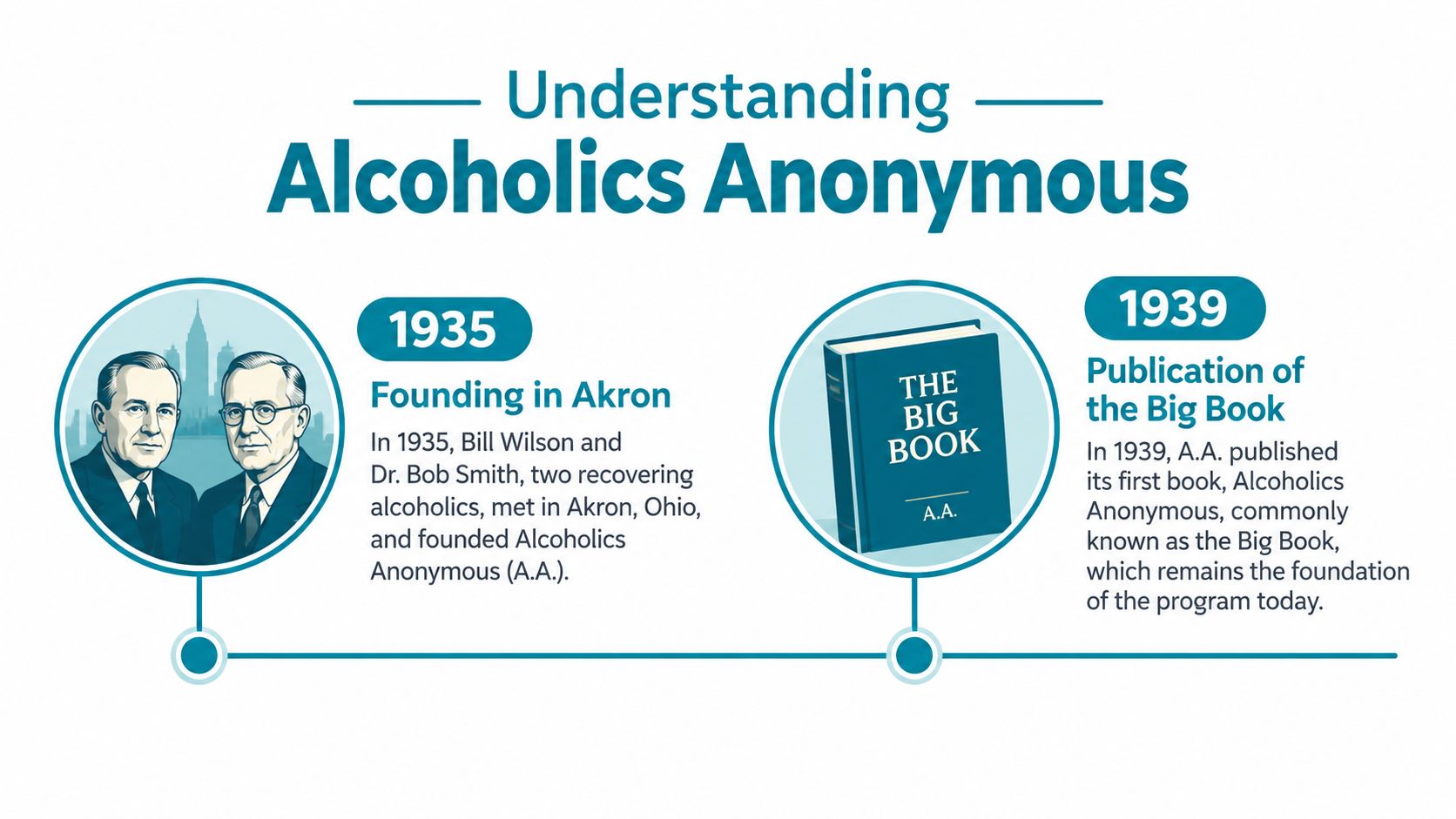
AA is generally dated to June 10, 1935, when Bill Wilson and Dr. Bob Smith met in Akron, Ohio. AA treats that meeting as its founding milestone, and its history describes the fellowship as beginning in 1935. The 1939 publication of Alcoholics Anonymous, commonly called the “Big Book,” helped formalize the Twelve Steps and define the program's structure. These historical details are summarized in AA's official history.
AA grew from a local peer-support effort into an international fellowship. A historical summary reports growth from about 2,000 members in 1940 to about 6,000 in 1941, then roughly 100,000 by 1950, with membership passing 1 million around 1970 and availability reaching roughly 180 countries by the 2020s. Those figures come from the historical account linked above and illustrate scale, not a guarantee that every person will benefit.
What happens at a meeting
Meeting formats vary by location and group. A meeting may include readings, a speaker, a discussion, or personal sharing. You can usually attend without speaking. Some meetings are open to anyone interested in learning about AA, while closed meetings are generally intended for people who want to stop drinking.
AA is voluntary and peer-led. Members may discuss sponsors, which are people who offer individual guidance within the fellowship, and the Twelve Steps. A sponsor isn't a physician, therapist, or emergency professional. Meeting participants may encourage you to seek medical care, but AA itself doesn't provide withdrawal management or prescribe medication.
People who want flexible support may also look at a 24 hour a day app explained resource to understand how digital recovery tools can complement, rather than replace, meetings or clinical follow-up.
A first visit can be simple. Find a meeting, arrive early if you want to ask logistical questions, listen, and leave if the setting doesn't feel appropriate. You can try a different group, format, or time without treating the first meeting as a final decision.
What Research Shows About AA Benefits and Limitations
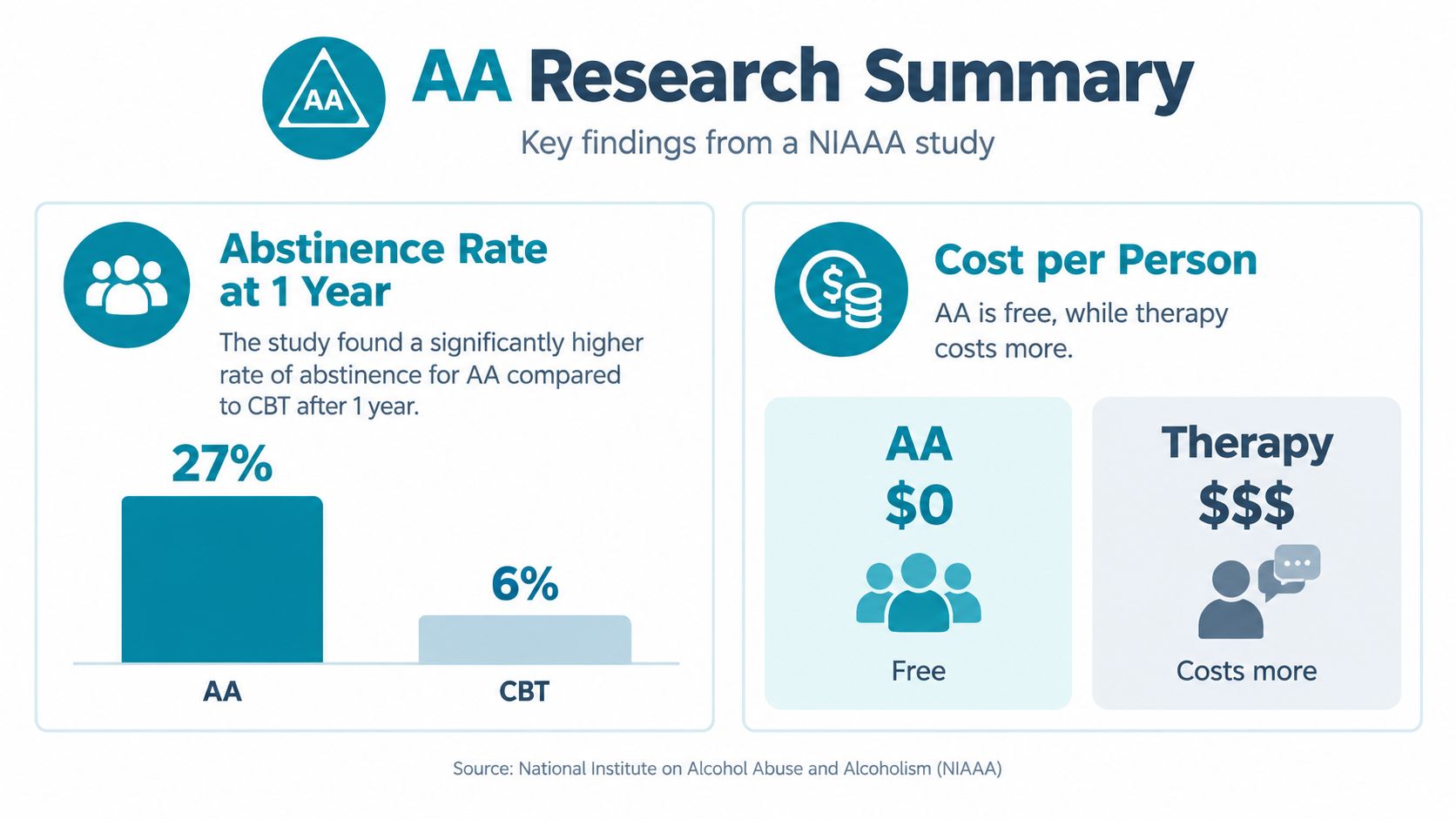
Research on AA is more useful when readers separate abstinence, meaning not drinking, from broader reduction in alcohol use or alcohol-related consequences. A 2020 NIAAA summary of a Cochrane systematic review examined AA and 12-step facilitation across 35 studies involving 10,080 participants. It reported that these approaches were at least as effective as other behavioral treatments for reducing alcohol consumption and alcohol-related consequences, and more effective for increasing abstinence. See the NIAAA evidence summary on AA and 12-step facilitation.
The same evidence base supports a careful interpretation. AA isn't a medication, and its proposed benefits are mainly connected with social, cognitive, and emotional processes. Regular contact with peers can reinforce recovery goals. Shared language can make behavior change feel more understandable. A continuing meeting structure can provide support outside scheduled clinical visits.
A clinician-focused review of related evidence described AA and 12-step facilitation as superior to comparison treatments for continuous abstinence and remission, with higher healthcare cost savings than other interventions. That review is a useful clinical distillation of the evidence, but it doesn't mean AA is the right choice for every person or that attendance alone causes recovery.
Why the evidence needs context
Studies don't all measure the same thing. A short period of meeting attendance isn't equivalent to sustained engagement. Randomized studies may evaluate a structured 12-step facilitation intervention, while observational studies examine people who choose to attend AA in everyday life. Those groups may differ in motivation, access, health, social support, and prior treatment.
The literature is therefore mixed. One randomized study found no sustained relapse advantage from self-help group attendance after one year. A long-term observational study found better remission and relapse outcomes among people who received any help than among those who received none, while AA participation wasn't always the independent driver after other factors were considered.
A balanced interpretation: AA has meaningful evidence for supporting abstinence, but “AA works” doesn't answer who will engage, how long support will continue, or what medical care a person may also need.
For adults considering private care, the most practical approach is often to treat AA as one part of a broader plan. Empire's addiction medicine service can be considered by adults seeking confidential outpatient evaluation and monitoring, without assuming that a meeting or a medical visit must replace the other.
Anonymity Confidentiality and What to Expect at Your First Meeting
AA's tradition of anonymity is designed to protect members from public identification and to keep attention on recovery rather than status or reputation. Many people introduce themselves by first name only. You generally aren't required to provide a legal name, employment details, diagnosis, or medical history.
A peer meeting still isn't identical to a clinician's office. AA groups are made up of members, and confidentiality expectations may differ across settings. Don't share information in a meeting that you wouldn't want repeated outside the group. Save medication questions, withdrawal concerns, pregnancy-related questions, and other private clinical details for a physician or another qualified professional.
AA has a substantial international history. A peer-reviewed NIH-hosted summary states that by AA's 75th anniversary in 2010, the fellowship had grown to about 2 million members in more than 160 countries, including more than 1.2 million members in the United States. The scale can make it easier to find different meeting styles, but it doesn't eliminate the need to assess personal fit.
A low-pressure first visit
You might expect a meeting to follow a general pattern:
- Arrival: You find the meeting location or sign into the online room.
- Orientation: A member may explain the format and basic expectations.
- Listening: Readings, a speaker, or discussion may follow.
- Optional sharing: You can speak if you want to. Listening is acceptable.
- Next step: You can ask about other meetings or leave.
People differ in what feels comfortable. Some prefer a discussion meeting. Others prefer a speaker meeting or an online option. Secular concerns, discomfort with spiritual language, scheduling, or a desire for more clinical structure may affect your experience.
If the first group feels awkward, that doesn't prove AA won't help. It may mean that the format, meeting culture, or timing isn't a match. You can sample another meeting while keeping medical care separate and available.
How to Find AA Meetings In Person and Online
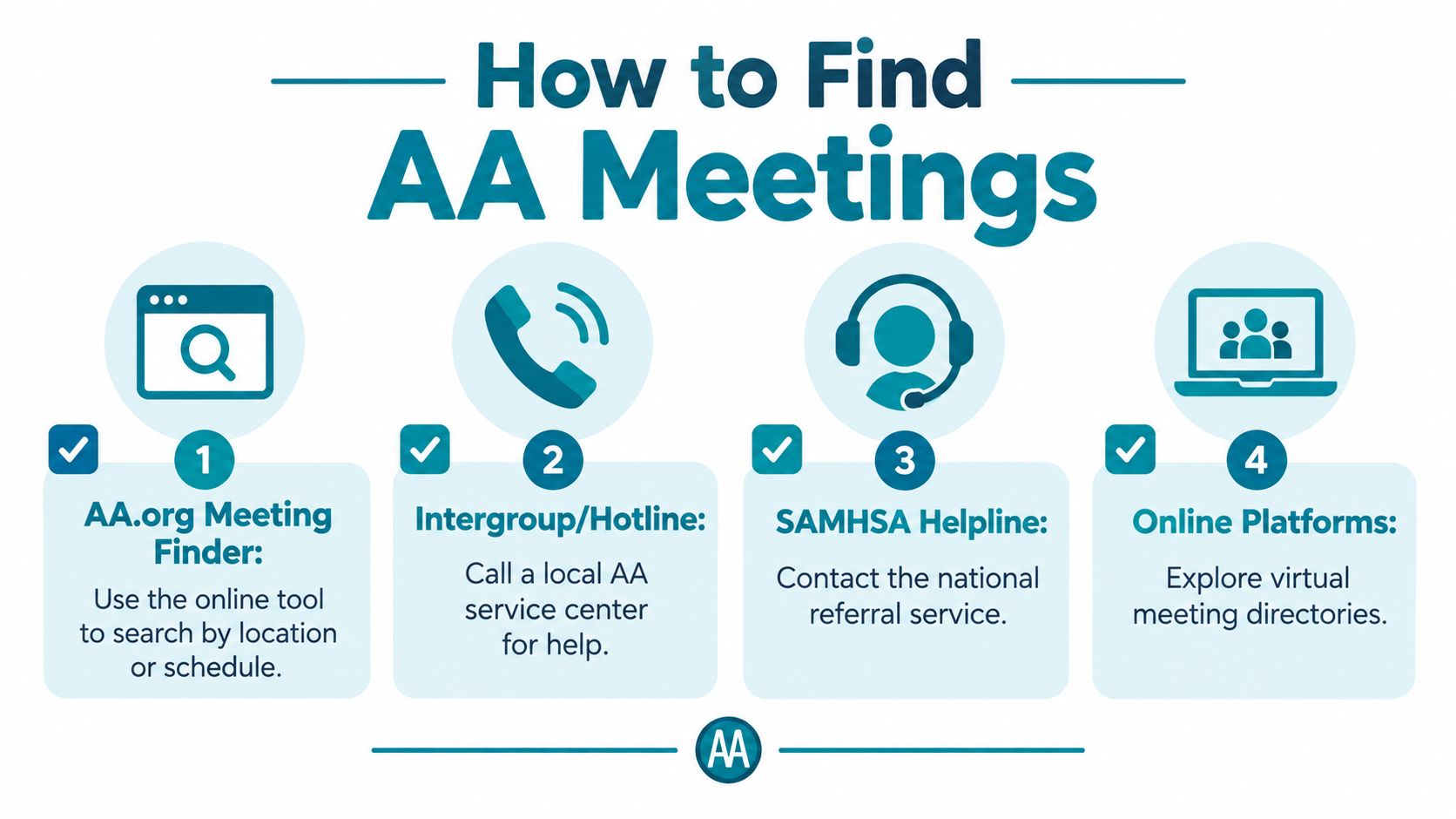
Start with official AA directories, local intergroup listings, or a referral service. Meeting information can change, so verify the time, format, access instructions, and whether the meeting is open or closed before attending.
Choose the format that protects participation
In-person meetings may offer easier face-to-face connection and a clearer separation from home or work. Online meetings can help when transportation, privacy, mobility, work hours, or location make attendance difficult. Hybrid access may provide flexibility, though the quality and rules of online meetings vary.
A simple fit check can help:
- Schedule: Can you attend without regularly missing sleep, work, medical visits, or essential responsibilities?
- Privacy: Would an online meeting from a private room feel safer, or would leaving home provide better boundaries?
- Format: Do you prefer discussion, a speaker, literature, or a quieter setting?
- Support level: Do you want peer connection alone, or do you also need clinical assessment and monitoring?
- Follow-through: Can you identify a realistic way to return if the meeting feels useful?
SAMHSA's National Helpline is free, confidential, and available 24/7, 365 days a year, in English and Spanish. SAMHSA also directs people toward support groups available in person and online, including AA. You can review SAMHSA's National Helpline information for referral support.
Digital access can make discovery easier, but browsing isn't the same as sustained participation. The Online Intergroup reported 432,267 users and 1,324,218 pageviews in May 2025, with 0.65 sessions per user, according to its published statistics. Those figures describe website activity, not treatment outcomes or the number of people who remain engaged.
You can explore several options without making a public announcement. Keep the meeting that feels respectful, practical, and compatible with your broader care plan.
Alternatives and Complements to AA for Alcohol Support
AA isn't the only recovery support option. Some adults prefer a secular approach, structured psychotherapy, medication, physician monitoring, or a combination. The right comparison depends on safety, goals, health history, access, and the kind of support a person can realistically continue.
NIAAA states that naltrexone, acamprosate, and disulfiram are FDA-approved medications that can help people stop or reduce drinking and prevent a return to drinking. NIAAA also states that these medications are non-addictive and may be used alone or with behavioral treatment or mutual-support groups. Medication decisions require clinical assessment, including review of other medicines and relevant medical conditions.
Alcohol Support Options at a Glance
| Option | What It Offers | Best Fit Considerations |
|---|---|---|
| Alcoholics Anonymous | Peer connection, mutual encouragement, meetings, and a Twelve Step framework | May suit adults who value shared experience, regular meetings, and a peer-led recovery structure |
| SMART Recovery | A skills-based mutual-support format with a different framework from AA | May suit adults who prefer a secular or behavior-focused approach |
| Clinician-led behavioral care | Structured counseling approaches, relapse-prevention work, and professional assessment | May suit people who want individualized clinical guidance or need care for co-occurring mental-health concerns |
| FDA-approved medication | Medical treatment that may support reduced drinking or abstinence | Requires a clinician to review suitability, risks, other medications, and follow-up needs |
| Combined care | Peer support, behavioral treatment, medical monitoring, and coordination | May suit adults who want more than one layer of support without treating any single service as sufficient for every need |
This comparison isn't a ranking. A person may try AA and find that another group better matches their values. Others may use a mutual-support group while receiving medication or behavioral care. For readers exploring medication information, Empire's naltrexone resource offers a starting point, but it can't replace a medical evaluation.
People seeking multilingual or international counseling resources may also find context in THERAPSY addiction recovery in Italy. External resources can broaden options, but they shouldn't be treated as endorsements or as a substitute for checking a provider's credentials, privacy practices, and clinical scope.
Treatment access remains uneven. NIAAA estimated that 28.0 million people age 12 and older in the United States had past-year alcohol use disorder in 2024, while 2.5%, or about 697,000 people, received medication-assisted treatment for AUD in the past year. These figures show why a person may need to consider several routes rather than waiting for one perfect option.
Safety Planning Standard Drinks BAC Limits and When to Seek Care
Alcohol risk depends on dose, pattern, physiology, medicines, and context. A standard drink is a measurement used to estimate alcohol exposure, but real-world pours vary. A restaurant serving, mixed drink, large glass, or home pour may contain more alcohol than a person assumes.
Blood-alcohol calculators have limits. Estimates can change with pour size, timing, food, body composition, metabolism, medications, and other physiological factors. They aren't a safety clearance and must never be used to decide whether to drive.
Standard drinks and BAC estimates
| Question | What the information can do | What it cannot do |
|---|---|---|
| How many standard drinks were consumed? | Help a clinician understand amount and pattern | Confirm exact alcohol exposure when serving size is uncertain |
| When was alcohol consumed? | Add context to a risk assessment | Predict a precise blood-alcohol concentration for every person |
| What does a BAC calculator show? | Provide a rough educational estimate | Prove that driving is safe or that impairment is absent |
| How much food was eaten? | Explain why absorption may vary | Cancel alcohol effects or make driving safe |
| What medicines or sedatives are involved? | Alert a clinician to possible interaction concerns | Establish safety without a complete medication review |
A labeled hypothetical composite illustrates the problem. An adult enters several drinks into a BAC calculator after an evening of drinking. The estimate changes when the person corrects the pour size and timing, and it still can't account for every physiological factor. The person must not use that estimate to decide whether to drive.
You can review Empire's alcohol level in blood calculator resource for educational context. It isn't a substitute for a clinical assessment or a safe-driving decision.
Withdrawal warning signs
Alcohol withdrawal can worsen after drinking stops or drops sharply. Risk-based medical assessment is especially important when there is a history of withdrawal, seizures, severe symptoms, use of other sedatives, pregnancy, significant liver disease, or serious mental-health concerns.
Seek emergency help for:
- Seizures: A seizure requires urgent emergency evaluation.
- Confusion or delirium: Severe confusion, disorientation, hallucinations, or inability to stay oriented can signal a medical emergency.
- Severe worsening symptoms: Marked shaking, agitation, vomiting, fever, or rapidly changing mental status requires urgent assessment.
- Immediate danger: Call emergency services for loss of consciousness, trouble breathing, serious injury, or thoughts of suicide.
Don't attempt to manage severe withdrawal alone or follow a self-detox plan from the internet. A clinician can quantify standard drinks and timing, use a validated screening tool, review withdrawal history and sedatives, assess pregnancy, liver, and mental-health risks, triage severe symptoms, and connect withdrawal management with ongoing treatment.
During pregnancy, avoiding alcohol prevents fetal alcohol spectrum disorders. The CDC explains that there is no known safe amount, safe time, or safe type of alcohol during pregnancy.
Next Steps With Confidential Physician Led Support
AA offers peer support, not medical treatment. If you want private outpatient evaluation, monitoring, recovery planning, or coordination with an outside program, you can review Empire's addiction medicine specialist service. Severe withdrawal, seizures, confusion, breathing problems, or immediate danger require emergency services, not routine follow-up.
This article is educational and isn't personal medical advice.
Empire Medical Wellness offers physician-led outpatient addiction medicine evaluation, monitoring, recovery planning, and authorized coordination with outside clinicians or programs when appropriate. Visit Empire Medical Wellness to learn about private outpatient care for alcohol-related concerns and decide whether a clinical conversation is appropriate.
Byline: Empire Medical Wellness Editorial Team
Published: September 14, 2026
Updated: September 14, 2026
Sources
- NIAAA, Treatment for Alcohol Problems
- NIAAA, AA and 12-Step Facilitation Evidence
- NIAAA, Understanding Alcohol Use Disorder
- NIAAA, Alcohol Treatment in the United States
- SAMHSA, National Helpline