
Alcohol withdrawal effects can begin within about 6 to 8 hours of the last drink, and they can escalate to seizures or delirium tremens. Because the course depends on drinking pattern, physiology, medicines, and context, withdrawal requires risk-based medical assessment rather than self-monitoring at home.
You may be reading this after noticing a tremor, sweating, poor sleep, nausea, anxiety, or a racing heartbeat when alcohol wears off. Those symptoms can be early withdrawal, but the same process can become medically dangerous even when it starts with what feels like ordinary discomfort. The safest next step depends on the person's history and current symptoms, not on a blood-alcohol calculator or a promise that withdrawal will last only a few days.
This guide explains what happens in the brain, how symptoms can unfold, which signs require emergency help, and how evidence-based treatment pathways differ. For confidential outpatient addiction medicine assessment, see Empire Medical Wellness addiction care. If someone has a seizure, new confusion, severe hallucinations, chest pain, trouble breathing, or marked instability, call 911 rather than waiting for an appointment.
Table of Contents
- What Alcohol Withdrawal Effects Actually Are
- How the Brain Produces Withdrawal Symptoms
- The Alcohol Withdrawal Timeline by Hour and Phase
- Red Flags and When Withdrawal Becomes an Emergency
- Evidence-Based Treatment Pathways and the CIWA-Ar Score
- How Outpatient Physician-Led Care Can Help
- Recovery Planning Beyond the Acute Phase
- Frequently Asked Questions
What Alcohol Withdrawal Effects Actually Are
Alcohol withdrawal is the body's response to abruptly stopping or sharply reducing heavy, sustained alcohol use. The brain adapts to repeated alcohol exposure. When alcohol is suddenly removed, that adaptation can produce a rebound state involving the nervous system, heart rate, sleep, mood, and perception.
Symptoms often begin within about 6 to 8 hours after drinking stops. They may peak around 24 to 72 hours, then improve over several days. Some people continue to experience sleep disruption, irritability, or cravings for weeks. The Cleveland Clinic overview of alcohol withdrawal describes common effects including anxiety, tremor, sweating, insomnia, palpitations, nausea, hallucinations, seizures, and delirium.
Roughly 50% of people with alcohol use disorder who stop or sharply reduce drinking experience withdrawal, according to the same clinical reference. That doesn't mean everyone faces severe withdrawal, but it does mean that stopping suddenly after heavy use shouldn't automatically be treated as a home experiment. Severe withdrawal can progress to delirium tremens, a medical emergency involving serious changes in attention, awareness, and autonomic function.
A spectrum, not a fixed three-day illness
Withdrawal isn't one uniform condition. One person may develop mild tremor and insomnia. Another may develop vomiting, hallucinations, seizures, or delirium. A prior uncomplicated episode doesn't guarantee that a later episode will follow the same path.
Alcohol risk also depends on dose, pattern, physiology, medicines, and context. A blood-alcohol calculator can offer only a rough estimate because pour size, timing, food intake, body composition, tolerance, and health conditions affect the result. It isn't a safety clearance and must never be used to decide whether it's safe to drive.
The practical questions are straightforward:
- What symptoms are present now?
- When was the last drink?
- Has the person had withdrawal before, especially seizures or delirium?
- Can the person stay hydrated and remain oriented?
- Is there a safe medical pathway if symptoms worsen?
The answers help clinicians decide whether someone needs emergency evaluation, hospital-based monitoring, or a carefully selected outpatient pathway.
How the Brain Produces Withdrawal Symptoms
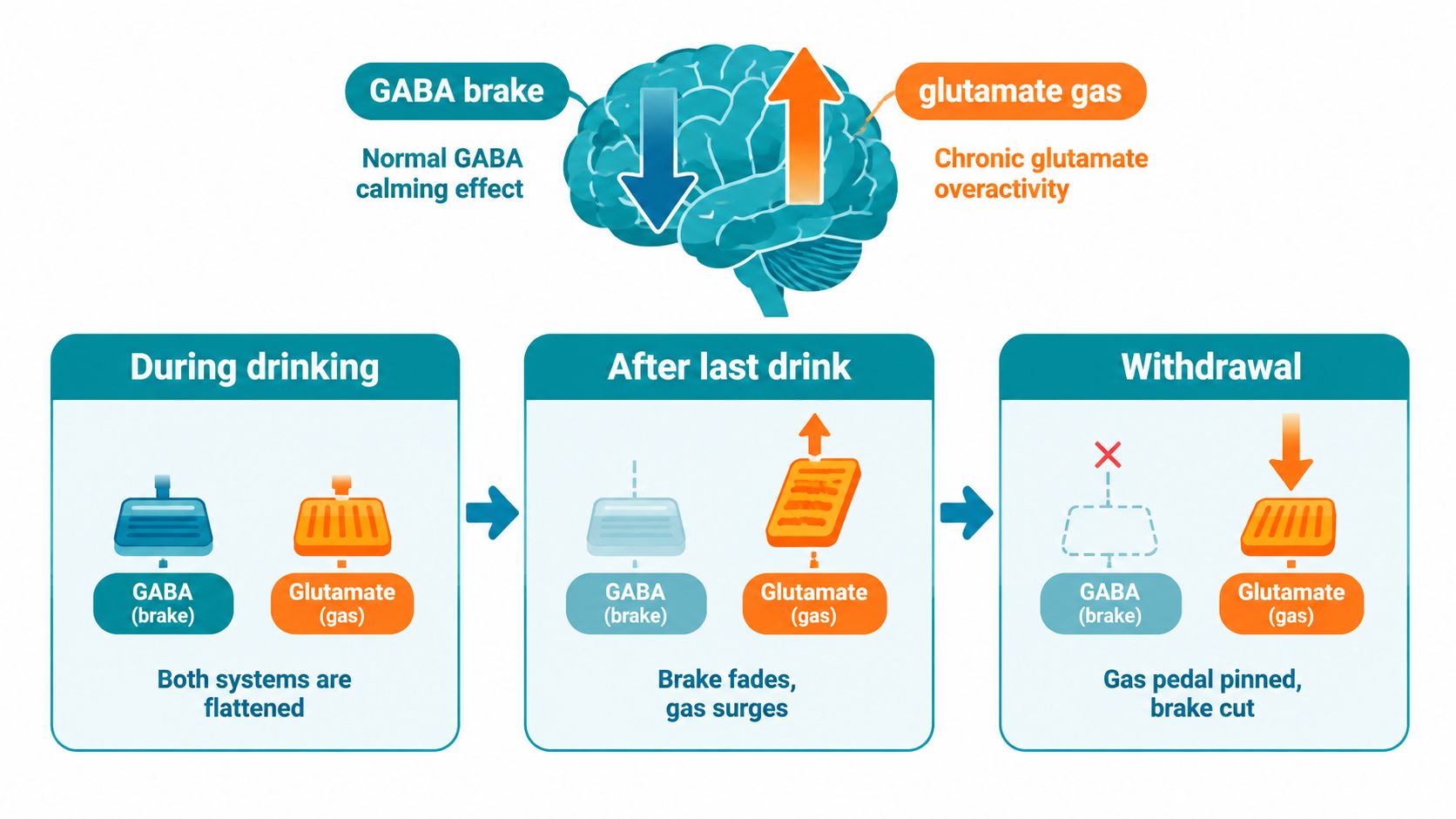
A useful mental model is a brake-and-gas-pedal system. GABA acts largely like a brake that reduces neuronal activity. Glutamate acts largely like an accelerator that promotes excitation. Alcohol changes both systems, and long-term exposure causes the brain to compensate.
The National Institute on Alcohol Abuse and Alcoholism explanation of alcohol and the brain describes chronic alcohol exposure as depressing GABAergic inhibition while suppressing glutamatergic excitation. In plain language, the brain becomes accustomed to alcohol's presence and adjusts its own signaling around it.
Why the rebound feels physical
When alcohol is removed, the calming brake no longer provides the same balance while excitatory signaling rebounds. The central nervous system becomes hyperexcitable, which helps explain:
- Tremor and agitation, caused by heightened neuronal activity.
- Anxiety and insomnia, caused by loss of calming signaling and increased arousal.
- Sweating, fast heart rate, and high blood pressure, reflecting autonomic nervous system activation.
- Seizures, when excessive excitation spreads through neural networks.
- Hallucinations and delirium, when altered brain activity disrupts perception, attention, and orientation.
This isn't just a matter of feeling nervous because someone has stopped drinking. The body can enter a physiologic stress state that needs clinical assessment.
The brain's stress circuits can also remain overactive after the most dangerous physical symptoms improve. That negative-affect state can contribute to irritability, dysphoria, emotional pain, and craving. Sleep and mood symptoms may therefore persist after tremor or sweating have eased.
Clinical perspective: A symptom such as insomnia may be uncomfortable on its own, but in the context of recent heavy drinking it can be one part of a broader withdrawal picture.
Physician-led addiction medicine care can help distinguish withdrawal assessment from longer-term treatment planning. It doesn't replace emergency care when severe symptoms are present.
The Alcohol Withdrawal Timeline by Hour and Phase
A person may stop drinking in the morning and feel only restless at first, then develop shaking or other symptoms later that day. The timing can guide monitoring, but it cannot make unsupervised detoxification safe. Symptoms may overlap, change quickly, or appear in an unexpected order.
Timeline at a glance
| Phase | Typical onset after last drink | Common features | Care setting |
|---|---|---|---|
| Early withdrawal | 6 to 24 hours | Tremor, sweating, nausea, anxiety, insomnia, palpitations, and high blood pressure | Medical assessment, with setting based on risk |
| Seizure-risk window | 6 to 48 hours | Withdrawal seizures, often generalized tonic-clonic, with or without prominent earlier symptoms | Urgent or emergency medical evaluation |
| Peak danger period | 48 to 72 hours | Worsening agitation, confusion, hallucinations, autonomic instability, and possible delirium tremens | Emergency or hospital-based care |
| Severe prolonged course | Up to 2 weeks in severe cases | Delirium and other serious complications may persist | Hospital-level monitoring |
| Subacute tail | Weeks after the acute phase | Insomnia, irritability, mood symptoms, and craving | Follow-up and ongoing recovery care |
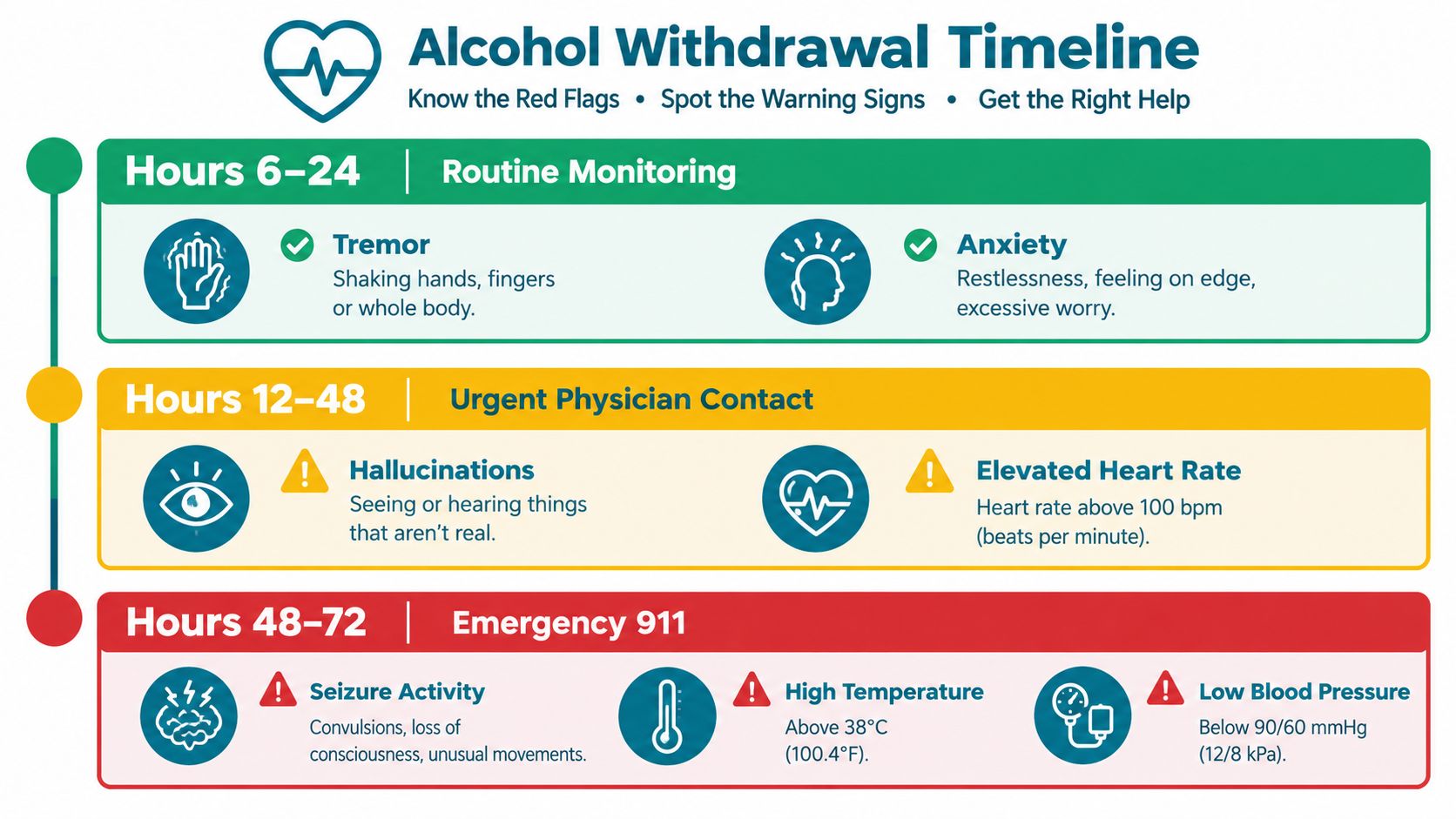
These ranges are summarized in Harvard Health's alcohol withdrawal timeline. Early symptoms often begin during the first day. Seizures most commonly occur during the 6 to 48 hour window, and they may occur even when earlier withdrawal symptoms appear mild or absent.
Delirium tremens often emerges around 48 to 72 hours after drinking stops. It may involve confusion, severe disorientation, agitation, hallucinations, and major changes in autonomic function. Severe cases may continue for up to 2 weeks, which is why the timeline is a clinical spectrum rather than a fixed three-day event.
Video: an overview of the alcohol withdrawal timeline and its phases.
The subacute tail can be difficult to interpret. Persistent poor sleep or craving does not by itself show that recovery has failed. Symptoms may continue for weeks after the acute danger window, so follow-up, sleep support, mood assessment, and relapse-prevention planning still matter.
The practical question is whether symptoms are improving under safe observation or require urgent medical evaluation. Improvement does not erase earlier risk. The first one to two days carry particular seizure concern, while symptoms commonly peak near 72 hours.
Red Flags and When Withdrawal Becomes an Emergency
A person may appear settled after stopping alcohol and still deteriorate later. The decision to seek care depends on current symptoms, time since the last drink, previous withdrawal, medical conditions, and whether qualified professionals can observe the person safely.
A 2024 review in Medical Sciences (Wiley) estimates severe alcohol withdrawal at roughly 2% to 7% in general inpatients with heavy alcohol use, about 1.9% to 6.7% among hospitalized heavy drinkers, and up to 20% in specialized alcohol treatment centers. Alcohol withdrawal delirium has a reported mortality of about 5% to 10%, with worse outcomes without appropriate treatment. peer-reviewed medical literature
Red-flag checklist
Call 911 now for:
- A seizure, whether generalized or focal, or repeated seizure activity.
- New confusion or severe disorientation, especially with agitation or reduced awareness.
- Hallucinations, particularly when the person cannot distinguish them from reality.
- Severe autonomic instability, including rapidly worsening shaking, sweating, a racing heart, or major blood-pressure changes.
- Chest pain, trouble breathing, fainting, or severe weakness.
- Persistent vomiting with signs of dehydration or an inability to keep fluids down.
If the person is confused, actively seizing, severely unstable, or difficult to wake, do not drive them yourself. Clear nearby hazards, stay with them, and tell emergency responders what they consumed and when the last drink occurred, if known.
Why home observation can fail
Withdrawal risk behaves more like a changing clinical process than a fixed appointment window. A person can look relatively comfortable and later develop seizures, even if earlier symptoms were mild. Hallucinations may occur with worsening attention and orientation, so they should not be dismissed as anxiety or poor sleep.
Routine follow-up suits someone stable and without red flags. It does not replace urgent evaluation when symptoms escalate. After the acute danger window, sleep problems, craving, or low mood may persist and call for follow-up rather than emergency treatment. No checklist can rule out serious withdrawal for an individual patient.
Evidence-Based Treatment Pathways and the CIWA-Ar Score
Clinicians choose a treatment setting by weighing the whole risk picture rather than relying on one symptom or one score. The Clinical Institute Withdrawal Assessment for Alcohol, revised, commonly called CIWA-Ar, evaluates ten symptoms, including nausea and vomiting, tremor, sweats, anxiety, agitation, hallucinations, and orientation.
In ASAM guideline examples, scores below 10 indicate mild withdrawal, scores from 10 to 18 indicate moderate withdrawal, and scores of 19 or higher indicate severe withdrawal. These thresholds support clinical assessment. They don't turn a person's home device or online questionnaire into a substitute for medical evaluation.
Alcohol treatment options at a glance
| Setting | Typical patient | What it provides | Limits to know |
|---|---|---|---|
| Physician-led outpatient care | A person assessed as lower risk and medically stable | Assessment, monitoring, recovery planning, medication review when appropriate, and coordination | Not emergency care or a substitute for hospital monitoring |
| Hospital or inpatient care | Moderate to severe symptoms, unstable vital signs, serious medical concerns, or high-risk history | Continuous clinical observation and treatment of complications | Requires a higher level of care and may involve transfer from outpatient care |
| Specialty addiction treatment | People needing structured support beyond acute withdrawal | Counseling, recovery planning, behavioral services, and peer support, depending on the program | Programs differ in intensity and available clinicians |
| Behavioral and peer-based supports | People building ongoing recovery support | Therapy or counseling through outside providers, mutual-support communities, and practical relapse planning | Support alone may not address medical withdrawal risk |
Medication decisions belong to a treating clinician. The clinician may need to consider liver function, other medicines, co-occurring conditions, prior seizures, and the person's current examination. This article doesn't provide dosing, tapering instructions, or a self-detox protocol.
Some medications used in alcohol treatment have specific FDA-approved indications, while other uses may be off-label. The FDA's medication information should be interpreted with a clinician, not used to select or combine medicines independently. Information about naltrexone treatment also shouldn't be treated as a withdrawal protocol.
How Outpatient Physician-Led Care Can Help
Outpatient care begins with risk assessment, not with an assumption that every person can safely remain at home. A clinician may review the drinking pattern, timing of the last drink, previous withdrawal episodes, seizures, hallucinations, medical and mental health conditions, current medicines, vital signs, and available support.
A clearly labeled hypothetical composite
Hypothetical composite, not an Empire patient: An adult has stopped drinking and notices tremor and poor sleep. They use a blood-alcohol calculator after several drinks and assume the result proves that their current symptoms are mild. During a clinical assessment, the physician explains that pour size, timing, food, physiology, tolerance, and other factors make the estimate uncertain. The calculator can't determine whether withdrawal is safe to watch, and it must never be used to decide whether to drive.
The physician then asks about prior withdrawal, including seizures or confusion, and checks for symptoms that would require emergency evaluation. If the presentation appears low risk and medically stable, outpatient follow-up may focus on monitoring, recovery planning, medication review when appropriate, sleep and mood concerns, and coordination with outside clinicians or treatment programs when useful and authorized.
If the history or current findings suggest higher risk, the safer recommendation may be hospital-based or supervised care. That decision isn't a judgment about character. It reflects the possibility that symptoms can worsen during the timeline described above.

Empire Medical Wellness provides confidential, physician-led outpatient addiction medicine care for adults. The practice doesn't provide emergency, detoxification, inpatient, residential, partial-hospitalization, or intensive-outpatient services. An addiction medicine specialist can help with outpatient assessment and planning when that level of care is clinically appropriate.
Recovery Planning Beyond the Acute Phase
The highest-risk withdrawal window can close while recovery remains medically active. A person may still have insomnia, irritability, low mood, anxiety, or craving for weeks. These symptoms can influence drinking decisions, work, relationships, and willingness to attend follow-up, so they belong in the care plan rather than being treated as a character issue.
A 2026 study in the International Journal of Health, Care and Behavioral Sciences (study publication) found that only 46% of patients achieved continuous abstinence six months after withdrawal treatment. The study also associated previous withdrawal episodes and alcohol-related organ damage with poorer long-term outcomes. Its findings describe a study population, not an individual's fate. They do, however, reinforce that withdrawal can mark both relapse vulnerability and broader medical risk.
What ongoing care may address
A practical plan may cover:
- Sleep and mood: Ongoing insomnia, irritability, anxiety, or low mood should be assessed rather than dismissed as low motivation.
- Medical health: Follow-up can consider alcohol-related effects on the liver and other organs.
- Medication review: Current medicines and co-occurring conditions may change treatment choices and safety.
- Relapse prevention: Behavioral care, peer support, and coordinated specialty treatment can provide structure after withdrawal. Adults who need outpatient help can review Empire's relapse-prevention support as one part of a broader plan.
- Monitoring: Regular contact can reveal worsening symptoms, barriers to treatment, or the need for hospital or specialty care.
Recovery often has a subacute tail rather than a clean endpoint. A later withdrawal episode may differ from an earlier one, and repeated episodes can raise concern about complications. Sharing that history openly helps the treating team choose safer follow-up.
A seizure, confusion, severe hallucinations, chest pain, or marked instability calls for emergency care, not routine follow-up. For adults who are medically stable and appropriate for outpatient care, ongoing physician-led planning can address symptoms, medical conditions, medications, and support needs over time.
Frequently Asked Questions
Can mild withdrawal be discussed by phone?
A phone discussion may help arrange care for someone who is stable and has no red flags, but it can't reliably rule out deterioration. New confusion, hallucinations, seizures, severe vomiting, chest pain, breathing difficulty, or marked autonomic instability requires urgent evaluation, and a person should call 911 for an emergency.
Is a second withdrawal episode more dangerous?
It can be. Repeated withdrawal episodes may produce progressively more severe responses through a process often described as kindling. Prior seizures, delirium, or other serious withdrawal complications should be disclosed because history helps clinicians assess risk.
Why is withdrawal called a spectrum?
Symptoms range from mild tremor and insomnia to seizures and delirium tremens. The same person may also have different experiences at different times. That range is why clinicians choose outpatient, hospital, or specialty care based on the full medical picture rather than a single symptom. This article doesn't diagnose withdrawal or provide individualized medication dosing.
Empire Medical Wellness offers confidential, physician-led outpatient addiction medicine assessment, monitoring, recovery planning, and coordination with outside treatment professionals when appropriate and authorized. Visit Empire Medical Wellness to learn about outpatient care and determine whether it fits your needs, or seek emergency help immediately for withdrawal red flags. This article is educational and isn't personal medical advice.
Byline: Empire Medical Wellness Editorial Team
Published: September 29, 2026
Updated: September 29, 2026