Opioid use disorder is a treatable medical condition, but it usually needs more than emergency overdose rescue to improve long-term safety. In the United States, about 105,000 people died from a drug overdose in 2023, and nearly 80,000 of those deaths involved opioids, which is why evidence-based medication, medical monitoring, and follow-up matter so much.
Many people first learn about opioids in a crisis. A loved one stops responding. Naloxone is used. The immediate danger passes. Then a harder question begins. What happens next?
That gap between rescue and ongoing care is one of the most overlooked parts of opioid treatment. Naloxone can save a life, but it doesn't treat the underlying disorder. Long-term improvement usually depends on a full medical assessment, a realistic safety plan, and, when appropriate, medications such as methadone, buprenorphine, or extended-release naltrexone.
Table of Contents
- Understanding Opioids and Their Medical Uses
- Recognizing the Signs of Misuse and Overdose Risks
- Evidence-Based Medications for Opioid Use Disorder
- Harm Reduction and Emergency Overdose Response
- Navigating Relapse and Reduced Tolerance Risks
- The Role of Outpatient Addiction Medicine in Recovery
- Frequently Asked Questions About Opioid Care
- Sources
Understanding Opioids and Their Medical Uses
Opioids are a group of drugs used to treat pain. Some are prescribed in medical settings. Others are used outside medical care or are mixed into the illicit drug supply. The basic medical purpose is straightforward. Opioids can reduce pain, but they also change breathing, alertness, and reward pathways in the brain.
The simplest explanation I give patients is this. An opioid is a drug that can turn down pain signals, but it can also turn down the body's drive to breathe. That's why the same drug class can help in medicine and still be dangerous.
How opioids work
Opioids bind to mu-opioid receptors, often shortened to MOR. This can produce pain relief, but it can also suppress brainstem respiratory centers, blunt the body's response to low oxygen, and reduce the ability to respond normally to rising carbon dioxide, which is why loss of ventilation is the main fatal mechanism in overdose, as described in this peer-reviewed review of opioid-induced respiratory depression.
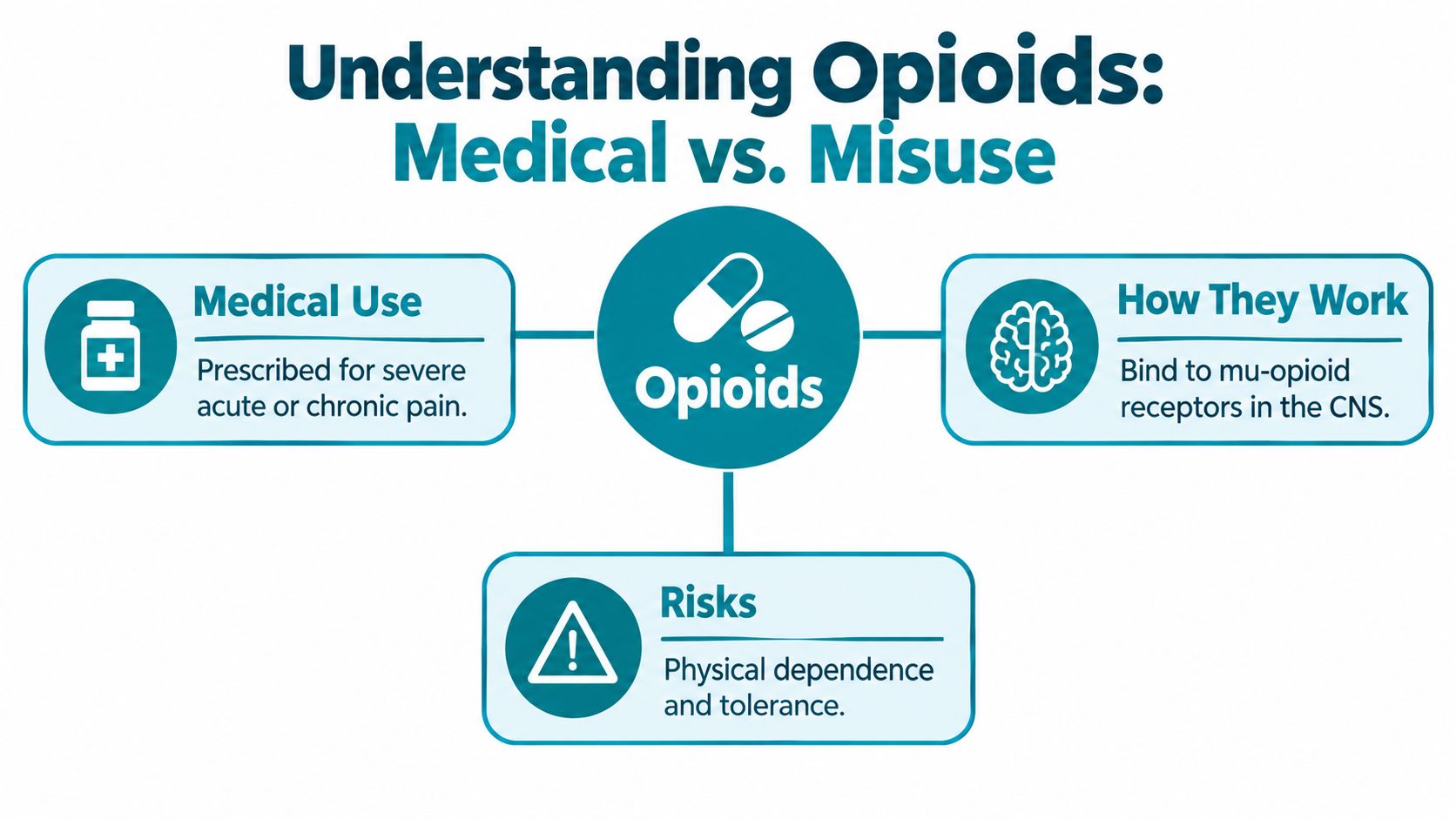
That mechanism also explains why overdose risk isn't just about the amount taken. Risk rises or falls based on the specific opioid, whether other sedating drugs are involved, and the person's underlying health.
Practical rule: When breathing slows or stops, that's the emergency. Sedation can be concerning, but respiratory depression is what makes opioid overdose life-threatening.
Tolerance and physical dependence
Two terms often cause confusion.
- Tolerance means the body becomes less responsive over time, so the same amount may have less effect.
- Physical dependence means the body adapts to the drug and may develop withdrawal symptoms if the drug is stopped suddenly.
- Opioid use disorder is different. It's a medical condition involving compulsive use despite harm, cravings, loss of control, or repeated return to use.
A person can develop physical dependence during legitimate medical treatment without meeting criteria for opioid use disorder. That distinction matters because shame gets in the way of good care.
Why careful conversion matters
Potency differences between opioids can be clinically significant. For example, a 100 microgram dose of fentanyl can provide analgesia roughly equivalent to 10 mg of morphine, and published conversion estimates between intravenous fentanyl and oral morphine vary widely, which is why equianalgesic conversion is only an approximation in StatPearls on fentanyl.
That wide range is one reason physicians use conservative dose changes, careful monitoring, and follow-up rather than rough comparisons.
Recognizing the Signs of Misuse and Overdose Risks
The U.S. opioid crisis didn't arrive all at once. The CDC overview of the opioid overdose epidemic describes three waves. The first began with prescription opioids in the 1990s. The second was linked to heroin around 2010. The third began around 2013 with synthetic opioids such as illegally made fentanyl.
That history matters because the current risk environment differs from what many families still picture. Dose estimation is less predictable. Street drugs may contain fentanyl or other substances. A person may think they're using one drug but instead be exposed to another. If you want more background on that shift, Empire's page on fentanyl risks and safety is one place to continue reading.
Warning signs that need emergency action
The FDA says opioid overdose warning signs include breathing problems, severe sleepiness, and being unable to respond or wake up in its NIDA opioid drug facts page reflecting FDA guidance. Those are not signs to watch passively. They are signs to act.
Look for:
- Slow or absent breathing. This is the most urgent red flag.
- Unable to wake the person. Calling their name or rubbing the sternum doesn't bring a meaningful response.
- Severe sleepiness or limpness. The person may appear sedated or collapsed.
- Opioid exposure with other sedatives. Alcohol or benzodiazepines can compound danger.
If someone isn't waking up and their breathing is impaired, treat it like an overdose until proven otherwise.
Why synthetic opioids changed the risk
The synthetic-opioid era accelerated sharply after 2013. In the United States, the age-adjusted death rate involving synthetic opioids other than methadone rose from 0.4 deaths per 100,000 in 2002 to 22.7 in 2022, and CDC-linked summaries reported that synthetic opioids accounted for about 90% of opioid overdose deaths in 2022, according to the World Health Organization opioid overdose fact sheet.
A common misconception is that only people with long-term opioid use are at risk. In reality, risk also rises when someone has lower tolerance, doesn't know what is in the supply, or combines opioids with other sedatives. The FDA also notes that the risk of opioid addiction, misuse, or abuse is increased in patients with a personal or family history of substance use disorder or mental illness in this opioid safety communication.
Evidence-Based Medications for Opioid Use Disorder
Medication treatment is often the foundation of care because it addresses the biology of opioid use disorder, not just the behavior around it. The key point is simple. Naloxone reverses overdose. It does not treat opioid use disorder. Ongoing treatment usually requires a different plan.
The three main FDA-approved medications are methadone, buprenorphine, and extended-release naltrexone. They aren't interchangeable. Each has different initiation requirements, settings, and practical trade-offs. For readers comparing office-based care, Empire's page on buprenorphine treatment may also be useful.
Comparing the main options
| Medication | Mechanism of Action | Initiation Requirement | Typical Care Setting |
|---|---|---|---|
| Methadone | Full opioid agonist | Started under structured clinical supervision with attention to safety and monitoring | Specialized opioid treatment program |
| Buprenorphine | Partial opioid agonist | Usually started when a patient is in appropriate withdrawal or by another carefully planned induction approach | Outpatient office-based addiction care or other qualified medical settings |
| Extended-release naltrexone | Opioid antagonist | Requires that opioids be fully out of the system before initiation to avoid precipitated withdrawal | Outpatient medical setting after detoxification or opioid-free period |
What works well for different situations
Methadone can be effective for people who need a highly structured setting. That structure can help, but it also means treatment logistics may be more demanding.
Buprenorphine is often a practical outpatient option because it can be prescribed in office-based medical care. For many adults seeking confidential physician-led treatment, that setting may better fit work, family responsibilities, and follow-up.
Extended-release naltrexone works differently. Because it's an antagonist, it blocks opioid effects rather than activating the receptor. Its biggest challenge is timing. A person must first complete withdrawal and be fully opioid-free before starting, which can be a major barrier for some patients.
The best medication isn't the one that sounds strongest. It's the one a patient can start safely and continue consistently.
What medication can and can't do
Medication can reduce cravings, support stability, and lower the chance that treatment depends on willpower alone. It does not erase stress, trauma, insomnia, chronic pain, housing strain, or relationship conflict. That is why good care also includes monitoring, practical problem-solving, and coordination with therapy or higher levels of care when needed.
This is also where physician-led outpatient addiction medicine can help. A careful evaluation can compare opioid type, route of use, prior overdose history, sedative exposure, pregnancy status when relevant, treatment goals, and barriers to follow-up before choosing a path.
Harm Reduction and Emergency Overdose Response
Harm reduction means lowering the chance of death and serious injury, even if a person isn't ready for full abstinence or a complete treatment plan yet. In opioid care, that starts with naloxone and a clear response plan.
Early in this process, it helps to review a simple visual guide.
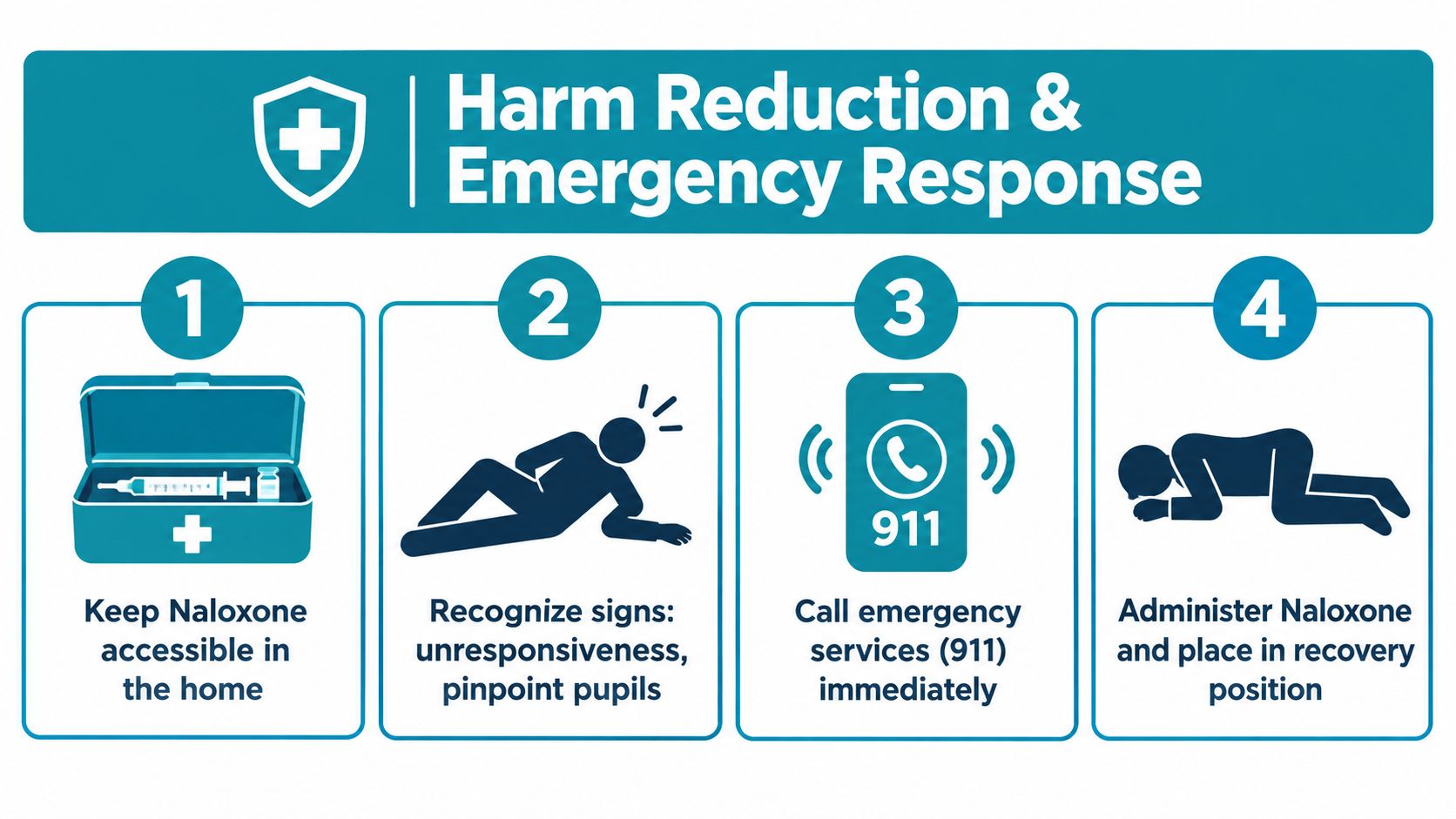
Naloxone works by competitively displacing opioid agonists at the mu-opioid receptor, which can rapidly restore breathing when enough receptor occupancy is reversed. Low-dose naloxone can sometimes reverse respiratory depression without fully abolishing analgesia, but recurrent toxicity can occur because naloxone's duration may be shorter than the opioid involved, as noted in the earlier StatPearls fentanyl review.
What to do right away
If opioid overdose is suspected:
- Check responsiveness and breathing. If the person can't be awakened or breathing is slow, irregular, or absent, act immediately.
- Give naloxone if available. Use the product as labeled.
- Call 911 right away. The FDA guidance reflected by NIDA says emergency medical attention should be sought immediately for overdose warning signs in this prescription opioids fact sheet.
- Stay with the person. Monitor breathing and responsiveness until emergency help arrives.
- Prepare for the effect to wear off. Naloxone is a rescue tool, not definitive treatment.
Later, once the immediate crisis is addressed, readers can learn more about access and practical questions on Empire's naloxone information page.
A brief demonstration can make those steps easier to remember.
Who should be offered naloxone
The CDC says clinicians should offer naloxone when prescribing opioids, especially for patients with higher overdose risk such as a history of overdose, substance use disorder, sleep-disordered breathing, concurrent benzodiazepine use, or opioid dosages at or above 50 MME/day in the CDC opioid prescribing guideline.
That recommendation is practical, not punitive. Naloxone belongs in routine safety planning the way an inhaler belongs in asthma care or glucagon belongs in diabetes care.
Navigating Relapse and Reduced Tolerance Risks
One of the most dangerous moments in opioid use disorder happens after a period of abstinence. Tolerance falls. The brain and body are no longer adapted to the previous amount. A dose that once felt familiar can suddenly become lethal.
A hypothetical composite example
This is a hypothetical composite drawn from common clinical patterns, not a real patient.
An adult stops opioid use for a period of time, then returns to use after a stressful event. They assume their old amount will affect them the way it used to. It doesn't. Their tolerance is lower. The overdose risk is now much higher.
A good medical response doesn't frame that return to use as proof that treatment has failed. It treats the event as urgent new clinical information.
What a reduced-tolerance safety plan should include
A physician-led plan often focuses on a few immediate priorities:
- Restore naloxone access. Make sure the person and people around them know where it is and how to use it.
- Reassess current risk. Recent abstinence, fentanyl exposure, sedatives, and prior overdose history all change the safety picture.
- Restart follow-up quickly. Delay increases danger, especially when use has resumed.
- Revise trigger management. The point isn't just to say "don't relapse." It's to identify what changed and what support now needs to change with it.
For readers exploring that phase of recovery, Empire's page on relapse and return-to-use planning discusses the topic in more detail.
A return to use should trigger reassessment, not abandonment. Reduced tolerance is a medical risk factor, not a character judgment.
Why discharge-only thinking often fails
If a person is removed from care the moment they struggle, the medical system loses the chance to reduce risk. Continuity matters most when risk rises. In opioid care, that often means keeping the person engaged, adjusting the treatment approach, and addressing the practical barriers that made follow-up fragile in the first place.
The Role of Outpatient Addiction Medicine in Recovery
Emergency care saves lives, but it is designed for crisis stabilization. Opioid use disorder usually needs something different after that. It needs continuity.
The treatment gap remains large. In the United States, only 15.7% of the 4 million people with opioid use disorder received medication treatment in 2025, and only 16% of all people who needed substance use treatment got any treatment at all, according to the 2025 national survey summary discussed by the Addiction Policy Forum. Structural barriers include stigma, limited provider availability, prior authorization, and uneven coverage.
Why rescue alone isn't enough
Federal review also found that Medicare enrollees received a record high of more than 750,000 overdose-reversal drug claims in 2023, yet fewer than one in five Medicare beneficiaries with opioid use disorder received medication treatment, while policy changes may increase out-of-pocket costs for some naloxone access, according to this HHS OIG review of naloxone and medication treatment access.
That contrast is the central problem. A person may survive an overdose and still struggle to get timely follow-up, medication access, and coordinated care.
What outpatient physician-led care can add
Private outpatient addiction medicine can help bridge that gap when it offers:
- Confidential medical assessment. This includes substance history, overdose risk, mental health history, other medications, and treatment goals.
- Medication evaluation when appropriate. Methadone, buprenorphine, and naltrexone each fit different situations.
- Monitoring over time. Treatment plans often need adjustment rather than one-time advice.
- Coordination with outside care. With patient authorization, a physician may coordinate with therapists, treatment programs, or other clinicians.
Empire Medical Wellness is one outpatient option for adults seeking physician-led addiction medicine specialist care with confidential assessment, monitoring, and coordination when clinically appropriate and authorized.
The practical value of outpatient care isn't that it replaces every other setting. It's that it can connect diagnosis, medication decisions, relapse planning, and follow-up in one ongoing medical relationship.
Frequently Asked Questions About Opioid Care
Can opioid use disorder be treated in outpatient care
Often, yes. Outpatient addiction medicine can include medical assessment, medication treatment when clinically appropriate, monitoring, recovery planning, and coordination with outside programs. It does not replace emergency care, inpatient detoxification, or hospital treatment when those are needed.
Does naloxone mean the problem is solved
No. Naloxone can reverse an opioid overdose, but it doesn't treat cravings, withdrawal vulnerability, or the underlying disorder. After an overdose, the next step should be prompt medical follow-up and discussion of ongoing treatment options.
Can adults use telemedicine for addiction medicine at Empire
Empire's current workflow supports telemedicine for adults physically located in New York, New Jersey, Connecticut, Pennsylvania, or Virginia, with in-person appointments also available. That matters for patients who want privacy and continuity without relying only on emergency or episodic care.
How does private-pay scheduling work
Empire lists a 50-minute initial evaluation for $350 and a 25-minute follow-up for $225. The practice doesn't bill insurance directly, but an itemized receipt is available through the patient portal for patients who want to explore possible out-of-network reimbursement. Coverage isn't guaranteed.
What if legal issues are part of the picture
Some adults seeking opioid treatment are also dealing with charges, court requirements, or family concerns tied to substance use. Medical care and legal guidance serve different roles, but both may matter. If someone in Connecticut needs legal information related to drug charges, a bilingual criminal defense Connecticut resource may be a practical starting point alongside medical follow-up.
What's the first visit usually focused on
A thoughtful first visit usually reviews current use, prior overdoses, withdrawal symptoms, other sedating substances, psychiatric history, medical history, pregnancy status when relevant, prior treatment, and the patient's goals. The aim isn't to judge. It's to understand risk clearly enough to build a safer plan.
Sources
- CDC overview of the opioid overdose epidemic
- World Health Organization opioid overdose fact sheet
- Peer-reviewed review of opioid-induced respiratory depression
- StatPearls review of fentanyl
- NIDA prescription opioids drug facts
- CDC opioid prescribing guideline
- FDA opioid safety communication on misuse risk
- Addiction Policy Forum summary of 2025 treatment-gap findings
- HHS OIG review of naloxone and medication treatment access
Byline: Empire Medical Wellness Editorial Team
Published: September 29, 2026
Updated: September 29, 2026
This article is for education only and isn't personal medical advice. If someone may be having an opioid overdose, call 911 and use naloxone right away if it's available.
If you're looking for confidential, physician-led outpatient evaluation for opioid-related concerns, Empire offers addiction medicine care that may include assessment, medication treatment when clinically appropriate, monitoring, and recovery planning. To learn more about the practice and whether its approach fits your needs, visit Empire Medical Wellness.