
In 2023, an estimated 316 million people worldwide used a drug, representing 6% of the population aged 15 to 64, according to a UNODC and WHO report summarized in the United Nations report transcript. Addiction is therefore not a character flaw or a problem confined to a small group. It's a treatable medical condition that can affect health, relationships, work, safety, and long-term quality of life.
A private, physician-led evaluation can help clarify what's happening, assess withdrawal and overdose risks, identify co-occurring medical or mental-health concerns, and determine whether outpatient care is appropriate. It can also create a safer connection to detoxification, residential, intensive outpatient, or behavioral programs when a higher level of care is needed.
Table of Contents
- What Addiction Looks Like Today and Why It Matters
- Understanding Substance Use Disorder as a Medical Condition
- How Addiction Affects the Brain and Behavior
- Recognizing Risk Factors, Warning Signs, and Severity
- Evidence-Based Treatment Options by Substance
- A Composite Example of Outpatient Care in Practice
- What Confidential Outpatient Addiction Care Includes
- Frequently Asked Questions and How to Take a Next Step
What Addiction Looks Like Today and Why It Matters
Only one in 12 people with a drug use disorder received treatment in 2023. That gap helps explain why substance-related harm remains a public-health concern. The same report estimated 244 million cannabis users, 61 million opioid users, 30.7 million amphetamine users, 25 million cocaine users, and 21 million ecstasy users in 2023. Drug use disorders were also associated with nearly half a million deaths and 28 million healthy years of life lost in 2021, according to the United Nations report transcript.
Alcohol belongs in this discussion because it can also produce a medical disorder requiring care. The WHO global alcohol report data estimated that around 400 million people worldwide lived with alcohol use disorders, including 209 million with alcohol dependence. Alcohol caused 2.6 million deaths per year, while psychoactive drug use caused another 0.6 million deaths annually. These figures show the scale of the problem, not a diagnosis for any particular reader.
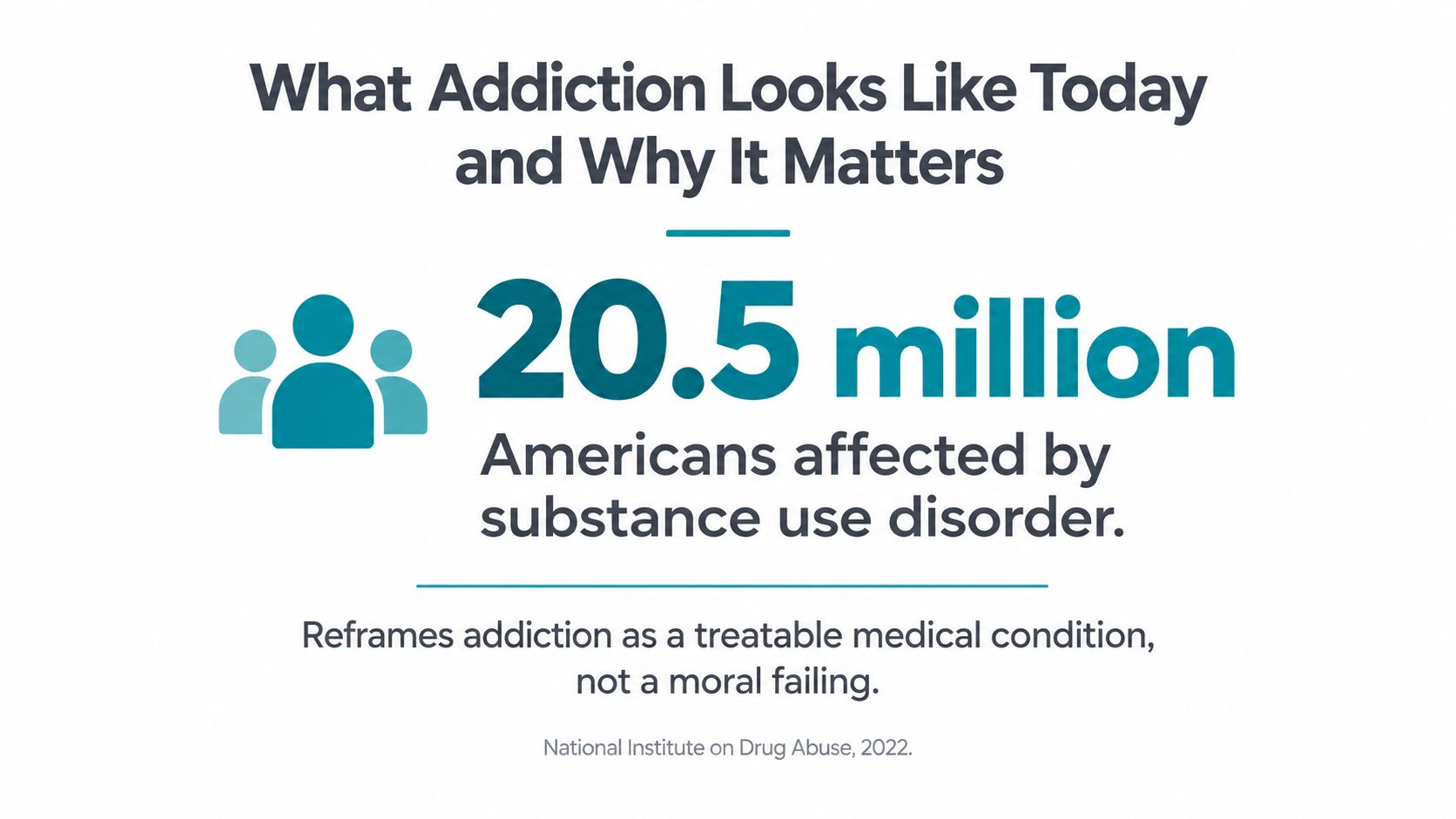
Why treatment access matters
Many people postpone care because they think they must first reach a crisis, complete detox, or enter residential treatment. A confidential outpatient physician evaluation can be an appropriate starting point for some adults. It typically reviews the substances involved, patterns of use, withdrawal risk, overdose risk, medical and psychiatric concerns, prior treatment, medications, and the supervision available at home.
The evaluation also helps match care to risk. A person with low immediate risk may begin outpatient follow-up, while someone facing dangerous withdrawal, overdose risk, or unstable medical or psychiatric symptoms may need detoxification, residential care, or a behavioral program first. These services can coordinate rather than compete, with outpatient medical care continuing when clinically appropriate.
The practical questions are:
- What substance or substances are involved?
- Is withdrawal potentially dangerous?
- Is there an immediate overdose, medical, or psychiatric risk?
- What treatment has been tried before?
- What support and supervision are available at home?
Understanding Substance Use Disorder as a Medical Condition
Substance use disorder, or SUD, describes a pattern of substance use that causes clinically meaningful problems or distress. Clinicians use person-first language, such as “a person with alcohol use disorder,” rather than labels such as “addict” or “substance abuser.” Those older terms reduce a person to a diagnosis and can make it harder to seek care.
Diagnosis focuses on behavior and functioning, not moral character. A physician may assess whether a person has difficulty controlling use, experiences strong cravings, gives up important activities, continues using despite harm, takes physical or personal risks, or develops tolerance and withdrawal. These observations are considered alongside medical history, mental-health symptoms, medications, family context, and the person's own goals.
What a clinical evaluation considers
A screening questionnaire can help start the conversation, but it doesn't replace a medical assessment. The clinician typically asks about:
- Impaired control, such as using more than intended or making unsuccessful efforts to cut back.
- Social impairment, including conflict, missed responsibilities, or withdrawal from valued activities.
- Risky use, such as use in physically dangerous situations or continued use despite health consequences.
- Physical adaptation, including tolerance, withdrawal, or using a substance to relieve withdrawal symptoms.
The same amount of use can affect two people differently. A person may have serious impairment without appearing intoxicated during an appointment. Another person may use a substance intermittently but face a dangerous withdrawal risk because of the substance, duration of use, medical history, or previous withdrawal experiences.
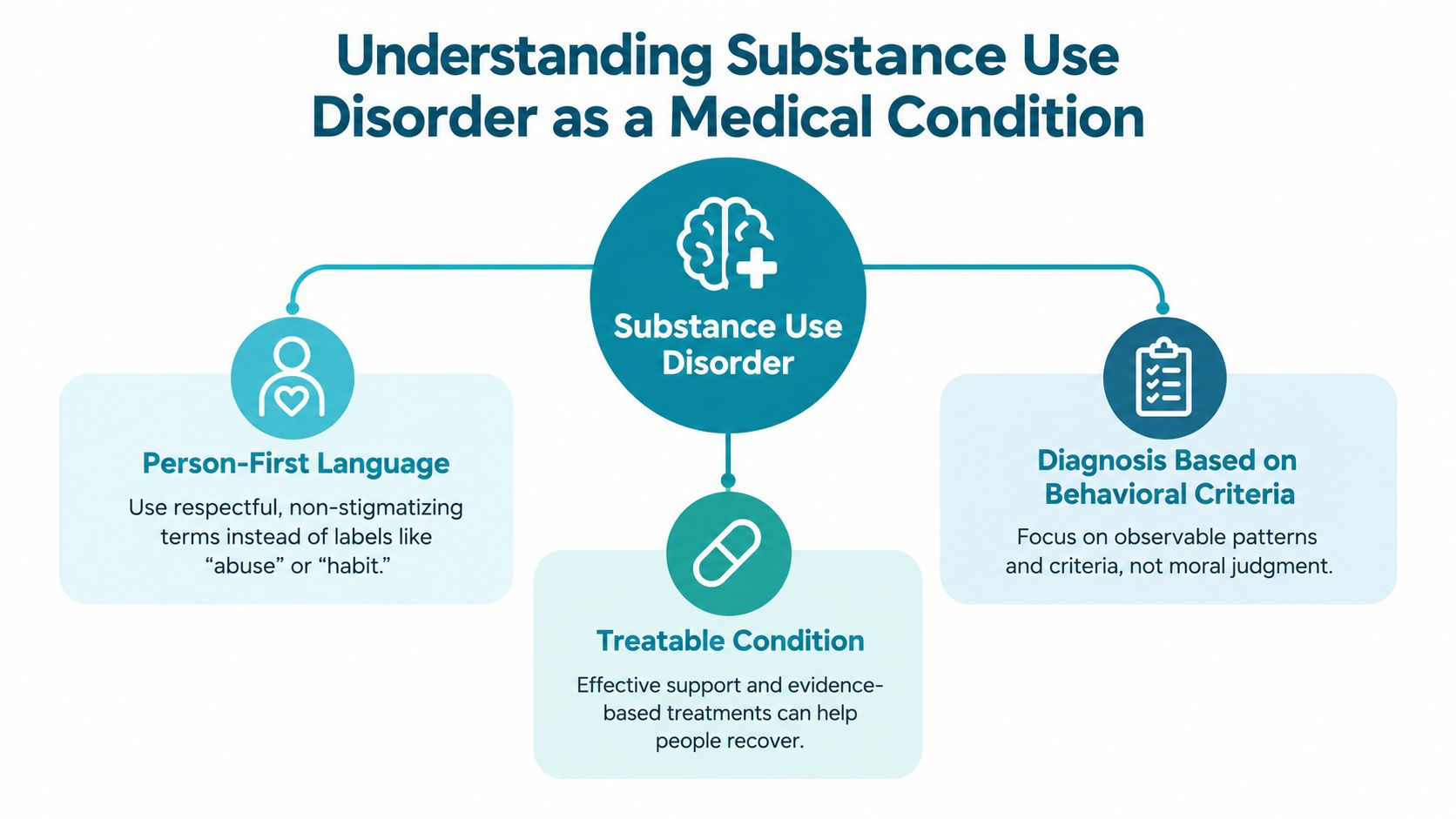
Why the medical model helps
Addiction involves brain circuits, learning, stress responses, genetics, development, and environment. Calling it a medical condition doesn't remove personal responsibility. It changes the response from blame to assessment, safety planning, treatment, and continued support.
This distinction matters in practice. A person may need medication, counseling, peer support, monitoring, or coordination with another clinician. A private addiction medicine specialist can help separate routine outpatient needs from situations that require urgent or more intensive care.
How Addiction Affects the Brain and Behavior
Addictive drugs and alcohol affect the mesolimbic reward system, particularly the pathway connecting the ventral tegmental area with the nucleus accumbens. These substances can produce sharp dopamine increases that reinforce drug-taking behavior and make environmental cues more powerful triggers for craving, according to this review of addiction neurobiology.
Dopamine is not just a “pleasure chemical.” It helps the brain learn what matters and what should be repeated. If a substance repeatedly creates an unusually strong signal, the brain begins to connect people, places, emotions, times of day, and routines with the expectation of using.
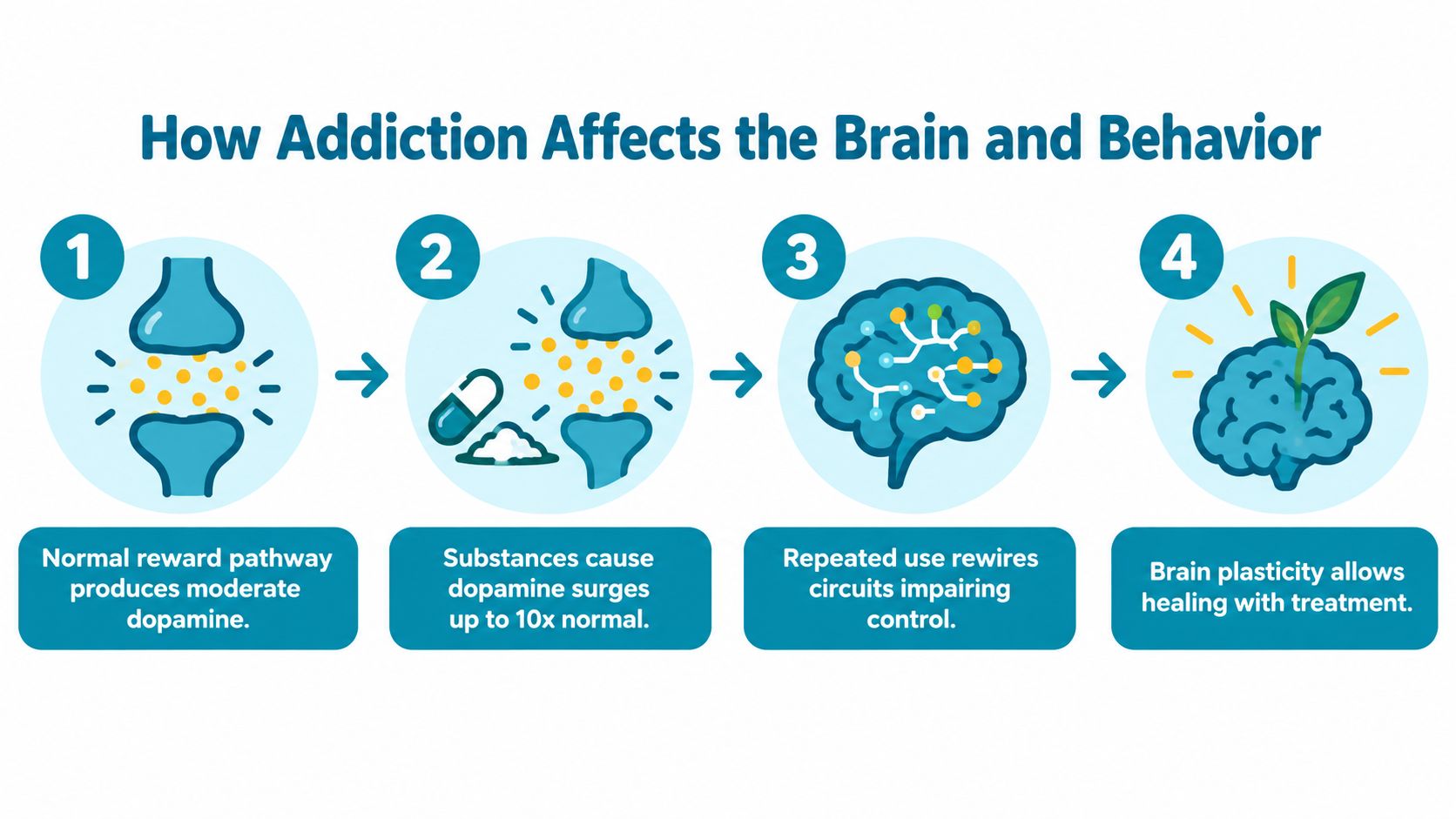
The thermostat analogy
Think of the brain as a thermostat that keeps adjusting to repeated exposure. When a substance repeatedly pushes reward signaling above its usual range, the brain adapts. Natural rewards may feel less satisfying, while the substance or its cues become unusually important.
This adaptation helps explain tolerance, when a person needs more of a substance or more frequent use to achieve a familiar effect. It also helps explain why stopping can feel physically or emotionally difficult. The person may use not to feel euphoric, but to reduce anxiety, irritability, low mood, pain, or other withdrawal-related discomfort. That pattern is called negative reinforcement.
Repeated exposure can also weaken executive-control circuits and strengthen conditioned responses and stress reactivity. In plain language, the brain's ability to pause and weigh consequences may be less reliable precisely when craving or stress is strongest.
Practical rule: Feeling a strong urge after stopping doesn't mean treatment has failed. It means the recovery plan needs to address cues, stress, sleep, support, and relapse risk over time.
Alcohol use disorder can involve measurable structural brain changes. A systematic review found gray-matter loss in prefrontal, cingulate, insular, and striatal regions, with greater frontal and cerebellar volume loss associated with higher severity and longer duration of alcohol use (systematic review and meta-analysis). This supports early assessment and longitudinal follow-up rather than waiting for a crisis.
For readers interested in the substance-specific effects of stimulant use, a physician can also discuss the medical evaluation of methamphetamine use.
Recognizing Risk Factors, Warning Signs, and Severity
Risk factors increase vulnerability, but they don't determine a person's future. A family history may raise concern. So may early exposure, trauma, chronic pain, social availability, persistent stress, or co-occurring anxiety, depression, or post-traumatic stress symptoms. These factors are reasons for careful assessment, not proof of addiction.
Warning signs usually involve a pattern rather than one isolated event. A person may notice that use is becoming more frequent, that attempts to reduce it keep failing, or that more of the substance is needed for the same effect. Family members may notice missed responsibilities, secrecy, mood changes, social withdrawal, financial or relationship problems, or continued use after clear harm.
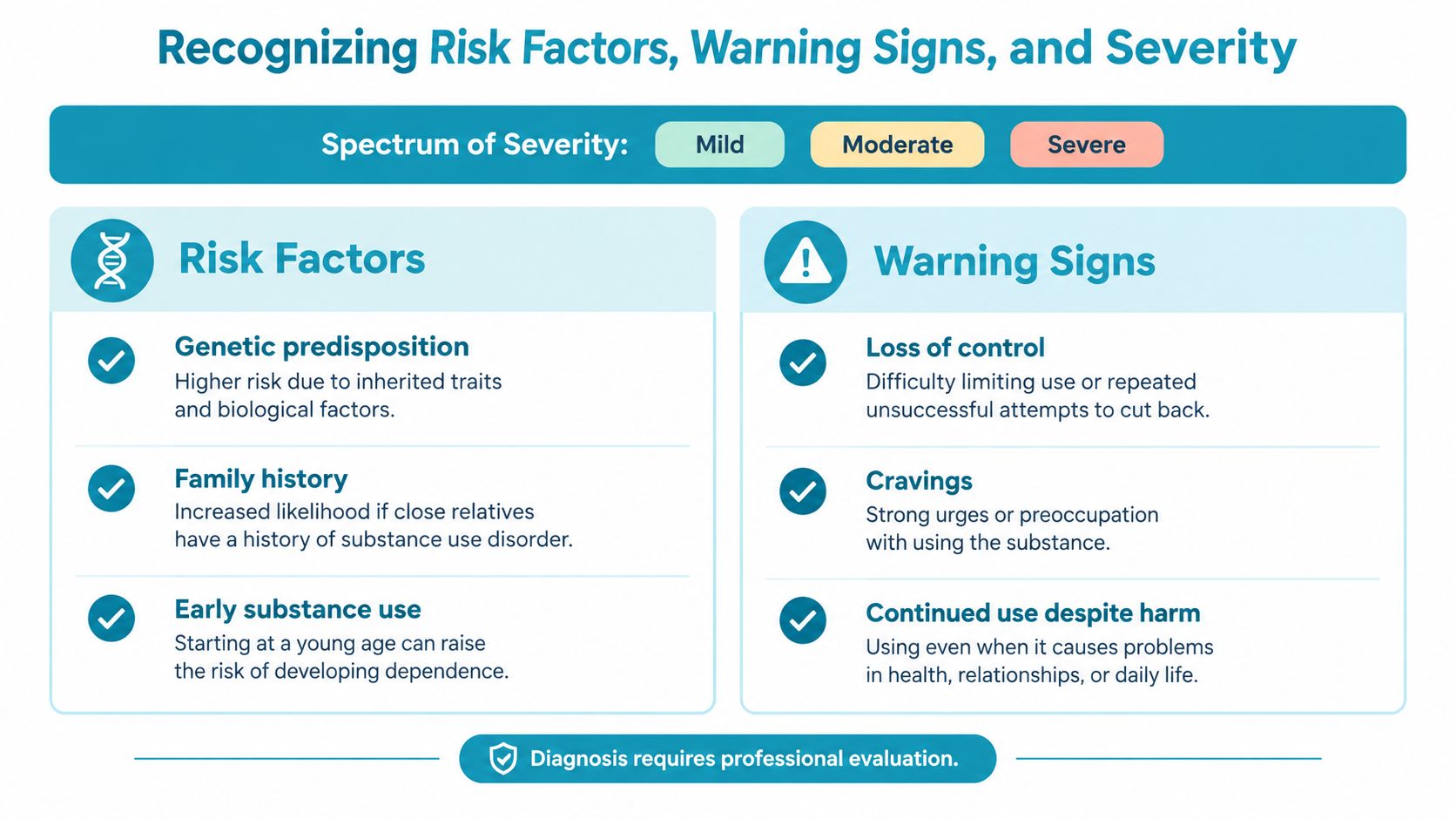
Risk factors and warning signs
The following observations can justify a scheduled medical evaluation:
- Loss of control: Use lasts longer or occurs more often than intended.
- Craving: Thoughts about obtaining or using the substance occupy increasing attention.
- Tolerance: The previous amount no longer produces the same effect.
- Withdrawal: Physical or emotional symptoms appear when use decreases.
- Continued harm: The person keeps using despite health, work, legal, or relationship consequences.
- Reduced functioning: Responsibilities, interests, or relationships receive less attention.
- Unplanned combinations: Alcohol, opioids, sedatives, or other substances are combined in ways that increase risk.
Online resources about driving and addiction red flags may help families recognize concerning behavior, but they can't establish a diagnosis. A clinician evaluates the whole pattern, including the substance involved and the person's medical context.
When the situation is an emergency
Loss of consciousness, slowed or difficult breathing, severe confusion, a seizure, suspected overdose, chest pain, or an immediate risk of self-harm requires emergency help. Call 911. For a suspected opioid overdose, the CDC naloxone fact sheet advises giving naloxone as quickly as possible, calling 911 immediately, trying to keep the person awake and breathing, placing the person on their side, and staying until emergency workers arrive.
Alcohol withdrawal deserves particular caution because severe withdrawal can include seizures or delirium. Someone with a history that suggests withdrawal danger shouldn't attempt to manage that risk alone without medical guidance. Alcohol-withdrawal concerns can be discussed through an alcohol withdrawal evaluation, with emergency referral when indicated.
Evidence-Based Treatment Options by Substance
Treatment must match the substance. A plan for opioid use disorder isn't interchangeable with a plan for alcohol, stimulant, nicotine, or sedative use. Medication decisions also depend on medical history, current medications, pregnancy status when relevant, withdrawal risk, prior treatment, and the person's goals.
| Substance | Withdrawal risk | Approved medications or medication considerations | First-line psychosocial care |
|---|---|---|---|
| Alcohol | Withdrawal can become medically dangerous, including seizures or severe confusion. | Clinicians may consider alcohol-use-disorder medications such as naltrexone, acamprosate, or disulfiram when appropriate. Withdrawal management may require supervised care. | Behavioral therapy, recovery planning, peer support, and treatment of co-occurring conditions. |
| Opioids | Withdrawal is often intensely uncomfortable, and overdose risk rises after tolerance changes or return to use. | FDA-approved medications include methadone, buprenorphine, and naltrexone. NIDA explains that methadone and buprenorphine reduce withdrawal and cravings and are associated with lower overdose and death risk than no treatment (NIDA medication guidance). | Medication treatment combined with counseling, recovery supports, and overdose education. |
| Stimulants | Withdrawal may involve fatigue, low mood, sleep changes, and strong cravings. | There are no broadly established FDA-approved medications specifically for stimulant use disorder. Medication research is ongoing. | Contingency management and cognitive behavioral therapy are important evidence-based approaches. |
| Nicotine | Withdrawal commonly involves cravings, irritability, concentration changes, and restlessness. | Clinicians may discuss varenicline, bupropion, or nicotine replacement therapy when suitable. | Counseling, quit planning, trigger management, and relapse prevention. |
| Sedatives | Abrupt cessation can be dangerous, particularly after regular or prolonged use. | A supervised, individualized taper may be needed. People shouldn't abruptly stop a regularly used sedative without medical guidance. | Behavioral therapy, sleep and anxiety treatment, support planning, and careful monitoring. |
For opioid use disorder, buprenorphine is commonly combined with naloxone. The naloxone component helps reduce misuse and diversion, while naloxone itself can be co-prescribed as an overdose-reversal medication (NIDA explanation of medication treatment). Medication isn't a cosmetic addition or a sign of weak recovery. It addresses specific biological risks.
A person preparing for a legal or administrative evaluation may also find a practical overview of a substance abuse evaluation DUI Florida useful, although legal evaluations and medical treatment assessments serve different purposes. For opioid-focused outpatient care, buprenorphine treatment may be considered when clinically appropriate.
A Composite Example of Outpatient Care in Practice
The following is a clearly labeled hypothetical composite, not a real patient story or Empire outcome. Consider an adult who uses alcohol, nicotine, and intermittent opioids. The person has mild depressive symptoms and a supportive family, but hasn't received a coordinated assessment.
The first visit would not begin with a lecture or a preset medication plan. The physician would review the substance history, timing and pattern of use, prior withdrawal, overdose history, medications, medical conditions, mood symptoms, safety at home, and the person's treatment goals. The clinician would then determine whether alcohol withdrawal creates a need for supervised withdrawal management rather than routine outpatient follow-up.
The opioid plan would be considered separately. It might include discussion of medication options such as buprenorphine, methadone, or naltrexone when appropriate, along with naloxone education. The nicotine plan would also be addressed rather than treating every substance as one problem with one solution.
Coordination makes the plan safer
If the adult needed detoxification, the physician would coordinate referral rather than attempting to provide detox through ordinary outpatient visits. After stabilization, outpatient follow-up could support medication management, monitoring, relapse-prevention planning, and communication with an authorized therapist or external program.
A therapist might provide cognitive behavioral therapy. An intensive outpatient program could be appropriate if the person needed more structure. Mutual-help or peer-recovery groups might add community support. Mild depression would receive its own assessment and treatment plan, without assuming that treating substance use automatically resolves every mental-health concern.
Screening tools can organize information, but they don't replace judgment. A clinician may use alcohol-withdrawal and opioid-withdrawal assessment tools when relevant, interpret them alongside the examination and history, and change the level of care if safety concerns emerge.
What Confidential Outpatient Addiction Care Includes
A first outpatient evaluation generally begins with consent, intake information, and a private discussion of why the person is seeking help. The physician reviews substance use, prior treatment, withdrawal and overdose history, medical conditions, psychiatric symptoms, current medications, sleep, pain, social supports, and safety concerns.
The visit may also include a physical examination and clinically appropriate testing. Depending on the situation, this can include laboratory evaluation, infectious-disease screening, medication review, pregnancy testing when relevant, and toxicology testing. Testing is used to improve safety and guide care, not to shame a patient.
Privacy and communication
Substance use disorder records receive special federal protection under 42 CFR Part 2 in applicable circumstances. SAMHSA describes Part 2 as a confidentiality framework for records that identify a person as having an SUD or receiving related services, with protections intended to encourage treatment seeking (SAMHSA confidentiality guidance).
Confidentiality still has boundaries. A physician generally needs appropriate authorization before discussing care with a family member, employer, therapist, or outside program, subject to applicable law and specific exceptions. Patients can ask how records, messages, test results, and coordination requests will be handled.
Follow-up and changing levels of care
Early follow-up may be closer together when medication is being adjusted, withdrawal risk is being monitored, or safety planning is active. Later visits may be spaced according to stability, treatment response, and ongoing risk. Monitoring can include medication reconciliation, prescription-monitoring review, toxicology testing when clinically indicated, craving and withdrawal assessment, mood and sleep review, and progress toward recovery goals.
Outpatient care can continue alongside authorized outside treatment. If the person needs detoxification, residential care, partial hospitalization, or intensive outpatient services, the outpatient physician can help coordinate the next step rather than treating referral as failure. Patients can learn more about certified addiction professional support as part of a broader recovery plan.
Frequently Asked Questions and How to Take a Next Step
How long does addiction treatment last?
There isn't one fixed treatment clock. Some people need months of structured care, while others benefit from longer medication management, monitoring, and recovery support. The decision should reflect safety, cravings, functioning, recurrence of use, co-occurring conditions, and the person's goals.
How do I know whether outpatient care is appropriate?
The key factors include withdrawal danger, overdose risk, medical and psychiatric stability, and whether the home environment is safe enough for the planned level of care. Emergency symptoms or dangerous withdrawal risk may require immediate emergency or supervised treatment instead.
Can family members participate?
Family involvement can be helpful, but it's generally consent-bound. A patient can authorize communication with selected people or programs, while the clinician still protects private information within applicable legal limits.
A confidential physician evaluation can clarify the next safe step. Empire Medical Wellness offers physician-led outpatient addiction assessment, evidence-based treatment when clinically appropriate, monitoring, recovery planning, and coordination with outside care. Visit Empire Medical Wellness to learn more about arranging an evaluation with Dr. Chhatpar.
This article is educational and isn't personal medical advice. If someone is unconscious, having difficulty breathing, experiencing a seizure, or at immediate risk of overdose or self-harm, call 911.