
Relapse means the return of symptoms or substance use after a period of improvement. A single brief lapse isn't automatically a full relapse, because clinicians also consider remission, duration, severity, and whether the underlying condition has become active again.
You may be searching this phrase after one drink, a return of cravings, a missed medication dose, or a sudden change in mood. The word can feel loaded, but its clinical purpose is practical. A return to substance use is a safety event and a signal to adjust treatment, not proof of moral failure or evidence that progress has disappeared.
In addiction medicine, relapse can involve renewed substance use after remission. In mental health care, it can mean the return or worsening of symptoms after improvement. The safest response is neither denial nor shame. It's a calm assessment of what happened, what risks are present, and what support needs to change.
By Empire Medical Wellness Editorial Team
Published September 26, 2026. Updated September 26, 2026.
Table of Contents
- What Relapse Means
- How Clinicians Define Relapse
- Lapse Versus Relapse and Why the Distinction Matters
- The Stages of Relapse Before Use Returns
- Common Causes and Early Warning Signs
- Substance-Specific Risks and Red Flags
- Evidence-Based Prevention and Early Response
- When to Call a Physician or 911
What Relapse Means
In plain language, relapse is the return of disease symptoms or substance use after improvement. The term describes a recurrence of illness or renewed use of an addictive substance after remission. The Cleveland Clinic's explanation of relapse and return to substance use clarifies why one episode does not automatically establish a sustained return of the disorder.
Remission means that a person no longer meets the active diagnostic criteria for a condition. Recovery and monitoring can still continue during remission. In substance use disorder, the DSM-5-TR framework distinguishes early remission, after at least 90 days without meeting diagnostic criteria, from sustained remission, after 12 months or more. Craving receives a specific clinical interpretation within these criteria. The timing and pattern of renewed use therefore help clinicians judge what kind of response is needed.
The word relapse is used in two related ways:
- Addiction medicine: substance use returns after improvement or remission.
- Mental health care: symptoms return or become worse after partial or full recovery.
A return of use or symptoms is a clinical signal and a safety event, not a character flaw. It may point to renewed cravings, stress, mood symptoms, medication problems, environmental cues, or another factor that needs attention. The information helps a physician and patient revise care before risks grow.
Practical rule: Treat a return of use or symptoms as information that deserves prompt attention, not as a verdict about the person.
Adults seeking confidential outpatient addiction medicine care can prepare for a visit by recording the timing, symptoms, substance involved if relevant, medications, sleep, stressors, and immediate safety concerns. This record cannot replace an assessment, but it can make the clinical discussion clearer and help identify warning patterns.
A lapse may stop quickly, while relapse can involve a broader return of symptoms or substance use. Clinicians assess the prior remission, the duration and intensity of the change, and whether diagnostic criteria are met again.
How Clinicians Define Relapse
Clinical language adds precision to a word people often use broadly. Someone may say, “I relapsed,” after one use or one difficult day. A clinician records that event as a safety signal, then assesses whether it represents a brief warning or a return to the earlier disorder pattern.
What the timing changes
Remission describes a period in which substance-use-disorder criteria are no longer met. Clinicians then focus on what happens after that period. A contained event that stops quickly may lead to a trigger review, safety planning, and closer monitoring. A return that re-establishes the disorder pattern can change the treatment plan, including medication review or a different level of care.
These categories describe the course of illness. They do not set a waiting period before someone can ask for help. A person does not need to meet a formal relapse definition to contact a clinician, especially when the substance carries overdose, withdrawal, or impaired-judgment risks.
Recovery has a wider meaning than remission. It includes ongoing changes in health, daily functioning, safety, relationships, and quality of life. A lapse or relapse can interrupt that process without erasing earlier progress.
Mental health recurrence
In mental health care, relapse generally means that previously improved symptoms return or worsen enough to represent a meaningful recurrence of the condition. Assessment considers the symptom pattern, duration, impairment, and whether the person again meets diagnostic criteria. A short period of sadness, anxiety, distraction, or feeling overwhelmed does not establish relapse by itself.
The substance involved also changes the safety lens. Alcohol or sedative use may increase impairment and breathing risk, while opioid use after reduced tolerance can raise overdose risk. Stimulant use may bring sleep loss, agitation, or cardiovascular concerns. These risks make the event clinically important even before a full disorder pattern is clear.
A clinician may ask:
- What symptoms or substance use returned?
- How long have they lasted?
- Are work, relationships, sleep, or safety affected?
- Did medication adherence or another treatment factor change?
- Does the pattern resemble the earlier illness?
People considering a physician-led addiction medicine evaluation can bring these details to an outpatient appointment. The goal is to match support to the current clinical picture, without assigning blame or forcing a label. A lapse still deserves prompt attention because early response can reduce the chance of a more dangerous recurrence.
Lapse Versus Relapse and Why the Distinction Matters
A person may use a substance once after a period of recovery, then stop and seek help. That event may be a lapse. If use continues, returns repeatedly, or meets the relevant clinical threshold, clinicians may describe it as a relapse. The terms are not identical across every condition or treatment program, so assessment of the full pattern still matters.
The NIH StatPearls review of relapse prevention describes relapse as a process and distinguishes an initial use, or lapse, from the uncontrolled use that may follow. The Cleveland Clinic's clinical overview also describes relapse as a return after improvement. Together, these perspectives support a practical point: one event may be an urgent warning without proving that the entire disorder has returned.
Lapse vs Relapse: Key Clinical Differences
| Feature | Lapse | Relapse |
|---|---|---|
| Pattern | A single or brief event that stops | A continuing or recurring return of use or symptoms |
| Clinical meaning | An early warning that support may need reinforcement | A possible return of the active condition |
| Questions clinicians ask | What preceded it, and what might prevent repetition? | Are diagnostic criteria met again, and how severe is the recurrence? |
| Likely response | Prompt review of triggers, supports, medication continuity, and safety | Treatment-plan reassessment, medication review, and consideration of a higher level of care |
| Effect on recovery | Does not erase prior progress | Does not erase prior progress, but may show that the current plan needs substantial adjustment |
The distinction protects two truths. A lapse should never be dismissed, because reduced tolerance can increase overdose risk, withdrawal can become dangerous, and symptoms may escalate quickly. The substance also changes the safety lens. Opioid use after reduced tolerance can raise overdose risk, while alcohol or sedatives may increase impairment and breathing problems.
At the same time, calling every isolated event total failure can increase shame and make honest help-seeking less likely. The practical payoff is a different response: a lapse calls for a trigger review and strengthened supports within days, while a relapse calls for formal reassessment of the treatment plan and level of care.
The Stages of Relapse Before Use Returns
Relapse can develop before physical substance use occurs. A review in NIH's PubMed Central archive on the stages of relapse describes emotional relapse, mental relapse, and physical relapse. The model is useful because it gives people earlier points at which to ask for help.
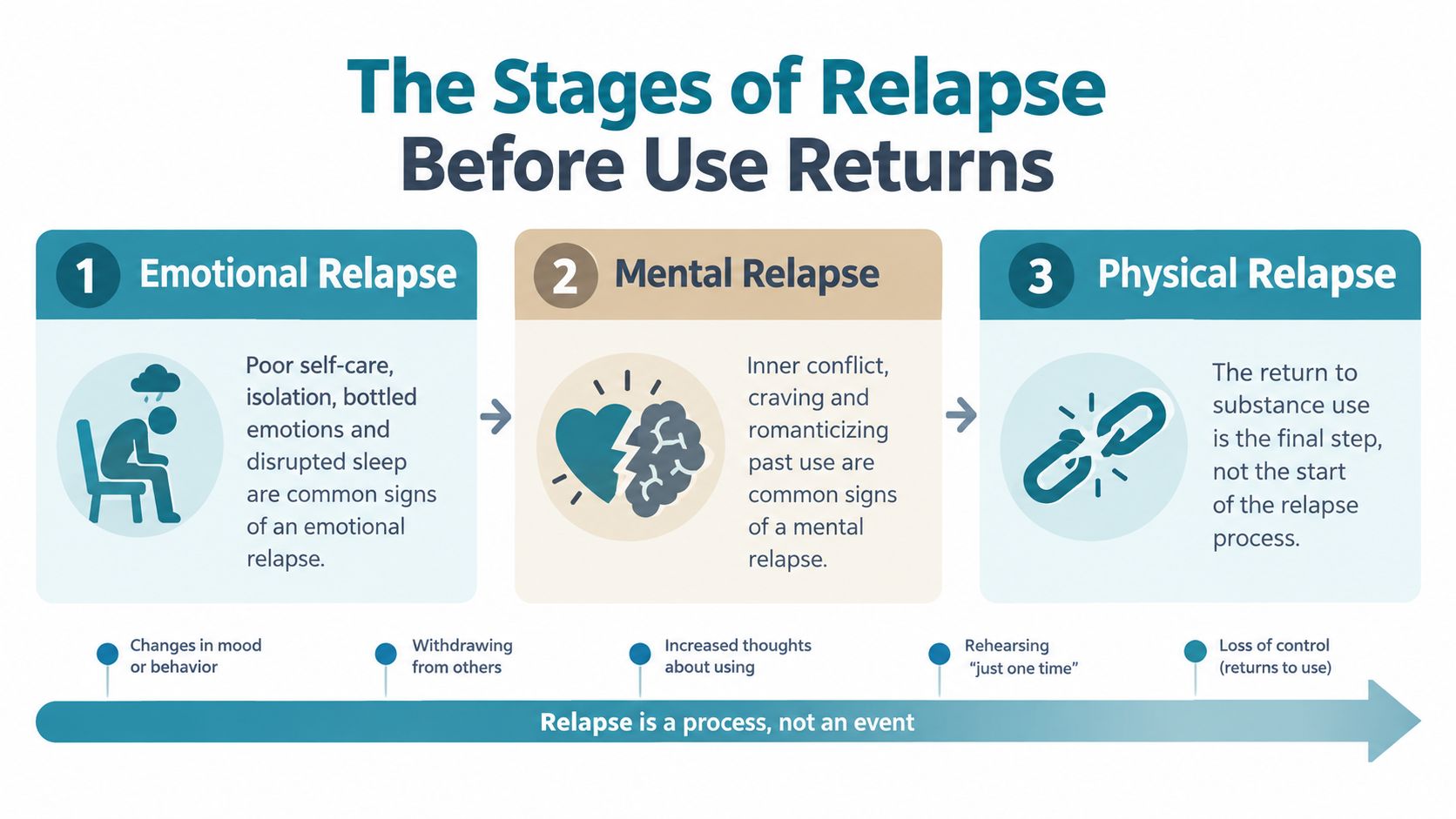
Emotional relapse
At this stage, a person may not be consciously thinking about using. They may stop sleeping well, withdraw from support, bottle up emotions, neglect meals, or abandon routines that previously helped. The response is structured stabilization, such as restoring regular sleep and meals, reducing isolation, attending an established support meeting, and contacting a clinician.
Mental relapse
Mental relapse involves conflict. One part of the person wants to remain in recovery, while another begins craving, romanticizing past use, minimizing consequences, or planning how to obtain a substance. Reaching out early matters. A sponsor, therapist, support group, or physician can help challenge the thought pattern before it becomes a plan.
Early warning signs are opportunities for recalibration. They aren't proof that treatment has failed.
Physical relapse
Physical relapse is the return to substance use itself. This is the point for immediate safety action, not secrecy. Don't use alone, don't assume prior tolerance remains, contact a support person, and seek rapid medical follow-up. If breathing, consciousness, chest pain, seizure activity, severe confusion, or suicidal intent is involved, use emergency services rather than waiting for an outpatient visit.
The value of this model is its timing. Emotional and mental signs may offer more room for prevention than the physical event, but every stage deserves a respectful, clinically appropriate response.
Common Causes and Early Warning Signs
A person may notice relapse risk after a difficult week, a medication change, or an unexpected encounter with an old using environment. Usually, several factors interact. Craving can intensify when familiar cues activate learned reward responses. Stress, poor sleep, pain, isolation, conflict, mood symptoms, and contact with people or places linked to past use can reduce the time available to choose a safer response.
Review the situation across biological, emotional, cognitive, and behavioral domains. Craving during abstinence and outpatient treatment has been associated with later return to use, and research summarized in this NIH review of relapse predictors links stress-system measures with faster return after discharge. These findings support monitoring and early clinical discussion, not self-diagnosis.
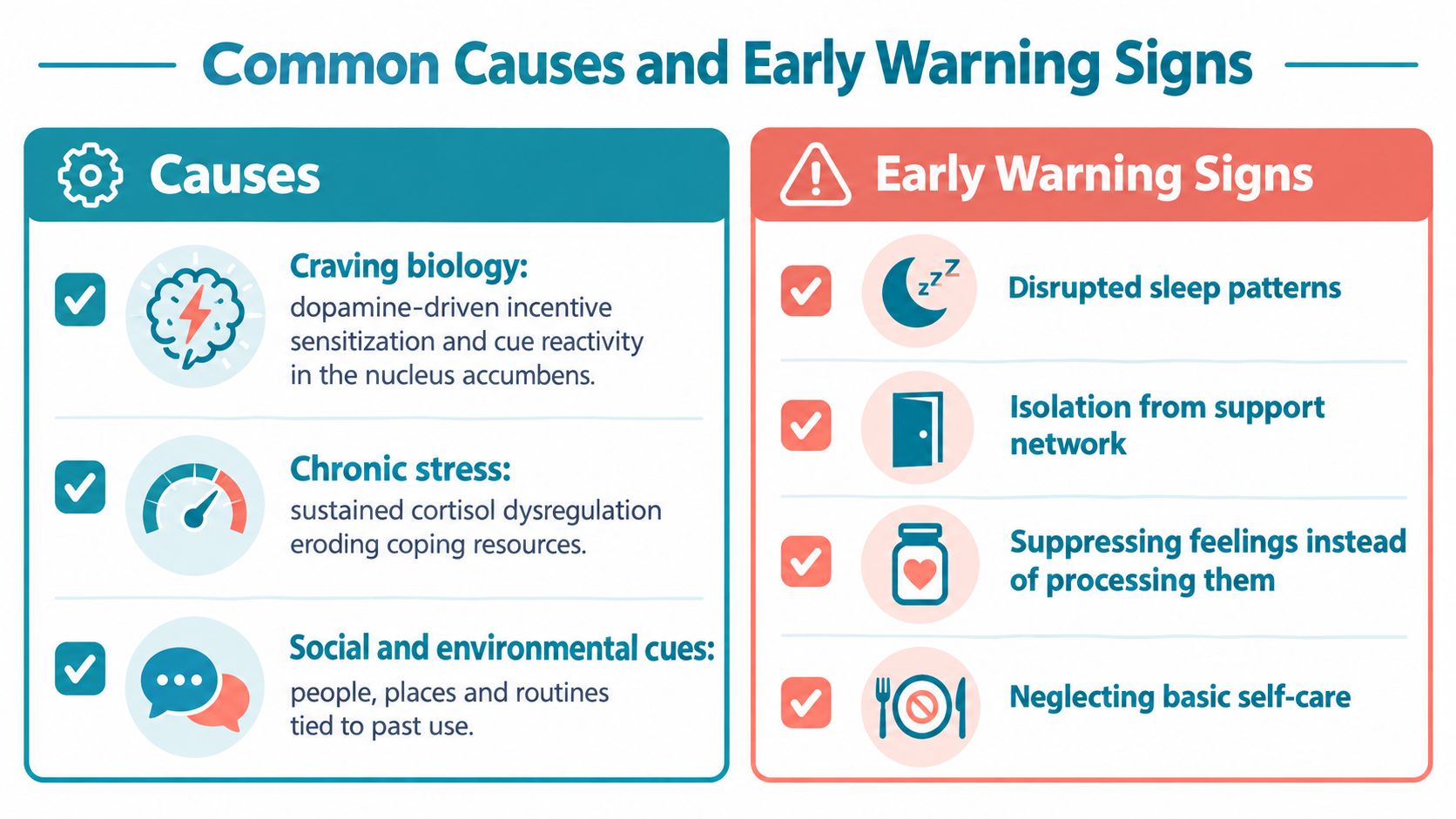
Causes and cues to review
- Craving biology: Record when an urge appears, what preceded it, how long it lasts, and whether a cue, memory, or location was involved.
- Stress and sleep disruption: Log repeated broken sleep, unusually high demands, exhaustion, or a noticeable drop in daily coping.
- Co-occurring symptoms: Depression, anxiety, trauma-related symptoms, and other mental health concerns can increase vulnerability when untreated or poorly controlled. Adults may discuss these concerns through adult mental health evaluation and medication management when clinically appropriate.
- Social and environmental exposure: Note contact with former using peers, paraphernalia, celebrations, familiar routes, or routines associated with substance use.
- Pain and prescribing changes: Report acute pain, surgery, missed medication, or a change in access to prescribed treatment to the treating clinician.
- Interpersonal strain: Grief, loneliness, conflict, or a sudden life change can alter mood and increase craving.
Signs worth recording
Use concrete observations rather than labels. Examples include three or more nights of broken sleep, skipping a scheduled meeting or appointment, missing medication doses, withdrawing from a support person, or a mood change lasting beyond 48 hours. Cognitive signs include searching for a supplier, checking availability, setting aside money, arranging transportation, or making any other plan to obtain a substance, however small. Behavioral signs include returning to a former route, hiding communications, or keeping substances or paraphernalia nearby.
These observations are signals for a safety review, not proof of treatment failure. A clinician can help assess changes in sleep, mood, medication continuity, access to substances, and available support.
Substance-Specific Risks and Red Flags
The meaning of relapse changes with the substance involved. Reduced opioid tolerance after abstinence can raise fatal-overdose risk. Alcohol and sedative withdrawal can become medically dangerous, while stimulant return can produce cardiovascular or psychiatric emergencies.
Use the table as a rapid reference for patients and families. It isn't a substitute for emergency care or an individualized withdrawal assessment.
Substance-Specific Relapse Risks and Red Flags
| Substance | Overdose Red Flags | Withdrawal Red Flags | Tolerance-Loss Warning | Emergency Actions |
|---|---|---|---|---|
| Opioids | Pinpoint pupils, slowed or stopped breathing, blue or gray lips or skin, unresponsiveness | Gooseflesh, diarrhea, cramping, severe cravings | Prior amounts may become dangerous after abstinence because tolerance can fall | Call 911, give naloxone if available and appropriate, provide rescue support as instructed by emergency dispatch, and stay with the person |
| Alcohol or benzodiazepines and other sedatives | Confusion, vomiting while sedated, slowed breathing, low body temperature, inability to stay awake | Tremor, rapid heart rate, seizures, severe confusion, hallucinations, delirium tremens risk | A changed pattern of use can produce unpredictable intoxication or withdrawal risk | Call 911 for breathing problems, seizure, severe confusion, or loss of consciousness. Don't attempt unsupervised detox |
| Stimulants | Chest pain, severe blood-pressure elevation, overheating, extreme agitation, seizure | Depressed mood, suicidal thoughts, excessive sleep, intense craving | Prior tolerance doesn't reliably predict current cardiovascular or psychiatric risk | Call 911 for chest pain, seizure, severe overheating, loss of consciousness, or dangerous agitation. Seek immediate psychiatric evaluation for psychosis or suicidal thoughts |
For a plain-language discussion of body and stress warning signs, readers may also find signs your nervous system needs support useful as a supplemental resource, not as a diagnostic tool.
NIDA describes addiction as chronic and explains that return to drug use after trying to stop can occur during recovery. That framing supports continued care rather than punishment. The immediate priority remains breathing, consciousness, temperature, seizures, chest symptoms, severe withdrawal, and suicide risk.
Evidence-Based Prevention and Early Response
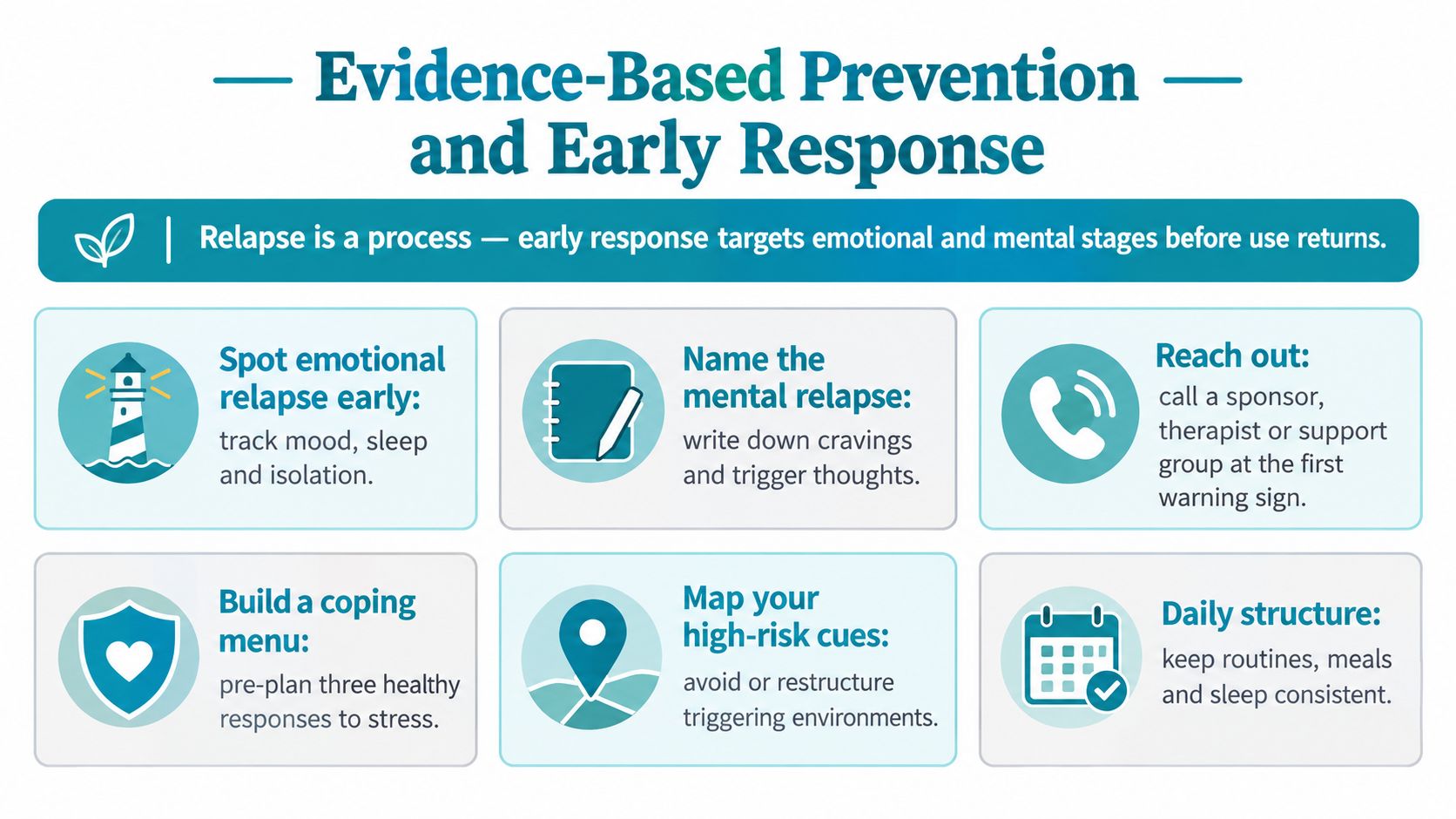
Prevention works best when it starts before physical use returns. The three-stage model places attention on emotional and mental changes, while medical care adds monitoring for cravings, mood symptoms, medication adherence, stress, and substance-specific safety.
A practical prevention plan can include four parts:
- Map triggers. Record people, places, emotions, pain episodes, celebrations, and routines linked with prior use. Identify which cues can be avoided and which require a prepared response.
- Repair the routine. Re-establish sleep, meals, movement, medication routines, and one reliable daily activity. Small predictable actions can provide structure when motivation is low.
- Rehearse the first call. Decide in advance whom you'll contact when cravings rise. Practice the words you'll use to request help before an urgent moment arrives.
- Support treatment continuity. Don't stop, restart, or change prescribed medication without speaking with the prescriber. Maintenance treatment and medication management need individualized clinical oversight.
A return-to-use safety plan
If substance use returns, focus on safety before analysis.
- Name the substance and timing. This helps clinicians assess overdose, interaction, and withdrawal risks.
- Assume tolerance may have changed. Don't test tolerance, and don't use alone.
- Prepare for opioid risk. Keep naloxone accessible when opioid exposure is possible and make sure people nearby know where it is and how to respond.
- Maintain medicine contact. Don't abandon prescribed treatment or make medication changes on your own. Contact the prescriber or outpatient clinician promptly, ideally within 24 to 48 hours when medically appropriate.
- Review the trigger chain. After immediate safety is addressed, identify the emotional, cognitive, social, and practical events that preceded use.
- Escalate care when needed. A physician may adjust monitoring, address co-occurring mood or anxiety symptoms, coordinate with outside treatment, or recommend a more intensive setting.
For adults receiving or considering medication treatment for opioid use disorder, Suboxone-related addiction medicine care should be discussed with a qualified prescriber who can evaluate the full medical context. The appropriate medication and treatment pathway varies by person.
When to Call a Physician or 911
Use three levels of response. If you're uncertain and safety may be compromised, choose the more urgent option.
Contact Tiers for Relapse-Related Concerns
| Tier | When to Act | Example Signs |
|---|---|---|
| Routine outpatient | Arrange a same-week call or visit | Any lapse, increasing cravings, disrupted sleep, new mood symptoms, missed treatment, or growing isolation |
| Urgent physician contact | Contact a physician within 24 hours | Repeated use, returning withdrawal symptoms, suicidal thoughts without a plan, or destabilization of a co-occurring condition |
| Emergency 911 or crisis services | Act immediately | Suspected overdose, stopped or difficult breathing, seizure, severe withdrawal with confusion or hallucinations, chest pain, loss of consciousness, or suicidal thoughts with a plan or intent |
For opioid-related prevention and medication discussions, naloxone access and education can be part of a broader safety plan. Naloxone doesn't replace emergency services, and it doesn't address every cause of unresponsiveness.
Call 911 for suspected overdose, severe breathing problems, seizure, chest pain, severe overheating, loss of consciousness, or dangerous confusion. If someone may harm themselves, call or text 988 in the United States for crisis support, or call 911 when there is immediate danger. Don't leave the person alone while waiting for help.
Seeking care is a safety action. It doesn't cancel recovery, and it doesn't require you to decide whether the event technically qualifies as a lapse or relapse before making contact.
Empire Medical Wellness provides private-pay, physician-led outpatient addiction medicine assessment, treatment planning, monitoring, and recovery-focused follow-up when clinically appropriate. Visit Empire Medical Wellness to learn about outpatient care and next steps for discussing return-to-use concerns with a qualified physician.
This article is educational and isn't personal medical advice.