
332 million people worldwide live with depression, and about 5.7% of adults are affected. In everyday terms, that means depression is not the same as a rough week or ordinary sadness, and a formal diagnosis depends on persistent symptoms, functional impairment, and at least two weeks of duration evaluated by a clinician using established criteria and screening tools.
If you're worried that what you're feeling “doesn't count,” that doubt is common. Many people picture depression as constant crying or staying in bed, but real depression can also look like irritability, exhaustion, numbness, slowed thinking, or a loss of interest that changes how work, relationships, and basic self-care feel.
Table of Contents
- What Depression Actually Means
- Types and Presentations of Depression
- Common Signs and Symptoms to Recognize
- Causes and Risk Factors Explained
- How Evaluation and Diagnosis Actually Work
- Treatment Options and How They Fit Together
- A Hypothetical Look at Shared Decision Making
- Self Help, Safety Planning, and Next Steps
What Depression Actually Means
A person may arrive saying, “I'm not myself,” while another says only that everything feels heavier, slower, or strangely flat. Both descriptions can fit depression. The diagnosis is not based on whether someone looks tearful or sounds sad, but on a lasting change in mood, interest, thinking, energy, and day-to-day functioning.
Depression is a medical condition, not a character flaw or a personal weakness. Clinically, it means a persistent pattern of low mood, loss of interest, or related emotional, cognitive, and physical changes that interfere with daily life. The key distinction is persistence plus impairment, because intensity alone does not tell the full story.
That is why clinicians ask how long symptoms have lasted, whether they have been present most days, and whether they have changed how someone functions. A person can feel sad after a loss or a hard month and still not meet criteria for a depressive disorder. Another person may not describe themselves as sad at all, yet still have depression because the main problem is loss of pleasure, heavy fatigue, slowed concentration, or withdrawal from normal activities.
Why the threshold matters
A two-week minimum is not arbitrary. It helps clinicians separate temporary emotional distress from a syndrome that usually needs more structured evaluation and follow-up. It also reduces the chance of labeling depression when the better explanation may be grief, burnout, medication effects, substance use, sleep loss, or a medical illness.
The World Health Organization has described depression as a major global health concern, and its depression fact sheet is one place to review how broad the condition is across settings. The point is not that every case looks the same. It is that depression is common, persistent, and seen in people from many different backgrounds and life circumstances.
Practical rule: if symptoms are persistent, affect sleep, energy, thinking, or relationships, and are getting in the way of life, it is worth a professional evaluation even if the feeling is not “classic sadness.”
Adults seeking private, physician-led care can benefit from a careful evaluation that distinguishes depression from other causes of persistent low mood. The first visit should focus on sorting through the pattern carefully, not on a label alone. Some people need reassurance and monitoring. Others need a broader evaluation for treatment planning, safety, and follow-up.
Types and Presentations of Depression
Depression does not present as one neat pattern. The diagnosis can refer to a single episode, a recurrent pattern, a chronic low-grade course, or depressive symptoms that occur within another mood disorder. The label matters because it changes what a clinician looks for next, especially around bipolar-spectrum symptoms, duration, and the likelihood of recurrence.
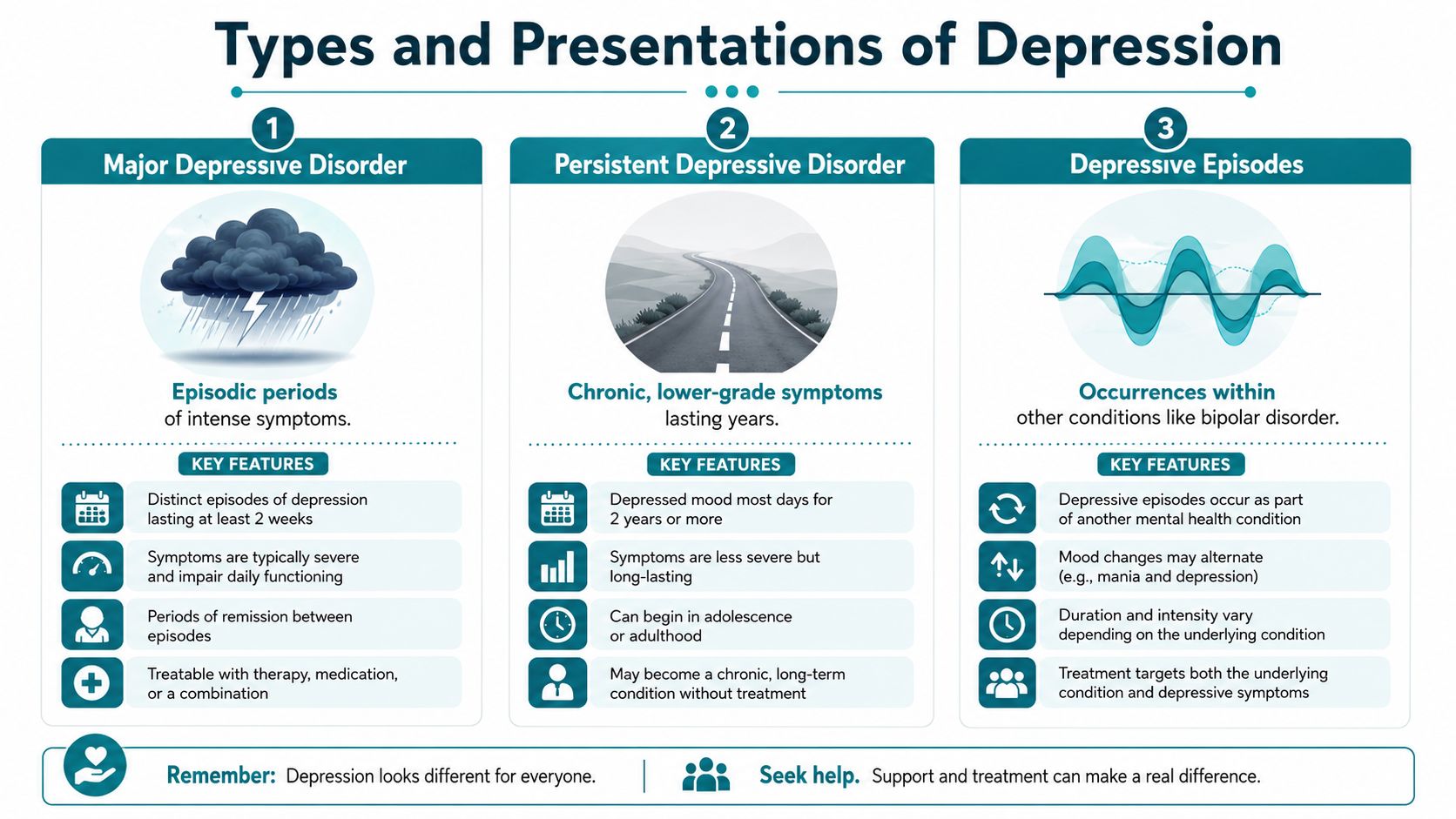
The main patterns clinicians think about
Major depressive disorder usually comes in episodes, with symptoms that are clearly worse than a person's baseline and strong enough to disrupt function. Persistent depressive disorder is different, because symptoms are lower grade but linger for a long time and can become the person's “new normal.” Depressive episodes within bipolar-spectrum illness matter because the treatment discussion changes when a history of mania or hypomania is part of the picture.
There are also presentations that online content often misses. Some people describe leaden heaviness, low motivation, or a body that feels slowed and drained. Others notice irritability, not sadness, or a strange sense of emotional flatness where nothing feels good or bad enough to name.
Why stereotype-based descriptions cause confusion
A narrow picture of depression leaves many adults unsure whether they qualify for help. If a person can still go to work but is barely keeping up, they may dismiss their symptoms. If they are not tearful, they may assume it cannot be depression.
That is a mistake. Depression can show up as sleep changes, appetite changes, reduced pleasure, reduced concentration, or a steady drop in functioning without obvious outward distress. Recent summaries of lived experience also point to heterogeneity, including trauma, comorbid conditions, gender-related factors, and environmental stressors shaping how depression feels and how it is recognized.
Depression is diagnosed by the pattern of symptoms and the impact on life, not by whether someone looks visibly sad.
For adults comparing experiences, the useful question is not “Do I look depressed?” It's “Has my baseline changed enough that daily life feels harder, flatter, or less manageable than before?”
Common Signs and Symptoms to Recognize
Symptoms tend to cluster, which makes them easier to notice without turning them into a self-diagnosis. The same person may have strong emotional symptoms but few physical complaints, or the reverse. That variation is one reason depression can be missed in primary care and in self-reflection.
Emotional and cognitive changes
Emotionally, depression often includes persistent sadness, emptiness, irritability, numbness, or loss of interest in things that used to matter. Cognitively, people may notice slower thinking, trouble making decisions, poor concentration, hopelessness, or recurring thoughts that life would be easier if they were not here. Some adults do not experience obvious sadness at all, which is why a “no tears, no depression” rule misses a lot of real illness.
Physical and functional changes
Physical symptoms can be just as important. Sleep may become too short, too long, or broken. Appetite can go up or down, energy can fall, and the body can feel heavy, tense, or drained. Unexplained aches and a general sense of being worn out are common enough that clinicians ask about them directly.
Functionally, depression often shows up as withdrawal. A person may miss work, answer fewer messages, stop exercising, skip meals, or let bills and chores pile up because each task feels harder than it used to.
| Cluster | What it can look like | Why it matters |
|---|---|---|
| Emotional | Sadness, emptiness, irritability, loss of interest | Often the first clue that mood has changed |
| Cognitive | Poor concentration, indecision, hopelessness, thoughts of death | Can affect safety, work, and judgment |
| Physical | Sleep disruption, appetite change, fatigue, aches | May be the main complaint, not mood |
| Functional | Withdrawal from work, relationships, or self-care | Shows whether symptoms are impairing daily life |
If thoughts of self-harm, inability to care for yourself, or a sudden severe worsening are present, the situation needs same-day attention. Call 988 in the U.S. for immediate crisis support, or use emergency services if there's imminent danger.
Causes and Risk Factors Explained
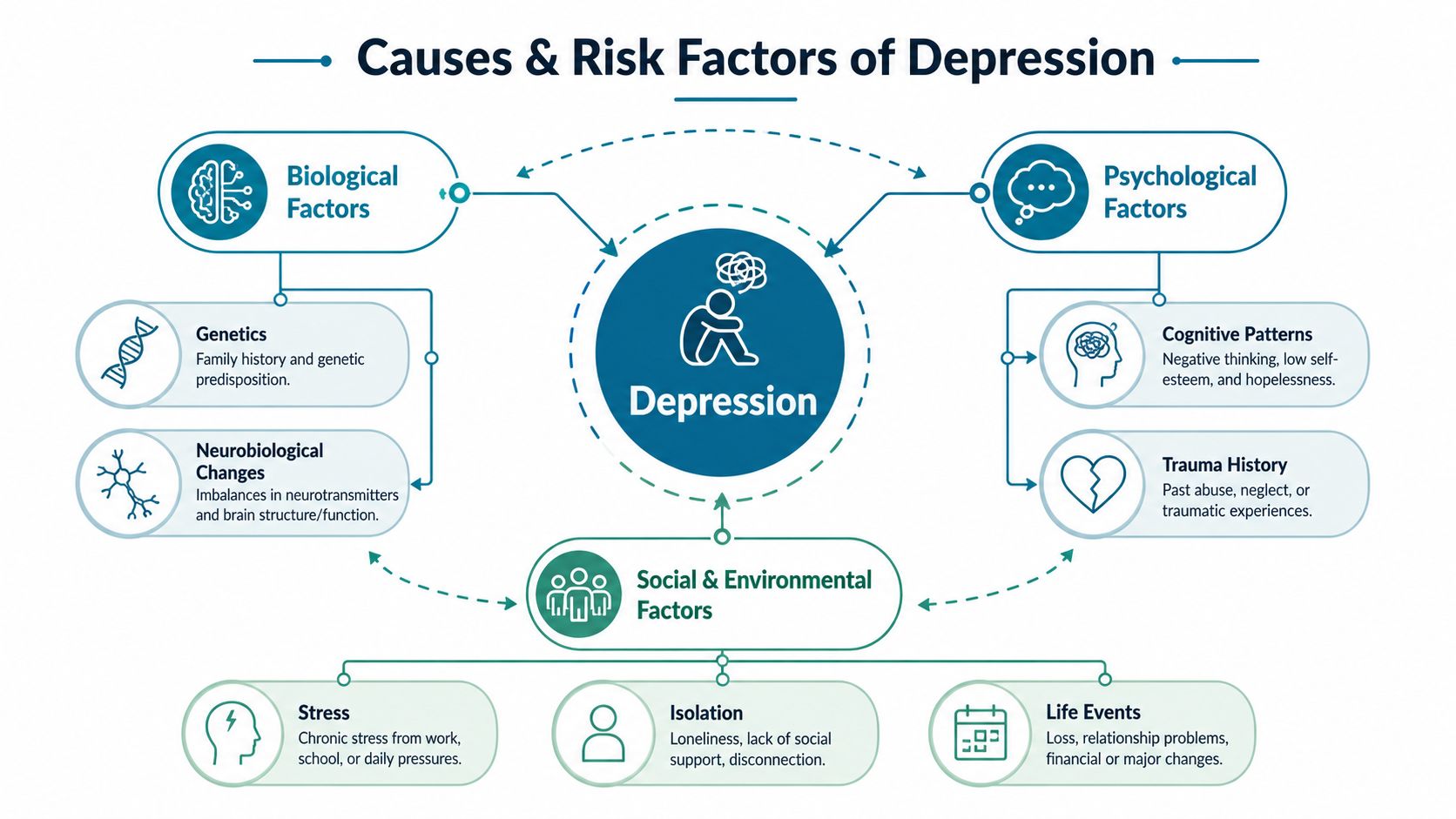
A person can have depression without a single obvious trigger, and another person can develop it after a clear stressor. The difference is one reason depression is better understood as a multifactorial neurobiological syndrome than as a simple chemical shortage. Several systems can be involved at the same time, including brain circuits, stress regulation, inflammation, neurotrophin signaling, and monoaminergic and glutamatergic neurotransmission, as described in an Oxford Academic review. That helps explain why two people can look similar at first glance and still need different treatment plans.
Biology, stress, and lived experience interact
Research in neuroimaging has linked depression with changes in prefrontal, anterior cingulate, insular, limbic, and hippocampal regions. Large-scale population imaging has also found reduced gray-matter volume or cortical surface area in the frontal cortex, anterior cingulate, and insula, according to a Nature review. These are research findings, not a bedside test for one individual person. They do, however, show that depression involves real network-level changes rather than a vague lack of willpower.
The lived picture is usually broader than biology alone. Chronic stress can keep the body in a state of alarm, trauma history can alter how safe a person feels in ordinary situations, and isolation can make symptoms heavier because there is less social buffering. Grief, sleep disruption, medical illness, and medication or substance effects can all add pressure to the same system. For adults whose mood symptoms overlap with alcohol or drug use, addiction medicine evaluation can be part of the discussion, because substance use may complicate depression even when it is not the main cause.
Clinical insight: when depression does not respond as expected, clinicians often revisit sleep, alcohol or drug use, medical conditions, and medications before assuming the diagnosis was wrong.
That broader lens also fits day-to-day outpatient care. A careful visit is often less about finding one cause and more about sorting out which forces are active, which are amplifying each other, and which are most practical to treat first. Sometimes one pathway is dominant and one intervention is enough. Other times several factors are working together, and follow-up becomes part of the treatment itself.
How Evaluation and Diagnosis Actually Work
A careful depression evaluation starts with the story, not the prescription pad. Clinicians ask when symptoms began, whether they've been persistent, what changed in sleep, appetite, energy, and concentration, and how much work, relationships, and self-care have been affected. They also look for triggers, medical causes, medication effects, substance use, and symptoms that suggest bipolar-spectrum illness.
What a thoughtful first visit includes
A good outpatient assessment usually covers these areas:
- Symptom duration and pattern: whether symptoms have lasted at least two weeks and whether they've been present most days.
- Functional impact: what's changed at work, at home, in relationships, or in basic routines.
- Medical and medication review: thyroid problems, sleep disorders, pain, steroids, some neurologic conditions, and other contributors may matter.
- Substance use: alcohol or other substances can mimic, worsen, or complicate depression.
- Bipolar screening: past periods of decreased need for sleep, unusually high energy, impulsivity, or feeling abnormally “up” change the diagnosis and treatment plan.
- Safety risk: thoughts of self-harm, intent, plan, past attempts, or inability to stay safe need urgent attention.
Validated screening tools can support that interview. The PHQ-9 is commonly used to track symptom severity and response over time, but it does not replace a clinical diagnosis. A score can help organize the conversation, yet the person's actual functioning and safety matter more than any single number.
Why the first visit is often about clarification
Some people expect an immediate medication decision. Sometimes that's appropriate, but not always. If the picture is unclear, a clinician may need records, collateral history, or additional medical workup before settling on a plan. That is especially true when symptoms could reflect grief, burnout, trauma, substance effects, or a medication side effect.
Empire Medical Wellness mental health medication review fits into this kind of stepwise evaluation, where the focus is careful diagnostic clarification and ongoing medication management rather than a one-time opinion.
| Screen or question | What it helps with | What it cannot do |
|---|---|---|
| PHQ-9 | Track severity and change over time | Diagnose depression by itself |
| Clinical interview | Sort depression from look-alikes | Eliminate uncertainty in one visit |
| Safety assessment | Identify urgent risk | Replace emergency evaluation when needed |
If the evaluation uncovers active suicidal thinking with plan or intent, or a person cannot stay safe, same-day crisis care or emergency services is the right next step. Waiting for a routine appointment is not appropriate in that situation.
Treatment Options and How They Fit Together
Depression treatment usually works best when it matches the person's symptom pattern, preferences, and practical constraints. The main options are psychotherapy, medication, lifestyle and behavioral support, and combined care. None of these is a universal fix, and each has trade-offs.
| Approach | Typical Role | Monitoring Focus | Reassessment Triggers |
|---|---|---|---|
| Psychotherapy | Teaches coping skills, thought patterns, and behavior change through evidence-based methods such as CBT and related therapies | Engagement, symptom change, functioning, and whether the therapy fit feels useful | Little progress, access barriers, worsening symptoms, or mismatch with the patient's goals |
| Common medication classes | Can reduce depressive symptoms when clinically appropriate, especially when symptoms are moderate to severe or persistent | Side effects, adherence, sleep, activation, mood change, and safety | Partial response, side effects, interactions, or new symptoms |
| Lifestyle and behavioral support | Sleep regularity, activity, nutrition, and reduction of alcohol or other substances can support recovery | Routine, energy, sleep quality, and follow-through | Inability to sustain basics, worsening function, or escalating substance use |
| Combined care | Blends medication, therapy, and coordination with other clinicians | Symptom trajectory, function, adherence, and safety across visits | Plateau, side-effect burden, or changing life circumstances |
For adults trying to coordinate therapy access, a resource like appointment scheduling for therapists can be helpful because access barriers often shape whether evidence-based therapy is reachable. The practical issue isn't just what works in theory, but what a person can reasonably start and continue.
What timelines and follow-up usually look like
Many treatments need several weeks before the full effect is clear, so follow-up matters. Clinicians often track repeated PHQ-9 scores alongside sleep, side effects, adherence, and daily functioning rather than treating one score as the whole story. If improvement is only partial, or if side effects make a treatment hard to keep taking, the plan usually gets revisited.
That reassessment may involve switching, adjusting, or combining treatments. The right next step depends on prior adequacy of treatment, interactions, comorbid anxiety, sleep problems, substance use, and patient preference. Some medication uses are FDA-approved for depression, while other psychiatric uses can be off-label, and a clinician should be clear about that distinction when it comes up.
Empire Medical Wellness anxiety medication is relevant when anxiety is part of the picture, because overlap between anxiety and depression can influence both the treatment discussion and what symptoms are monitored first.
Monitoring matters because response is not binary. A partial improvement can still be clinically meaningful, but it also tells the clinician to keep refining the plan.
Physician-led medication management is realistic and useful when it focuses on evaluation, follow-up, tolerability, and coordination. It does not guarantee remission, and it should not be framed as a one-visit solution.
A Hypothetical Look at Shared Decision Making
Hypothetical composite scenario: an adult comes in after months of low energy, reduced interest, and trouble sleeping. They've had a partial response to a previous antidepressant, but they also worry about daytime sedation, have coexisting anxiety, want to avoid worsening weight concerns, and are trying to cut back on alcohol.
The clinician's job is not to pick a medication in a vacuum. It's to map the current symptoms, review what was tried before, ask whether therapy is available, and consider what the patient can realistically monitor between visits. If sleep is the main issue, that may change how the discussion is framed. If alcohol use is active, that changes it again.
Shared decision making in practice
The plan might emphasize one of several evidence-based paths:
- Continue or change medication thoughtfully: based on prior benefit, side effects, and safety.
- Add psychotherapy if accessible: especially if anxiety, avoidance, or negative thinking are prominent.
- Track functional goals: sleep consistency, work attendance, or social reconnection, not just symptom counts.
- Reassess early if needed: because a response trajectory is more informative than a single visit.
Empire Medical Wellness Suboxone is relevant only as an example of how the practice also addresses substance use concerns when they coexist with other issues, although depression care and substance-use care still need to be assessed separately.
The important part of shared decision making is humility. No approach guarantees remission, and response times vary. A careful follow-up visit is meant to see what is changing, what isn't, and whether the original assumptions still fit.
Some people need a medication change. Others need better sleep, a therapy match, or more time. Good care keeps all of those possibilities open.
That's also why trajectory matters more than chasing a single score. A person who is sleeping better, functioning a little more, and feeling less trapped may be moving in the right direction even if they're not fully well yet.
Self Help, Safety Planning, and Next Steps
Daily habits can support recovery, but they don't replace treatment when depression is moderate, persistent, or unsafe. Sleep regularity, gradual return to activity, regular meals, limiting alcohol, and staying connected to other people are the basics that often make the next step of care easier to sustain. For adults who get stuck before starting tasks, Lumas' guide to task paralysis is a practical adjacent resource, especially when low motivation and avoidance are making ordinary routines feel unreachable.
Empire Medical Wellness nutrition is relevant here because nutrition and appetite changes can become part of the mood picture, even when depression is the primary concern.
When safety becomes urgent
If someone is thinking about suicide, feels unable to stay safe, or is worried they might act on an impulse, that is a crisis. Call or text 988 in the U.S. for immediate help, or call emergency services if there is imminent danger. If a person has a plan, intent, or access to means, don't wait for a routine visit.
A practical safety plan usually includes warning signs, people to contact, means reduction, and a clear next action if symptoms worsen. That plan works best when it's written down and easy to find during a hard moment.
For adults seeking private outpatient care, the practice can evaluate depression, review medications, and coordinate with a therapist or another treating clinician when that's useful and authorized. Empire Medical Wellness also supports telemedicine for adults physically located in New York, New Jersey, Connecticut, Pennsylvania, or Virginia, with in-person appointments available as well. The care model is measured and follow-up oriented, which fits depression well because symptoms often change gradually rather than all at once.
If you're sorting out whether your symptoms are depression, burnout, anxiety, substance-related, or something mixed, a thoughtful evaluation is a reasonable next step. Visit Empire Medical Wellness to learn more about physician-led mental health evaluation and medication management, and use that visit to get clearer on what's happening and what care may fit.
This article is for educational purposes only and isn't personal medical advice. If you may be in immediate danger or thinking about self-harm, call 988 or emergency services now.
Sources
- World Health Organization, Depression fact sheet
- National Institute of Mental Health, Major depression statistics
- CDC FastStats, Depression
- CDC NCHS Data Brief, Depression prevalence
- Oxford Academic review of major depressive disorder mechanisms
- Nature review on depression-related neuroimaging findings
- PMC review on barriers, access, and depression care