
A major global review estimated that foetal alcohol syndrome affects 14.6 people per 10,000 worldwide, equivalent to roughly 119,000 children born with FAS globally each year. The same analysis estimated that 9.8% of people use alcohol during pregnancy, showing why prenatal alcohol exposure remains a clinical and public-health concern across regions. (The Lancet global review30021-9/fulltext))
Foetal alcohol syndrome, or FAS, is a clinical diagnosis within the broader group of fetal alcohol spectrum disorders. It can affect growth, facial development, the brain, learning, behavior, and everyday functioning. A compassionate evaluation focuses on understanding the person's needs, not assigning blame to a parent or reducing an adult's identity to a diagnosis.
Byline: Empire Medical Wellness Editorial Team
Published: September 27, 2026
Updated: September 27, 2026
Table of Contents
- Defining Foetal Alcohol Syndrome and the FASD Spectrum
- How Prenatal Alcohol Exposure Alters Fetal Development
- Diagnostic Criteria and the Multidisciplinary Evaluation
- The Clinical Blind Spot of Adult FASD Diagnosis
- Lifespan Management and Supportive Care Strategies
- Prevention Messaging and the Evidence Gap
- When to Seek Physician-Led Evaluation and Care Coordination
Defining Foetal Alcohol Syndrome and the FASD Spectrum
Fetal alcohol spectrum disorders, or FASD, is an umbrella term for physical, cognitive, and behavioral conditions caused by prenatal alcohol exposure. It includes foetal alcohol syndrome, partial FAS, alcohol-related neurodevelopmental disorder, and alcohol-related birth defects. NIH materials also describe neurobehavioral disorder associated with prenatal alcohol exposure as part of the diagnostic environment. (NIH diagnostic guidance)
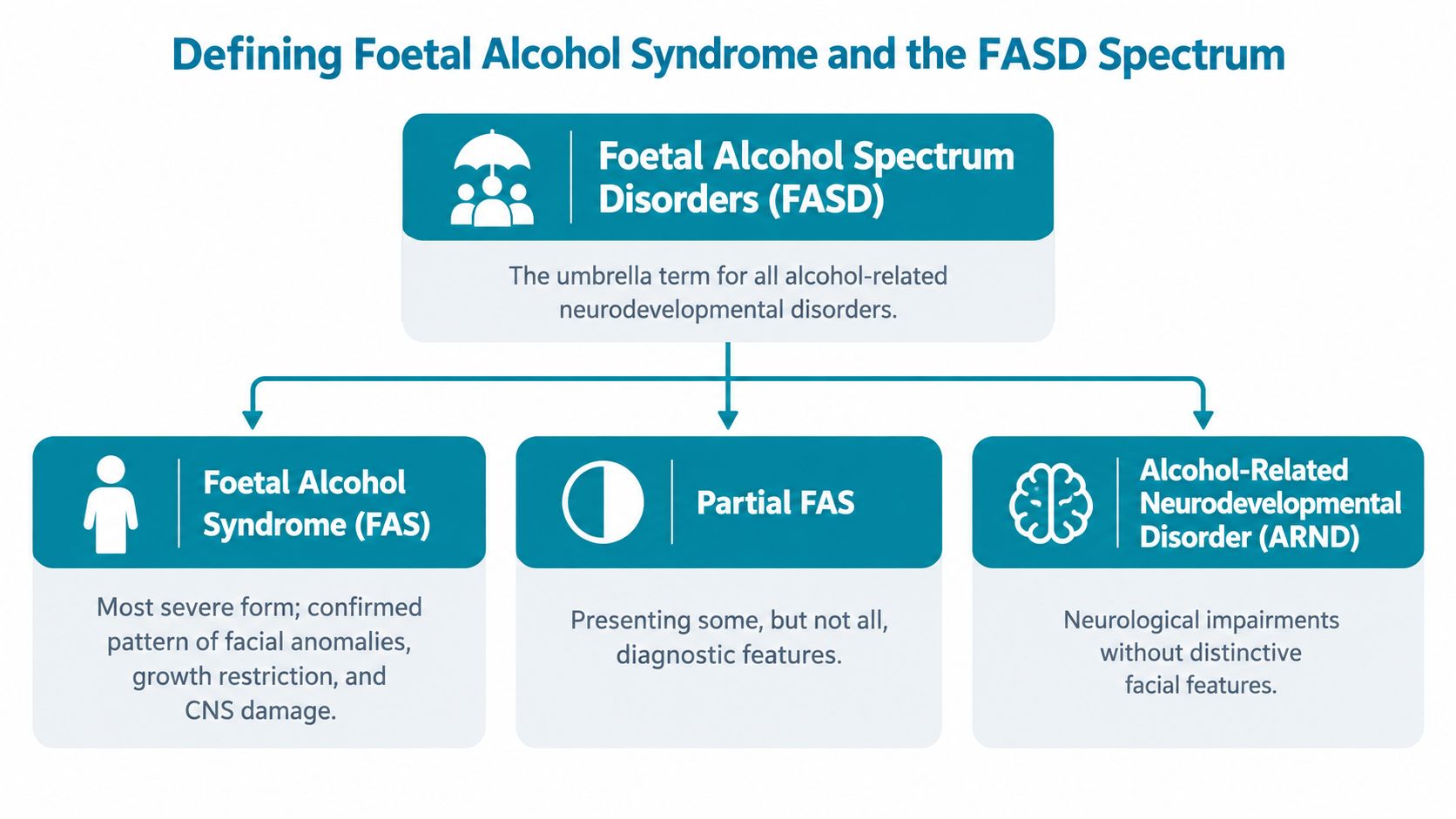
FAS is the most specific and involved diagnosis on this spectrum. It generally requires a characteristic pattern involving all three sentinel facial findings, growth deficiency, and central nervous system or neurobehavioral abnormality. Partial FAS presents some, but not all, of the classic findings. Alcohol-related neurodevelopmental disorder can involve significant neurological, learning, or behavioral impairment without the distinctive facial pattern. Alcohol-related birth defects refer to physical problems affecting organs or body systems.
Those distinctions matter because prenatal alcohol exposure alone doesn't establish FAS. A person may have important alcohol-related neurodevelopmental difficulties without meeting criteria for the full syndrome. Conversely, the absence of obvious facial differences doesn't rule out a meaningful effect on cognition, executive function, adaptive skills, or mental health.
A diagnosis with a long clinical history
The term foetal alcohol syndrome entered English-language medical literature in 1973, when two reports in The Lancet described a recognizable pattern of growth, facial, and developmental problems in children of mothers who used alcohol. A public U.S. warning followed in 1977, an early milestone in prevention and recognition. (Historical review of FAS)
Prevalence estimates differ because researchers use different methods, age groups, records, and direct assessments. CDC surveillance has estimated about 1 infant with FAS per 1,000 live births in certain U.S. areas, while a CDC study identified FAS in 0.3 per 1,000 children ages 7 to 9. Community studies using in-person assessment have found higher estimates, around 6 to 9 per 1,000 school-aged children. (CDC FASD data)
The practical lesson: A missed diagnosis doesn't mean the difficulties aren't real. It may mean the right developmental history and assessment were never assembled.
How Prenatal Alcohol Exposure Alters Fetal Development
Alcohol crosses the placenta and can interfere with fetal development. The effects are dose- and timing-sensitive, so risk and clinical presentation may vary according to the amount and pattern of exposure, the developmental stage, and individual biological factors. Alcohol can disrupt development at any stage of pregnancy, including before pregnancy recognition. (Review of prenatal alcohol effects)
Early development depends on rapidly changing cells, tissues, and organ systems. Alcohol may interfere with cellular growth and organization, including formation of the nervous system. Later exposure can affect brain maturation and function as well. These mechanisms help explain why clinicians cannot identify a universally safe amount or timing from an individual's recollection alone. An exposure history can guide care, but it cannot predict one person's outcome with certainty.
Brain-imaging studies in FASD have found overall and regional reductions in brain volume and surface area, as well as differences in particular regions and in white- and gray-matter organization. The brain works through connected networks, much like a communication system whose efficiency depends on both its pathways and processing centers. Disruption in these systems may contribute to difficulties with attention, memory, language, impulse control, emotional regulation, planning, or adaptive functioning. Those difficulties can remain significant even when standard physical features are subtle. Adult assessment therefore needs to consider real-world functioning across work, relationships, independent living, and health care, not only childhood appearance or school records.
Why calculators can't answer the pregnancy question
People sometimes use an alcohol level in blood calculator to estimate blood alcohol concentration after drinking. These tools provide rough estimates, not safety clearances. Pour size, alcohol concentration, timing, food, body composition, metabolism, medications, and other physiological factors can change the result.
| Question | What an estimate can and can't tell you |
|---|---|
| How much alcohol was consumed? | A standard-drink framework can organize recall, but glasses and pours vary. |
| What was the blood alcohol concentration? | A calculator can provide an approximation, not a measured result. |
| Is driving safe? | No estimate should determine whether to drive. |
| Is prenatal exposure harmless? | No calculator can establish safety during pregnancy. |
If alcohol was used before pregnancy was recognized, stopping once pregnancy is known is a constructive next step. A physician can discuss the exposure without judgment, review available records, and coordinate developmental surveillance or later evaluation when appropriate. Avoiding alcohol during pregnancy prevents FASD, while people who drank before recognition still deserve respectful care and practical guidance.
Diagnostic Criteria and the Multidisciplinary Evaluation
Foetal alcohol syndrome is identified through a clinical pattern, not a single blood test or biomarker. A physician brings together prenatal alcohol exposure, physical findings, growth history, neurological signs, and developmental or behavioral evidence. Current guidance describes several forms of exposure documentation, including 6 or more drinks per week for at least 2 weeks during pregnancy, 3 or more drinks on an occasion on at least 2 occasions, alcohol-related social or legal problems, or objective intoxication testing. Exposure history supports the assessment, but it cannot establish FAS on its own. (Updated diagnostic guidelines)
The core clinical domains
| Clinical domain | Specific indicators | Assessment method |
|---|---|---|
| Facial phenotype | Smooth philtrum, thin vermilion border, and small palpebral fissures | Trained physical examination, facial measurement, and comparison with diagnostic standards |
| Growth | Prenatal or postnatal growth deficiency | Birth records, growth charts, height and weight history |
| Central nervous system | Structural, neurological, or functional abnormalities | Neurological examination, developmental history, neuropsychological testing, and functional assessment |
| Prenatal alcohol exposure | Documented exposure or reliable collateral history when available | Medical records, birth records, caregiver report, and structured clinical interview |
The assessment may include a primary-care clinician, developmental specialist, geneticist, neurologist, psychologist, psychiatrist, speech-language professional, occupational therapist, social worker, or educational specialist. The team is selected according to the person's age, symptoms, available records, and local expertise. For an older patient, a physician may coordinate records and referrals so that testing answers practical questions about work, relationships, independent living, and health care. This process also helps distinguish FASD from genetic conditions, traumatic brain injury, ADHD, autism, mood disorders, substance-related conditions, and other causes of developmental impairment.
Why the full pattern matters
CDC diagnostic guidance identifies the classic facial findings as smooth philtrum, thin vermilion border, and small palpebral fissures, alongside growth deficiency and central nervous system abnormality. One feature by itself does not establish FAS. Clinicians assess how the findings fit together, much like assembling a developmental map rather than relying on one landmark. (CDC diagnostic criteria summary)
Prenatal alcohol exposure may remain unconfirmed, especially when records are missing or family history is incomplete. Characteristic physical and neurodevelopmental findings can still support an evaluation, but uncertainty may affect diagnostic classification. Careful documentation of what is known, unknown, and reported by others helps the clinical team explain its reasoning and plan appropriate follow-up. (NIH diagnostic guidance)
The Clinical Blind Spot of Adult FASD Diagnosis
Adults are often assessed after years of difficulty with attention, organization, emotional regulation, school completion, employment, relationships, or mental health. Some have childhood records that were never reviewed for prenatal alcohol exposure. Others don't know their prenatal history, were raised outside their birth family, or have family members who remember the circumstances differently.
Adult diagnosis is difficult because there is no single diagnostic test, childhood growth records may be missing, and facial features can become less obvious with age. Earlier photographs can sometimes help, but photographs alone can't establish FASD. A specialist still needs a multidisciplinary neurodevelopmental assessment. (Adult FASD diagnostic considerations)
What an adult evaluation may examine
A clinician may gather school reports, developmental records, medical history, employment information, prior testing, medication response, and collateral observations from a trusted person. The assessment can examine intellectual abilities, attention, memory, language, executive function, social cognition, adaptive skills, and emotional or behavioral regulation.
The central question is not merely, “Does this adult look like they have FAS?” It's whether a coherent developmental pattern supports FASD and whether another explanation better accounts for the presentation. ADHD, bipolar disorder, trauma-related conditions, personality-related symptoms, autism, intellectual disability, sleep problems, seizures, and substance use can overlap with FASD. They can also coexist.
For readers exploring overlapping attention and mental-health concerns, a clinically grounded resource on comorbidity management in ADHD may help explain why one diagnosis shouldn't automatically replace a broader assessment.
A respectful route to clarification
Start with a primary-care or physician-led evaluation and bring whatever records are available. Useful materials include childhood report cards, individualized education plans, growth records, developmental assessments, old photographs, adoption or birth records, and a medication history. Missing information shouldn't stop someone from asking for help, but it may limit how confidently a specialist can classify the condition.
Adult mental-health care can address current anxiety, depression, attention problems, sleep disturbance, or other symptoms while a broader evaluation proceeds. That distinction matters. Treating a co-occurring condition doesn't prove or disprove FASD, and a suspected FASD diagnosis shouldn't prevent treatment of a separate, clinically significant disorder. Adult mental-health evaluation and medication management can be one part of that coordinated process.
Lifespan Management and Supportive Care Strategies
There isn't a medication that reverses the structural brain effects of prenatal alcohol exposure, and there isn't one universal treatment plan for FASD. Care focuses on functional support, symptom management, prevention of secondary problems, and treatment of co-occurring conditions. The most useful plan changes as responsibilities change.
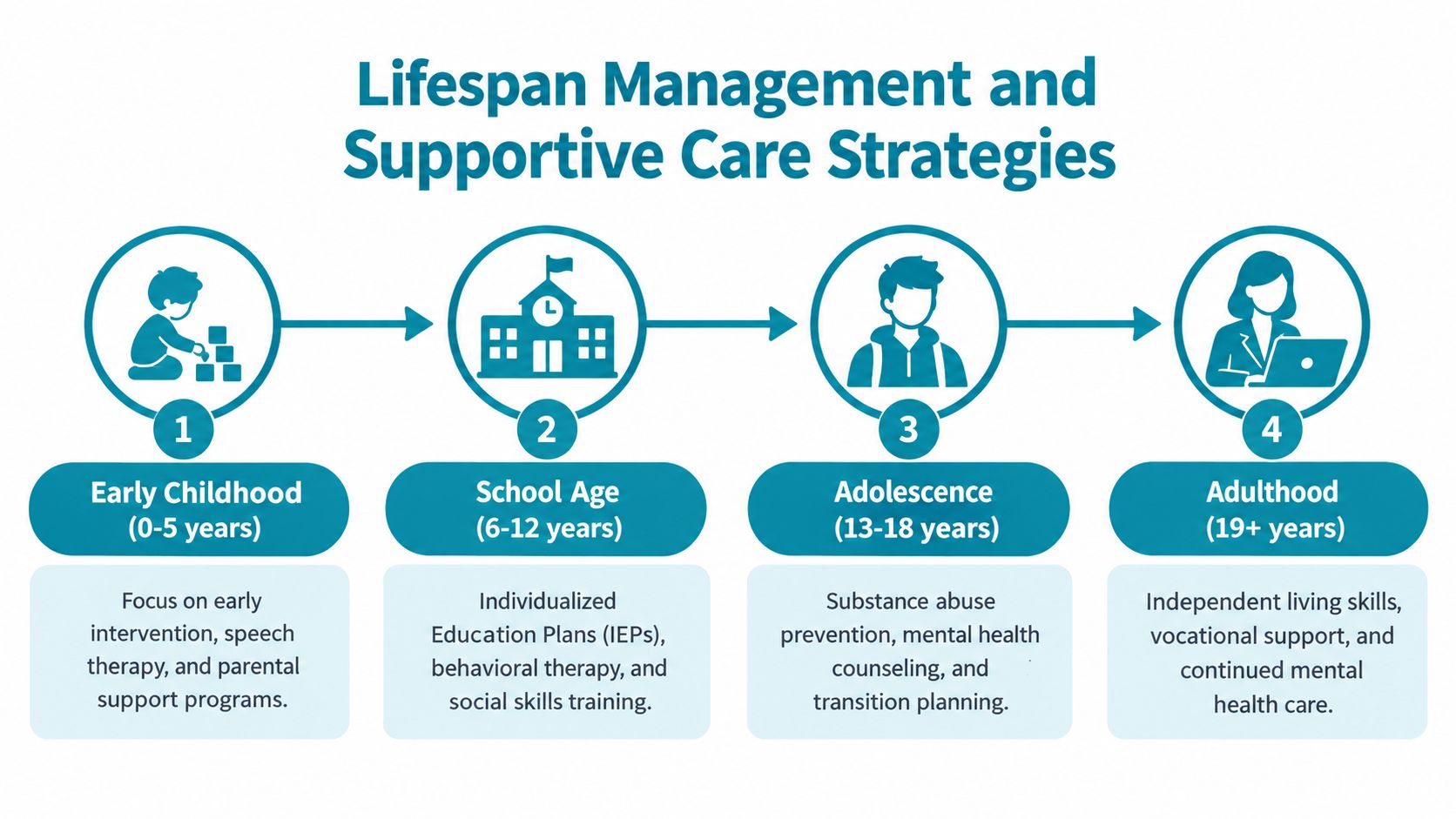
A child may need speech-language therapy, occupational therapy, caregiver coaching, educational accommodations, and support for emotional regulation. An adolescent may need help with social judgment, medication safety, substance-use prevention, school transitions, and practical decision-making. An adult may need support with employment, finances, appointments, relationships, independent living, and ongoing mental-health care.
| Life stage | Common clinical priorities |
|---|---|
| Childhood | Developmental assessment, speech and occupational therapy, caregiver support, and school accommodations |
| Adolescence | Executive-function support, social skills, mental-health care, safety planning, and transition preparation |
| Adulthood | Adaptive-function assessment, vocational support, medication review, coordinated mental-health care, and practical routines |
A hypothetical composite example
Hypothetical composite, not an Empire patient: An adult has lifelong problems with planning and attention, but no formal FASD evaluation. They use a BAC calculator after several drinks and assume the result tells them whether driving is safe. A clinician explains that pour size, timing, food, physiology, and the calculator's assumptions create substantial uncertainty. The clinician also screens for alcohol-related risk, addresses immediate safety, and considers referral for neuropsychological and developmental assessment.
The management strategy doesn't depend on proving one diagnosis on the first visit. It may include medication review for a co-occurring condition, simplified routines, written instructions, appointment reminders, therapy or skills-based support from outside clinicians, and authorized coordination with specialists. Medication decisions must be individualized because attention, mood, sleep, seizure risk, substance use, and other medical factors can affect safety.
The embedded educational resource below provides additional context. It isn't a substitute for an assessment or a treatment plan.
Peer-support resources such as Alcoholics Anonymous information may be useful for some adults, but peer support isn't the same as medical withdrawal assessment or physician-led treatment. Alcohol withdrawal can progress to seizures or delirium, so a person with regular heavy alcohol use shouldn't attempt an unsupervised detoxification plan.
Prevention Messaging and the Evidence Gap
Current public-health guidance states that there is no known safe amount, type, or timing of alcohol use during pregnancy. That message is clinically straightforward, but prevention conversations should remain compassionate. People may drink before they know they're pregnant, may be coping with alcohol dependence, or may fear judgment from a clinician. Stigma can make accurate disclosure less likely.
The evidence gap isn't only biological. Health systems don't consistently record prenatal alcohol exposure, and screening and diagnostic practices vary. Missing exposure information can weaken prevention, delay referral, and make it harder to identify people who need developmental support. (Australian Institute of Health and Welfare report)
Better questions produce better information
A nonjudgmental clinician may ask about the type of alcohol, approximate quantity, frequency, pattern of heavier drinking, timing during pregnancy, and whether the patient was taking medications or experiencing other health issues. The purpose is clinical understanding, not punishment. Memory can be incomplete, and a person shouldn't be pressured to manufacture certainty.
A practical prevention conversation should also include alcohol-use screening, treatment options when needed, and a plan for follow-up. If someone is physically dependent on alcohol, abrupt cessation can be dangerous. Withdrawal risk requires medical assessment rather than a self-directed schedule.
Factual information about alcohol-related care can help adults distinguish routine support from situations requiring urgent medical attention. The central prevention message remains clear, while the clinical response should account for physiology, context, safety, and the possibility that a person needs treatment for alcohol use rather than a warning alone.
When to Seek Physician-Led Evaluation and Care Coordination
Consider asking for a physician-led evaluation when an adult has lifelong learning or executive-function problems, unexplained adaptive difficulties, a known history of prenatal alcohol exposure, or a complex psychiatric presentation that hasn't been fully clarified. A referral is also reasonable when several diagnoses have been applied over time but don't explain the person's functioning across settings.
A practical referral checklist
- Developmental history: Bring school records, childhood assessments, growth information, and early photographs when available.
- Current functioning: Describe difficulties with planning, money, work, relationships, medication organization, safety, and independent living.
- Mental-health history: List prior diagnoses, hospitalizations, therapies, medications, benefits, side effects, and periods of worsening.
- Exposure information: Share what is known about prenatal alcohol exposure, while clearly labeling uncertainty.
- Collateral information: With permission, ask a trusted family member or caregiver to describe lifelong patterns rather than isolated recent symptoms.
Private outpatient care can provide diagnostic clarification, medication review, and management of co-occurring mental-health or substance-use concerns. It typically can't replace a specialized FASD diagnostic team, neuropsychological testing, genetics consultation, or developmental assessment. With appropriate authorization, a physician may coordinate with outside clinicians and help organize next steps.
Urgent symptoms require a different response. Seek emergency care for a seizure, severe confusion, hallucinations, inability to stay awake, trouble breathing, chest pain, or signs of delirium. Alcohol withdrawal can become life-threatening, especially when a person has a history of withdrawal seizures or severe withdrawal. Don't use a BAC estimate to decide whether to drive, and don't attempt an unsupervised detoxification protocol.
For adults seeking confidential outpatient assessment related to alcohol use, addiction medicine physician care may help clarify the appropriate level of support. The right pathway may include outpatient follow-up, medication management when clinically appropriate, outside therapy or testing, or referral to a higher level of care.
Empire Medical Wellness offers private-pay, physician-led outpatient evaluation, medication management, and care coordination for adults, including support related to addiction medicine and adult mental health. Visit Empire Medical Wellness to learn whether an outpatient consultation fits your needs and to review the current care options.
This article is educational and isn't personal medical advice.