
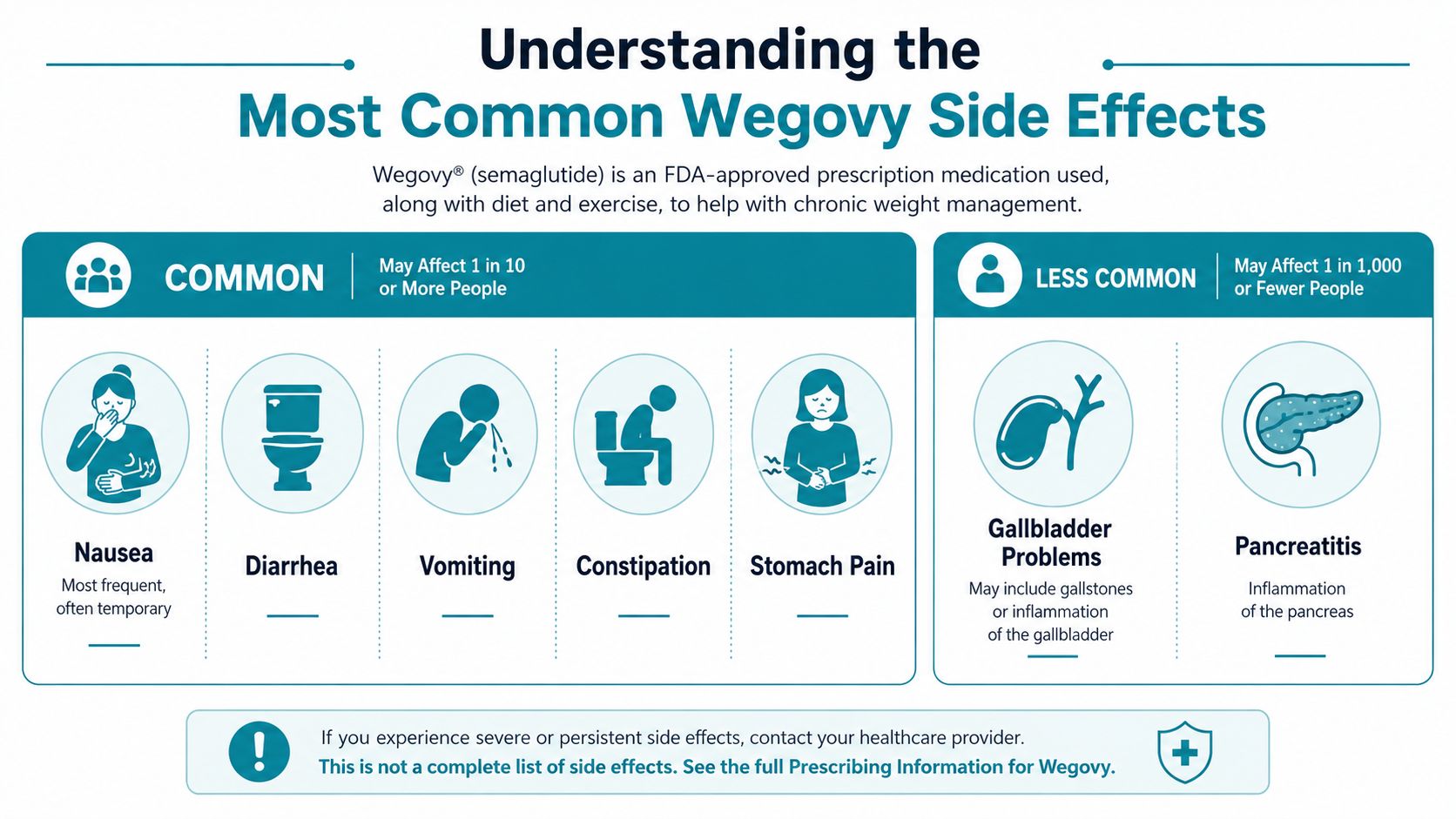
Wegovy side effects are usually gastrointestinal. In the FDA label, the most common reactions are nausea, diarrhea, vomiting, constipation, and abdominal pain, and these are listed as common because they occur in at least 5% of adults or adolescents taking the drug. Most of these symptoms are dose-related and often become easier to manage over time.
That pattern matters because Wegovy's side-effect profile is not random. It follows the drug's GLP-1 action, which slows gastric emptying and reduces appetite, so the same mechanism that helps with weight loss also explains why the stomach and bowels are where people feel it first.
By Empire Medical Wellness Editorial Team
Published: August 14, 2026
Updated: August 14, 2026
Table of Contents
- Understanding the Most Common Wegovy Side Effects
- How Dose Escalation Affects Side Effect Timing
- Common Side Effects Versus Serious Warning Signs
- Practical Strategies for Managing Gastrointestinal Symptoms
- Less Common but Serious Risks to Monitor
- What Happens When You Miss Doses or Stop Treatment
- How Physician-Led Monitoring Supports Safe Treatment
Understanding the Most Common Wegovy Side Effects
The FDA label is the best place to start because it defines what counts as common. For Wegovy, that means adverse reactions seen in 5% or more of adults or pediatric patients ages 12 and older, including nausea, diarrhea, vomiting, constipation, abdominal pain, headache, fatigue, dyspepsia, dizziness, abdominal distension, eructation, hypoglycemia in patients with type 2 diabetes, flatulence, gastroenteritis, gastroesophageal reflux disease, and nasopharyngitis (FDA prescribing information).
The STEP 1 trial helps put those reactions in perspective. In the semaglutide 2.4 mg group, nausea occurred in 44.2%, diarrhea in 29.7%, vomiting in 24.5%, and constipation in 24.2%, compared with lower placebo rates for each event (STEP 1 trial summary). Those are high enough numbers that GI symptoms should be expected, not treated like a surprise.
Why the stomach and bowels are affected first
Semaglutide acts like GLP-1, a hormone that helps regulate appetite and digestion. The practical result is slower gastric emptying, earlier fullness, and a higher chance of bloating, belching, reflux, and nausea, especially when meals are large or heavy (EMA Wegovy overview). That's why the most common side effects cluster around eating and bowel habits rather than around a broad, whole-body toxicity pattern.
The placebo comparisons matter too. In the NIH/NCBI clinical review, the same side-effect signal appears clearly, with nausea at 53% versus 22% and diarrhea at 35% versus 24% in the Wegovy arm compared with placebo (NCBI clinical review). That gap tells you the symptoms are tied to treatment, not just background digestive complaints.
For readers who also deal with hemorrhoid flares when constipation or diarrhea becomes persistent, a practical overview like when to see a doctor for hemorrhoids can help separate routine irritation from symptoms that need medical attention.
The broad takeaway is simple. GI effects are the rule, not the exception, and the early counseling conversation should focus on what's expected, what's manageable at home, and what crosses the line into a warning sign.
How Dose Escalation Affects Side Effect Timing
Side effects often feel worst during starting doses and dose increases, not because the medication suddenly becomes unsafe, but because the body is adjusting to a new digestive pattern. The European Medicines Agency states that Wegovy's GI effects may affect more than 1 in 10 people, and symptoms are often most pronounced during initiation and dose escalation (EMA Wegovy overview).
Why timing matters
Wegovy is built around gradual titration, starting low and increasing over time so tolerance can build. That design exists to improve comfort, especially for nausea, bloating, diarrhea, and overall GI upset. Patients often describe the first few doses, and each increase after that, as the point where they notice their stomach most.
That timing also helps explain why side effects can feel different over the course of treatment. Early on, the gut is adapting to slower emptying and reduced intake. Later, many people find that symptoms settle into a more predictable pattern, though not everyone has the same trajectory.
Practical rule: if a symptom appears right after a dose increase, it's more likely to be a tolerability issue than a new disease process, but it still deserves attention if it limits fluids, food, or daily function.
For a comparison with another GLP-1 medication, the discussion at Mounjaro side effects can be useful if you're trying to understand why dose timing and GI tolerance matter across this drug class.
What the timeline usually looks like
The early phase is where patients are most likely to notice nausea, early fullness, and reflux-like symptoms. The middle phase can be variable, some people improve, some plateau, and some remain sensitive at each step-up. By maintenance dosing, side effects often stabilize if the medication is tolerated at all.
That doesn't mean symptoms should be ignored. It means the pattern itself is informative. A symptom that comes and goes with titration is usually handled differently from one that is constant, severe, or accompanied by dehydration, abdominal pain, or inability to keep fluids down.
Common Side Effects Versus Serious Warning Signs
The cleanest way to think about Wegovy side effects is to separate expected GI intolerance from symptoms that can point to a more serious problem. The common effects are unpleasant but usually manageable. A smaller group of symptoms needs prompt evaluation because the concern is not just discomfort, it is dehydration, gallbladder disease, pancreatitis, or allergy.
| Side Effect | Frequency | Management | When to Call Your Doctor | When to Seek Emergency Care |
|---|---|---|---|---|
| Nausea | 44.2% in STEP 1, versus 16.0% on placebo (FDA label summary) | Smaller meals, slower eating, avoid heavy meals | If it keeps you from eating or drinking well | If you cannot keep fluids down or feel faint |
| Diarrhea | 29.7% versus 15.9% (FDA label summary) | Fluids, bland foods, replace electrolytes as tolerated | If it persists, worsens, or causes weakness | If there are signs of dehydration, confusion, or collapse |
| Vomiting | 24.5% versus 6.3% (FDA label summary) | Pause heavy foods, focus on hydration | If repeated vomiting limits intake or lasts beyond a brief flare | If vomiting is severe, persistent, or paired with severe pain |
| Constipation | 24.2% versus 11.1% (FDA label summary) | Fluids, tolerated fiber, movement if you feel well enough | If bowel movements stop or discomfort builds | If you have severe abdominal swelling or cannot pass stool and gas |
| Abdominal pain | Listed among common adverse reactions at 5% or more in labeling (FDA prescribing information) | Track timing, location, and relation to eating | If pain is persistent or new | If pain is severe, especially with vomiting or fever |
| Headache, fatigue, dizziness, reflux, bloating, belching | Listed as common adverse reactions at 5% or more (FDA prescribing information) | Hydration, smaller meals, symptom tracking | If symptoms interfere with daily function | If dizziness comes with fainting or chest symptoms |
| Severe abdominal pain | Not an expected routine effect | Needs targeted assessment | Call promptly | Seek urgent care or ER, possible pancreatitis |
| Allergic symptoms such as swelling, hives, or breathing trouble | Rare, but important | Stop exposure and get urgent help | Call immediately if mild but concerning | Seek emergency care right away |
| Ongoing vomiting with dark urine or lightheadedness | Not routine | Needs hydration assessment and possible labs | Call the prescriber the same day | Seek urgent care if severe or worsening |
A few points belong above the table in plain language. Gallbladder issues, pancreatitis, dehydration-related kidney injury, and low blood sugar in people with type 2 diabetes are uncommon but real concerns, and they do not fit the usual “normal nausea” bucket (Cleveland Clinic, Harvard summary of Harvard-CDC analysis).
Clinical boundary: if the symptom is mainly uncomfortable but you are still drinking, urinating, and functioning, it is usually handled differently than symptoms that threaten hydration, breathing, or abdominal stability.
For readers comparing approaches to weight management, the practical overview at balanced meal to lose weight can help frame food choices that are easier on the stomach while treatment is being adjusted.
Practical Strategies for Managing Gastrointestinal Symptoms
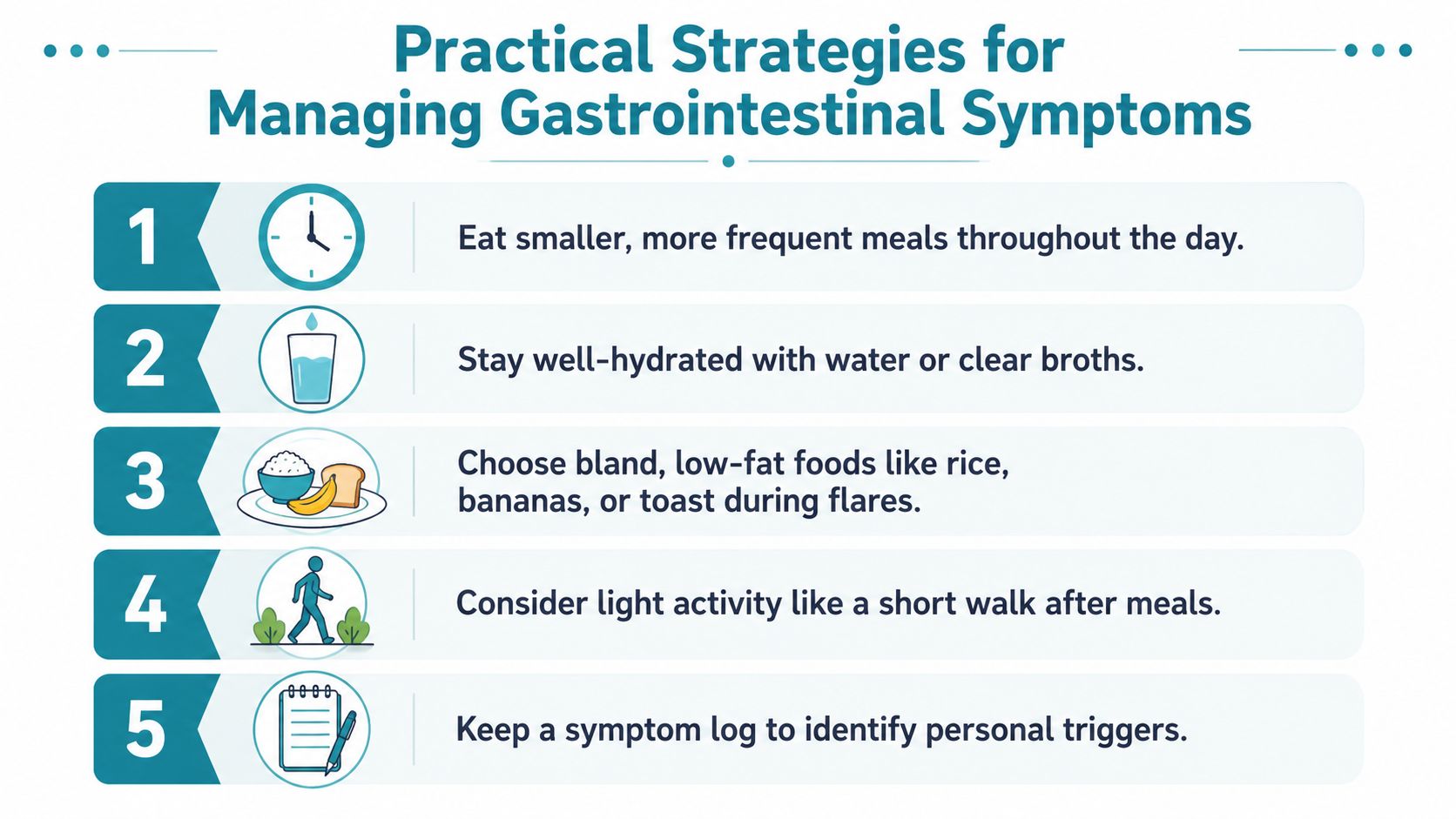
The most useful day-to-day strategy is to reduce the load on the stomach while semaglutide is slowing digestion. That means smaller portions, slower eating, and stopping when you feel comfortably full instead of pushing past that point. These habits work with the medication's mechanism, not against it.
What usually helps most
A few practical choices tend to be easier for patients than broad, restrictive rules. Bland foods are often better tolerated during flare-ups, and very fatty or heavy meals can make nausea and reflux worse. Many people also do better when they keep fluid intake steady throughout the day instead of trying to “catch up” all at once.
A short walk after meals can help some people feel less bloated, though it shouldn't be forced if you feel weak or dehydrated. A symptom log can also be surprisingly useful, because it helps you spot whether discomfort is tied to a particular meal pattern, dose increase, or missed fluids.
Good target: if nausea or diarrhea is affecting how much you eat or drink, that's the point to contact the prescriber, not the point to self-adjust the medication.
For readers who want a simple food pattern to pair with treatment, relief from constant diarrhea can be a helpful general resource for symptom management ideas, especially when bowel changes are the main problem.
What not to do
Don't change or skip doses on your own. Don't force large meals because you're worried about not eating enough. And don't assume every stomach symptom means you should just wait it out.
If symptoms persist, limit your intake, or keep returning after each step-up, the prescriber needs to know. Persistent symptoms can affect hydration, blood pressure, and renal function, especially if vomiting or diarrhea is ongoing. If you need a nutrition framework that's easier to sustain during treatment, a structured plan such as balanced meal to lose weight is often more realistic than an extreme diet.
Less Common but Serious Risks to Monitor
The serious risks get less attention than nausea, but they matter because they can change the treatment plan quickly. With Wegovy, clinicians watch for gallbladder disease, pancreatitis, acute kidney injury from dehydration, hypoglycemia in patients with type 2 diabetes, and aspiration risk during anesthesia or deep sedation (Cleveland Clinic, Harvard summary).
Why these risks are different
Gallbladder problems are linked to rapid weight loss and changes in bile handling, which is why clinicians ask about right upper abdominal pain, fever, nausea after fatty meals, or yellowing symptoms. In STEP 1, gallbladder-related adverse events occurred in 2.6% of semaglutide users versus 1.2% on placebo, and the Harvard summary notes that less than 2% of adults in clinical trials developed gallstone problems (Harvard summary).
Pancreatitis is different. Severe, persistent abdominal pain, especially if it reaches the back or comes with vomiting, needs prompt evaluation. Kidney injury is often a dehydration story, not a direct kidney-toxin story, and that's why prolonged vomiting or diarrhea plus dark urine or lightheadedness deserves attention.
Who needs extra caution
People with type 2 diabetes need a closer look at low blood sugar risk, especially if they're also taking glucose-lowering medicines. People scheduled for sedation or anesthesia need to tell their procedural team about semaglutide use because delayed gastric emptying can increase aspiration risk, which is why this medication belongs on the pre-procedure medication list.
Red flag rule: common GI upset can be watched, but severe abdominal pain, repeated vomiting, breathing trouble, or symptoms of dehydration should not be managed as routine side effects.
For readers comparing long-term obesity treatment options, the weight loss page gives a broader sense of how a physician-led plan is typically organized around safety, monitoring, and maintenance.
What Happens When You Miss Doses or Stop Treatment
A lot of consumer guidance falls short. People often want to know whether symptoms come back after a gap, how long they linger after stopping, or whether it's safe to restart where they left off. The short answer is that side effects can recur when treatment is restarted or when the dose is increased again after a break, so the next step is best made with a clinician rather than by guesswork.
GI symptoms usually fade after discontinuation, but the exact timeline varies from person to person. If the medication is stopped because of nausea, vomiting, or diarrhea, the issue isn't just comfort, it's also whether hydration and nutrition recovered enough for a safe re-entry.
Why interruptions matter
Travel, illness, surgery, and supply gaps can all interrupt treatment. After that, the body may no longer tolerate the medication the same way it did before the break, especially if the return is too abrupt. That's one reason patients are told not to make their own dose changes.
The same logic applies after side effects settle. A person may feel fine at one dose, then become symptomatic again after a missed period and restart. That doesn't mean the medication “stopped working,” it means the digestive system may need a different clinical plan.
If you've been off treatment and you're unsure what a symptom means, the safest move is to contact the prescriber before taking the next dose. Restart decisions should be individualized, especially if the original reason for stopping was persistent vomiting, poor intake, or dehydration.
How Physician-Led Monitoring Supports Safe Treatment
A physician-led follow-up visit should track the details that predict whether Wegovy is being tolerated safely. That usually means weight trajectory, blood pressure, heart rate when relevant, hydration status, gastrointestinal symptoms, and the exact dose stage the patient is on. If a patient has diabetes, the visit also has to account for glucose readings and any diabetes medications that may need adjustment. If vomiting, diarrhea, or poor intake is present, a BMP and kidney function assessment are often the first labs I review.
The timing of symptoms matters as much as the symptoms themselves. Nausea that appears during dose escalation and then eases over the next few weeks usually fits the expected pattern. New vomiting after a stable dose, or symptoms that return after a gap in treatment, deserves a different response. The same is true for people who are doing well on treatment but then stop eating or drinking normally. I do not treat those changes as routine side effects until I have checked whether dehydration or another problem is developing.
A practical follow-up schedule depends on the patient, but the early phase usually needs closer contact than long-term maintenance. In clinical practice, I want to know whether weight loss is trending in the expected direction, whether the patient is tolerating the current dose, and whether there are warning signs that require a pause or a slower titration plan. A person who loses weight steadily but develops persistent constipation, dizziness, or repeated vomiting needs a different plan from someone whose appetite has returned and who feels well. Monitoring is most useful when it changes the next decision, whether that means holding a dose, repeating labs, or continuing the titration.
That is also why physician-led obesity medicine visits are not just a prescription check. They are a chance to match the medication plan to the patient's medical history, current symptoms, and response over time. For adults looking for structured lose weight care, this kind of follow-up is where safety, dose timing, and long-term maintenance planning get reviewed together.
If symptoms point to something more serious, the decision is faster and more direct. Severe abdominal pain, trouble breathing, signs of dehydration, or allergic symptoms should not wait for the next routine visit. Those findings need prompt evaluation, not another dose adjustment at home.