
Many people are told to find the perfect diet, then blame themselves when it doesn't last. In obesity medicine, that's the wrong target. Balanced diet and weight loss work best when the plan creates a calorie deficit you can live with, then supports maintenance with structure, follow-up, and realistic food choices.
Table of Contents
- Why No Single Diet Is Best for Weight Loss
- Assessing Your Calorie Needs and Building a Balanced Plate
- Macronutrient Balance and Meal Timing Myths
- Portion Control and Mindful Eating in Real Life
- Monitoring Progress and Maintaining Weight Loss Long Term
- When to Seek Physician-Led Obesity Care
Why No Single Diet Is Best for Weight Loss
People often expect one eating plan to work for everyone. That expectation usually fails in real life. A peer-reviewed review found no one most effective diet overall, and long-term results tend to converge when adherence is similar, because the driving factor is eating fewer calories than you expend (PubMed review).
That matters because people often begin with a strict plan, lose weight early, and then hit a wall. The usual problem is not a broken metabolism or a character flaw. The plan is often too rigid to sustain once work, travel, family meals, stress, or boredom become part of the routine.
Balanced patterns outperform rigid labels when life gets busy
A large randomized trial in The New England Journal of Medicine showed that reduced-calorie diets produced meaningful weight loss even when the macronutrient mix differed. At 6 months, participants on each diet had lost an average of 6 kg, or about 7% of starting weight, and by 2 years the average loss remained similar across groups, ranging from 2.9 to 3.6 kg depending on assignment (NEJM trial). Weight loss began to be regained after 12 months, which is exactly why maintenance planning has to be part of the first conversation.
Practical rule: if two eating patterns create the same calorie deficit, the one you can repeat is the one that matters clinically.
That is also why a balanced approach is not code for “eat anything in moderation.” It means choosing a pattern that supports calorie control, enough protein, enough fiber, and enough satisfaction to keep you on track. The U.S. Dietary Guidelines evidence review found that adults can lose weight through many dietary patterns if they create an energy deficit, and patterns emphasizing vegetables, fruits, and whole grains offer modest benefits for preventing weight gain or promoting loss (Dietary Guidelines evidence review).
For patients considering physician-led care, the better question is not “Which diet is best?” It is “Which structure can I follow on an ordinary Tuesday?” That is the version that tends to survive beyond the first month. In some cases, that structure is easier to build with Empire Medical Wellness weight loss support, especially when you need follow-up, accountability, and a plan that fits your schedule.
Assessing Your Calorie Needs and Building a Balanced Plate
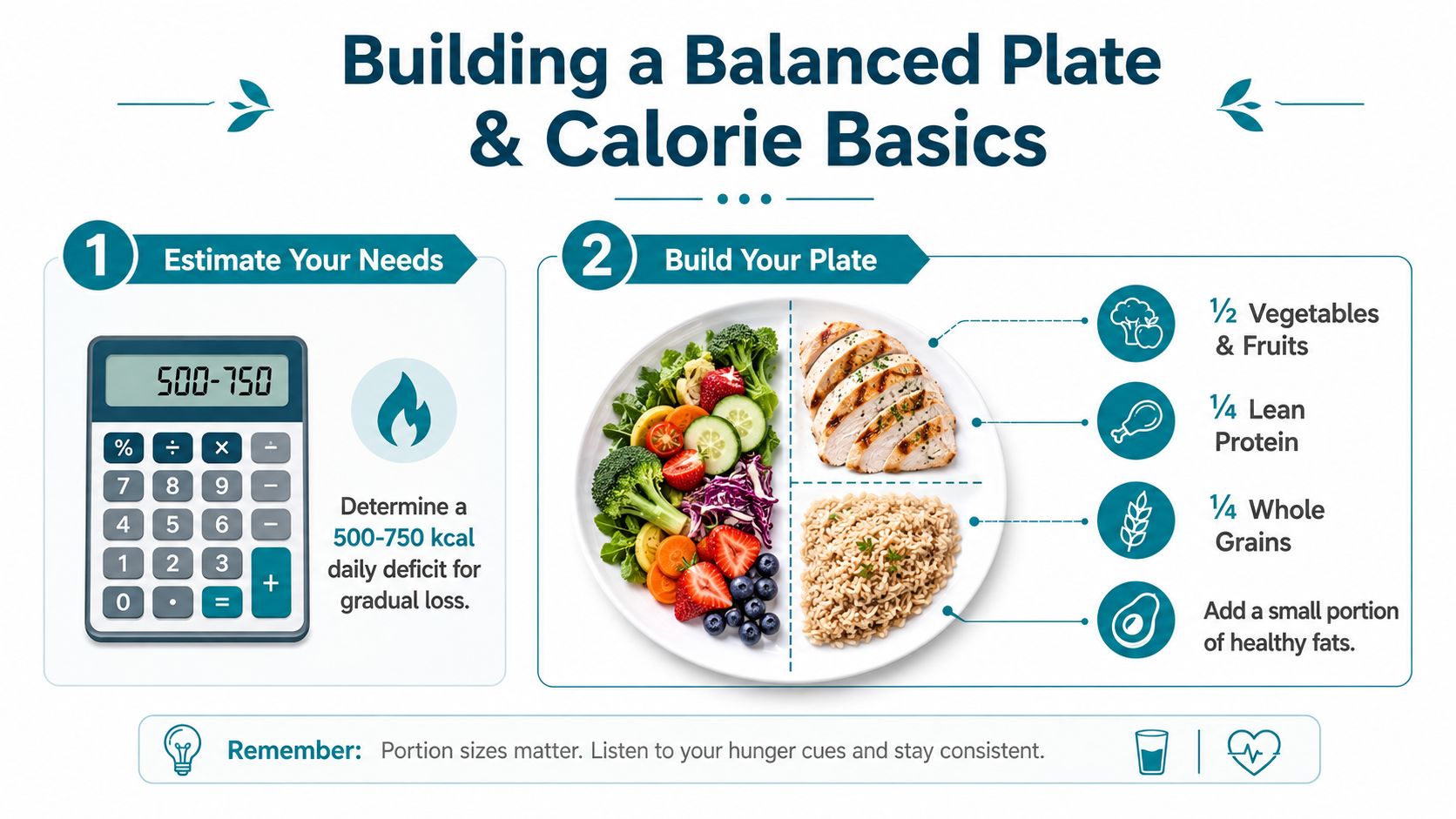
A practical starting point in obesity care is a 500 to 750 kcal/day deficit, or a plan that reliably creates that deficit (NIH review). The point is to build a system you can live with, one that lowers intake enough to move weight in the right direction while still allowing regular meals, family dinners, and portions that do not feel punitive.
NIH-based guidance also describes a 500 to 1,000 kilocalorie per day deficit as the kind of program design commonly used to aim for about 1 to 2 pounds of weight loss per week (NIH Bookshelf). In practice, that is a planning target. Actual results still depend on adherence, metabolism, medications, sleep, and other day-to-day factors.
Build the plate before you obsess over the scale
The NHS Eatwell Guide gives a useful visual structure for a balanced diet, at least 5 portions of fruit and vegetables daily, meals based on higher-fibre starchy foods, some dairy or dairy alternatives, protein foods such as beans, pulses, fish, eggs, meat, or other protein, unsaturated oils in small amounts, and 6 to 8 glasses of fluids a day (NHS balanced diet guide). That kind of framework reduces guesswork and gives people a practical place to start.
In clinic, a simple plate pattern works because it translates directly to real food:
- Half the plate: vegetables and fruit, with the emphasis on vegetables.
- One quarter: lean protein such as fish, poultry, eggs, tofu, Greek yogurt, or beans.
- One quarter: whole grains or other higher-fibre starches.
- Small added fat: olive oil, nuts, seeds, avocado, or similar options in modest portions.
The broader evidence also supports eating patterns that emphasize minimally processed plant foods while keeping total energy intake lower. That is the foundation of a balanced eating pattern for weight loss, and it does not require eliminating entire food groups.
One practical way to start is to plan one breakfast, one lunch, and one dinner template you can repeat. Then adjust portion size before you start cutting out foods you enjoy. Fewer decisions usually works better than more. If you want a more structured starting point, this balanced meal guide for weight loss fits that approach and keeps the focus on portions, food quality, and follow-up.
Macronutrient Balance and Meal Timing Myths
People often ask whether a balanced diet has to be low-carb, low-fat, or built around frequent small meals. The honest answer is no. The World Health Organization defines a healthy diet by adequacy, balance, moderation, and diversity, not by one fixed macro split (WHO healthy diet factsheet).
That doesn't mean macronutrients are irrelevant. It means they work best as part of the whole pattern. Protein supports satiety, fiber supports fullness and bowel regularity, and higher-quality carbohydrate sources can help with energy and day-to-day adherence. The goal is a way of eating you can keep using without feeling deprived or constantly correcting course.
What the evidence supports, and what it doesn't
Weight loss still comes back to sustained calorie reduction. In practice, several dietary approaches can work if they create a real deficit and the person can stay with them over time. That makes the search for a single “best” macronutrient ratio less useful than most online advice suggests.
Meal timing follows the same rule. Some people feel better with three meals a day. Others do better with one planned snack. There is no universal rule that says you must eat every three hours to lose weight. The better question is whether your schedule supports steady intake, fewer impulsive choices, and enough structure to avoid overeating later.
A meal pattern should reduce friction, not create it.
The stronger signal is food quality. The evidence review behind the U.S. Dietary Guidelines found modest benefit from patterns emphasizing vegetables, fruits, and whole grains (Dietary Guidelines evidence review). That lines up with broader guidance that calorie-controlled plans with more fruits and vegetables can support weight loss and maintenance when the pattern is realistic enough to follow.
A practical takeaway is simple. Use macros as a tool, not a rulebook. If a lower-carb pattern helps control hunger and fits your life, that can be reasonable. If a more traditional balanced plate keeps you more consistent, that can work too. For people who want a structured place to start, the guidance on build meals you'll enjoy can make serving sizes easier to use in everyday meals, and a practical portion control guide can help turn that structure into routine.
Portion Control and Mindful Eating in Real Life
The hardest part of weight loss is rarely knowing what a balanced meal looks like. It's eating that meal when lunch happens between meetings, dinner is late, or the restaurant portion is large enough for two people. That's where portion control becomes a skill instead of a slogan.
One patient scenario I see often is the weekday lunch trap. Someone brings a healthy meal from home, then adds a sweet drink or snack because they're tired and distracted. The meal itself was fine, but the extras erase the deficit. Liquid calories are easy to underestimate, especially when they don't feel like part of “real food.”

Make portions visible before hunger makes the decisions
A balanced plan gets easier when portions are concrete. That's why resources such as build meals you'll enjoy can help people translate serving sizes into everyday meals without turning dinner into a math problem.
For people in busy or budget-constrained settings, the best strategy is often substitution, not perfection. Shelf-stable beans, frozen vegetables, plain yogurt, eggs, canned fish, oats, and brown rice can all support a balanced diet when fresh produce isn't easy to get. Public health guidance also recognizes that healthy food access depends on availability, affordability, and transportation, which means the plan has to match the environment people live in (ODPHP food access summary).
The point is not to eat “clean.” The point is to eat consistently.
Practical rule: if restaurant portions are large, ask for a to-go box early and move half the meal away before you start eating.
For a clinician's-eye view of this topic, Empire's portion control resources fit well with the idea that weight loss often comes down to repetition, not willpower.
When food access is limited, the most realistic balanced diet is the one built from affordable staples you can keep on hand. That's also why generic advice like “just eat more produce” falls short. In underserved settings, implementation details matter more than slogans.
Monitoring Progress and Maintaining Weight Loss Long Term
Early weight loss often feels encouraging, then the pace slows. That shift is expected, and it is the point where structure matters more than enthusiasm. Long-term maintenance works better when the plan already includes follow-up, self-monitoring, and a realistic response to plateaus before they turn into full regain.
Regaining weight is common, and that pattern reflects how many programs are built, not a personal shortcoming. In maintenance studies, structured support has consistently mattered more than a single perfect macronutrient split or a one-time burst of motivation. The practical question is whether the plan helps you keep doing the behaviors that got results in the first place.
Track the behaviors that predict maintenance
The most useful maintenance habits are ordinary on purpose. Track intake often enough to notice drift, weigh yourself on a regular schedule, and review activity patterns before the numbers slide too far. During the first 1 to 2 months of maintenance, or around holidays and other high-risk periods, that structure matters even more (PubMed maintenance review).
A long-term review found that after 4 to 5 years of follow-up, people who completed successful hypoenergetic balanced diets maintained an average of 2.0 kg of loss, while those on very-low-energy diets maintained 7.1 kg of loss, with better maintenance rates after healthy behavior-based diets than very-low-energy diets (NCBI review). The point is not that one diet label wins forever. It is that meal regularity, structured follow-up, and habits that can survive real life matter more than chasing the perfect macro ratio.
The maintenance benchmark often used in expert literature is at least 60 minutes per day of activity, or about 2,000 to 3,000 kcal/week of expenditure (PubMed maintenance review). Exercise does not replace dietary control, but it supports weight stability and makes relapse less likely when eating gets less predictable.
Practical rule: when weight loss plateaus, reassess adherence before you assume the plan stopped working.
Technology can help with awareness if it leads to action. AI-generated summaries or smart-scale reports can make trends easier to review, especially when they are paired with honest food logging and follow-up. A tool such as AI summaries for better weight results is useful only if it changes what you do next, not if it becomes passive watching.
Follow-up is part of treatment, not an afterthought. That is why structured obesity care can be worth considering when a plan keeps stalling or when maintenance is harder than it should be, and why a discussion about the cost of weight treatment and follow-up belongs in the larger conversation about long-term success.
When to Seek Physician-Led Obesity Care
Lifestyle changes are still the foundation of care, but they do not always produce lasting results on their own. That becomes clear when weight loss repeatedly stalls, weight returns after early success, or medical conditions make change harder to sustain. Obesity is a complex medical condition that calls for structured support, not willpower alone.
Physician-led obesity medicine can help with medical and metabolic assessment, individualized planning, and review of treatment options, including anti-obesity medication when it is clinically appropriate. Medication should not replace behavior change. It can support behavior change when the clinical picture shows that extra help is needed.
Care makes sense when the plan needs more than motivation
One of the most useful parts of medical care is follow-up. A board-certified physician can review weight history, eating patterns, activity, sleep, medications, and related health factors, then adjust the plan over time. That matters because long-term success usually depends on structured support rather than a one-time diet decision, as noted in a maintenance review from NCBI.
The same logic applies when people feel stuck in the first few months. If a plan is too restrictive, too confusing, or too hard to sustain, a physician can help simplify it. If the issue is not enough protein, too many liquid calories, or poor meal timing, those are practical problems that can be addressed directly.
Empire Medical Wellness offers physician-led obesity medicine for adults who want a structured, private-pay approach to weight management. Lose weight with physician-led care if you want a more formal evaluation of what has been limiting progress and what kind of follow-up may help.
Empire Medical Wellness provides physician-led obesity medicine with individualized evaluation, monitoring, and long-term planning for adults who want a more structured approach to weight management. If your efforts have helped at first but have not held up, visit Empire Medical Wellness to learn more about care that focuses on sustainability, not shortcuts.
This article is educational and not personal medical advice.