
In obesity medicine, the cost of weight is not a single bill. It shows up as higher medical spending, larger employer costs, and a treatment decision that can look cheap at first but become expensive over time when monitoring, maintenance, or delayed care enters the picture.
The financial scale is large enough to change how the topic should be framed. A recent U.S. review found adults with obesity had annual medical care costs $2,505 higher than adults at normal weight, and costs rose with severity to 233.6% higher for class 3 obesity, according to the National Bureau of Economic Research working paper. That is why the key question is not just what weight costs, but where the cost appears, who pays it, and which treatment pathway changes the total over time.
Table of Contents
- Why the Cost of Weight Matters Now
- What Clinicians Mean by Obesity and Overweight
- How Excess Weight Raises Individual Medical Spending
- The Broader Economic Weight Beyond the Clinic
- What Anti-Obesity Medication Actually Costs
- Physician-Led Care as a Cost Decision, Not Just a Price
- A Practical Framework for Thinking About Total Cost
- Common Questions About the Cost of Weight
Why the Cost of Weight Matters Now
Obesity is expensive at the individual level, and it also shows up in national spending. The National Bureau of Economic Research review found that adults with obesity in the United States had annual medical care costs $2,505 higher than adults at normal weight, and that the gap widened as obesity severity increased. That pattern matters because the burden is not fixed. It changes as clinical risk changes, which means the economics vary by patient, not just by diagnosis.
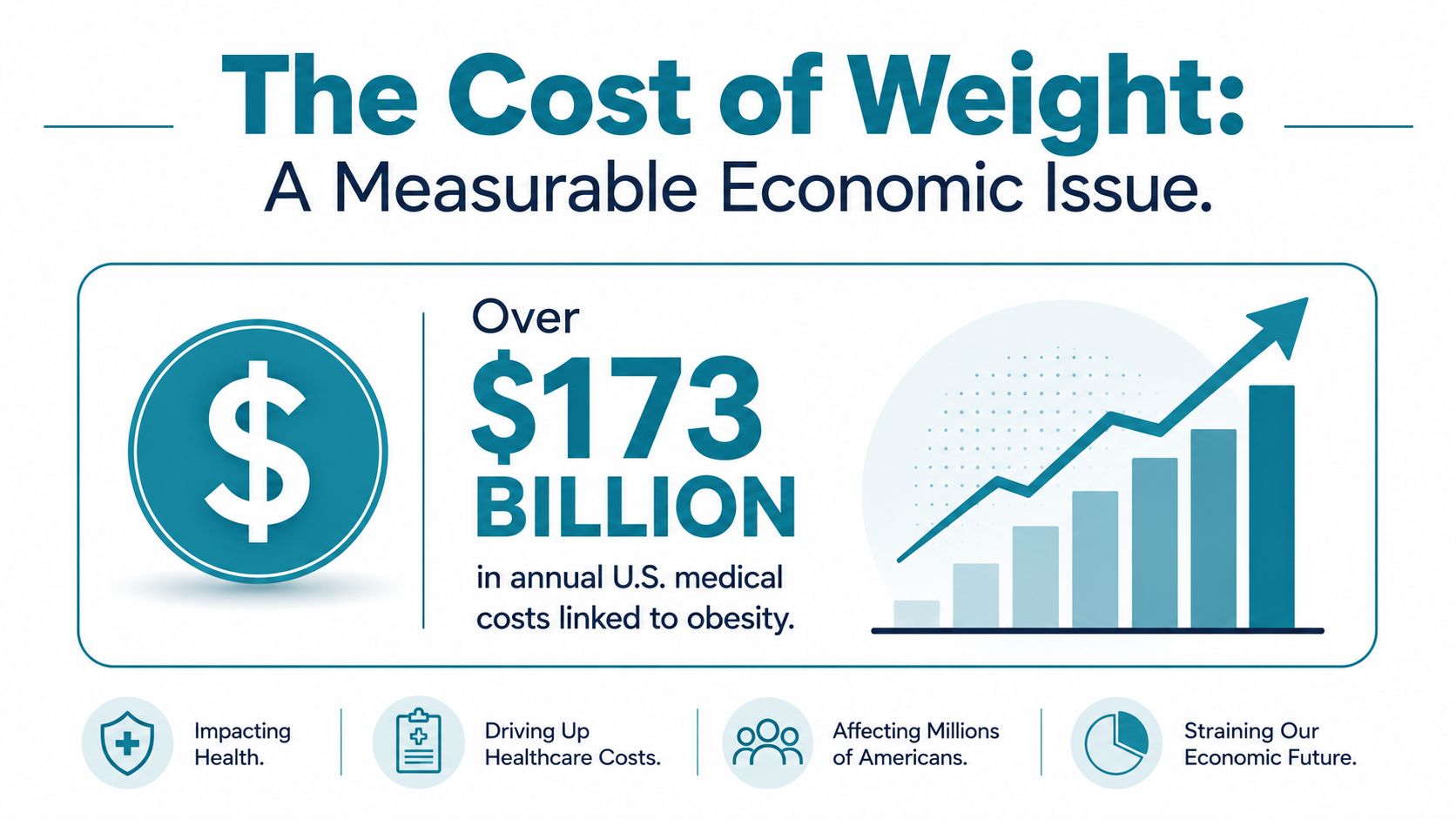
The right way to frame the issue is in layers. One layer is individual medical spending, which includes office visits, laboratory work, medications, and treatment for related conditions. A second layer is labor-market impact, which affects employers through productivity and benefit costs. A third layer is treatment cost, especially when a monthly prescription price is compared with physician-led management over time. A fourth layer is long-term value, which asks whether a structured care pathway may lower downstream spending even if the sticker price looks higher at the start.
A monthly price tag rarely captures the full bill.
A narrow focus on the sticker price can also obscure what is being purchased. A medication-only approach may look cheaper month to month, while a physician-led plan can include evaluation, monitoring, medication selection, and follow-up that shape total cost of care. Those differences matter because obesity care is not just a pharmacy decision. It is a medical decision with spending consequences across the clinic, the workplace, and, in some cases, long-term care.
The broader economy has already absorbed those costs. A global analysis by the World Obesity Federation estimated that the worldwide economic impact of overweight and obesity was a little under US$2 trillion in 2020 and is projected to exceed US$3 trillion by 2030 and US$4 trillion by 2035 World Obesity Federation report. In the U.S., employers feel part of that burden through productivity losses and benefit spending. For readers trying to understand the cost of weight, the key question is not only what treatment costs each month, but what total cost is created when care is delayed, fragmented, or too narrow in scope.
If you want a closer look at how clinicians think about treatment choices and cost, this overview of obesity medicine provides useful context.
What Clinicians Mean by Obesity and Overweight
Clinicians use BMI, body mass index, as a screening tool to estimate weight category. It is a starting point, not a diagnosis. BMI helps sort people into categories because medical risk, eligibility for treatment, and expected cost often differ between overweight and obesity.
In common clinical use, overweight means a BMI from 25 to 29.9, and obesity means a BMI of 30 or higher. Those categories are widely used in obesity medicine because next steps in care depend on risk, not appearance. Some clinicians also look at body fat distribution and waist circumference, since abdominal fat can add risk even when weight alone does not show the full picture.
Clinical categories matter because they map to different treatment decisions and, later, to different spending patterns. As noted earlier in the NBER review, costs rise with obesity severity, including a 233.6% higher cost figure for class 3 obesity compared with normal weight. That does not mean every person in a category will have the same bills. It means the population-level pattern shifts as severity changes.
A clinical label is only the beginning. The financial picture depends on what follows, including evaluation, treatment selection, monitoring, and follow-up. A person with the same BMI may need very different care if sleep apnea, diabetes, joint disease, or other conditions are part of the picture, and those differences affect total cost of care.
Plain-language takeaway: BMI helps clinicians sort risk. It does not tell the whole story, and it does not predict one person's bill.
How categories relate to cost
- Overweight: Often associated with increased risk, but usually lower average added spending than more severe obesity.
- Obesity: Associated with higher average medical costs, especially when other conditions are present.
- Class 3 obesity: The highest severity category in routine use, and the category linked to the largest cost burden in the review cited above.
How Excess Weight Raises Individual Medical Spending
A person-level view of the cost of weight starts with a simple distinction. Per-person averages describe what tends to happen across a group. National totals show what those patterns add up to across the population. A review in the NBER paper on obesity economics found that obesity was associated with $2,826 in higher annual medical care costs per adult in one analysis, while another review reported a 2008 per-person direct medical cost of $1,723 for obesity and $266 for overweight, along with combined national direct medical costs of $113.9 billion. The same review also placed adult obesity-related annual medical care costs at $2,505 higher than normal weight in a more recent estimate.
Those figures are not interchangeable. They come from different methods, years, and comparison groups. Their common thread is direction. Extra weight is associated with extra cost, and the burden rises as severity rises. The financial effect is therefore not only about whether someone has obesity. It also depends on how advanced the condition is and how much other care it drives.
What the numbers do and don't mean
These figures are population averages, not forecasts for a specific adult. A person with obesity and few complications may spend less than the average. Another person with the same BMI but sleep apnea, diabetes, or joint disease may spend far more. The average still matters because it shows the economic gradient attached to severity.
A higher BMI often changes the type of care a person uses, not just the amount. More visits, more testing, more medication, and more follow-up can all raise spending. A clinical label is only the starting point. The cost picture depends on what follows.
Here is a concise comparison from the U.S. literature cited above.
| Category | Extra annual per-person medical cost, U.S. | Source |
|---|---|---|
| Overweight | $266 direct medical cost in one review | NBER paper on obesity economics |
| Obesity | $1,723 direct medical cost in one review | NBER review noted above |
| Obesity | $2,826 higher annual medical care cost in one analysis | NBER review noted above |
| Obesity | $2,505 higher annual medical care cost in a 2021 to 2023 review | NBER review noted above |
| Class 3 obesity | 233.6% higher annual medical costs versus normal weight | NBER review noted above |
The practical point is straightforward. Severity changes the economics. If treatment delays allow weight-related disease to build, the cost is not only clinical. It becomes financial as well, because each additional condition can raise the volume and intensity of care a person uses.
The Broader Economic Weight Beyond the Clinic
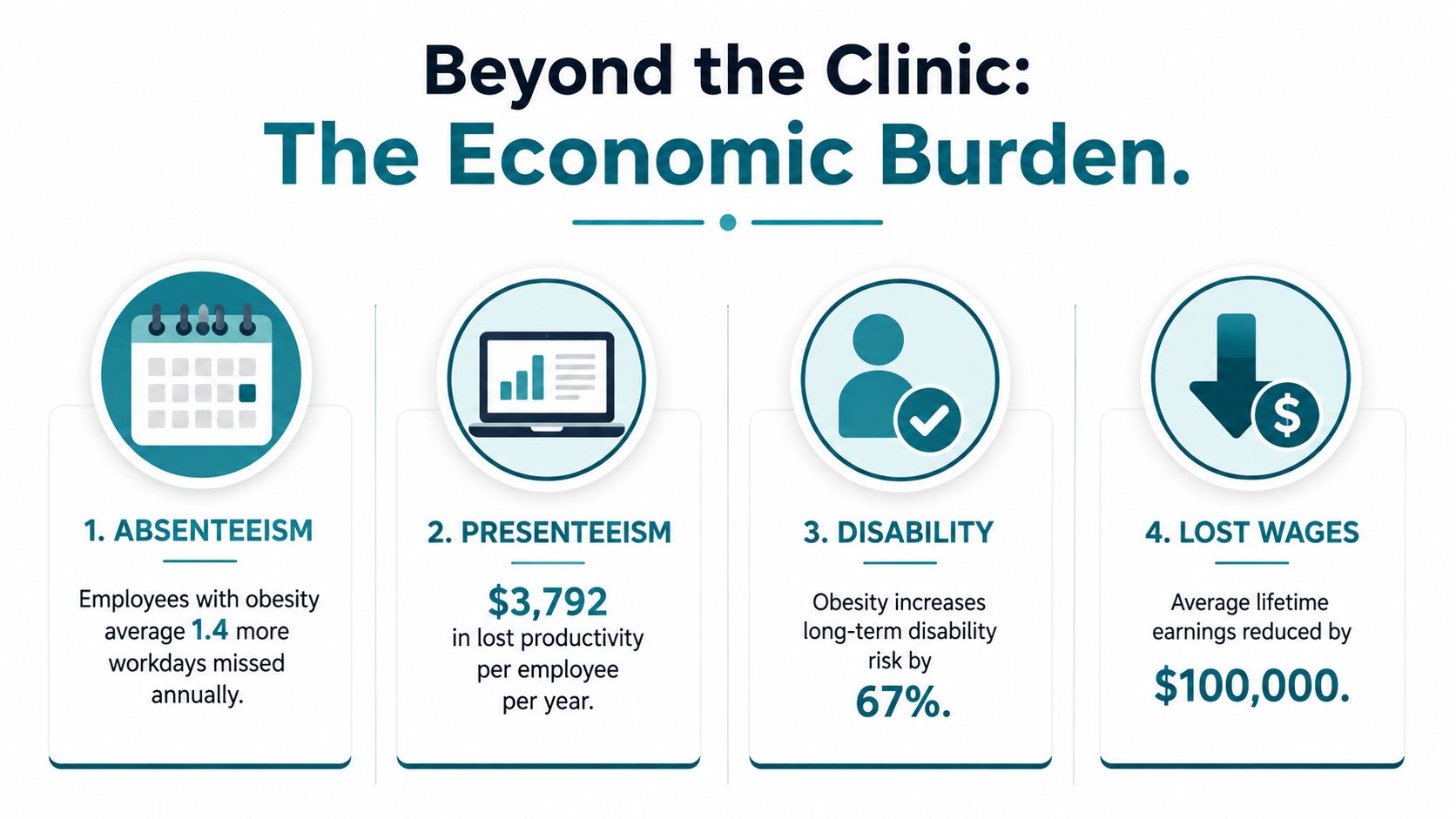
The cost of weight reaches beyond the exam room. Employers absorb part of it through workforce disruption, benefit spending, and lost productivity, while national economies absorb part of it through lower output and higher health spending. As noted earlier, the World Obesity Federation report estimated the worldwide economic impact of overweight and obesity at a little under US$2 trillion in 2020, with projections above US$3 trillion by 2030 and US$4 trillion by 2035.
U.S. employer data point in the same direction. A 2024 analysis estimated that obesity and overweight together generated $425.5 billion in costs for businesses and employees in 2023, including $347.5 billion tied to obesity and $78 billion tied to overweight. The same analysis estimated average annual cost per worker at $6,472 for obesity and $1,244 for overweight. The pattern is clear. The cost of weight is an employer issue as well as a clinical one.
Why employer costs matter to patients
Labor-market costs can look abstract in aggregate reports, but they are concrete for the worker who misses time and for the employer who pays for the absence and the lost output. When treatment is delayed, the financial burden can shift from outpatient spending to broader workplace and disability costs.
The economic burden is not separate from the clinical burden. They usually move together.
The analytical point is not blame. Chronic disease affects work, function, and long-term health, so the costs show up in more than one place. For adults considering private, physician-led care, that means the financial question is larger than a prescription refill. It also includes whether treatment may reduce downstream costs that build outside the clinic. For a closer look at treatment options, see this anti-obesity medication overview.
What Anti-Obesity Medication Actually Costs
The monthly drug price is the first figure many readers look for, and it can be high even before care is added. According to a 2024 review of anti-obesity medication costs, median U.S. 30-day product prices at maximum dose were about $1,296 for Wegovy, $1,017 for Zepbound, $1,296 for Saxenda, and $629 to $724 for Xenical. Those figures are useful, but they describe only the medication itself. They do not include evaluation, follow-up, or the way coverage changes what a patient pays.
The review also found that no FDA-approved anti-obesity medication is covered by Medicare Part D, and that coverage remains highly variable across plans. Recent manufacturer self-pay programs changed the comparison again. Novo Nordisk lowered Wegovy to $499 per month in its self-pay program, and Eli Lilly offers Zepbound through a self-pay channel at $299 to $449 per month, depending on dose peer-reviewed review.
Sticker price and access are not the same thing
That difference matters because the same prescription can lead to very different out-of-pocket costs. One patient may have commercial insurance with prior authorization. Another may pay cash. A third may meet medical criteria but still face a plan with narrow coverage rules.
For a closer look at how drug choice and route of administration affect decisions, see this anti-obesity medication overview. The broader point is straightforward. The price attached to obesity treatment depends on access pathway, not just the drug name.
Cost rule: Monthly drug price is a starting point, not the final bill.
A careful reader should also keep FDA approval status and coverage separate. The medications above are FDA-approved anti-obesity drugs discussed in the review, but approval does not guarantee insurance payment, and insurance payment does not reveal the total cost of care. For private-pay adults, that difference often separates a short-term purchase from a longer treatment plan.
Physician-Led Care as a Cost Decision, Not Just a Price
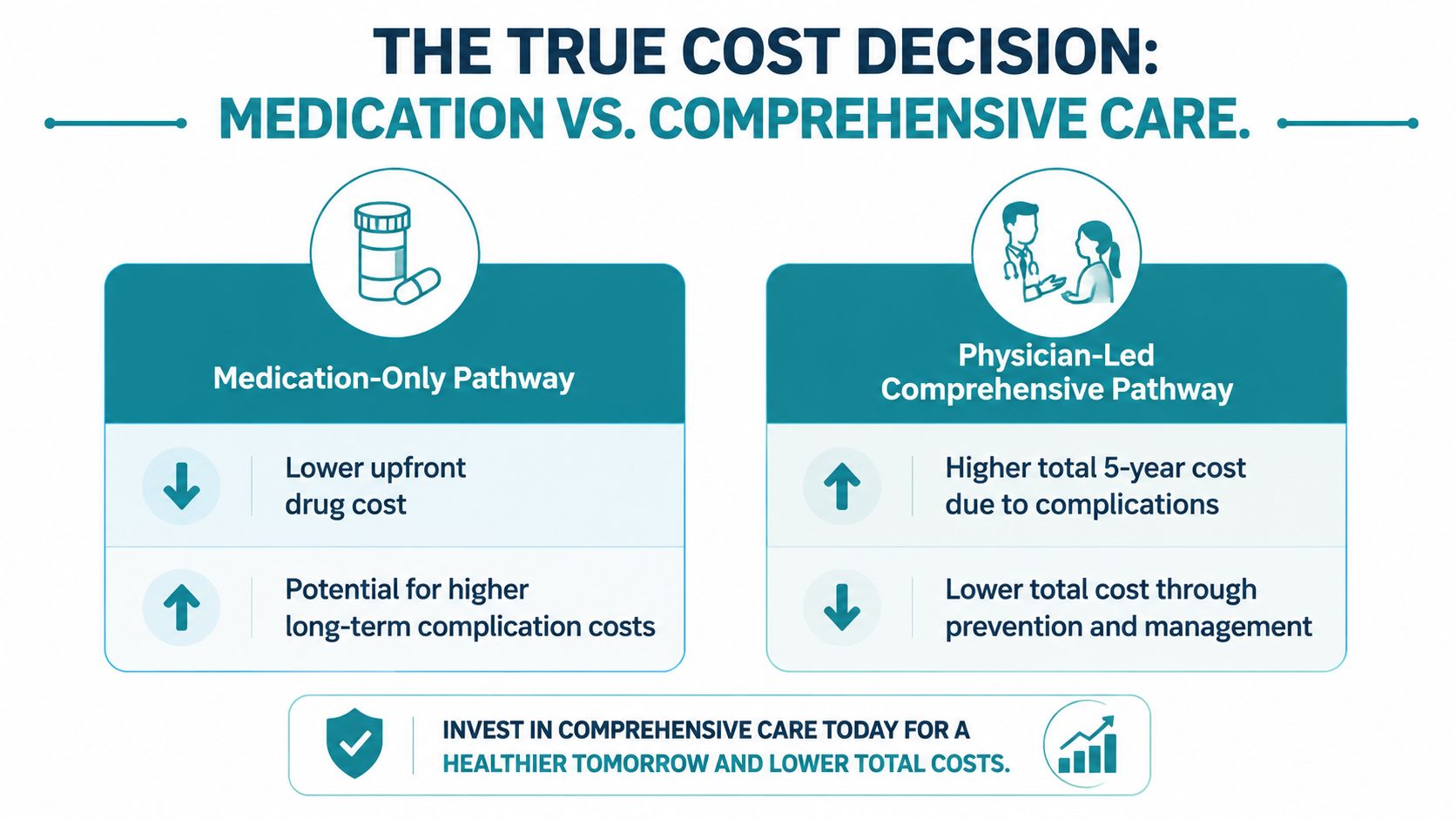
The cheapest monthly option is not automatically the lowest total cost. Physician-led obesity care includes initial evaluation, ongoing monitoring, maintenance planning, and coordination with other clinicians when needed, and each of those steps changes the economic picture even when the medication itself is expensive. A prescription alone does not account for follow-up, persistence, side effects, or the possibility that a different pathway may be more cost-effective over time.
The American College of Surgeons reported in 2024 that bariatric surgery is more cost-effective than newer GLP-1 weight-loss drugs alone over the long term. The same report also found that combining the two can be more cost-effective than surgery alone. That does not mean surgery is right for everyone. It does mean the economic question is wider than which drug costs less this month.
What a higher-touch pathway changes
A physician-led approach can change cost in several ways.
- Fewer blind spots: A clinician can assess whether obesity is the main issue or part of a broader metabolic picture.
- Better maintenance planning: Long-term management matters because obesity is chronic, and stopping treatment can change the cost curve.
- More deliberate sequencing: Some people may need medication, some may need surgery evaluation, and some may need a combination approach.
- Clearer monitoring: Follow-up can help identify whether the current pathway is worth continuing from a cost perspective.
That is why price comparisons alone can mislead. A medication that looks cheaper up front may end up more expensive if it does not fit the person's needs, is not maintained, or gets used without monitoring. Private-pay patients often care about this because they are paying for the decision process, not just the product, which is a core tenet of physician-led care.
Empire Medical Wellness offers physician-led obesity medicine as one outpatient option, with evaluation, medication when clinically appropriate, and monitoring framed as part of a longer-term plan. You can review the practice's fee structure and how visits work if you are comparing the economics of structured care against medication-only shopping.
A Practical Framework for Thinking About Total Cost
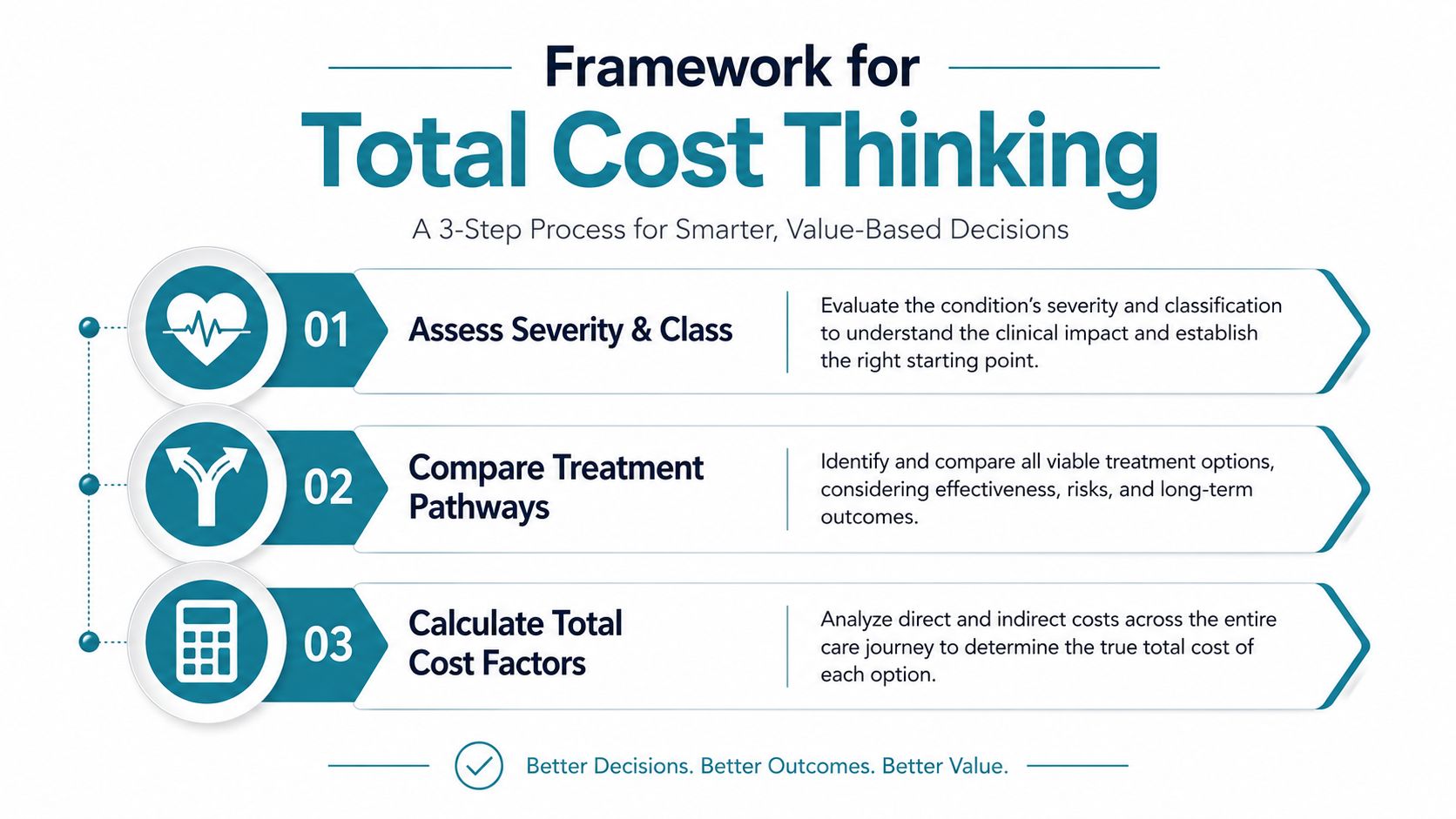
The smartest way to think about the cost of weight is to sort it into four variables. Severity and class affect baseline risk. Treatment pathway changes what you pay now and later. Time horizon determines whether you're looking at one month, one year, or several years. Coverage status decides how much of the price lands on the patient instead of the plan.
That framework helps explain why two people with similar BMIs can face very different expenses. One may pay cash for medication. Another may have insurance that covers part of the workup but not the drug. A third may be considering surgery after years of medical treatment. The cost is not fixed because the pathway isn't fixed.
Questions worth bringing to a clinician
What is being evaluated?
Ask whether the visit is focused only on weight or also on related conditions that may change the plan.What counts as monitoring?
Monitoring may include follow-up visits, symptom review, and reassessment of whether the current path still makes sense.What does maintenance mean here?
Some patients need a long-term plan after initial progress. Maintenance is part of cost, not a bonus feature.How does coverage change the total?
A plan that looks expensive on paper may be less expensive if it reduces downstream care, while a cheaper drug may not stay cheap if access is limited.
A practical comparison also includes the question of what kind of care you want to pay for. Some people want only a prescription. Others want a structured obesity medicine visit with clear follow-up. If that's the model you're evaluating, the service summary on glp-1 versus phentermine can help you think about the medication side of the decision without collapsing the whole issue into one price.
Common Questions About the Cost of Weight
Does insurance ever cover anti-obesity medication?
Sometimes, but coverage is uneven and depends on the plan. As noted earlier in the article, access remains inconsistent, and Medicare Part D does not cover FDA-approved anti-obesity medication.
Can private-pay obesity care reduce later spending?
It can, although the result depends on the treatment path and the patient's needs. As discussed earlier in the article, individualized care can be more cost-effective over time than medication alone, especially when long-term planning is built into the model.
What does an obesity medicine visit usually include?
A physician-led visit usually includes medical and metabolic assessment, review of weight history and related health factors, a discussion of treatment options, and a plan for follow-up. That matters because the cost conversation starts with evaluation, monitoring, and maintenance, not just the first prescription or visit fee.
Is the monthly drug price the main thing to compare?
No. The monthly sticker price is only one part of the expense. Access, monitoring, follow-up, and ongoing maintenance shape the total cost of care more than many consumer-facing messages suggest, so the better comparison is the full pathway rather than the pharmacy label alone.
For adults who want a structured, physician-led evaluation, Empire Medical Wellness offers obesity medicine visits that can include assessment, medication when clinically appropriate, and follow-up planning. If you want to compare that kind of private-pay model with a medication-first option, review the glp-1 versus phentermine service page for a closer look at the medication side of the decision.
This article is educational and not personal medical advice. If you are considering treatment, a clinician can help you compare the total cost of care, not just the monthly price of a medication.