
Methamphetamine is a powerful, highly addictive stimulant that increases dopamine and norepinephrine activity in the brain. Based on the 2012 National Survey on Drug Use and Health, NIDA reported that over 12 million people, or 4.7% of the population, had tried methamphetamine at least once, while about 1.2 million had used it during the prior year.
What is methamphetamine beyond that basic definition? It's a synthetic drug that can affect the heart, brain, sleep, mood, teeth, kidneys, and judgment. A useful medical explanation must also address what happens when someone has an emergency, how the illicit market is changing, and what treatment can look like when there isn't a methamphetamine-specific medication approved by the FDA.
This guide uses one clearly labeled hypothetical composite example. It doesn't describe an Empire patient or a real person. It illustrates how clinicians may prioritize immediate safety before discussing longer-term recovery care.
Table of Contents
- What Is Methamphetamine and Why This Explanation Matters
- Chemistry, Street Names, and How Methamphetamine Works in the Body
- Immediate and Long-Term Health Effects of Methamphetamine Use
- Overdose Signs, Emergency Triage, and When to Seek Immediate Care
- Evidence-Based Treatment Options and Recovery Pathways
- Harm Reduction, Legal Status, and Trusted Resources
- What a Physician-Led Evaluation Looks Like in Practice
- Sources
What Is Methamphetamine and Why This Explanation Matters
What is methamphetamine, and why does a useful definition need to include more than its effects on the brain?
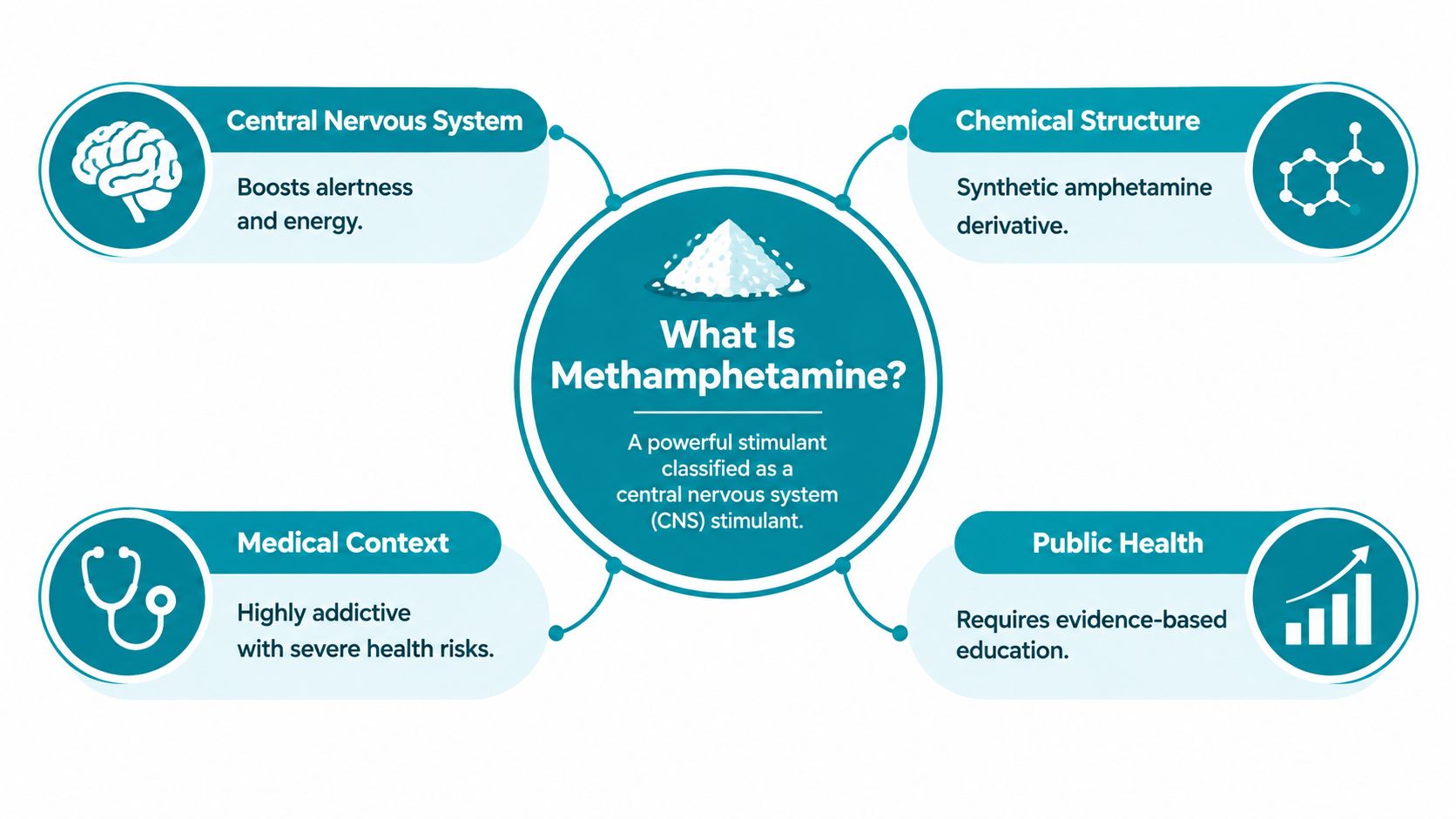
Methamphetamine is a central nervous system stimulant. It activates systems involved in alertness, energy, attention, heart rate, blood pressure, and reward. Developed in the early twentieth century from amphetamine, it was first used in nasal decongestants and bronchial inhalers. In the United States, it was later classified as a Schedule II stimulant. Federal controlled-substance rules require prescriptions to have a nonrefillable status, as described in NIDA's methamphetamine research report.
At comparable doses, more methamphetamine enters the brain than amphetamine. That difference helps explain its potentially stronger, longer-lasting effects, along with substantial risks of dependence and toxicity.
The question is also about public health. UNODC data on methamphetamine seizures reports that global seizures reached another record high in 2024. Its smoothed long-term trend suggests approximately 13% annual growth by that year. Authorities in East and Southeast Asia seized 236 tons in 2024, a 24% increase from 2023. UNODC also described nearly 10 tons seized in Cambodia that year as the largest methamphetamine seizure in history.
Those findings show why the risk picture changes over time. UNODC reports a threefold rise in global methamphetamine seizures from 2014 to 2024, while reported precursor seizures fell 85% and dismantled laboratory reports fell 94%. This pattern may reflect more concentrated, mobile, and difficult-to-detect production, with activity extending beyond traditional markets into the Near and Middle East, Africa, and parts of Europe.
Composite example: A person may need two kinds of help at once: emergency assessment for a dangerous change in physical or mental status, followed by structured addiction care. A definition alone cannot guide those decisions.
Adults seeking private, physician-led care can review confidential addiction-medicine services from Empire Medical Wellness. Suspected overdose or dangerous symptoms require emergency care rather than a routine appointment.
Chemistry, Street Names, and How Methamphetamine Works in the Body
How can one chemical produce both intense alertness and serious medical instability? Methamphetamine is a synthetic amphetamine derivative that readily crosses the blood-brain barrier, which works like a guarded border between the bloodstream and brain tissue. Once inside, it raises extracellular dopamine and norepinephrine, chemical messengers involved in reward, alertness, attention, movement, and the body's stress response.
The mechanism involves more than “releasing dopamine.” Methamphetamine enters neurons and moves monoamines out of storage vesicles through VMAT2, a transport protein. It also drives reverse transport through dopamine and norepinephrine transporters, increasing signaling outside the neurons. A useful analogy is a delivery system running in reverse: instead of collecting chemical messengers from outside the cell, the transporters push them into the surrounding space. This helps explain wakefulness and attention, while also contributing to euphoria, dependence potential, rapid heartbeat, and raised blood pressure. The NCBI Bookshelf overview of methamphetamine pharmacology describes the mechanism in greater technical detail.
People may use terms such as meth, crystal meth, ice, crank, speed, or chalk. These names change by region and over time, and one term may refer to different substances in different settings. Slang can help a clinician understand what a patient means, but it cannot confirm the drug's contents, strength, or safety. As the illicit market changes, the label on a substance becomes an even less reliable guide to risk.
| Clinical question | What the mechanism suggests |
|---|---|
| Which signals are affected? | Dopamine and norepinephrine signaling increase, with VMAT2 and reverse transporter activity involved. |
| What might a person feel? | Stimulation, greater alertness, reward, and reduced need for sleep. |
| What may the body experience? | Increased heart rate, raised blood pressure, anxiety, or other physiologic strain. |
| What should guide care? | Assessment should consider the brain, cardiovascular system, mental state, sleep, and substance contents. |
Composite example: A person who says they used “ice” may be awake and talkative but also have a racing heart, severe anxiety, or confusion. If the change is dangerous, emergency assessment comes first. Once medically stable, an evidence-based addiction treatment pathway can address repeated use, dependence, and recovery planning.
Readers seeking more detail about terminology and forms can review information about crystal methamphetamine. Online descriptions cannot determine what an illicit substance contains.
Immediate and Long-Term Health Effects of Methamphetamine Use
What can methamphetamine use do to the body before a person appears visibly ill? Harm may develop during acute intoxication, after repeated exposure, or through disrupted sleep, poor nutrition, cardiovascular stress, and psychiatric symptoms. These phases can overlap, so a calm appearance does not rule out danger.

Acute effects that need medical attention
Methamphetamine increases sympathetic activity, the nervous system's “fight-or-flight” response. That stimulation can place several systems under strain:
- Cardiovascular strain: A rapid or irregular heartbeat and higher blood pressure can progress to chest symptoms, heart disease, or stroke.
- Neurologic toxicity: Hyperthermia, or dangerously high body temperature, and convulsions can occur. Severe overheating and seizures require prompt medical care and may be fatal.
- Psychiatric changes: Anxiety, agitation, paranoia, hallucinations, or psychosis can impair judgment and personal safety.
- Basic physiologic disruption: Appetite may fall while activity rises. Prolonged stimulation can prevent sleep and limit physical recovery.
NIDA's methamphetamine health guidance describes cardiovascular, sleep, dental, cognitive, and psychiatric harms. These risks can affect people regardless of the route used or assumptions about who uses the drug.
Longer-term consequences
Repeated use is linked to rapid or irregular heartbeat, high blood pressure, stroke, heart disease, psychosis, insomnia, cognitive decline, kidney damage, and nonfatal overdose. Dental problems, persistent sleep disruption, and mood changes may become part of the same medical picture. NIDA's drug information summarizes short- and long-term risks.
Composite clinical example: A person whose substance came from a changing illicit market may report feeling energetic while sleeping poorly, eating little, and experiencing suspicious thoughts. A clinician would assess chest symptoms, headaches, temperature, mental state, urination, and dental pain. Severe findings call for emergency triage; after medical stabilization, evidence-based treatment can address repeated use, dependence, and recovery planning.
Feeling energetic reflects stimulation, not safe function of the heart, brain, or body.
Overdose Signs, Emergency Triage, and When to Seek Immediate Care
Could a person who appears merely restless be developing a methamphetamine overdose? Yes. Methamphetamine toxicity can push the heart, brain, and temperature-control system beyond safe limits, much like an accelerator stuck down. Call 911 in the United States for chest pain, trouble breathing, a seizure, severe confusion, possible stroke, extreme agitation, loss of consciousness, or dangerously high body temperature. Do not wait for the person to “sleep it off.”
The changing illicit market also raises the possibility of polysubstance exposure. CDC surveillance found nearly 35,000 overdose deaths involving psychostimulants with abuse potential in 2023. From January 2021 through June 2024, 68.8% of methamphetamine-involved overdose deaths also involved opioids, according to the CDC stimulant-overdose resource. Unexpected sedation, slowed breathing, or unresponsiveness may therefore signal opioid exposure alongside stimulant toxicity.
Emergency triage table for methamphetamine overdose
| Symptom | Urgency level | Action required |
|---|---|---|
| Chest pain, severe shortness of breath, or a very rapid or irregular heartbeat | Immediate emergency | Call 911, stay with the person, and follow the dispatcher's instructions |
| Seizure, collapse, or loss of consciousness | Immediate emergency | Call 911, protect the person from nearby hazards, and do not put anything in the mouth |
| Very high body temperature, hot skin, or severe agitation | Immediate emergency | Call 911, move away from excess heat if safe, and stay with the person |
| New weakness, facial drooping, trouble speaking, sudden severe headache, or loss of coordination | Immediate emergency | Treat it as a possible stroke and call 911 without delay |
| Severe paranoia, hallucinations, confusion, or behavior that threatens safety | Immediate emergency | Call 911, reduce stimulation, and keep others at a safe distance |
| Fatigue, poor sleep, dental pain, or mood changes without acute danger | Prompt routine or urgent assessment | Arrange medical evaluation, especially if symptoms persist or worsen |
Composite clinical example: A person using methamphetamine from an unpredictable illicit supply becomes intensely agitated, then unusually drowsy. A companion should call 911, report the possible substances, observe breathing, and avoid giving alcohol or more drugs. After emergency stabilization, referral to evidence-based treatment can address repeated use and recovery planning. Emergency overdose guidance from Empire Medical Wellness can support preparation, but it cannot replace 911 during a crisis.
Evidence-Based Treatment Options and Recovery Pathways
What should treatment address when the methamphetamine market supplies products of uncertain strength or composition? The answer begins with a clinical assessment, not an assumption. A clinician reviews current use, sleep, mood, psychosis, blood pressure, cardiovascular symptoms, dental concerns, cognitive changes, other substances, and safety at home. Acute medical or psychiatric danger requires stabilization before outpatient recovery planning.

No medicine is currently FDA-approved specifically for methamphetamine-use disorder. The NIDA clinical guidance on methamphetamine identifies contingency management as the behavioral approach with the strongest evidence. It uses clearly defined incentives to reinforce treatment participation and agreed recovery behaviors. The purpose is measurable reinforcement, not a judgment about character.
Cognitive behavioral therapy, motivational interviewing, and continuing-care approaches may also help. Their suitability varies, and care should address mental health, cardiovascular, sleep, dental, and other substance-related concerns alongside methamphetamine use.
Composite clinical example: An adult using methamphetamine from an unpredictable illicit supply has repeated sleep loss, worsening anxiety, and difficulty stopping. Once immediate danger has been assessed, a clinician can help set measurable goals, discuss contingency management, consider therapy, and arrange follow-up. The example shows why treatment must match both the person's symptoms and the changing risks of the drug market.
A practical monitoring pathway
- Safety assessment: Check urgent cardiovascular, neurologic, psychiatric, and overdose concerns.
- Medical review: Discuss heart symptoms, blood pressure, sleep, mood, dental health, nutrition, and other substances.
- Behavioral treatment: Consider contingency management and structured therapies when appropriate.
- Follow-up: Track sleep, mood, cardiovascular symptoms, and daily functioning.
- Coordination: Connect with emergency, psychiatric, dental, specialty, or community services when outpatient care is insufficient.
A physician-led addiction medicine evaluation can support confidential outpatient assessment and recovery planning. Outpatient care does not replace detoxification, inpatient, residential, or emergency services when those levels are needed.
Harm Reduction, Legal Status, and Trusted Resources
Harm reduction doesn't mean approving of methamphetamine use. It means reducing the chance that a person dies or suffers preventable injury while connecting them with medical care. A nonjudgmental conversation can make it easier to disclose possible opioid exposure, sleep deprivation, chest symptoms, hallucinations, or prior overdose.
Useful safety principles include:
- Don't use alone: An emergency can become fatal when no one is present to call for help.
- Avoid mixing substances: Methamphetamine combined with opioids, alcohol, or other stimulants can create unpredictable risks.
- Consider possible opioid contamination: If opioid exposure is possible, tell emergency responders. Naloxone access and overdose education may be relevant, but emergency services remain essential for unresponsiveness or breathing problems.
- Seek care for warning signs: Chest pain, seizures, severe overheating, stroke symptoms, and altered mental status require 911.
- Use trusted information: SAMHSA, NIDA, CDC, FDA, and qualified clinicians are more reliable than anonymous social-media advice.
In the United States, methamphetamine is a Schedule II stimulant. That legal classification reflects controlled-substance regulation and does not make illicit methamphetamine predictable or medically safe. Prescription status, when applicable, is separate from nonmedical or illicit exposure.
The FDA's controlled-substance information and federal public-health resources can help readers distinguish regulated medicines from illicit substances. Readers looking for information about possible opioid involvement can also review fentanyl and overdose risks. If someone is in immediate danger, call 911. For a behavioral-health crisis, call or text 988 in the United States.
What a Physician-Led Evaluation Looks Like in Practice
A clearly labeled hypothetical composite
A hypothetical adult presents after several sleepless days and reports increasing paranoia. The first clinical priority isn't a long-term incentive plan or a discussion of recovery goals. It's an urgent safety assessment, including questions about chest symptoms, overheating, confusion, hallucinations, suicidal thoughts, access to dangerous objects, and possible exposure to opioids or other substances.
If the person appears medically or psychiatrically unstable, emergency evaluation takes priority. If immediate danger has been addressed, follow-up can focus on sleep, mood, blood pressure, heart rate, dental concerns, nutrition, and the person's goals. A structured behavioral pathway, including contingency management when appropriate, may then be considered alongside counseling and coordination with outside services.
This composite contains no identifying details and doesn't represent a specific patient or clinical outcome. It demonstrates a general principle: stabilize urgent risk before building a recovery plan.
What the first appointment may address
A physician-led evaluation commonly depends on honest information about recent substance exposure, sleep, medical conditions, prescribed medications, mental health symptoms, and prior treatment. Patients don't need to use perfect medical terminology. Clear details about what happened and when can help a clinician choose the safest next step.
Follow-up may examine whether sleep is improving, whether mood or suspiciousness is changing, whether cardiovascular symptoms are emerging, and whether dental or nutritional concerns need outside care. It may also determine whether outpatient monitoring remains appropriate or whether a higher level of support is necessary.
A useful question for any appointment: “Which symptoms mean I should call 911 instead of waiting for follow-up?”
Publication date: October 2, 2026
Updated date: October 2, 2026
Byline: Empire Medical Wellness Editorial Team
Sources
- NIDA methamphetamine research report
- NIDA methamphetamine health information
- CDC stimulant-overdose surveillance and guidance
- UNODC World Drug Report methamphetamine data
- NCBI Bookshelf pharmacology overview
This article is educational and isn't personal medical advice. If you or someone else has emergency symptoms, call 911.
Empire Medical Wellness provides confidential, outpatient, physician-led addiction medicine assessment, monitoring, and recovery planning for adults. Visit Empire Medical Wellness to learn whether a private evaluation is an appropriate next step for your concerns.