You find an adult unresponsive beside a bed, sofa, or bathroom door. There are pills nearby, but you don't know whether they're prescription medication, fentanyl, a sedative, or something else. Treat an unknown-drug overdose as an emergency: check responsiveness and breathing, call 911, give naloxone when opioid exposure is possible, support breathing if you're trained, and stay until help arrives.
An overdose can happen with illegal drugs, prescribed medications, alcohol, or combinations of substances. The goal in the first minutes isn't to identify every substance. It's to protect breathing and circulation long enough for emergency clinicians to take over.
Table of Contents
- What Counts as a Drugs Overdose
- Danger Signs Across Opioids, Stimulants, Sedatives, and Alcohol
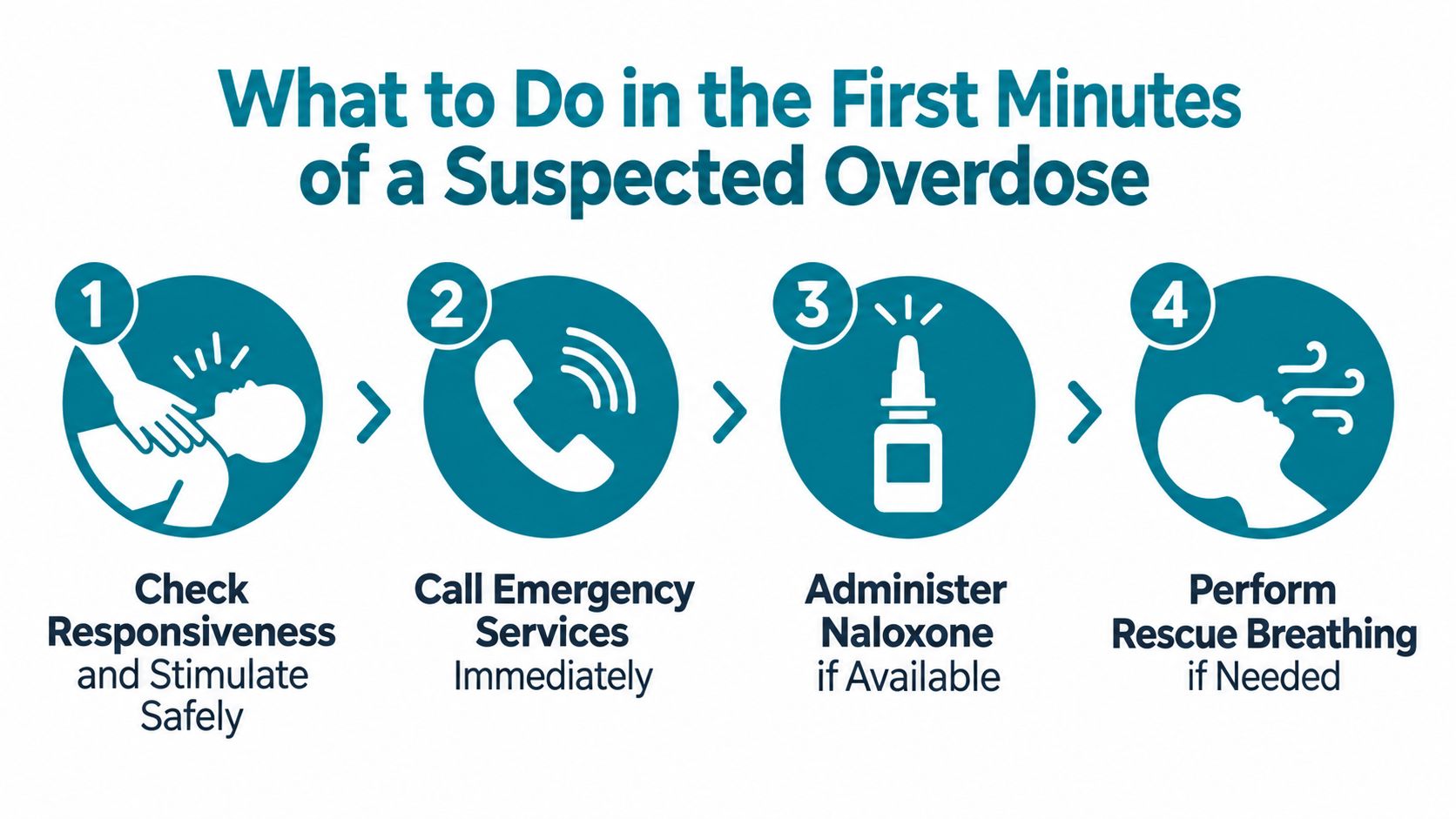
- What to Do in the First Minutes of a Suspected Overdose
- From Emergency Care to Outpatient Addiction Medicine
- Harm Reduction Strategies That Reduce Overdose Risk
- When to Seek Outpatient Help After an Overdose or Risky Use
- A Hypothetical Walk-Through of a Continuous Response
- Common Questions About Drugs Overdose
- Can naloxone harm someone who isn't having an opioid overdose?
- How can you tell a severe high from an overdose?
- Does mixing substances really increase risk?
- Why can overdose happen after abstinence?
- What if the person wakes up angry after naloxone?
- How long should someone be watched after naloxone?
- Will calling emergency services lead to arrest?
- Can outpatient addiction medicine prescribe medication without inpatient treatment?
- Sources
What Counts as a Drugs Overdose
A drug overdose occurs when a substance, or combination of substances, overwhelms the body. The result may impair breathing, heart function, consciousness, temperature control, or several of these systems at once. Some overdoses develop gradually through increasing sleepiness. Others cause agitation, chest pain, seizures, or sudden collapse.
An acute toxic event is different from an uncomfortable but non-life-threatening episode. Someone may feel nauseated, dizzy, panicked, or excessively intoxicated without having immediate respiratory or cardiovascular failure. A bystander still can't safely rule out danger based only on how the person looks, especially when the substance or amount is unknown.
Why the same amount can affect people differently
Risk depends on more than the amount taken. Tolerance, the body's adaptation to repeated exposure, can fall after a period without use. Route of administration, individual health, liver and kidney function, sleep, hydration, and the presence of other substances also matter.
Alcohol and benzodiazepines can intensify opioid-related sedation and respiratory depression. A person may also be exposed to an unexpected ingredient in a counterfeit pill or illicit powder. Fentanyl can be present in several drug forms, and the person using it may not know it's there. The CDC's fentanyl guidance explains why naloxone and immediate emergency assistance matter when opioid exposure is possible.
Practical rule: If you can't wake someone normally, or their breathing looks abnormal, respond to the signs in front of you rather than waiting to identify the drug.
The national burden remains severe even as recent mortality has improved. The CDC reported 105,007 drug overdose deaths in the United States in 2023, an age-adjusted rate of 31.3 deaths per 100,000, and noted that deaths had increased about 520% from 1999 through 2023 (NIDA summarizes the CDC mortality data). Final CDC data later recorded 79,384 deaths in 2024, with a rate of 23.1 per 100,000, a 26.2% decline from 2023 (CDC National Center for Health Statistics). A lower national count doesn't make an individual overdose less urgent.
For readers researching a specific medication, an overview of barbiturate overdose risks can provide additional context. It shouldn't replace emergency assessment when someone is difficult to wake, breathing abnormally, or having a seizure.
Danger Signs Across Opioids, Stimulants, Sedatives, and Alcohol
You don't need to name the substance before calling 911. The pattern of symptoms can help responders prepare, but mixed exposure often produces overlapping or contradictory signs.
| Substance class | Key danger signs | Highest-risk combinations |
|---|---|---|
| Opioids | Pinpoint pupils, very slow or absent breathing, blue or gray lips, gurgling, limpness, or unresponsiveness | Opioids with alcohol, benzodiazepines, or other sedatives |
| Stimulants | Chest pain, severe agitation, overheating, seizure, collapse, or stroke-like symptoms such as weakness or trouble speaking | Stimulants with other stimulants, opioids, or substances that increase cardiac strain |
| Sedatives | Extreme drowsiness, confusion, poor coordination, loss of postural control, slowed breathing, or inability to stay awake | Benzodiazepines with opioids or alcohol |
| Alcohol | Vomiting while semi-conscious, cold or clammy skin, irregular breathing, inability to protect the airway, or choking | Alcohol with opioids, benzodiazepines, sleep medicines, or other sedatives |
Opioid danger signs
Opioid overdose is primarily a breathing emergency. A person may look asleep, but their breathing can be slow, shallow, irregular, or absent. Gurgling, snoring that doesn't respond to stimulation, pale or blue-gray skin, and pinpoint pupils are strong warning signs. The National Center for Biotechnology Information clinical review describes naloxone's purpose as reversing opioid-induced respiratory depression rather than just waking a person.
Stimulant, sedative, and alcohol danger signs
Stimulant toxicity often looks different. Severe overheating, chest pain, extreme agitation, seizure, collapse, or stroke-like symptoms require emergency care even when the person is awake. Sedatives can cause confusion and loss of coordination before breathing becomes dangerously slow. Alcohol poisoning can cause vomiting and choking when a person is too impaired to sit up or protect the airway.
Fentanyl and other opioids can be involved in counterfeit pills and mixed drug supplies. The Empire Medical Wellness fentanyl information offers substance-specific background, but uncertainty about the substance should never delay a 911 call.
What to Do in the First Minutes of a Suspected Overdose
Use this universal response card when an adult may have overdosed. An unknown-drug overdose is an emergency.
Check responsiveness safely. Speak loudly and gently tap the shoulder. Don't shake the person violently, put anything in their mouth, or expose yourself to spilled powder or bodily fluids. If they don't respond normally, move to the next step.
Call 911 immediately. Give the dispatcher the location, explain that the person may have overdosed, and report whether they're breathing, unconscious, vomiting, seizing, or having chest pain. Don't delay the call while searching for a pill bottle.
Assess breathing. If the person is breathing normally but remains unconscious, place them on their side when appropriate and keep the airway clear. If breathing is absent or abnormal, begin rescue breathing or CPR only if you're trained, while following the dispatcher's instructions.
Give naloxone when opioid exposure is possible. Use an available product according to its labeling. Naloxone can reverse opioid overdose, including fentanyl exposure, and it won't cause opioid withdrawal in someone who has no opioids in their system. It also doesn't replace emergency care. If breathing doesn't improve, follow the product instructions and dispatcher guidance regarding additional doses.
Stay until responders arrive. Keep the person warm, observe their breathing, and tell paramedics what you know. Naloxone's effect can wear off in about 30 to 90 minutes, while the opioid may last longer, so renewed sedation is possible (NCBI clinical review).
The FDA approved Narcan, a 4 mg naloxone hydrochloride nasal spray, for over-the-counter use on March 29, 2023, and later approved RiVive as a second over-the-counter nasal spray in July 2023 (FDA announcement). Availability can vary, so households affected by opioid exposure should discuss access with a pharmacist, clinician, or local public-health program.
For additional patient-facing information about naloxone, see naloxone guidance from Empire Medical Wellness. Calling 911 is still necessary after naloxone, even if the person wakes up and says they feel fine.
From Emergency Care to Outpatient Addiction Medicine
Emergency care and outpatient addiction medicine solve different problems. In the emergency department, clinicians focus on airway, breathing, circulation, toxic effects, reversal medication when indicated, complications, and observation. They may also evaluate injuries, aspiration, heart problems, seizures, temperature abnormalities, and mental status.
Hospital clinicians decide whether a person needs continued observation, admission, intensive support, or discharge with follow-up. An addiction consultation, when available, can help connect the acute event to treatment planning. That connection matters because surviving an overdose doesn't automatically remove the conditions that contributed to it.
What outpatient care can add
A physician-led outpatient assessment may review substance use, prior treatment, overdose history, prescribed medications, mental health symptoms, medical conditions, and recovery goals. Testing, including urine or saliva toxicology, may be used when clinically indicated and interpreted in context rather than as a stand-alone judgment.
Evidence-based treatment may include medication options for opioid use disorder, such as buprenorphine or naltrexone, when clinically appropriate. Methadone treatment generally involves referral to an authorized opioid treatment program. Medication choice depends on the person's health, current exposure, goals, and clinical assessment.
| Care setting | Primary role | Typical duration | Key clinicians |
|---|---|---|---|
| Emergency medical services | Immediate assessment, breathing support, naloxone when indicated, and transport | Until handoff or hospital arrival | Paramedics and emergency medical technicians |
| Emergency department | Stabilization, evaluation for complications, observation, and disposition planning | Based on clinical need | Emergency physicians, nurses, and consultants |
| Inpatient care | Treatment of persistent medical complications and monitored stabilization | Based on clinical need | Hospital physicians, nurses, and consulting specialists |
| Outpatient addiction medicine | Assessment, medication management when appropriate, monitoring, recovery planning, and coordination | Ongoing follow-up | Physician and authorized outside clinicians |
Outpatient care doesn't replace emergency treatment, detoxification, or inpatient services. It provides a structured place for follow-up, relapse-prevention planning, medication monitoring, and coordination with counseling or peer support. An addiction medicine specialist can help clarify which level of care fits the person's current medical needs.
Harm Reduction Strategies That Reduce Overdose Risk
Harm reduction doesn't approve of drug use. It recognizes that people may continue using despite danger and offers practical measures that can prevent death while making treatment more reachable.
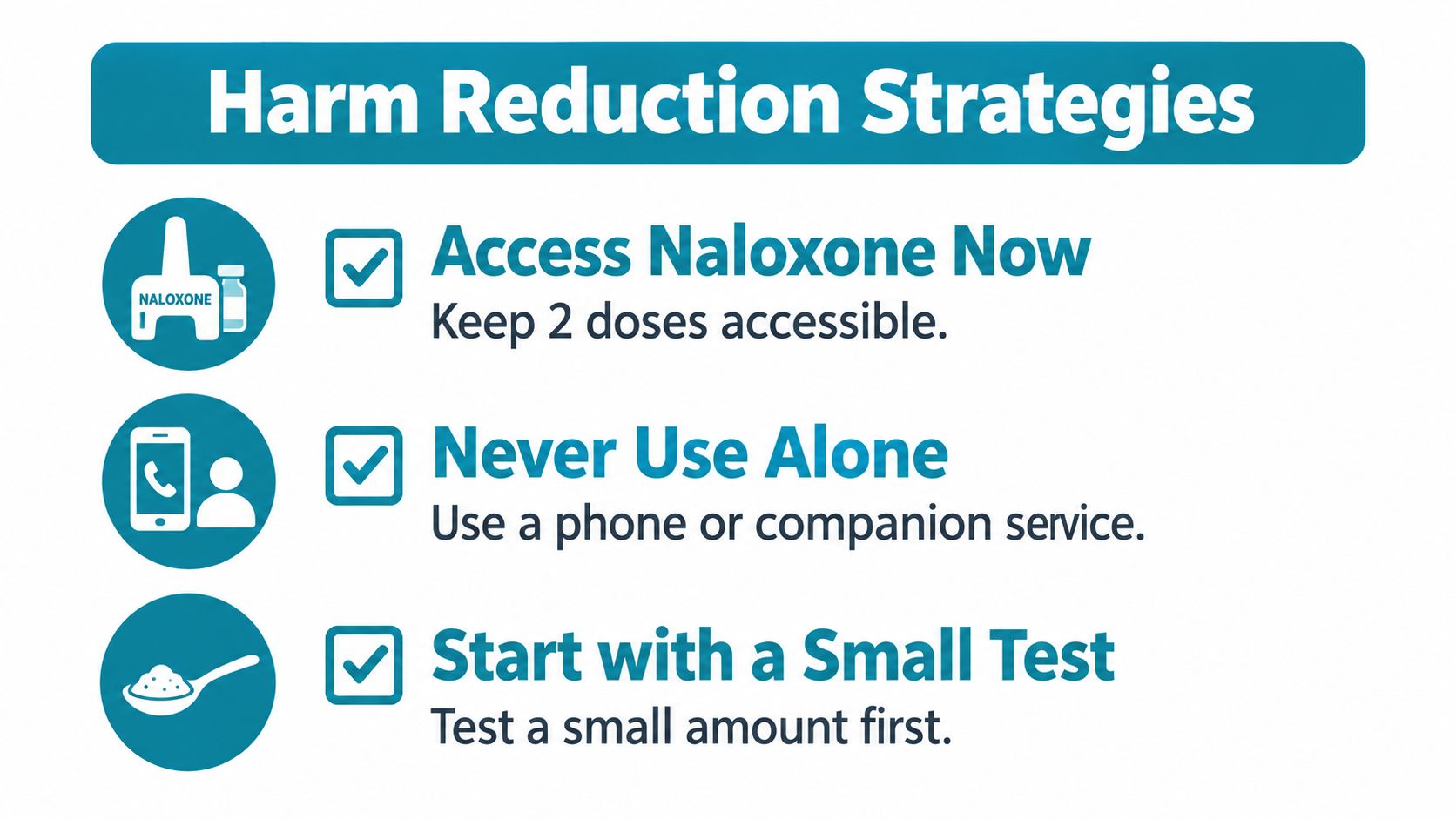
Naloxone should be nearby when opioid exposure is possible. A person who uses opioids, lives with someone who uses them, takes prescribed opioids, or may encounter counterfeit pills should discuss access with a pharmacist, clinician, or community program. Friends and family members can also learn where naloxone is available. The medication is most useful when people can find it quickly and know to call 911.
Fentanyl test strips can detect fentanyl in many pills, powders, and injectable drugs. The CDC says results usually appear within about five minutes, but a negative result doesn't eliminate risk because some fentanyl-like substances may not be detected (CDC overdose safety guidance). Test strips are one layer of protection, not a guarantee of safety.
Practical measures that create time
Avoiding combinations is especially important. Alcohol and benzodiazepines can worsen opioid-related respiratory depression, while combinations involving stimulants can create complicated cardiovascular and neurologic risks. After a period of abstinence, tolerance may be lower, which can make a previously familiar amount dangerous.
Never using alone gives another person a chance to call 911, administer naloxone, and support breathing. Overdose prevention centers and telephone-based services may offer additional safety options where legally available. These resources differ by jurisdiction, so local public-health departments and harm-reduction organizations are appropriate places to ask about current availability.
Medications for opioid use disorder can reduce the cycle of craving, withdrawal, and return to use for appropriate patients. A physician can explain whether medication, counseling, peer support, or a coordinated combination fits the person's goals. Information about cocaine and addiction medicine should be interpreted as general education, not a self-directed treatment plan.
When to Seek Outpatient Help After an Overdose or Risky Use
Go to the emergency department, or call 911, for ongoing breathing difficulty, chest pain, seizure, persistent confusion, severe overheating, inability to wake the person, suicidal thoughts, or a recent overdose that hasn't received medical evaluation. Don't use a scheduled appointment as a substitute for emergency care when a red flag is present.
Outpatient addiction medicine may be appropriate for escalating use, a prior nonfatal overdose that has already been medically addressed, return to use after treatment, concern about multiple medications or substances, or a desire to discuss safer options. A person doesn't need to wait for another crisis before asking for help.
What the first appointment may involve
A physician may ask about:
- Substance exposure: What was used, how often, and whether combinations are involved.
- Medical safety: Breathing problems, pain, seizures, pregnancy potential, liver or kidney concerns, and current prescriptions.
- Mental health: Depression, anxiety, trauma symptoms, sleep, and suicidal thinking.
- Treatment goals: Safer use, stopping, medication treatment, recovery support, or referral to a higher level of care.
- Next steps: Testing when indicated, medication discussion, follow-up timing, and coordination with outside clinicians.
Contacting a clinic doesn't commit someone to detoxification or inpatient treatment. It starts a clinical conversation about safety and appropriate care.
A Hypothetical Walk-Through of a Continuous Response
Hypothetical composite example: This scenario combines features from multiple possible situations. It isn't an Empire patient story and doesn't predict any particular outcome.
An adult is found unresponsive beside unknown pills at home. A housemate speaks loudly and checks for normal breathing. The person doesn't respond, and breathing is absent or abnormal.
The housemate calls 911 and tells the dispatcher that the drug is unknown, the person is unresponsive, and opioid exposure can't be excluded. The housemate gives naloxone because it's available, then follows dispatcher instructions for rescue breathing or CPR. The point isn't to prove that the pills contain an opioid. The point is to act on a potentially reversible cause without delaying emergency care.
How the handoff works
Paramedics assess breathing and circulation, provide support, and transport the person for emergency evaluation. The housemate brings the available medication packaging or tells clinicians what was observed, without handling unknown powders unnecessarily.
After stabilization, the emergency team may discuss follow-up. If the adult agrees, a scheduled outpatient addiction medicine visit can address substance history, overdose risk, prescriptions, mental health, and recovery goals. The outpatient clinician may coordinate with the hospital or another treating professional when authorization and clinical need support that communication.
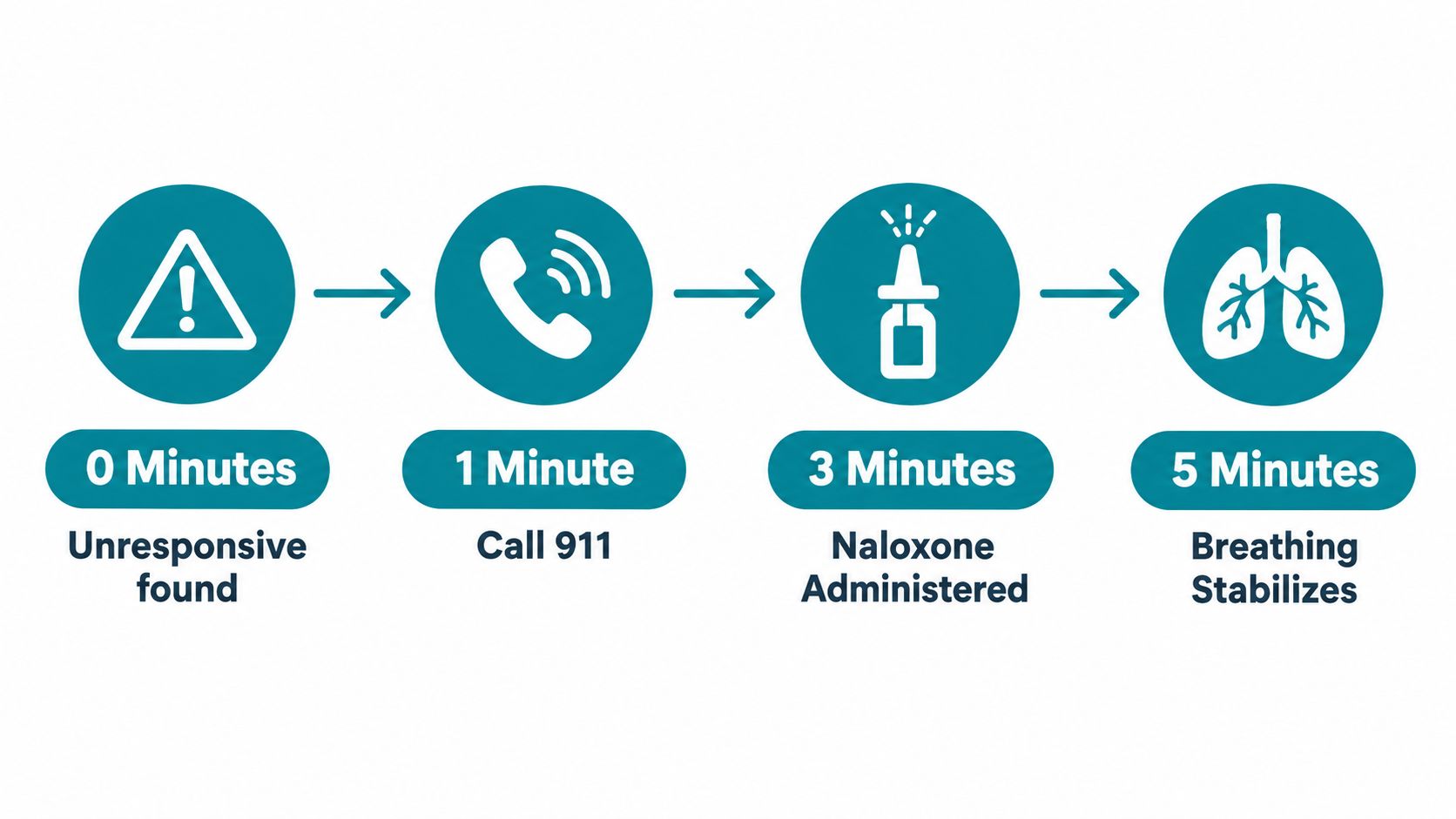
This sequence shows the overdose continuum clearly. Bystander action protects the next few minutes. Emergency care treats immediate medical danger. Outpatient care addresses ongoing risk and continuity. No single setting can safely perform all three jobs.
Common Questions About Drugs Overdose
Can naloxone harm someone who isn't having an opioid overdose?
Naloxone is designed to reverse opioid effects. It doesn't reverse stimulant, alcohol, or sedative toxicity, but giving it when opioid exposure is possible generally doesn't harm a person because opioids aren't involved. Call 911 regardless, because a person may have another serious poisoning or a mixed overdose.
How can you tell a severe high from an overdose?
A severe high may involve intoxication, anxiety, nausea, or unusual behavior while the person remains responsive and breathes normally. An overdose is suggested by inability to wake the person, abnormal breathing, seizure, chest pain, severe overheating, persistent confusion, or loss of airway protection. If you're uncertain, treat it as an emergency rather than trying to classify it at home.
Does mixing substances really increase risk?
Yes. Substances can interact in ways that intensify sedation, respiratory depression, cardiac strain, impaired judgment, or aspiration risk. Opioids combined with alcohol or benzodiazepines are especially concerning, and polysubstance exposure can make symptoms harder to interpret.
Why can overdose happen after abstinence?
Tolerance may decrease when someone hasn't used for a period of time. Returning to a previously familiar amount can therefore have a stronger effect, particularly when the drug supply or product strength is uncertain.
What if the person wakes up angry after naloxone?
Withdrawal, confusion, fear, or embarrassment can make a person agitated. Keep your distance, avoid arguing, and let emergency responders assess them. Don't allow anger or reassurance that they feel fine to end the emergency response prematurely.
How long should someone be watched after naloxone?
Stay with the person and follow dispatcher and paramedic instructions. Naloxone can wear off before some opioids do, so renewed sleepiness or abnormal breathing requires immediate attention. A clinician should determine when monitoring is no longer needed.
Will calling emergency services lead to arrest?
Good Samaritan protections commonly exist, but laws vary by jurisdiction and circumstances. Don't delay a life-saving call to investigate legal details. The dispatcher and responding clinicians need accurate information about what happened.
Can outpatient addiction medicine prescribe medication without inpatient treatment?
Some people can begin or continue evidence-based outpatient treatment without an inpatient stay, while others need emergency, detoxification, or inpatient support first. A physician assesses medical stability, current substance exposure, withdrawal risk, and the appropriate level of care during the evaluation.
For a non-emergency concern, a confidential outpatient conversation can help clarify the next safe step.
Empire Medical Wellness provides confidential, physician-led outpatient addiction medicine for adults, including medical assessment, evidence-based treatment when clinically appropriate, monitoring, recovery planning, and coordination with outside care. Visit Empire Medical Wellness to learn more, but call 911 for any suspected overdose or other emergency. This article is educational and isn't personal medical advice.
Byline: Empire Medical Wellness Editorial Team
Published: September 25, 2026
Updated: September 25, 2026