
You might be standing in the grocery aisle, reading one headline that says protein is the answer and another that warns about carbs, then wondering why good advice keeps changing. Nutrition is the study and practice of how food, drinks, and their components support the body's energy needs, repair, growth, and long-term health. It's both personal and clinical, which is why the same meal can mean something different for weight management, recovery, or mental health.
Table of Contents
- What Nutrition Actually Means
- Macronutrients, Micronutrients, and Calories
- How Nutrition Guidance Is Built and Where to Verify It
- Nutrition in Three Real Adult Situations
- Common Misconceptions and Red Flags
- Practical Habits That Actually Move the Needle
- When to Seek Physician-Led Evaluation and Outside Coordination
- Frequently Asked Questions
What Nutrition Actually Means
A lot of people hear “nutrition” and think of calorie counting or a short list of good and bad foods. In clinical care, it means something broader. It's the way your body takes in food, breaks it down, uses the parts it needs, and gets rid of what it doesn't.
From deficiency diseases to modern chronic care
That broader view took time to develop. Early nutrition science focused on deficiency diseases like scurvy and pellagra, then moved toward population-level guidance as medicine learned how diet affects more than vitamin shortages. A major turning point came with the first Recommended Dietary Allowances in 1941, followed by the first Dietary Guidelines for Americans in 1980, the DRI framework in 1994, and later expert-panel reports from 1997 to 2004 that expanded nutrient assessment beyond the original RDA model. Those milestones helped create the reference standards used today in dietary planning, public health, and medical counseling.[^1]
That history matters because adults rarely need advice about one missing nutrient alone. They usually need help deciding how food fits with blood sugar, weight goals, medications, appetite changes, sleep, work schedules, or recovery. A person who wants a practical starting point might pair a simple meal plan with a resource like our anti-inflammatory cookbook, especially if they want structure without turning every meal into a science project.
Practical rule: when food advice starts sounding extreme, step back and ask whether it fits your actual life, not just a headline.
Why the clinical view matters
The clinical side of nutrition is not about perfection. It's about matching food patterns to a real body, real symptoms, and real constraints. That can matter even more when a person is trying to manage weight, recover from a period of poor intake, or stabilize mood and energy.
In this article, the same core idea shows up three times, but in different ways. Weight management, recovery, and mental health each change how nutrition is assessed and what “better” looks like. That's why a one-size-fits-all answer usually falls short.
Macronutrients, Micronutrients, and Calories
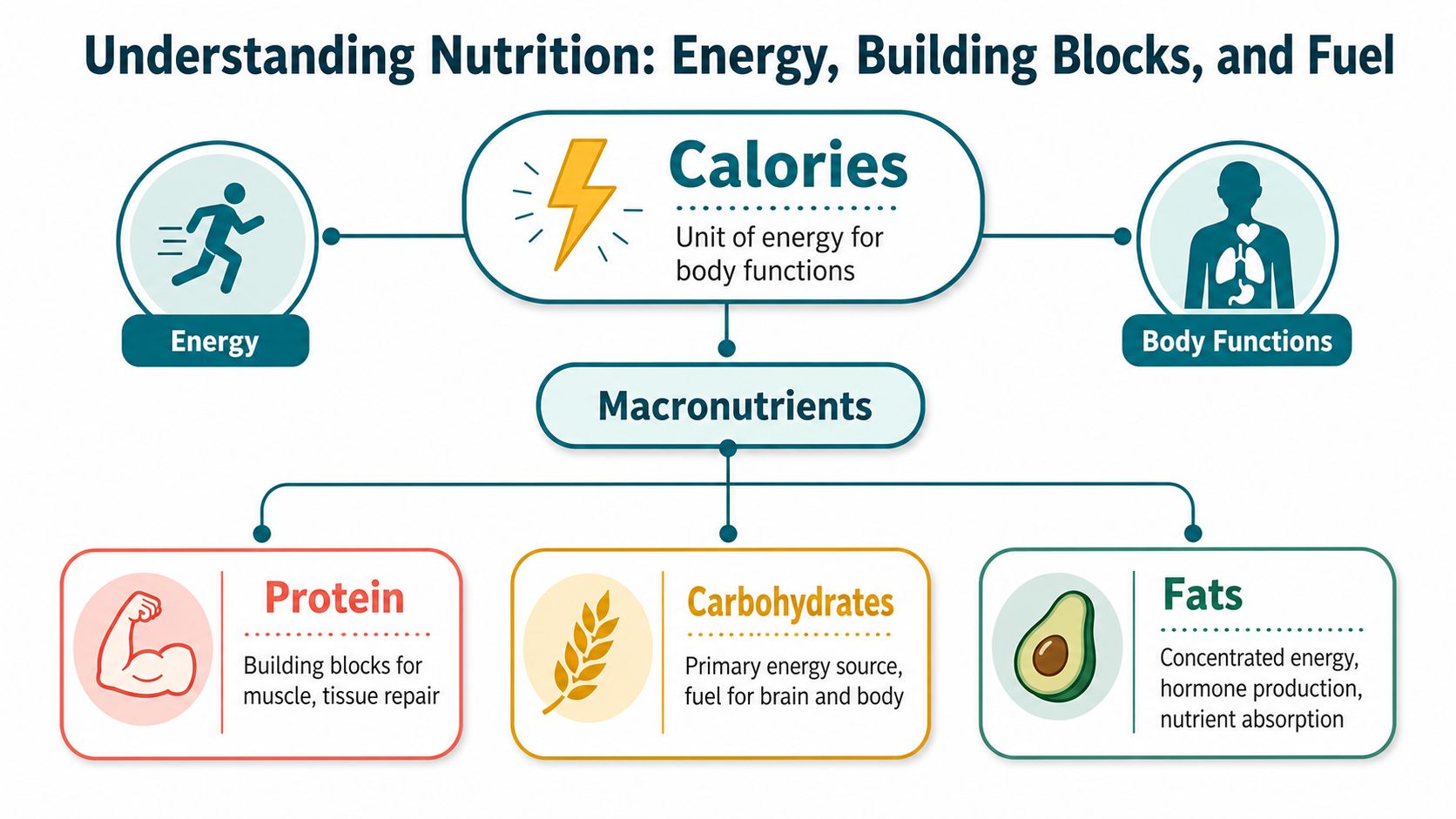
Calories are not a moral score. They're a unit of energy. Your body uses them to breathe, think, move, digest, and repair tissue, much like a car needs fuel to run.
The big three macronutrients
The three main macronutrients are protein, carbohydrate, and fat. Think of protein as building material, carbohydrate as fuel that can be cleaner or rougher depending on the source, and fat as both a concentrated energy source and part of the structure that helps cells and hormones work properly.
Protein gets a lot of attention because it helps maintain and repair lean tissue, but it's not just for athletes. Carbohydrates are the body's quick-access energy source, and the quality of the carb matters. Fruit, beans, oats, and vegetables behave very differently from candy or sweetened drinks. Fat isn't the enemy either. It helps with energy storage and nutrient absorption, which is one reason food quality matters as much as calorie totals.
Micronutrients are different. Vitamins and minerals are needed in small amounts, but the body can't make them on its own in sufficient quantities. A useful analogy is that they're like spark plugs in an engine. You don't need them in large amounts, but without them, the system doesn't run well. Water and fiber matter too, because hydration and digestion affect how comfortably food patterns work in daily life.
Reading labels without getting lost
The terms on a Nutrition Facts label can feel abstract until you link them to what the body does. A food can be calorie-dense but low in protein. Another can be lower in calories but still leave you hungry if it lacks fiber or enough volume. That's why nutrition is about balance and quality, not just total calories.
Simple test: if a meal keeps you full, supports your goals, and gives you room for other nutrients across the day, it's doing its job.
The right label is less about fear and more about translation. Once you know what calories, protein, carbohydrate, fat, vitamins, minerals, water, and fiber each do, the label becomes a tool instead of a puzzle.
A practical food question here is often less about theory and more about sourcing. If you're comparing animal proteins and want a deeper look at a specific option, the grass fed beef guide can help you think about the food itself in a more grounded way.
How Nutrition Guidance Is Built and Where to Verify It
Nutrition advice isn't supposed to come from the loudest voice online. In the U.S., it's built from a framework of public health guidance and food composition data. The Dietary Guidelines for Americans set broad patterns for healthy eating, while the Dietary Reference Intakes provide more detailed nutrient benchmarks used by clinicians and policy makers.[^1]
What to check before trusting a claim
If a post tells you a food is “bad” or a supplement is “necessary,” check the source before you act. The FDA explains that the serving size on a Nutrition Facts label is the amount the listed numbers refer to, not necessarily the amount you ate.[^6] That matters because a package can contain multiple servings, and the calories or sodium can add up quickly if you assume the whole package equals one serving.
For concrete nutrient lookups, USDA FoodData Central is the place to verify what's in a food, especially when brand-specific information matters.[^8] If you're checking a packaged food, the FDA's guide to the Nutrition Facts label helps you interpret calories, nutrients, ingredients, and serving size correctly.[^6]
Verify before you modify: if a nutrition claim changes what you plan to eat, confirm it in a primary source first.
Why labels and databases beat memory
People often remember a food as “healthy” or “not healthy” based on reputation, not data. That's where confusion starts. A product can look simple on the front but still have a serving size that makes the back label easy to misread. Food databases and label guides help you compare foods on a consistent basis instead of relying on guesswork.
The goal isn't to turn every meal into a spreadsheet. It's to know where to check the facts so you can make better decisions without being manipulated by marketing, social media trends, or oversimplified rules. When the numbers matter, use the numbers that the FDA and USDA already publish.
Nutrition in Three Real Adult Situations
Nutrition changes meaning depending on the clinical context. A plan that works well for one adult can miss the mark for another who is trying to manage weight, rebuild after disrupted eating, or steady mood and energy. The same word, nutrition, can point to very different clinical goals.
Weight management, recovery, and mental health are not the same problem
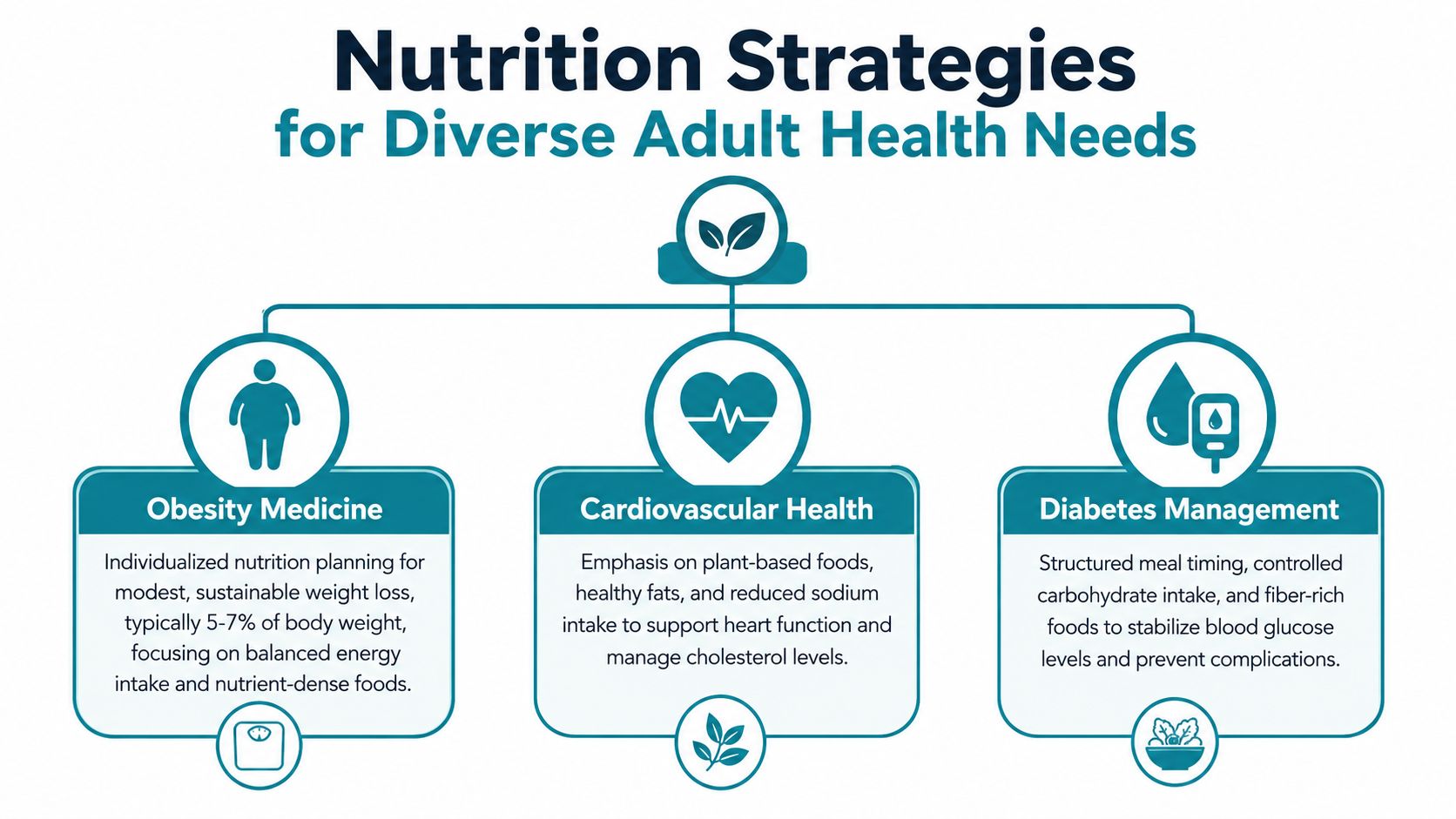
In obesity medicine, nutrition planning is individualized because the goal is not just eating less, it is finding a pattern a person can maintain. The WHO notes that for most adults, protein intake of 10–15% of total daily energy is generally sufficient, which is roughly 50–75 g/day for a person eating 2,000 kcal/day, and that unrefined carbohydrates can supply about 45–75% of total energy while free sugars should stay below 10%.[^3] In diabetes-focused nutrition guidance, even a modest 5–7% weight loss can reduce the risk of developing type 2 diabetes, which is why small, sustained changes matter more than crash diets.[^4] In real practice, medical treatment can be considered alongside nutrition and activity when clinically appropriate, including FDA-approved anti-obesity medication such as semaglutide in a physician-led plan.[^15]
In addiction medicine, nutrition often becomes irregular during active use or early recovery. Meals get skipped, hydration slips, and appetite cues can be hard to trust. Regular meals and fluids matter because recovery planning works better when the body is not running on empty. If a person is already working with outside treatment programs, authorized coordination can help keep medical care aligned without blending every issue into one bucket.
In adult mental health, diet quality can interact with sleep, energy, and medication tolerability. That does not mean food replaces psychiatric care. It means nutrition can support steadier routines, fewer blood sugar swings, and better day-to-day functioning when the treatment plan is already in motion.
Why the same meal can land differently
A meal plan that helps one adult feel full and focused may feel impossible to another adult juggling nausea, shift work, or medication side effects. That is why physician-guided nutrition care looks at context, not just food groups.
A structured plan can still be simple. The best version is the one a person can repeat on an ordinary Tuesday.
Common Misconceptions and Red Flags
A person can hear nutrition advice that sounds certain because it is simple, even when the advice leaves out how bodies, medications, access, and daily routine shape eating. Real nutrition care has to account for those pieces.
What misleading advice leaves out
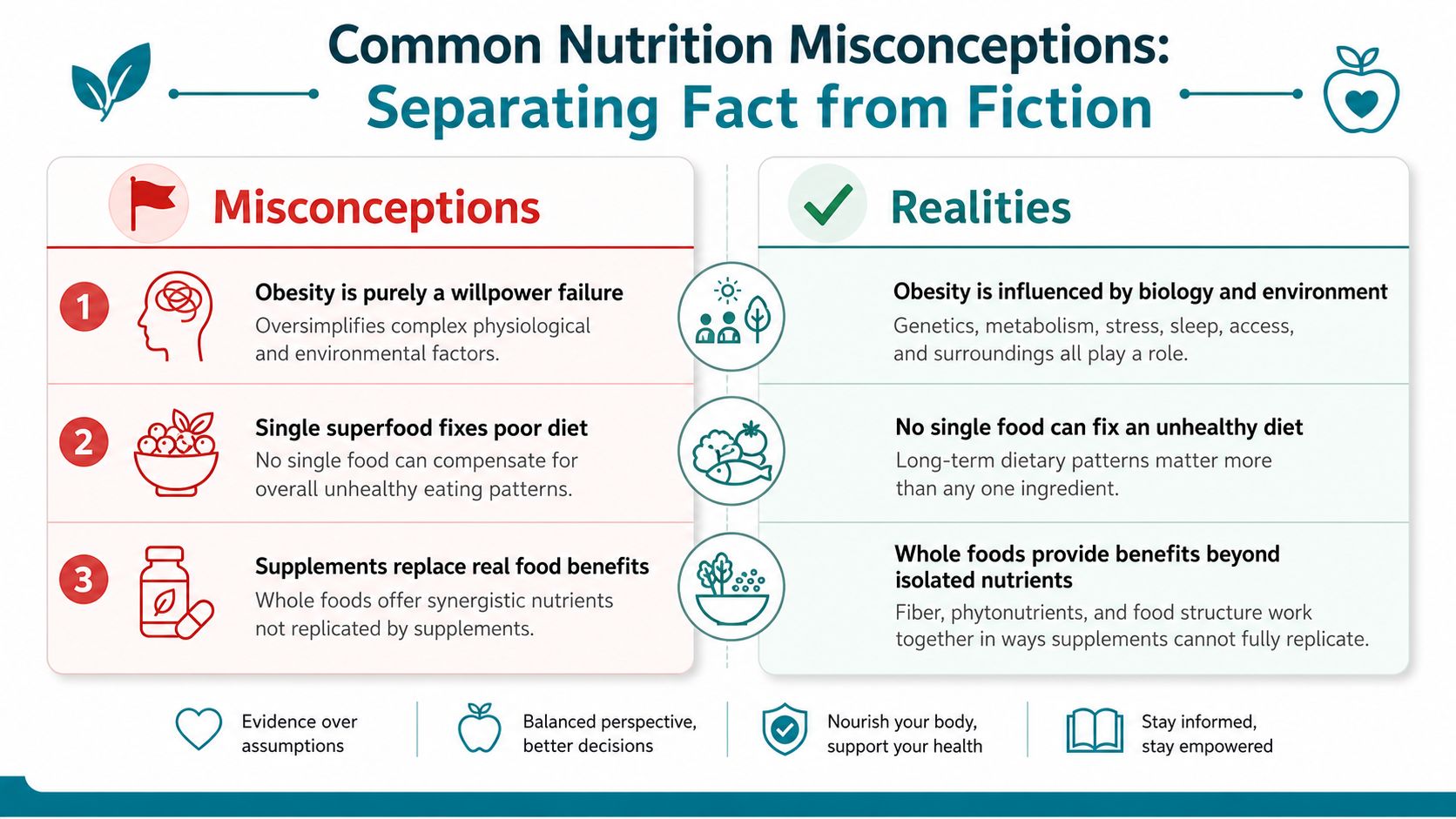
The claim that obesity is only a matter of willpower leaves out biology, medications, environment, and food access. Nutrition security is broader than having food available. It also includes consistent access, affordability, storage, preparation, and reliable information, which matters in rural, lower-income, and racially marginalized communities.[^5] If someone does not have transportation, cooking equipment, time, or stable storage, telling them to “just eat healthier” is not a usable plan.
The same problem shows up in miracle claims. No single superfood can cancel out an otherwise poor pattern, and supplements cannot replace the full mix of nutrients and food structure that whole foods provide. Extreme restriction is also misleading, because a plan that is too rigid often ignores the social and practical cost of keeping it going over time.
Social media adds another layer of confusion. It blends education, marketing, identity, and entertainment in one feed. A post can feel persuasive and still be clinically weak. That is why label reading, food databases, and medical context still matter.
The same caution applies to weight-loss promises that flatten every person into one category. A medication choice depends on the person's goals, risks, and medical history, and GLP-1s and phentermine work differently, so a one-size-fits-all recommendation can miss the point.
Red flags that need medical attention
Some changes in eating are really symptoms that need attention.
- Rapid unintentional weight change: this deserves evaluation, especially if it happens without a deliberate change in eating or activity.
- Persistent gastrointestinal symptoms: ongoing nausea, vomiting, diarrhea, constipation, pain, or swallowing problems can affect intake and absorption.
- Eating-disorder patterns: restrictive eating, bingeing, purging, or intense fear around food can become medically serious.
- New fatigue or mood changes: if these appear alongside dietary shifts, the cause may be nutritional, medical, medication-related, or psychiatric.
If a food plan is making you weaker, more anxious, or more isolated, that is not a sign to push harder. It is a sign to reassess what is driving the problem.
The point is not to treat every change as dangerous. It is to recognize when nutrition is part of a larger medical story.
Practical Habits That Actually Move the Needle
Good nutrition usually comes from a few repeatable habits, not a perfect menu. The habits that last are the ones that work when you're tired, busy, or eating out.
Start with the parts of the plate that help most
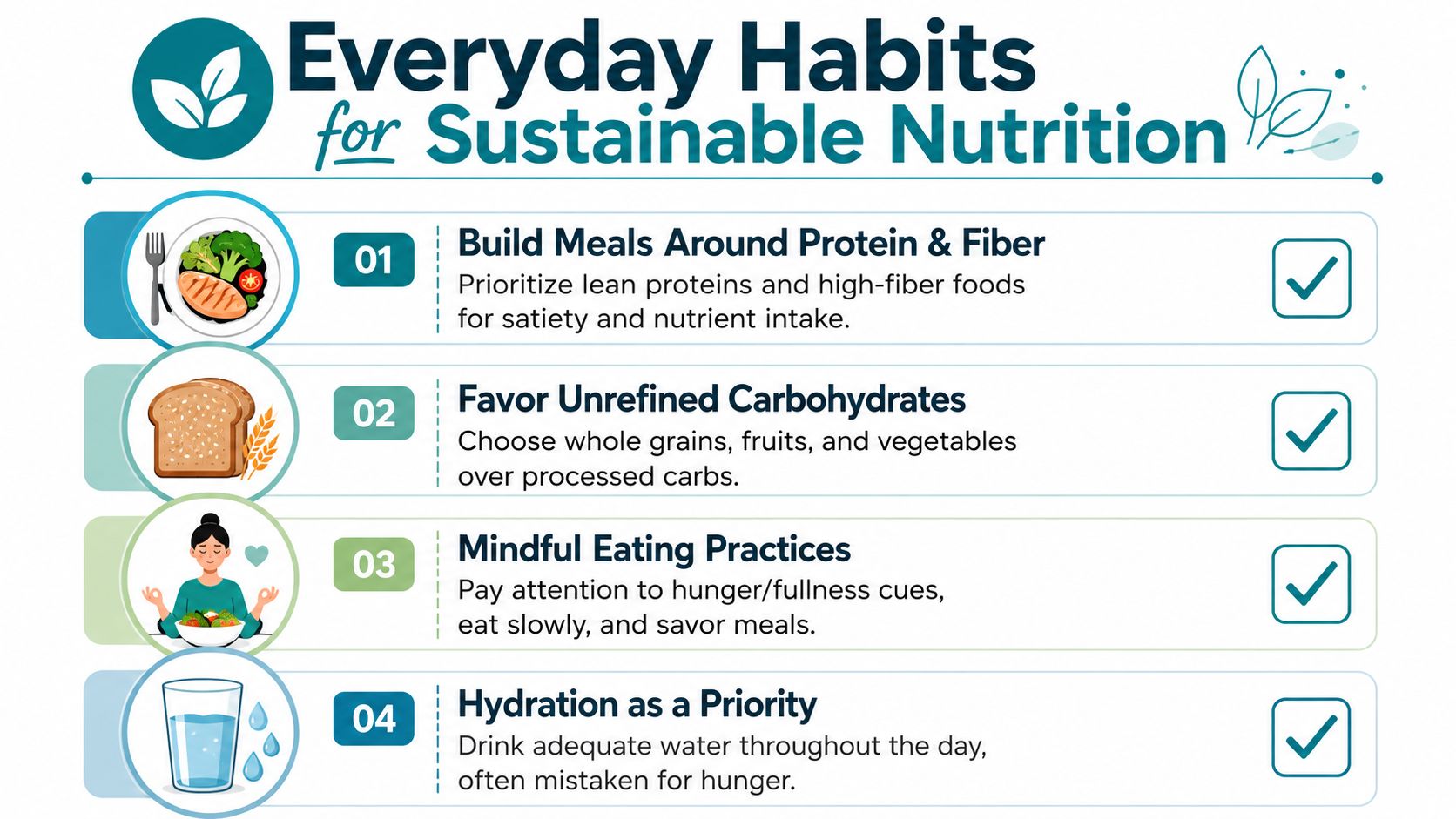
Build meals around protein and fiber-rich foods first, then fill in the rest with foods you enjoy. The WHO's guidance for most adults allows a wide range for carbohydrate, but it specifically favors unrefined carbohydrates over highly refined ones and keeps free sugars below 10% of total energy.[^3] That means fruit, beans, vegetables, oats, and intact grains usually deserve more space than sweets and sugary drinks.
Use the serving size on the label as your anchor, not the package. The FDA's serving-size guidance is there because package size and actual intake are often not the same thing.[^6] If the numbers matter to you, check them per serving before you compare foods or assume one package equals one meal.
For a specific food, USDA FoodData Central gives a more exact nutrient profile than memory ever will.[^8] That's helpful if you're comparing proteins, checking fiber, or trying to understand why one branded item works better for you than another.
Habits that are easier to keep
- Choose the first source of satisfaction: start with protein, vegetables, fruit, or another high-fiber food before adding extras.
- Treat sweets as occasional, not invisible: free sugars accumulate quickly in drinks, sauces, and snacks.
- Use the label, not the vibe: if you need to know what's in it, read the serving size, then the numbers.
- Keep water close by: hydration helps people avoid confusing thirst, fatigue, and hunger.
- Match the plan to the day: a simple routine usually beats a strict plan that collapses after one busy week.
A helpful food resource can also make habits easier to sustain. If you want ideas for adding more gut-friendly foods without turning meals into a project, the benefits of natural probiotics article is a useful place to start.
If you're looking for a structured meal framework rather than broad advice, the balanced meal approach for weight goals can help you think about food as a pattern, not a punishment.
When to Seek Physician-Led Evaluation and Outside Coordination
A physician-led nutrition evaluation is useful when food choices are tied to weight history, medications, mental health, recovery, or symptoms that do not fit a simple pattern. A quick example helps: two people can say they are “eating better,” yet one is adjusting meals for medication side effects, while the other is missing meals because of low mood or stress. A clinician helps sort out which of those paths is driving the problem, so the next step is based on the medical picture rather than guesswork.
What a medical visit can clarify
At Empire Medical Wellness, the process is private-pay, with a 50-minute initial evaluation for $350 and a 25-minute follow-up for $225, and an itemized receipt is available through the patient portal.[^9] The practice supports telemedicine for adults physically located in New York, New Jersey, Connecticut, Pennsylvania, or Virginia, and in-person appointments are also available.[^10]
That kind of visit can help sort out whether nutrition concerns are being influenced by medications, appetite changes, sleep problems, substance use, or mood symptoms. It can also help decide when another clinician should be involved. A registered dietitian may be helpful for detailed meal planning. A psychiatrist or mental health clinician may be needed for diagnosis or medication management. A substance-use specialist may support recovery planning, and a primary care clinician may be the right fit for broader medical workup. Coordination works best when it is authorized and specific, so each clinician knows their role.
Empire Medical Wellness is one option when you want physician-led obesity care with nutrition and activity goals built into the treatment plan. If clinically appropriate, medication may be part of obesity treatment.[^14] That does not replace outside care when another condition is driving the problem. It works best as part of a shared plan, especially when the question is not just weight, but how weight, symptoms, and treatment fit together.
For people comparing care options, the physician-led weight loss program page shows how that type of visit is organized in practice.
When to act sooner
Seek care sooner if nutrition changes come with rapid weight change, persistent gastrointestinal symptoms, severe restriction, or worsening fatigue and mood. If a person is in crisis, emergency services or a crisis line should be used right away.
Frequently Asked Questions
Is a general healthy diet enough for most adults?
Often, yes, if the goal is broad prevention. A steady pattern of fruits, vegetables, protein, fiber, and sensible portions goes a long way for many adults. The picture changes when weight history, medications, food insecurity, appetite changes, or mental health concerns are part of the story. The WHO and FDA guidance provide a helpful baseline, but they do not replace a real assessment when symptoms or treatment goals are more complex.[^3][^6]
How do I know if poor nutrition is a symptom rather than the cause?
Look for patterns that do not fit simple eating habits. Sudden weight change, persistent stomach symptoms, unusual fatigue, or major mood changes can point to a medical, medication-related, or psychiatric issue rather than diet quality alone. In that setting, nutrition is often one piece of a larger clinical picture. Those are good reasons to seek evaluation.
What happens in a physician-led nutrition visit?
The clinician reviews food patterns, weight history, medical conditions, medications, and related symptoms, then helps decide whether nutrition changes, outside referrals, or treatment adjustments make sense. That visit usually works like a structured case review, where the clinician sorts out what belongs to food intake, what belongs to a medical condition, and what may need another specialist. At Empire Medical Wellness, that visit is structured, private-pay, and can be done by telemedicine for adults located in the approved states or in person.[^9][^10]
Where do outside specialists fit in?
They fit in when the question is more specific than one clinician should handle alone. A registered dietitian may focus on meal structure, a mental health clinician may address mood or medication issues, and an addiction specialist may support recovery planning. Coordination works best when the patient consents and each role stays distinct.
If your main question is weight, medication, or a more careful medical review, the Empire Medical Wellness weight management page is a reasonable place to start.
Empire Medical Wellness offers physician-led care that can help adults connect nutrition with weight management, recovery, and mental health in a way that stays medically grounded and practical. If you want a careful review of your situation and a plan that respects the whole picture, visit Empire Medical Wellness to learn more.
This article is educational and not personal medical advice.
[^1]: Historical development of U.S. nutrition guidance and dietary reference frameworks
[^3]: WHO healthy diet fact sheet
[^4]: Evidence-Based Nutrition Principles and Recommendations for the Treatment and Prevention of Diabetes and Related Complications
[^5]: Nutrition security and barriers beyond food access
[^6]: FDA guide to understanding and using the Nutrition Facts label
[^8]: USDA Nutrition.gov food composition resources and FoodData Central
[^9]: Empire Medical Wellness weight visit pricing and follow-up structure
[^10]: Empire Medical Wellness telemedicine states and in-person care details
[^14]: Empire Medical Wellness obesity medicine page with nutrition and activity goals
[^15]: FDA information on semaglutide as an anti-obesity medication