
If you've just heard about naltrexone at an appointment, or you're reading about it because you want to drink less or stay off opioids, the core question is simple. Naltrexone is a prescription medication used in addiction medicine for adults with alcohol use disorder or opioid use disorder, and it works by blocking opioid receptors rather than sedating you or “curing” addiction. In real life, it's a tool that supports a broader treatment plan, not a standalone fix.
Many people first ask about it when they're trying to decide whether a medication discussion is worth bringing up at a visit. That's a sensible place to start, because the biggest practical issues are usually readiness, safety, and whether the oral tablet or monthly injection fits the person's situation.
Table of Contents
- What Naltrexone Is and Who It Is For
- How Naltrexone Works in the Brain
- FDA-Approved Indications and Off-Label Uses
- Oral Naltrexone Compared with the Monthly Injection
- Getting Started Safely Before the First Dose
- Dosing, Monitoring, and Realistic Outcomes
- Side Effects, Liver Cautions, and Opioid Interactions
- Frequently Asked Questions About Naltrexone
What Naltrexone Is and Who It Is For
You may be at the point where a medication comes up in conversation, but you still want a plain answer before you ask more questions. Naltrexone is a prescription opioid antagonist, which means it blocks opioid receptors. In the United States, it is used for alcohol use disorder and opioid use disorder, the two approved indications to keep in mind when you read about it online.
The practical question is not just what the drug is, but whether it fits your situation. Naltrexone works like a blocker at the receptor level, so it can reduce the reward from alcohol and stop opioids from producing their usual effect. That makes it a good fit for some adults who want medication support while continuing outpatient care, counseling, and regular follow-up.
It also comes with a readiness question that articles often skip. People who are taking opioids, or who may still have opioids in their system, need careful medical review before starting naltrexone, because the medication can trigger withdrawal if it is started too soon. A physician usually checks opioid use history, current medications, and the timing of the last opioid dose before deciding whether the medication is appropriate.
That is one reason it comes up so often in outpatient treatment rather than in a detox-only setting. In day-to-day practice, the decision is usually about whether someone is opioid-free enough to start, whether oral treatment or the monthly injection fits the person's routine, and whether liver history needs closer attention. Those questions matter more than the label on the bottle.
For a broader primer on the condition side of the picture, this overview of what addiction is can help frame why medication sometimes belongs in the discussion. Addiction medicine uses medications, monitoring, and follow-up together because cravings, cues, and relapse risk do not respond to willpower alone.
Practical rule: if a medication sounds like a cure, be cautious. Naltrexone is a support, and the plan around it matters as much as the prescription itself.
How Naltrexone Works in the Brain
A person may hear that naltrexone helps with drinking or opioid recovery and still wonder what it is doing in the brain. The short answer is that it blocks the receptors opioids use to produce their effects, especially the μ-opioid receptor DrugBank. A receptor is a protein on a cell that receives a chemical signal. If the receptor is a lock, naltrexone is a key that fits the lock but does not turn it.
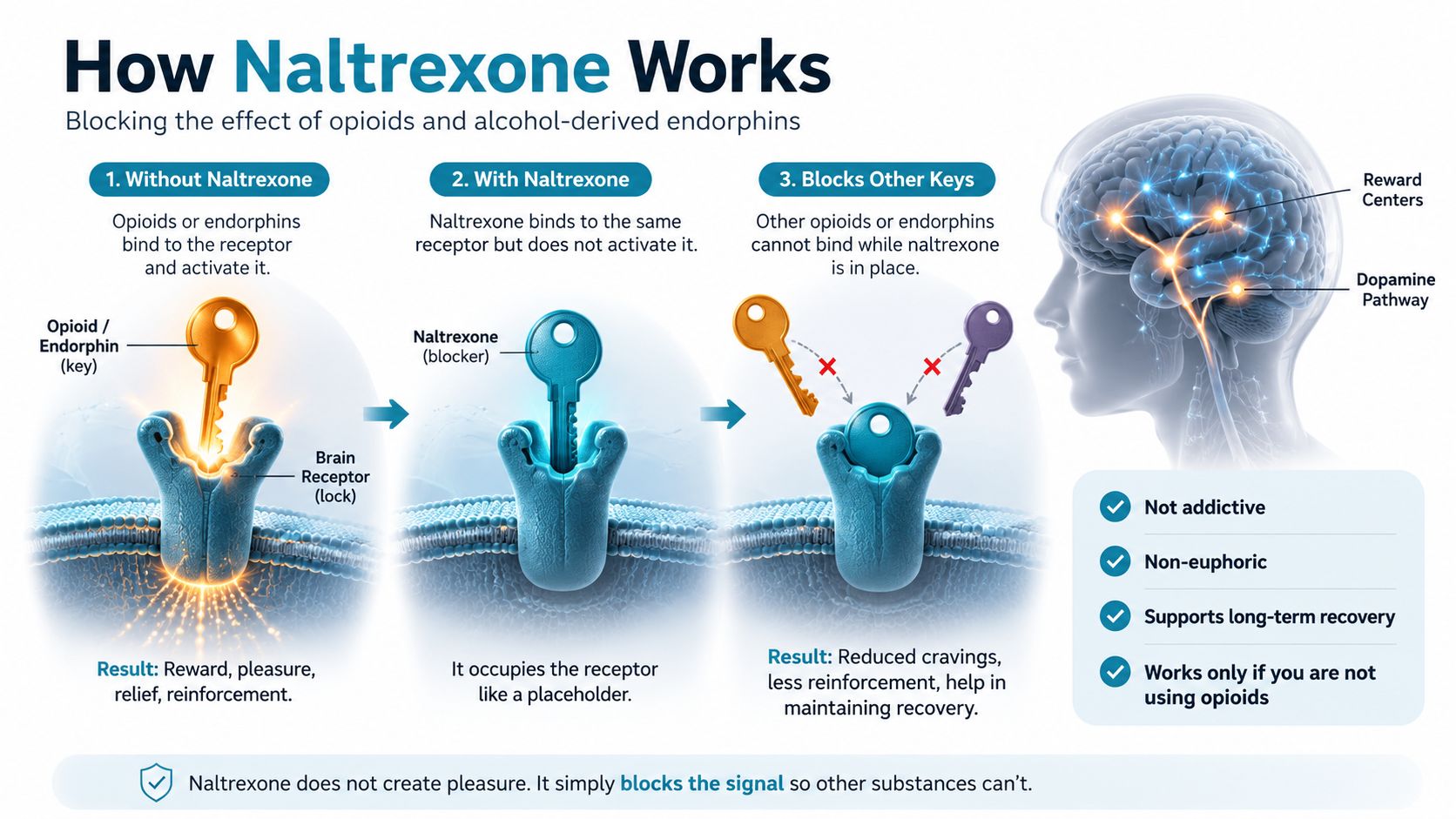
That blocking effect matters because it changes how reward signals are experienced. In opioid use disorder, naltrexone reduces the effects people often seek, including euphoria, analgesia, sedation, and respiratory depression DrugBank. In alcohol use disorder, the pathway is less direct, but the same receptor system is involved in alcohol's reinforcement. By interrupting that signaling, naltrexone can make alcohol feel less rewarding to the brain DrugBank.
The change is usually subtle in daily life. Review data describe attenuated alcohol hedonic properties, meaning drinking may feel less stimulating, less pleasant, or more tiring, and some people report more tension after exposure PMC review. That is one reason naltrexone is often used to reduce heavy-drinking episodes and the pull of relapse, rather than as a medication that forces immediate abstinence on its own.
The same mechanism also explains why starting too soon can backfire. If opioids are still present in the body and naltrexone is taken before the system is clear, the sudden receptor blockade can trigger precipitated withdrawal. That reaction is a warning sign that the medication was started before the person was opioid-free enough for safe treatment.
FDA-Approved Indications and Off-Label Uses
The approved uses are the cleanest place to start, because they shape the first conversation a patient should have with a prescriber. In the United States, naltrexone is FDA-approved for alcohol dependence and opioid use disorder. Clinical references describe the oral form as a once-daily tablet, and one NCBI Bookshelf summary places the alcohol approval history at 1994 NCBI Bookshelf. Some summaries describe the history differently, usually because they are referring to a specific formulation or to how the approval is being discussed.
Anything outside alcohol use disorder or opioid use disorder is off-label. Off-label use is not the same as improper use. It means the medication is being prescribed for a purpose that sits outside the formal FDA indication, so the prescriber should explain the reasoning and the level of evidence behind it. That matters when a patient has heard about naltrexone in connection with impulse control, chronic pain discussions, or other experimental uses.
For people who are sorting out treatment choices, it helps to separate pain care from addiction treatment. A chronic pain management guide can be useful background if pain is part of the picture, but naltrexone itself is not a pain medication. It blocks opioid receptors, so opioid pain medicines may not work as expected while it is active. That is one reason physician-led follow-up matters in outpatient care, especially if a person may need surgery, dental work, or other treatment where pain control could come up.
For readers comparing medication-assisted treatment options, this MAT overview helps place naltrexone within the broader treatment framework. The practical point is straightforward. FDA-approved use means the medication has an established evidence base. Off-label use means the prescriber should spell out the goal, the limits of the evidence, and why the choice makes sense for that individual.
Oral Naltrexone Compared with the Monthly Injection
The two main forms create different day-to-day routines, and that difference matters in outpatient care. Oral naltrexone is taken once daily. The extended-release injection is given about every four weeks. Both contain the same active medication, but the choice often turns on practical issues, not on a theoretical preference.
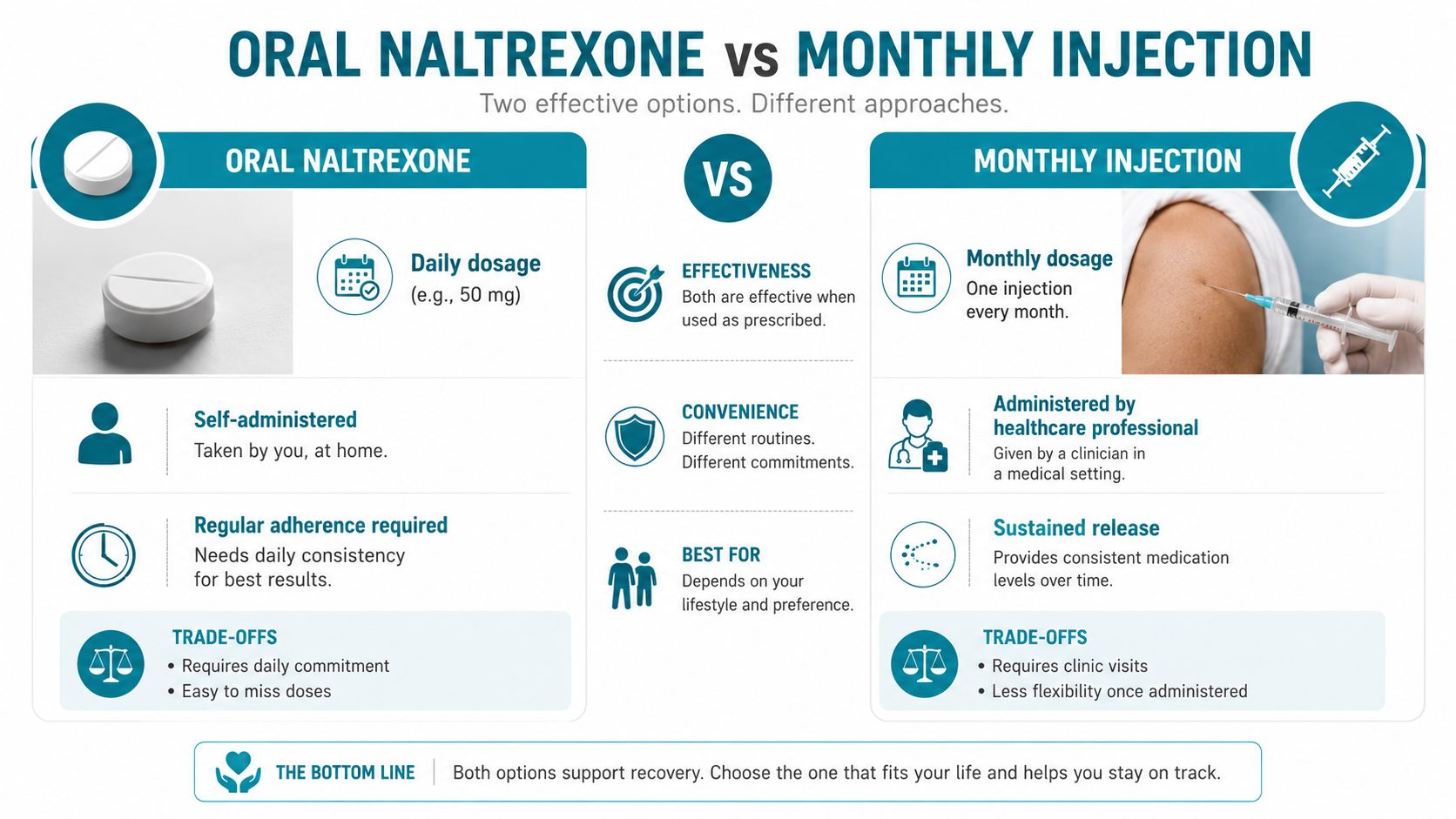
The tablet gives more flexibility. If a side effect appears, or if a future procedure might require opioid pain medicine, a pill can be stopped more easily than an injection that is already in the body. That matters for people whose plans may change, because a medication that wears off on its own gives the clinician more room to adjust. The main weakness is adherence. As noted earlier, daily dosing can make long-term use harder to sustain, and in outpatient treatment that is often the central problem.
The injection works differently. Its main advantage is consistency. You are not making a daily decision, which can help when forgetfulness, ambivalence, or a busy routine gets in the way. The tradeoff is that the commitment lasts longer. If a side effect shows up, you cannot skip the next dose, because the medication has already been given. It also adds a clinic visit, since the injection has to be administered in person.
Practical rule: oral naltrexone gives you more control over stopping. The monthly injection gives you more protection against missed doses.
A clinician also has to look at the person's real routine. Someone with reliable follow-up may do well on either form. Someone who has trouble remembering daily medication may prefer the injection, while someone who wants the quickest off-ramp if circumstances change may prefer the tablet. The better option is usually the one that fits the patient's actual life, not the one that looks simpler on paper.
For adults looking at physician-led outpatient care, Empire Medical Wellness offers addiction medicine visits that can include medication review and follow-up. In a setting like that, the oral-versus-injection discussion becomes concrete, because the form you choose should fit your schedule, your risks, and your recovery goals.
Getting Started Safely Before the First Dose
A careful start matters more with naltrexone than many people realize. Before a clinician writes the first prescription, the main question is whether the person is opioid-free. Standard guidance says naltrexone should be started only after about 7 to 10 days without opioids, because starting too soon can trigger precipitated withdrawal, which means withdrawal symptoms are brought on suddenly by the medication itself SAMHSA PDF.
A real outpatient visit often begins with a quiet inventory. The prescriber asks about recent opioid exposure, current prescriptions, and over-the-counter products that might contain opioids. That includes pain medicines, some cough products, and certain diarrhea treatments. If the history is uncertain, clinicians may use urine drug testing, and some also use a low-dose naloxone challenge to check readiness before moving ahead SAMHSA PDF. A naloxone challenge is a supervised test dose that helps reveal hidden opioid dependence.
Baseline liver assessment belongs in the same conversation. Naltrexone carries a liver-related caution, and MedlinePlus notes that it may cause liver damage when taken in large doses. Older clinical reviews also reported hepatotoxicity at 100 to 300 mg daily MedlinePlus. That does not mean every patient has liver disease. It does mean the prescriber should know the starting point, especially if there is a history of hepatitis, heavy alcohol use, or other medications that can strain the liver.
If opioid exposure is unclear, slowing down is safer than guessing. Naltrexone blocks opioid effects, so a person who still has opioids in the body may feel abruptly worse after the first dose. That is why the first appointment is not just paperwork. It is the step that separates a planned start from a preventable complication.
For people who want physician-led outpatient evaluation, an addiction medicine specialist can review readiness, interactions, and follow-up needs before treatment begins.
Practical rule: if there is any doubt about recent opioid use, the first question is not “Can I start today?” It is “How do we verify readiness safely?”
Dosing, Monitoring, and Realistic Outcomes
A typical oral plan uses a once-daily tablet, while the injection is given about every four weeks NCBI Bookshelf. On paper, that sounds straightforward. In real outpatient care, the schedule matters less than whether the patient can keep taking it, come back for follow-up, and stay opioid-free if the goal is to avoid precipitated withdrawal.
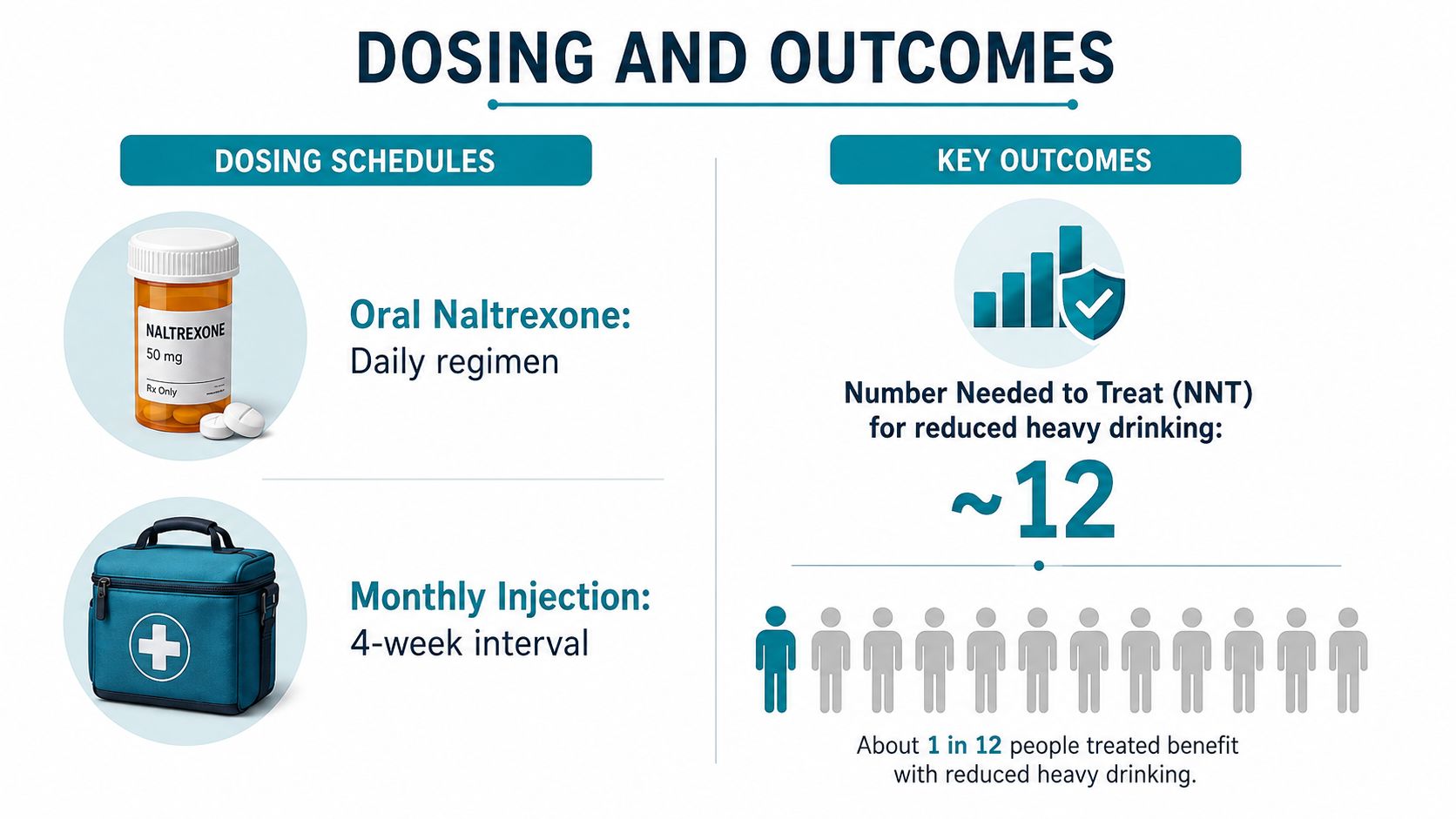
The outcome data are encouraging, but they are not guarantees. One evidence summary found oral naltrexone had a number needed to treat of 12 for preventing heavy drinking NCBI Bookshelf. In plain language, that means a group of about 12 treated patients produced one additional person who avoided heavy drinking compared with control in the analyzed trials. A peer-reviewed review of a large randomized trial reported 73.7% of patients on naltrexone had good clinical outcomes versus 58.2% on placebo, an absolute difference of about 15 percentage points PMC review.
Another meta-analysis found naltrexone did better than placebo, with relapse risk reduced by 14% and abstinence increased by 10% after 12 weeks of treatment PMC review. Those numbers help set expectations. Some patients notice a clear drop in craving or fewer heavy-use days. Others feel only a modest change, and a subset will not improve enough for the medication to justify staying on it.
Monitoring is usually a combination of patient report, lab markers when they are appropriate, and structured follow-up. That matters because there is no single blood test that says, “this is working well enough.” Clinicians often look for fewer heavy-drinking episodes, less urge-driven use, or steadier protection against opioid relapse. If those patterns are not improving, the treatment plan should be revisited rather than assumed to be effective.
The follow-up visit is often where outpatient treatment becomes real. It is a chance to review side effects, adherence, liver concerns, and whether the dose form still fits the patient's life. For some adults, that conversation is similar to a mental health medication review, because the question is the same, whether the medication is helping enough, and whether the current plan still makes sense in daily life.
Side Effects, Liver Cautions, and Opioid Interactions
Many people start by asking about side effects, because that is what they will feel first. Nausea, headache, dizziness, fatigue, anxiety, and sleep disturbance are among the reactions commonly discussed in clinical references. These symptoms often settle as the body adjusts. If a side effect feels severe, keeps going, or seems out of character, the prescriber should hear about it.
The safety issues that matter most
The first issue is the liver caution. Naltrexone can place extra strain on the liver, especially at higher doses, and older reports linked liver injury to 100 to 300 mg daily. That is why clinicians usually ask about liver disease, past hepatitis, heavy alcohol use, and other causes of liver stress before starting it. The second issue is opioid blockade. People who are still using opioids, or who have not been fully cleared from them, can run into serious problems if naltrexone is started too soon, so careful assessment is needed before treatment begins.
Opioid blockade has practical consequences outside the clinic. Pain medicines that work through opioid receptors will not work normally while naltrexone is active, which matters for emergency care, surgery, and dental work. If a person needs pain control and the treating team does not know about naltrexone, the situation can become harder to manage quickly. Carrying a medication list, or telling the team directly, is a simple but useful habit.
Practical rule: always tell outside clinicians, urgent care staff, and surgeons that you're taking naltrexone before procedures that might involve pain medication.
The monthly injection creates a longer period of opioid blockade, so planning around procedures matters even more. The oral form is easier to stop, but it still blocks opioid effects while it is in the body. That is why emergency clinicians and procedural teams need the medication list at the start of care, not afterward.
For readers comparing treatment pathways, naltrexone also differs from Suboxone. The Suboxone overview is useful here because it belongs to a different treatment approach. Naltrexone blocks opioid receptors, while buprenorphine partially activates them, so the two medications are used for different clinical goals and require different thinking about timing, withdrawal risk, and pain treatment.
Side effects are usually judged by how much they interfere with daily life, not just by whether they exist. A useful outside frame is the CTCAE reference on OMOPHub OMOPHub CTCAE reference, which reflects how clinicians grade adverse effects from mild to dangerous. In plain language, the key question is whether a symptom is brief and tolerable, or whether it is worsening and needs the plan to be reassessed.
Frequently Asked Questions About Naltrexone
Can someone with moderate drinking problems ask about naltrexone?
Yes. Naltrexone is not only for the most severe alcohol problems, and outpatient care often considers it when the goal is to cut down, lower craving, or reduce relapse risk. A clinician still needs to review drinking pattern, liver history, and any opioid exposure before deciding whether it fits.
How soon can it be started after opioid use stops?
Before the first dose, the usual requirement is about opioid-free time long enough to avoid triggering withdrawal, often described as 7 to 10 days opioid-free SAMHSA PDF. If the timing is unclear, a clinician may use history, urine testing, or a naloxone challenge instead of guessing. Those steps help confirm that a person is ready, which matters because naltrexone blocks opioid receptors rather than easing withdrawal.
What does follow-up usually look like in outpatient care?
Follow-up usually includes a symptom check, a review of side effects, discussion of cravings or relapse risk, and a decision about whether the current form still fits. In physician-led care, that visit is also where the team revisits medication interactions, plans for surgery or dental work, and liver concerns if they come up. Care outside a detox program is often gradual and practical, with the dose, the formulation, and the goals adjusted as the picture becomes clearer.
Oral naltrexone or the monthly injection, which one do people usually ask about first?
A lot of people start by asking whether the tablet or the injection is easier to live with. Oral naltrexone gives more flexibility because it can be stopped sooner if side effects or procedure planning become an issue, while the monthly injection may suit people who want a longer-acting option and do not want to remember a daily pill. The tradeoff is that the injection stays in the system longer, so if a problem comes up, the blockade is harder to reverse quickly. The right choice often depends on routine, adherence, and how much planning a person wants around possible pain treatment.
What if liver tests are abnormal?
That question needs a careful review, not a reflexive yes or no. Naltrexone is often discussed with liver safety in mind because the medication is processed by the liver, and clinicians usually want to know whether there is active liver disease, a history of hepatitis, or symptoms that suggest worsening injury. Mild abnormalities do not always rule it out, but they do change how a physician weighs the risks, how closely the person is monitored, and whether another option makes more sense.
When is urgent care or emergency care the right call?
If someone has suspected overdose after stopping naltrexone and resuming opioids, severe withdrawal symptoms after starting too early, trouble breathing, chest pain, or suicidal thinking, emergency care is the right move. Naltrexone can be useful in outpatient treatment, but it is not an emergency medication. A person who is unsure whether a symptom is a side effect, withdrawal, or something more serious should seek prompt medical help rather than waiting it out.
For another practical perspective on sorting through symptoms and test-related questions, this find your health test answers resource can be helpful as a general reference point. For naltrexone specifically, the main questions stay anchored to opioid-free readiness, drinking goals, liver history, and the follow-up plan.
If you're considering naltrexone in a private, physician-led outpatient setting, Empire Medical Wellness provides addiction medicine visits that can include confidential assessment, medication review, and follow-up planning. If you want to talk through whether the oral tablet or monthly injection fits your situation, visit Empire Medical Wellness to learn more about the practice's approach to addiction medicine.