
Could a device marketed as “single-use” make nicotine dependence harder to recognize, not easier to manage? Disposable vaping uses a prefilled electronic device to deliver nicotine without burning tobacco. For an adult who already vapes, the useful question isn't whether the choice deserves judgment. It's how nicotine reinforcement, withdrawal, toxic exposure, and practical quitting support fit together.
Byline: Empire Medical Wellness Editorial Team
Published: September 28, 2026
Updated: September 28, 2026
Table of Contents
- What Disposable Vaping Actually Is
- How Disposable Vapes Work and Why They Hook
- Health and Addiction Risks Adults Should Know
- Environmental and Safety Concerns Beyond the User
- U.S. Rules on Age, Marketing, and Authorization
- Comparing Nicotine Products by Risk and Delivery
- A Practical Path to Reduce Use or Quit
- When to Seek Medical Help and How the Practice Can Support You
What Disposable Vaping Actually Is
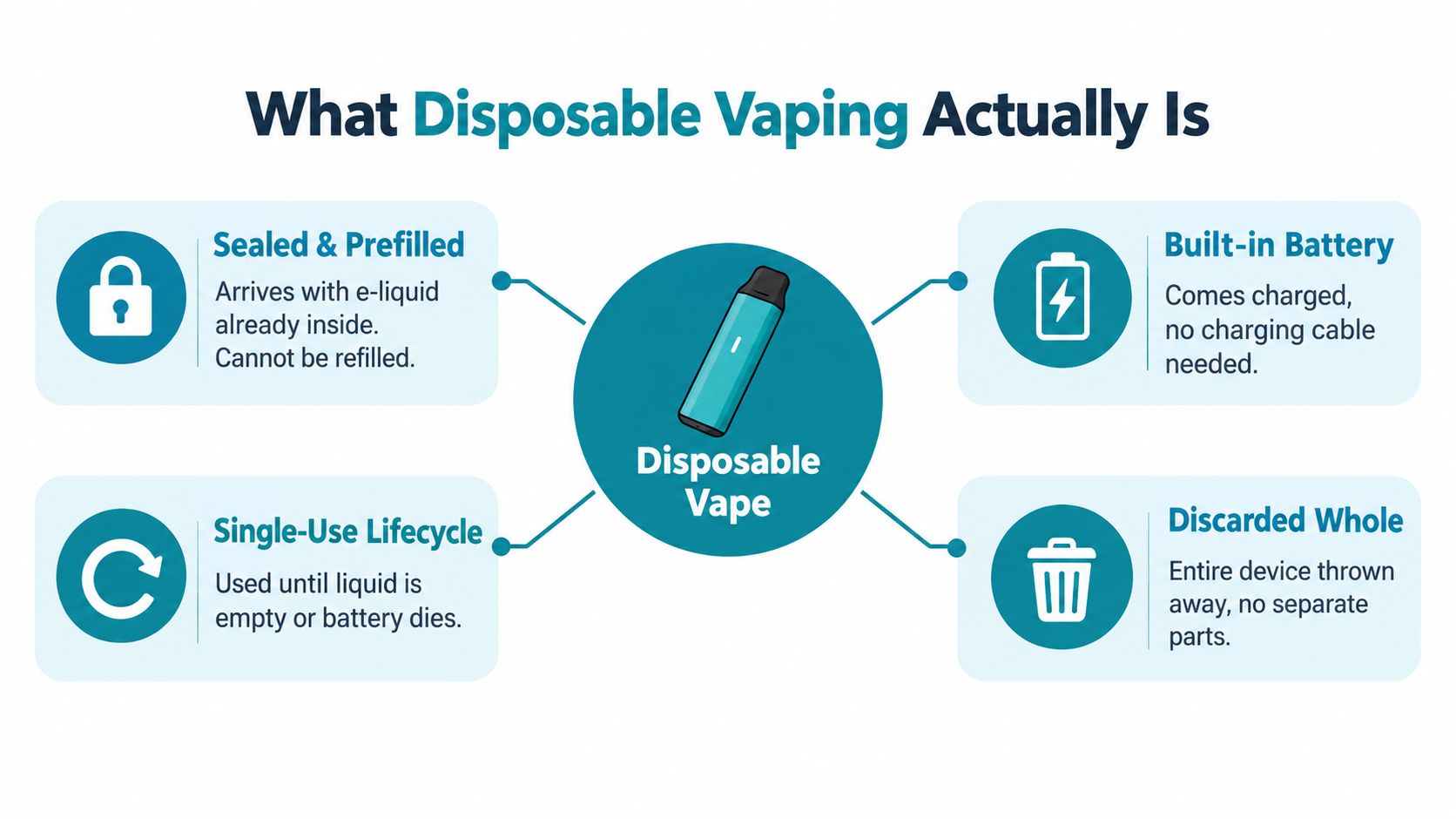
A disposable vape is a sealed electronic nicotine delivery system that arrives with e-liquid and a battery inside. You use it until the liquid is depleted or the battery no longer works, then discard the device instead of refilling a tank or replacing a coil.
The FDA defines disposable ENDS products as devices that are prefilled with e-liquid and not designed to be refilled. Some newer products blur the line by including rechargeable batteries, but a rechargeable battery doesn't automatically make a device reusable if the liquid reservoir remains sealed.
A typical unit combines a plastic or metal casing, a battery, an absorbent wick, a heating coil, an airflow sensor or button, and a mouthpiece. The device may be labeled by flavor, nicotine concentration, or an estimated puff count. Those labels don't tell you exactly how much nicotine your body absorbs because inhalation depth, puff duration, device power, and frequency all vary.
Refillable pod systems, cigalikes, and larger mods differ mainly in hardware and maintenance. A refillable system permits new liquid or pods, while a mod may allow changes to power and airflow. Dependence, however, is driven chiefly by nicotine delivery and learned cues, not by the shape of the device.
If you're trying to understand your own use, focus on three questions: how soon you vape after waking, how often you reach for the device without planning to, and what situations reliably trigger use. A private nicotine cessation evaluation can help organize those questions without assuming that every adult needs the same plan.
How Disposable Vapes Work and Why They Hook
Why can a disposable vape turn occasional use into a repeated habit? The answer begins with its delivery system. Drawing on the mouthpiece activates an airflow sensor, which starts the battery and heats a coil against a saturated wick. The coil converts e-liquid into an aerosol containing nicotine and other ingredients. Button-activated designs use the same heating process, while the button controls when the device fires.
Many newer products use nicotine salts. This formulation can feel smoother at higher concentrations than traditional freebase nicotine, making repeated inhalation easier for some users. Instead of a clearly defined smoking break, a person may take small doses throughout the day, often without noticing how frequently use occurs.
The device also creates learned cues. A flavor, hand movement, location, or pause in the day can become linked with nicotine. Once that association is established, the cue may trigger an urge before you consciously choose to vape. Withdrawal can intensify the cycle through irritability, restlessness, difficulty concentrating, or a strong desire to use.
Disposable vape generations and nicotine delivery
A history-focused review of disposable devices describes early modern disposable models appearing around 2018 with roughly 300 to 600 puffs. Later versions reached 7,000 to 10,000 puffs by 2022, and some newer generations exceeded 120,000 puffs. These figures indicate product capacity, not the amount of nicotine an individual necessarily absorbs. Inhalation depth, puff duration, device power, and frequency all affect delivery.
| Generation | Typical capacity | E-liquid volume | Nicotine strength | Delivery profile |
|---|---|---|---|---|
| Early modern models | 300 to 600 puffs | Varies by product | Varies by product | Lower-capacity, simple disposable format |
| Later high-capacity models | 7,000 to 10,000 puffs by 2022 | Varies by product | Often nicotine salt formulations | More opportunities for repeated use |
| Newer generations | Some exceed 120,000 puffs | Varies by product | Varies by product | Extended device lifespan and prolonged exposure |
A refillable device may reduce whole-device waste, yet it does not automatically reduce dependence. High-strength refillable liquid can still reinforce frequent nicotine use. Adults who want physician-led support can explore addiction medicine care when vaping continues despite a clear intention to stop.
Health and Addiction Risks Adults Should Know
Could a product that feels easy to use still create dependence? Yes. The central concern is nicotine dependence. Nicotine trains the brain's reward system to expect repeated exposure, while withdrawal can produce craving, irritability, anxiety, low mood, sleep disruption, and difficulty concentrating. Continued vaping may then feel like relief from withdrawal rather than simple pleasure.
The aerosol is not harmless water vapor. The CDC explains that it can contain nicotine, cancer-causing chemicals, heavy metals, and ultrafine particles that reach the lungs. Exposure varies with the product and the way someone uses it, so potentially lower exposure than cigarette smoke does not mean no exposure. The e-cigarette health information also explains the risks of nicotine exposure for young people and during pregnancy.
Nicotine deserves particular attention during pregnancy and for people younger than 25, while brain development continues. Adults who vape may also be exposed more often than they realize because a disposable device is available throughout the day. Frequent small doses can reinforce the same dependence cycle that makes cigarettes difficult to stop.
What is established and what remains uncertain
Several conclusions are well established. Nicotine can cause dependence, aerosol can contain harmful substances, and people who use cigarettes and vapes together may remain exposed to smoke while sustaining nicotine dependence. The full long-term cancer profile of inhaled aerosol remains under study, so uncertainty should not be mistaken for safety.
A University of California, Riverside report adds a further concern: heavily used high-puff devices may generate higher levels of harmful chemicals than fresh devices. Reporting on discarded nicotine vapes also found very high lead and other heavy-metal levels in remaining e-liquid. These findings are still developing, but they challenge the assumption that a device's chemical exposure stays constant throughout its use. The University of California, Riverside report on high-puff devices describes this evidence.
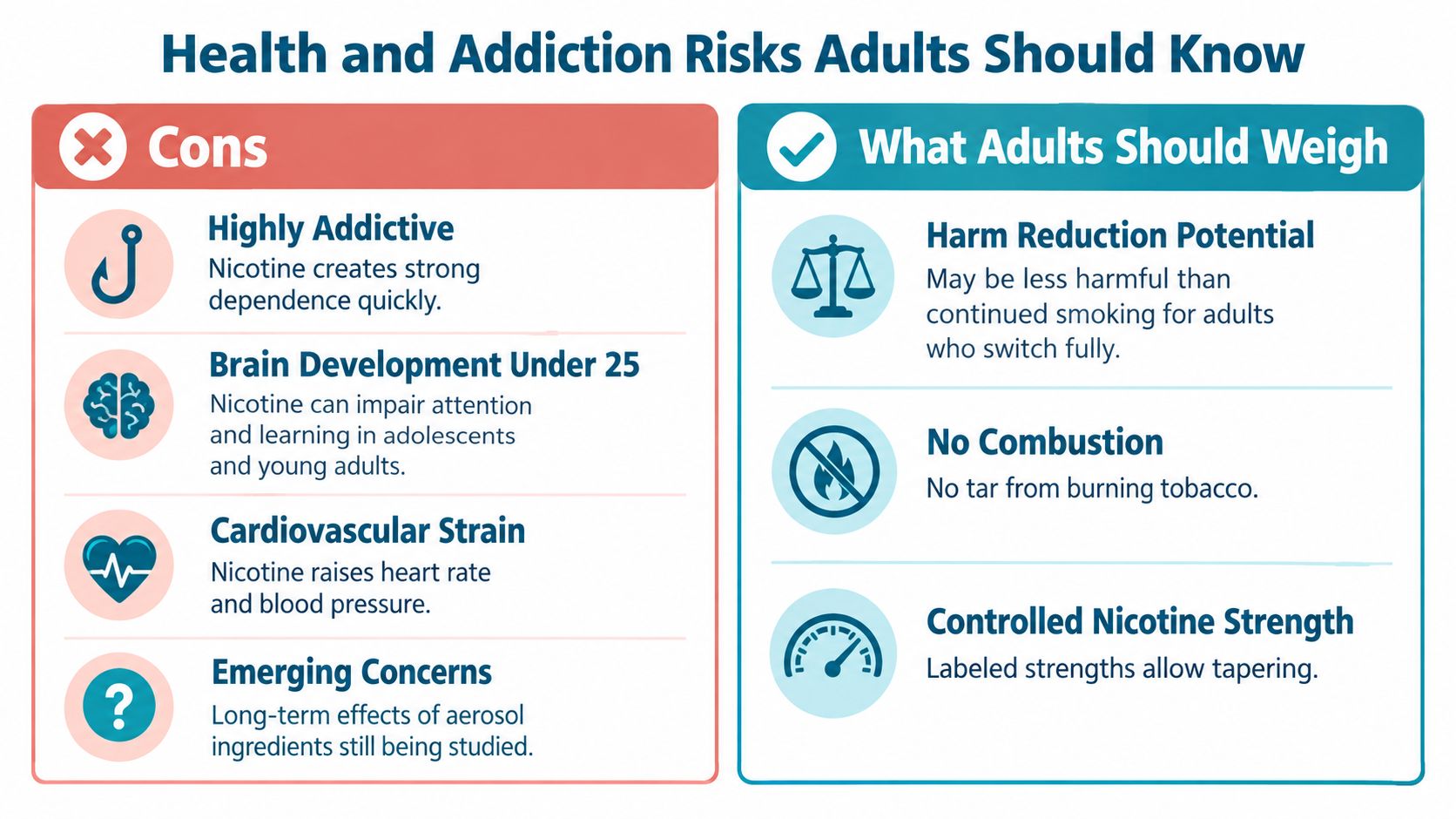
For adults who smoke combustible cigarettes, switching completely to a regulated vaping product may reduce exposure to combustion-related toxins. That is a harm-reduction comparison, not a claim that vaping is safe. Using both products can preserve dependence and maintain smoke exposure.
Environmental and Safety Concerns Beyond the User
Could a product designed for a short use cycle create risks after it leaves the user's hand? A disposable vape combines a battery, plastic, metal, and leftover e-liquid. Discarding it therefore means discarding the whole device rather than one replaceable part. A history-focused review of disposable devices estimates that nearly 500,000 disposable vapes are discarded each day in the United States, producing about 30 tons of lithium waste annually. The reported disposal and lithium-waste estimates illustrate why ordinary household trash is not an appropriate solution.
The United Kingdom shows the same challenge in another major market. One estimate places annual discarded vapes above 67 million, while separate reporting estimates that about 1.3 million disposable vapes are thrown away each week. These figures come from different reports and should not be combined. Together, they show how single-use nicotine products create a substantial stream of battery-containing waste.
Why batteries change the safety problem
A lithium battery can be damaged in a garbage truck, compactor, or recycling machine. Contact with metal or other materials may then cause it to ignite. Leftover nicotine liquid adds another handling risk for waste workers and anyone who finds a discarded device.
Disposal instructions vary locally. Do not place a used disposable vape in curbside recycling unless the local program specifically accepts it. Keep damaged, leaking, or swollen devices away from children, pets, heat, and ordinary trash. Contact a household hazardous-waste service or battery-recycling program for instructions.
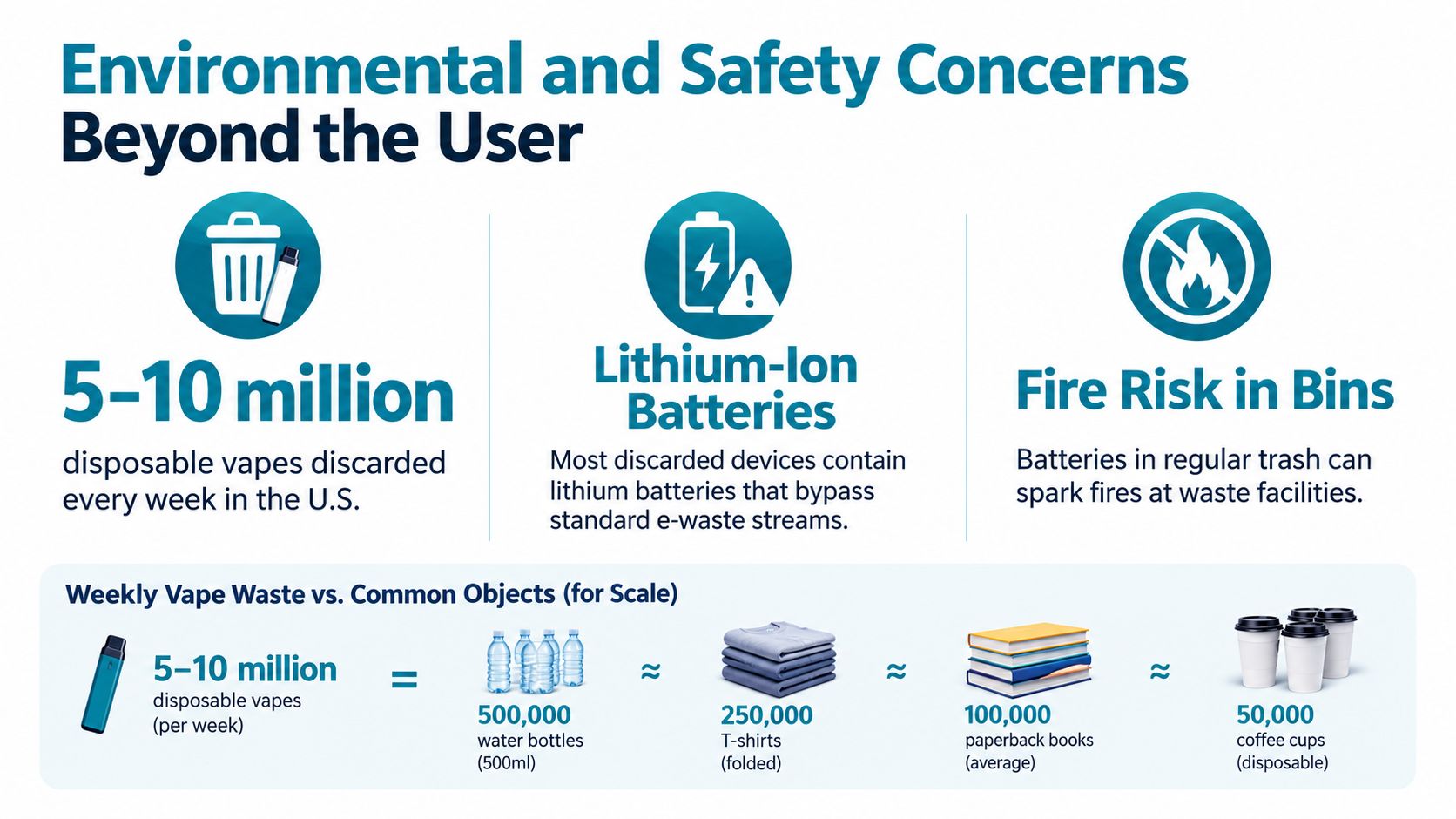
The environmental concern does not depend on judging the person who vapes. It follows from the product's design. A reusable device may reduce battery disposal, while nicotine dependence and inhalation concerns still require attention. Recognizing both issues supports practical harm reduction: safer disposal now, and gradual reduction or quitting when the user is ready.
U.S. Rules on Age, Marketing, and Authorization
Could an adult legally buy a disposable vape and still be buying a product that cannot legally be marketed? Yes. U.S. rules address the buyer's age and the product's authorization separately.
Federal law prohibits retailers from selling tobacco products, including e-cigarettes and other ENDS products, to anyone under 21. The rule applies to every retailer and store, without exceptions. The FDA's federal tobacco minimum-age guidance explains this requirement.
Adult access does not establish that a product is authorized. New tobacco products, including many disposable ENDS products, generally need FDA authorization before they can be legally marketed in the United States. A product without authorization may face enforcement action, and a pending application does not grant permission to sell. The CDC's overview of e-cigarette authorization describes this distinction.
What authorization does and doesn't mean
FDA authorization does not mean a product is harmless or approved as a quit-smoking medicine. It means the agency has evaluated whether the product meets the legal standard for marketing as a tobacco product. The FDA has also stated that no e-cigarette has been approved as a smoking-cessation therapy.
State and local rules may add restrictions on flavors, taxes, retail sales, and shipping. Because these requirements vary by jurisdiction, adults should check the law where they live instead of relying on a product listing or an online seller's description.
Comparing Nicotine Products by Risk and Delivery
How should an adult compare nicotine products when exposure and dependence are related but different? The key questions are what reaches the body with nicotine and how quickly the product reinforces repeated use. This comparison is not a personal treatment plan. Smoking history, pregnancy, cardiovascular disease, medications, and other health factors can change the safest choice.
| Product | Toxic exposure | Dependence risk | FDA status |
|---|---|---|---|
| Combustible cigarettes | Highest concern because burning tobacco creates smoke, carbon monoxide, and many toxic chemicals | High, with rapid nicotine delivery and strong behavioral cues | Tobacco product, not an FDA-approved cessation therapy |
| Disposable vapes | No combustion, but aerosol may contain nicotine, ultrafine particles, heavy metals, and other harmful chemicals | Can be high, especially with frequent nicotine-salt use and easy access | Only legally marketed products with FDA authorization may be sold in the U.S. |
| Refillable vapes | No combustion, but exposure depends on the liquid, device, heating, and use pattern | Can be high when liquids deliver concentrated nicotine repeatedly | Product-specific tobacco authorization rules apply |
| Oral nicotine pouches | No inhaled aerosol, but nicotine is absorbed through the mouth and dependence remains possible | Variable, depending on nicotine content and frequency | Product-specific FDA tobacco authorization rules apply |
| FDA-approved nicotine replacement therapy | Delivers nicotine without tobacco smoke or inhaled vape aerosol | Lower reinforcement potential because delivery is generally slower | FDA-approved medicine for cessation support |
The CDC's overview of e-cigarette aerosol supports an important distinction: vape aerosol is not just harmless water vapor. Exposure can differ by product and use, so “smoke-free” does not mean risk-free.
FDA-approved nicotine replacement therapy, including patches, gum, lozenges, inhalers, and nasal spray, is regulated as medicine and designed to support cessation. Its slower nicotine delivery can act like a steady bridge rather than the rapid reinforcement produced by inhaling smoke or aerosol. A nicotine patch treatment guide can explain how a patch fits into a broader quitting discussion.
For adults who smoke, nicotine replacement is far safer than continuing to smoke. The appropriate product, combination, and schedule still depend on current nicotine exposure and clinical context. Adolescents should not use nicotine products except under medical guidance. A clinician or pharmacist can help compare options without turning general information into an individualized prescription.
A Practical Path to Reduce Use or Quit
Could a quit plan address both nicotine withdrawal and the routines that surround disposable vaping? It should. Nicotine dependence is reinforced by the drug itself and by repeated cues, such as driving, meals, stress, or seeing someone else vape. Reducing use can be meaningful, while stopping nicotine and avoiding cigarette smoke remains the clearest health goal.
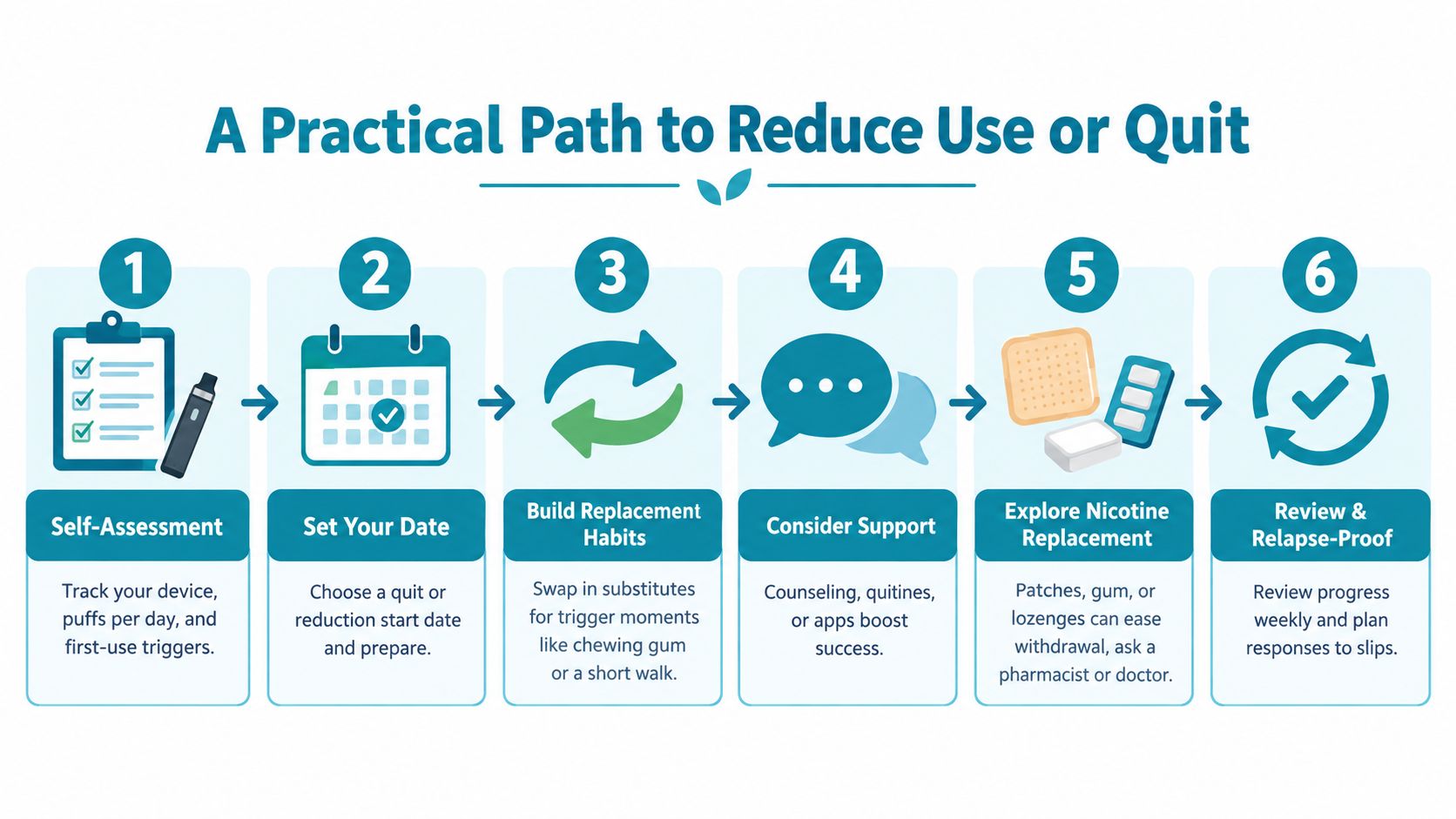
Measure the pattern before changing it. Record the device, how often you reach for it, how soon you vape after waking, and what happens just before each use. Puff counts cannot precisely show how much nicotine you absorb, but they can expose routines that a plan can target.
Choose a defined goal. Some adults set a quit date. Others start by reducing use and then set a date to stop. Write down why the change matters, whether that means easier breathing, lower cost, more privacy, pregnancy planning, or freedom from constant cravings. A written reason can provide direction when motivation changes.
Discuss FDA-approved NRT. A patch can provide baseline nicotine coverage, while gum or a lozenge can address breakthrough cravings. The appropriate amount and combination depend on current nicotine exposure and medical history. Do not estimate needs from a label's nicotine percentage alone.
Use short-acting products correctly. Nicotine gum is not chewed continuously like ordinary gum. Chew it briefly until a tingling or peppery sensation appears, then park it between the cheek and gum. Repeat that cycle according to the product label. A clinician or pharmacist can explain nicotine gum technique and dosing before you adjust your routine. Avoid eating or drinking around use when the label advises it, and ask a pharmacist or physician about nausea, dizziness, palpitations, or other symptoms.
Plan for cues before cravings arrive. Keep water or sugar-free gum in the car. After meals, stand up, brush your teeth, or take a short walk. During social use, tell one trusted person about your goal and step away when others vape. A substitute is more useful when it is prepared in advance.
Review slips without abandoning the plan. A lapse identifies a trigger; it does not prove that treatment failed. Record what happened, revise the cue plan, and contact a clinician or quitline if cravings remain difficult.
A labeled hypothetical composite
Hypothetical composite, not an Empire patient: An adult vapes frequently and chews nicotine gum as though it were ordinary gum, causing nausea. A clinician would clarify the complete nicotine pattern, review the product label and health history, teach the chew-and-park method, consider an appropriate baseline approach, and identify the cues that prompt vaping.
This example does not establish a dose or promise abstinence. It shows why tolerability depends on technique and why effective planning addresses nicotine delivery and behavior together. CDC smoking-cessation guidance and state quitline services can provide structured support.
When to Seek Medical Help and How the Practice Can Support You
Seek urgent medical care for chest pain, severe shortness of breath, persistent vomiting, confusion, or rapidly worsening symptoms after vaping. Fever with a progressive cough or breathing difficulty also warrants prompt evaluation because clinicians may need to consider vaping-associated lung injury and other causes. Suicidal thoughts require immediate crisis support. In the United States, call or text 988 for the Suicide & Crisis Lifeline, or call emergency services when there is immediate danger.
Routine outpatient care may be appropriate if you can't cut back despite repeated attempts, wake with strong cravings, use nicotine to manage distress, or alternate between vaping and smoking. Pregnancy, coexisting anxiety or depression, other substance use, and adolescent nicotine use are additional reasons to involve a qualified clinician rather than attempting an unsupported change.
What an addiction-medicine visit can cover
A physician-led assessment typically includes a nonjudgmental history of nicotine use, withdrawal, triggers, smoking or vaping products, medical conditions, medications, mood, and other substances. The clinician may assess dependence, review cardiovascular and respiratory symptoms, discuss FDA-approved NRT, and consider whether a non-nicotine medicine or referral is clinically appropriate.
Care should remain individualized. A practice may monitor response and tolerability, coordinate with a primary-care clinician, or refer to pulmonary, behavioral-health, counseling, or quitline services when useful and authorized. It shouldn't be confused with emergency care, detoxification, inpatient treatment, or residential treatment.
For readers who want recovery-focused language and additional perspective, litter caterpillars recovery offers a nonclinical resource. Adults seeking confidential outpatient evaluation can learn about an addiction medicine specialist and decide whether a physician conversation fits their needs.
Empire Medical Wellness offers private-pay, physician-led outpatient addiction medicine for adults, including confidential assessment, evidence-based treatment when clinically appropriate, monitoring, and recovery planning. If disposable vaping has become difficult to control, visit Empire Medical Wellness to review the practice's current care model and request information about an evaluation.
Sources
- CDC information on e-cigarette aerosol and health risks
- FDA federal tobacco sales age requirements
- FDA information on e-cigarette product authorization
- FDA nicotine replacement therapy safety information
- CDC smoking cessation resources
This article is educational and isn't personal medical advice.