
Most diet advice gets one thing wrong. A balanced diet for weight loss is not about cutting out entire food groups, and it's not about chasing the newest named plan. In practice, weight loss comes from a sustainable calorie deficit, enough protein and fiber to stay satisfied, and food choices you can repeat on ordinary days.
That matters because the hardest part of weight loss usually isn't knowing what to eat. It's making a plan work with your budget, your schedule, and your culture. The best approach is the one that fits real life and still keeps total energy intake in check, which is why balanced eating tends to work better than extreme restriction over time.
Table of Contents
- What a Balanced Diet for Weight Loss Actually Means
- Setting Your Calorie and Macronutrient Targets
- Building Meals Around Real-World Constraints
- Which Dietary Patterns Produce Lasting Results
- Monitoring Progress and Knowing When to Seek Help
- Key Takeaways and Next Steps
What a Balanced Diet for Weight Loss Actually Means
A balanced diet for weight loss does not mean eliminating carbohydrates, fat, or whole food groups altogether. The core mechanism is a calorie deficit, and a major review notes that reducing daily calorie intake is the most important factor for weight loss, while macronutrient composition alone usually does not create major differences in outcomes. Public health guidance is aligned with that basic idea, including the WHO recommendation that adults keep total fat to 30% or less of total energy, saturated fat to 10% or less, and trans fat to 1% or less. You can see how that fits with practical meal planning through balanced meal ideas, which can be useful when you need structure without turning food into a list of forbidden items.
What “balanced” really means is nutritionally complete, calorie-aware, and maintainable. In plain terms, that means getting enough protein, fiber, and micronutrients while keeping the overall diet sustainable enough to follow day after day. The U.S. Dietary Guidelines evidence review found moderate evidence that patterns emphasizing vegetables, fruits, and whole grains are linked with modest benefits for preventing weight gain or supporting weight loss in adults (PMC review).
Practical rule: If a plan is so strict that you can't imagine repeating it on a normal week, it's probably too fragile to support long-term weight loss.
A useful mental model is this, calorie deficit means eating less energy than your body uses, macronutrients are carbohydrates, protein, and fat, and a dietary pattern is the overall way you eat, not a single meal or food. The distinction matters because weight loss is rarely won by one perfect lunch. It's won by a pattern that keeps intake lower over time without making meals miserable.
The long-term data are consistent with that. A large observational analysis cited by Harvard followed more than 120,000 adults for 20 years and found weight change was most strongly linked to foods like potato chips, sugar-sweetened beverages, and processed meats, while vegetables, whole grains, fruits, nuts, and yogurt were associated with weight loss (PMC review). For adults who want physician-guided support, the broader obesity medicine approach at Empire Medical Wellness weight loss care focuses on the same principle, sustainable change rather than punishment.
Setting Your Calorie and Macronutrient Targets
A practical weight-loss plan starts with a realistic calorie target, not a complicated formula. Clinical guidance commonly uses a daily reduction of about 500 to 750 calories, with typical intake ranges of 1,200 to 1,500 calories per day for women and 1,500 to 1,800 for men in obesity management reviews (PMC review). The exact number isn't the point here. The point is that the deficit has to be large enough to matter and small enough to sustain.
A simple macro framework
One clinical review describes a sustainable pattern at roughly 50–60% of energy from carbohydrates, 15–25% from protein, and less than 30% from fat (PMC review). That isn't a prescription for every person. It is a practical starting point that keeps meals familiar while still helping with fullness.
| Nutrient | Percentage of Calories | Example for 1,500 Calorie Diet |
|---|---|---|
| Carbohydrates | 50–60% | 750–900 calories from carbs |
| Protein | 15–25% | 225–375 calories from protein |
| Fat | Less than 30% | Less than 450 calories from fat |
Protein and fiber are especially helpful when hunger is the barrier. The same review highlights fiber in the 25–38 g/day range and notes that enough protein plus regular meal timing can reduce hunger and preserve meal structure during weight loss (PMC review). That is one reason a breakfast with Greek yogurt and fruit often works better than a sweet coffee drink alone. It gives the day a stable start.
The best target is the one you can follow 4+ days per week. If a plan only works on perfect days, it usually won't last.
A useful first step is to find one or two priority gaps. Maybe lunch is low in protein. Maybe dinner lacks vegetables. Maybe sugary drinks are the main source of extra calories. Fixing one gap at a time is more durable than overhauling every meal at once.
For readers who prefer a practical overview of energy balance, calorie deficit guidance can help frame the bigger picture without turning the process into guesswork. The goal is not perfection. It's a plan that lowers intake consistently enough to move weight in the right direction.
Building Meals Around Real-World Constraints
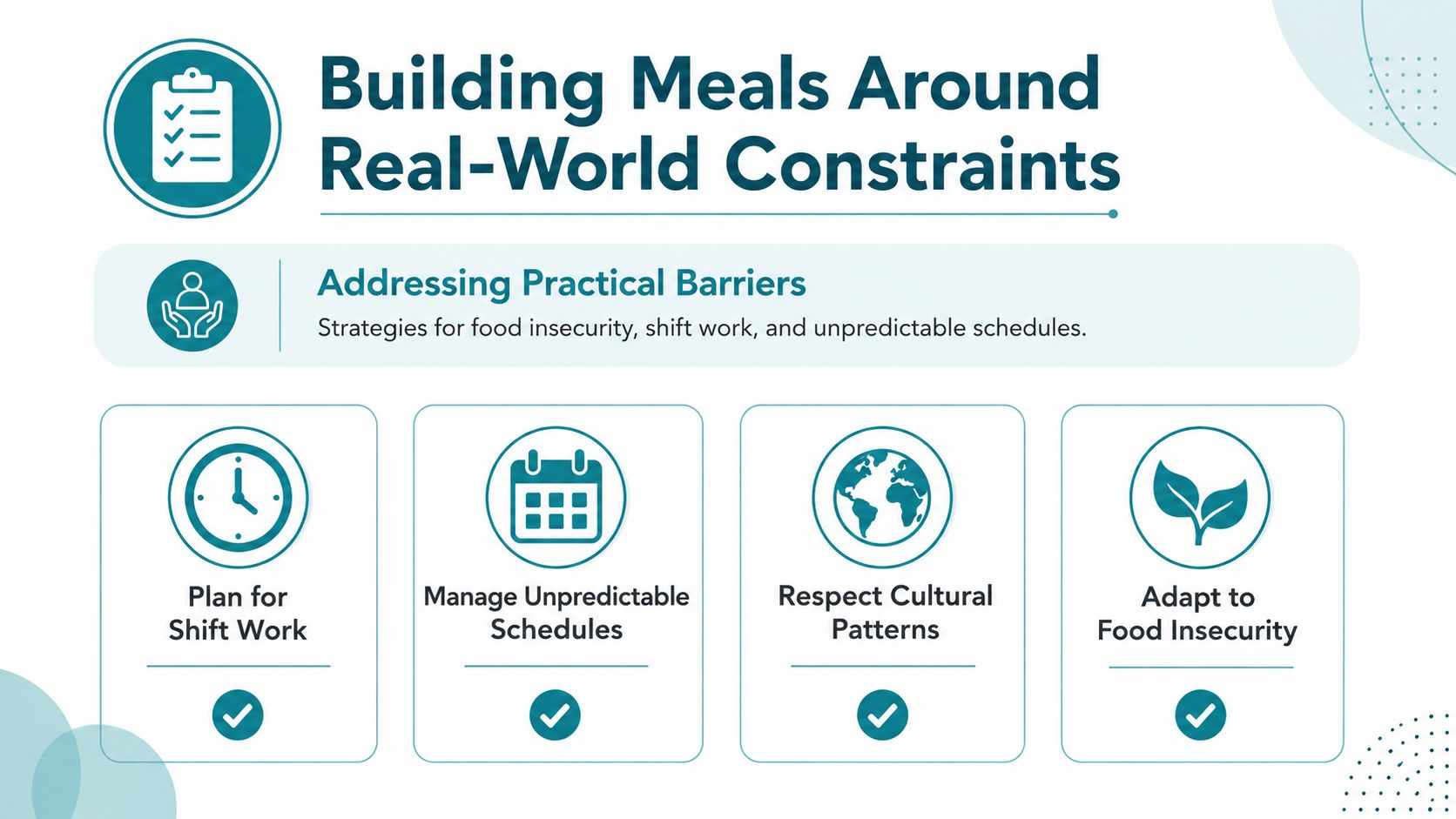
A balanced diet fails when it assumes ideal conditions. Many adults are trying to eat well while working evenings, splitting meals around childcare, managing food costs, or cooking from a familiar cultural tradition that doesn't fit a generic menu. That's not a discipline problem. It's a planning problem.
A realistic day can still be balanced
Consider a night-shift worker who can't count on a formal dinner. A workable day might start with eggs and toast before work, pack yogurt and fruit for the midpoint of the shift, and end with leftovers built from beans, rice, and vegetables. That pattern keeps protein, fiber, and calories in view without requiring perfect timing.
Budget matters too. A balanced plate doesn't need premium ingredients. Beans, lentils, eggs, canned fish, frozen vegetables, oats, brown rice, plain yogurt, and peanut butter can all fit a weight-loss plan if portions are reasonable and added sugar is limited. If you want structured prep ideas that use ordinary groceries, smart meal prep for weight loss is a practical place to look for inspiration.
A culturally familiar meal can also stay balanced with small edits. Rice and beans can remain on the table, but portions can be adjusted and vegetables can be increased. Tacos can stay tacos, but the filling can shift toward leaner protein, more beans, and extra lettuce or peppers. The point is not to replace your food identity with a diet template.
For a practice-oriented planning frame, balanced meal planning helps organize meals around real-world constraints instead of idealized ones.
Practical insight: The meals people repeat most often are usually the meals that fit their schedule, budget, and family table.
A simple shopping list can keep the system moving:
- Protein staples: eggs, Greek yogurt, canned tuna, chicken, tofu, beans.
- Fiber-rich carbs: oats, brown rice, whole-grain bread, potatoes, fruit.
- Produce basics: frozen mixed vegetables, salad greens, onions, carrots, apples.
- Flavor builders: salsa, garlic, spices, olive oil, vinegar.
The goal is not a perfect weekly menu. It's a repeatable set of meals that still supports a calorie deficit when work runs late or dinner changes at the last minute.
Which Dietary Patterns Produce Lasting Results
No single named diet wins for everyone. A systematic review found little or no difference in weight loss between low-carbohydrate diets and balanced diets over time, including at 3–6 months and again at 1–2 years (PLOS One review). That is one of the clearest messages in weight management, adherence matters more than the label on the plan.
What the clinical data suggest
In the DIRECT study, which followed 322 adults with obesity for 2 years, mean weight loss was 2.9 kg with a low-fat diet, 4.4 kg with a Mediterranean diet, and 4.7 kg with a low-carbohydrate diet (PMC review). Those differences are real, but they're not a reason to treat one pattern as universally best. They show that several approaches can work when people can stick with them.
A related clinical review found the Mediterranean diet produced an average 8.7% weight loss after 12 months, and a low-carbohydrate Mediterranean version produced about 10% loss (PMC review). That same broader evidence base also supports the simpler message that food quality matters. In Harvard's cited observational analysis of more than 120,000 adults, foods like potato chips, sugar-sweetened beverages, and processed meats tracked with weight gain, while vegetables, whole grains, fruits, nuts, and yogurt tracked with weight loss (PMC review).
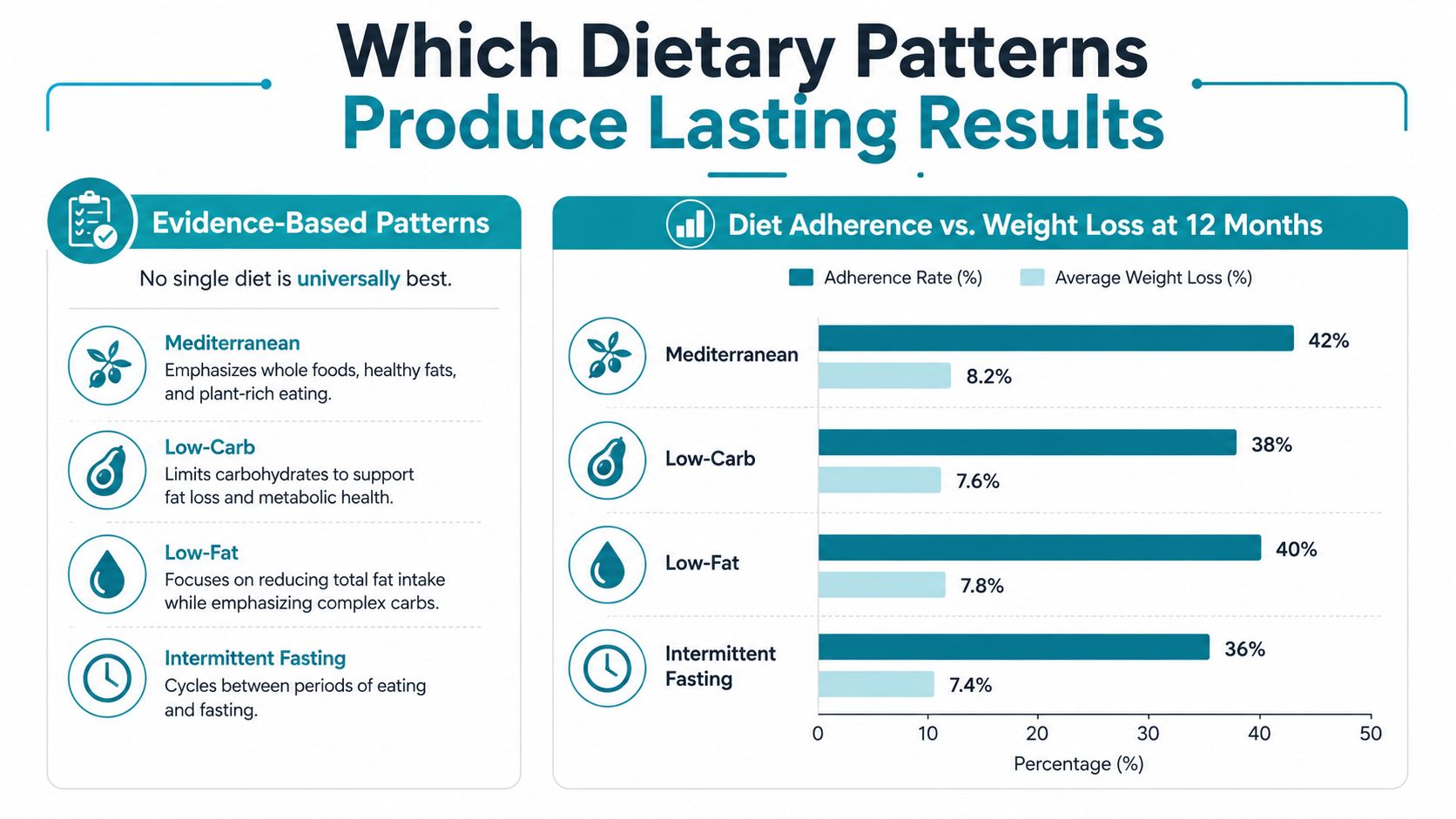
The balanced-diet message is not that every meal must look identical. It's that the pattern should make it easy to eat more vegetables, fruit, whole grains, and quality protein while keeping total calories in a controlled range. The most useful diet is the one that works on weekdays, not just on paper.
For readers who want a broader framework for food quality, healthy eating patterns can help connect the evidence to everyday decisions. In clinic, that usually means simplifying the plan until it's something a person can maintain without constant rebound hunger or all-or-nothing thinking.
Monitoring Progress and Knowing When to Seek Help
Progress tracking works best when it is calm and routine. Regular weigh-ins can help, but the number on the scale should be read as a trend, not a verdict. Daily weight can move with sodium, sleep, bowel habits, and menstrual cycle changes, so the question is whether the overall pattern is moving in the right direction.

What to watch besides weight
Track the parts of the plan, not just the final outcome. If lunches are drifting toward vending-machine snacks or dinner keeps getting skipped, that pattern usually explains the plateau better than the scale does. Behavior change is more durable when the plan is practical enough to repeat 4+ days per week (PMC review).
Use a short weekly check-in:
- Meals: Which meals were repeatable, and which ones fell apart?
- Hunger: Where did you feel most deprived?
- Triggers: What events, shifts, or routines disrupted eating?
- Structure: Did you keep protein, fiber, and meal timing steady?
If progress stalls, first look at consistency. Sometimes the calorie target is fine, but weekend eating, liquid calories, or erratic meal timing are canceling out weekday effort. If the pattern is already consistent and weight still isn't moving, a physician-led review can help sort out medical factors, metabolic adaptation, and whether a different strategy is appropriate.
The practice model at Empire Medical Wellness weight management care reflects that kind of assessment. In obesity medicine, the goal is to look carefully at weight history, health conditions, medications, and the plan itself, then decide whether ongoing monitoring or anti-obesity medication may be clinically appropriate.
Seeking help is not the same as giving up. It usually means the plan needs better fit, more structure, or medical oversight. That's a normal part of treatment when self-guided efforts have not produced lasting change.
Key Takeaways and Next Steps
A balanced diet for weight loss is built around energy deficit, not food punishment. The most useful plans keep overall diet quality high, include enough protein and fiber, and stay realistic enough to repeat in ordinary life. Evidence consistently points in the same direction, sustainable patterns beat extreme ones, and the best food plan is the one you can keep following.
Real-world constraints matter. If you're working shifts, managing a tight grocery budget, or cooking foods that are central to your culture, the answer is not a rigid template. It's a practical structure that fits your schedule and still controls calories.
If you've been trying to lose weight without lasting progress, physician-led obesity medicine can help you look at the plan, the barriers, and the medical context together. A thoughtful evaluation can clarify whether you need more structure, a different eating pattern, or longer-term treatment support.
This article is educational and not personal medical advice. If you want individualized obesity medicine care, visit Empire Medical Wellness to learn how a physician-led evaluation can support a more sustainable weight-management plan.
Empire Medical Wellness offers physician-led obesity medicine care for adults who want a careful, evidence-based approach to weight management. If you're looking for a balanced diet for weight loss that accounts for real schedules, food preferences, and long-term maintenance, visit Empire Medical Wellness to explore whether a medical evaluation is the right next step for you.