
Starting Ozempic can feel straightforward on paper and messy in real life. A person may take the first few doses, then feel nausea, bloating, or a strong sense of fullness that makes them wonder if the medication is “working” or is not agreeing with them.
That reaction is common enough to deserve a calm explanation. Ozempic side effects are usually digestive, they often show up during dose increases, and individuals experience better outcomes when they understand what's normal, what needs attention, and how follow-up should work with a physician-led obesity medicine plan.
Table of Contents
- Introduction to Ozempic and Side Effect Overview
- How Ozempic Works and Why Side Effects Occur
- Common Side Effects Frequencies Timing and Duration
- Rare and Serious Side Effects Risks and Interactions
- Managing Side Effects with Practical Strategies
- Monitoring Recommendations and Red Flags
- Comparing Ozempic with Other GLP-1 Agonists
- Empire Medical Wellness Approach to Assessment and Follow-Up
Introduction to Ozempic and Side Effect Overview
A patient may leave the first injection feeling unchanged, then notice a few days later that dinner seems to sit in the stomach like a slow-moving train. Another person may find that a favorite food suddenly brings on nausea or burping. Those reactions can be frustrating, but they are also familiar patterns with Ozempic, which is semaglutide used in adults with type 2 diabetes, and often discussed in obesity care as well.
For many patients, the first question is simple: why does a medicine that helps appetite also upset the stomach? The answer is that the same effect that can make eating feel easier to control can also make digestion feel slower and heavier at first. That is why the side effects people ask about most often are digestive, not random symptoms scattered across the body.
Practical rule: If a symptom is mild, expected, and short-lived, observation and practical adjustments usually make more sense than panic.
Clinicians at Empire Medical Wellness see this often in private-pay obesity medicine visits. A person may do well on one dose, then feel queasy after an increase, or discover that fried foods and large meals are harder to tolerate than before. For a closer look at how Ozempic is used in treatment plans, see Ozempic for type 2 diabetes at Empire Medical Wellness.
The safest way to understand Ozempic side effects is to sort them into three groups. Common digestive effects are the ones patients talk about most, rare but serious effects need prompt medical attention, and monitoring issues matter because semaglutide is often used as ongoing therapy rather than as a short course. The FDA label and trial data help separate expected effects from online rumor, because they reflect what was seen in studied patients and in later real-world use FDA prescribing information, FDA trial label data.
For adults in obesity medicine, the goal is straightforward. Learn what is common, learn what is concerning, and know when a symptom deserves a physician's review instead of self-diagnosis.
How Ozempic Works and Why Side Effects Occur
Semaglutide changes how quickly food moves
A patient may expect a weight-loss medicine to act only on appetite, then notice the bigger change happens in the stomach. Ozempic is a GLP-1 receptor agonist, which means it copies part of a natural gut hormone signal. In plain language, it helps people feel full sooner, and it slows gastric emptying, the rate at which food leaves the stomach mechanism overview.
The easiest way to picture it is a controlled pipeline. Food enters the stomach, then the body decides how fast that material should move onward. Semaglutide works like a regulator on that pipeline, so the flow slows down. For some people, that slower flow is exactly why appetite drops. For others, it is also why they feel heavy, overly full, or nauseated after eating.
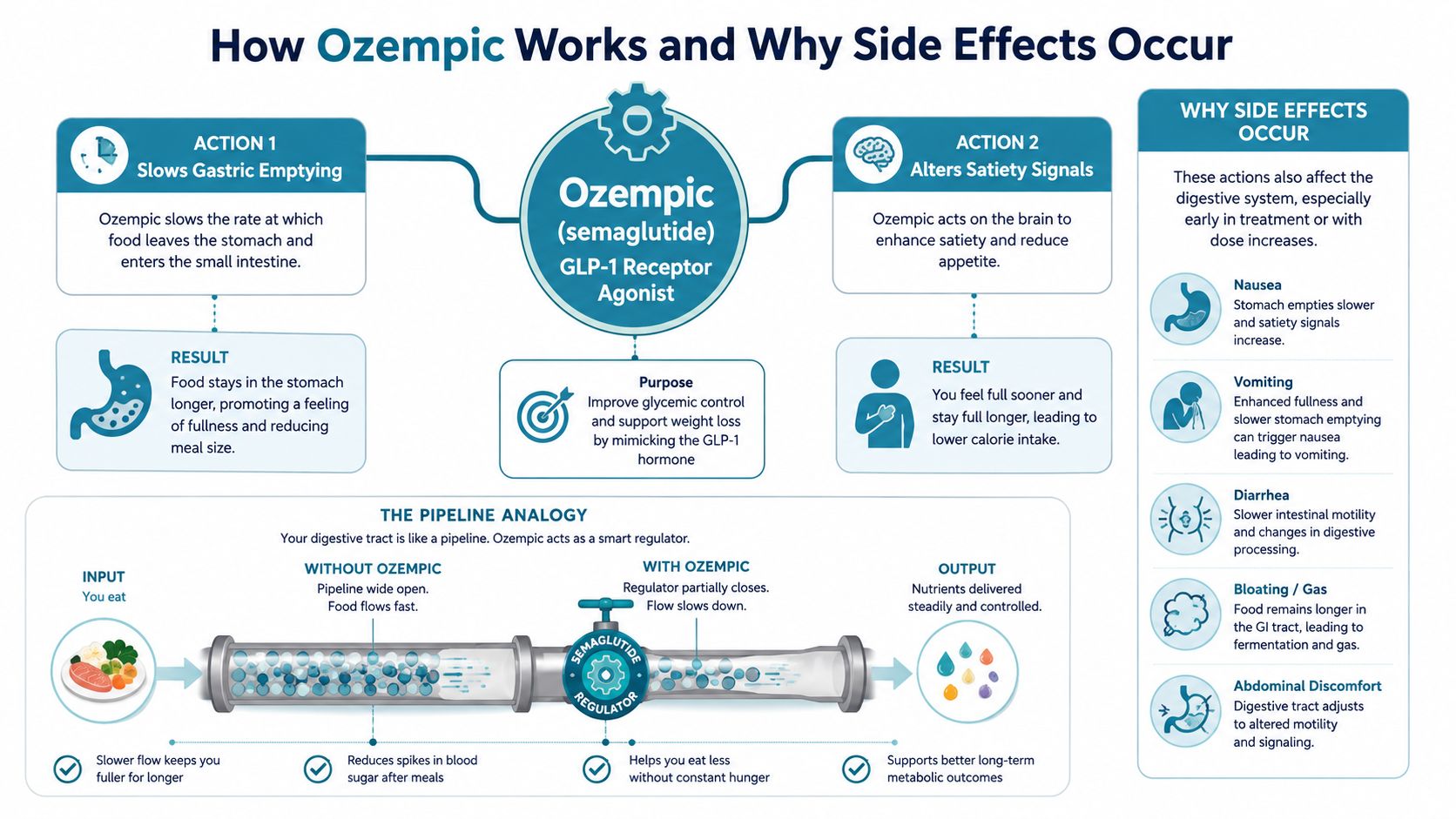
That same mechanism explains why the most common problems are digestive rather than random. The medicine is acting where digestion starts, so symptoms tend to cluster around the stomach and intestines instead of showing up in unrelated systems. The FDA label reflects that same pattern in the studied patients.
Why dose increases can feel rough
Dose escalation is often when people notice the strongest symptoms. The body is adapting to a new level of GLP-1 signaling, and that transition can feel like the digestive system is running a little behind the prescription schedule.
The pattern also fits what clinicians see in private-pay obesity medicine visits. A patient may tolerate one dose well, then feel queasy after an increase, or find that fried foods and large meals are suddenly harder to handle. That is the kind of counseling discussed in Ozempic for type 2 diabetes at Empire Medical Wellness, where the focus is on practical expectations, follow-up, and dose-by-dose adjustment.
The good news is that adaptation often happens over time. The manufacturer's safety information summarized in the FDA label notes that many nausea, vomiting, and diarrhea reports occurred during dose escalation, which fits the clinical pattern many obesity medicine clinicians see in practice. That is why gradual titration matters so much manufacturer safety information summarized in FDA label.
Semaglutide does not usually create a brand-new gut problem. It changes the speed of a system that already exists.
That distinction helps patients think about management. The usual response is not to assume the medicine is intolerable after one uncomfortable day. Instead, clinicians often focus on meal size, hydration, and follow-up timing, because those changes can make the difference between stopping too soon and settling into a stable plan mechanism and tolerability discussion.
For adults comparing treatment plans, Ozempic is the diabetes-branded semaglutide product, and the obesity care conversation is similar but not identical. The practical counseling principles are closely related to the way clinicians discuss it on Ozempic for type 2 diabetes at Empire Medical Wellness.
Common Side Effects Frequencies Timing and Duration
What FDA trials showed about common side effects
A patient starts Ozempic, feels queasy after the first few doses, and wonders whether something is wrong. In obesity medicine, that story is familiar. The clinical trials help explain why.
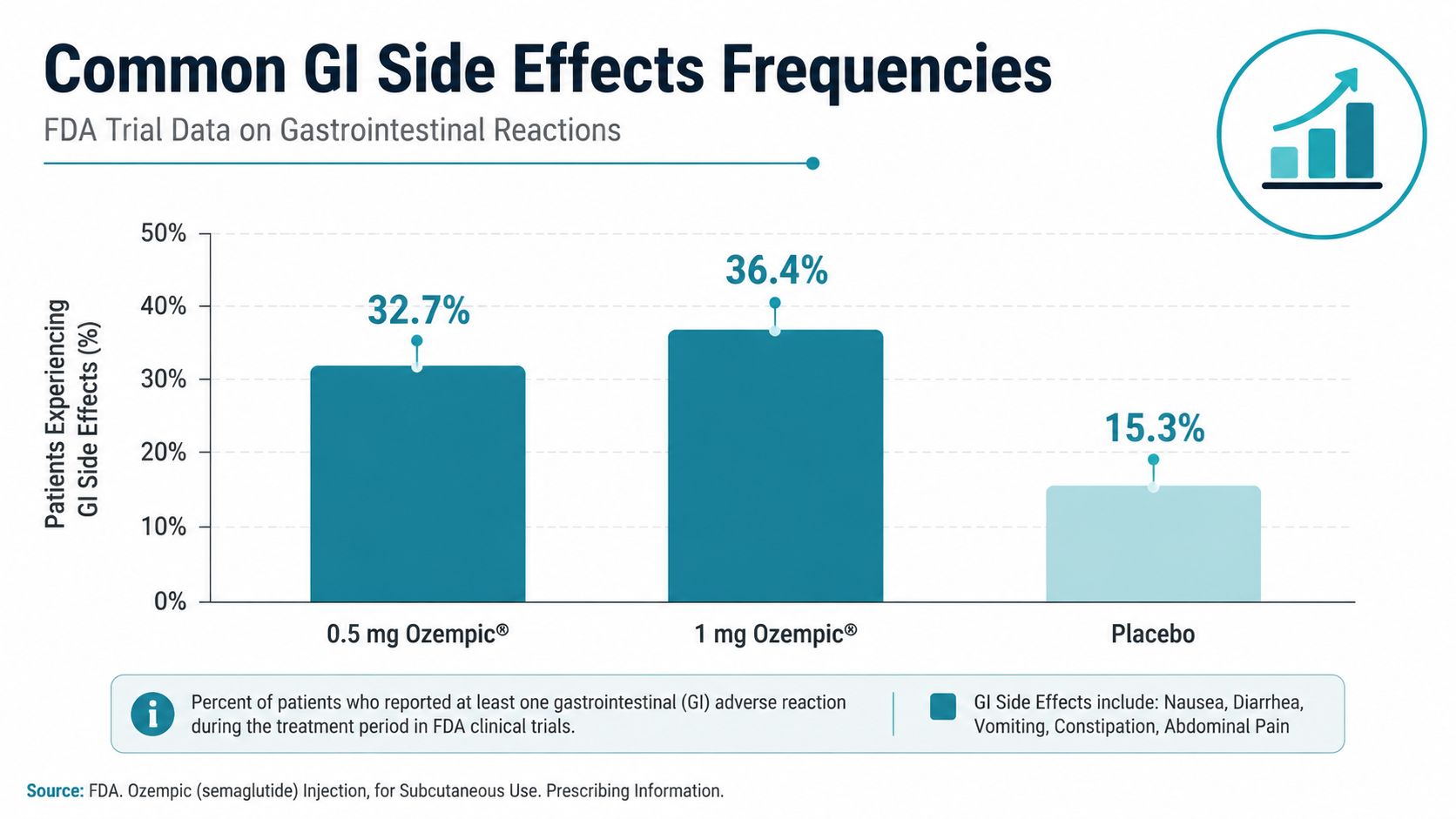
In the placebo-controlled studies, gastrointestinal adverse reactions occurred in 32.7% of patients taking 0.5 mg and 36.4% taking 1 mg, compared with 15.3% on placebo FDA label trial data. The most common reactions reported in at least 5% of treated patients were nausea, vomiting, diarrhea, abdominal pain, and constipation FDA prescribing information.
Those figures matter because they show the main tolerability issue early. These are expected patterns seen in formal trials, not unusual complaints that show up only in rare cases.
When symptoms tend to appear and fade
Most nausea, vomiting, and diarrhea reports clustered during dose escalation in the FDA data FDA label trial data. That timing gives patients a useful clue. If the stomach symptoms begin soon after a dose increase, the medication is often the most likely trigger.
The manufacturer also notes that most nausea, vomiting, and diarrhea reports occurred during dose escalation, and discontinuation because of GI reactions was 3.1% at 0.5 mg and 3.8% at 1 mg, compared with 0.4% for placebo FDA label trial data. Many people stay on treatment, but some need a slower pace, a pause, or closer follow-up.
A common pattern in private-pay obesity medicine is short-term worsening after a new dose, followed by steadier symptoms over the next several weeks as the body adjusts. That is one reason clinicians at practices like Empire Medical Wellness's discussion of Ozempic faces and routine follow-up visits keep the focus on tolerance over time, not just the first uncomfortable day.
What patients often confuse with intolerance
Many patients assume any stomach upset means Ozempic has failed. The clinical picture is more nuanced. Sometimes the medicine is only part of the issue, and the trigger is a larger meal, a richer meal, or not enough hydration while the dose is changing.
A useful way to judge the symptom is simple. If it is predictable, mild to moderate, and improving, continued monitoring often makes sense. If it is getting worse, lasting, or interfering with daily life, the prescriber should reassess the plan.
That is the practical line obesity medicine clinicians use in real-world care. The goal is to separate an expected adjustment period from a true intolerance problem, so patients do not stop too early or ignore symptoms that need attention.
Rare and Serious Side Effects Risks and Interactions
Serious events are uncommon, but they matter
Clinical trials are designed to watch for expected reactions under controlled conditions. Post-marketing reports are different. They collect the problems that show up after Ozempic is used in everyday care, where patients have different diets, different medical histories, and different follow-up patterns. One safety summary reported 51,186 total adverse-event cases associated with Ozempic, including 24,642 serious cases and 718 deaths post-marketing safety summary. Those reports do not prove that Ozempic caused every event, but they do show why rare harms stay on the checklist in obesity medicine.
A separate Harvard and CDC analysis estimated fewer than 4 emergency department visits per 1,000 patients, and about 70% of those visits involved GI problems such as nausea, vomiting, abdominal pain, diarrhea, or constipation. That pattern helps put risk in context. A stomach reaction is far more likely than a true medical emergency, yet the uncommon events still need a clear plan for spotting them early.
Eye, allergy, and glucose concerns
Regulatory reviews also highlight serious worsening of diabetic retinopathy, which may affect up to 1 in 10 people. For patients with diabetes and existing eye disease, that means any new blurry vision, floaters, or vision loss should be treated as a medical issue, not written off as routine adjustment.
The same safety summary notes allergic reactions and very low blood sugar as reasons some people ended up in emergency care. Low blood sugar is mainly a concern when Ozempic is used with other glucose-lowering medicines, because the combination can push glucose lower than expected. In practice, that is one reason clinicians in private-pay obesity medicine review the full medication list carefully, then keep the conversation focused on GLP-1 safety through Empire Medical Wellness's GLP-1 safety guidance.
Clinical takeaway: The rare risks are real, but they are different from the usual GI pattern. Patients need to know which symptoms fit expected adjustment and which ones call for faster action.
Internal medicine and obesity care also pay attention to risk factors that can shape the safety conversation, including prior pancreatitis, gallbladder problems, kidney disease, and active diabetic eye disease. Those concerns do not automatically rule out treatment, but they do change how carefully the medication is started, monitored, and reviewed.
Managing Side Effects with Practical Strategies
A patient may feel fine after the first injection, then notice queasiness once meals stay large or rich. That pattern is common in obesity medicine, and the response usually starts with simple changes that fit the medicine's effect on the stomach rather than with stopping treatment at the first uncomfortable day.
Start with food, fluid, and pacing
People often do better when they treat Ozempic as a medicine that responds well to steady habits and poorly to overcorrection. Small, low-fat meals are easier on a slower digestive system than large, heavy plates. Hydration matters too, because nausea and diarrhea can contribute to dehydration if fluid intake drops.
If breakfast suddenly feels too heavy, the answer is usually not to skip every meal. Reduce the portion, slow the pace, and choose foods that are less likely to sit heavily in the stomach. That practical adjustment fits the way semaglutide changes gastric emptying.
A hypothetical example
A hypothetical patient starts to feel queasy after the second dose increase. The nausea is worse after late, greasy dinners and improves on days when meals are smaller and water intake stays steady. With a physician's guidance, they simplify dinner, avoid very heavy foods before bedtime, and track symptoms until the next follow-up.
That kind of adjustment is ordinary, not dramatic. It works because the plan matches the medication instead of fighting it.
Practical rule: Don't confuse “mildly uncomfortable” with “unsafe.” Many patients improve when the plan is adjusted instead of abandoned.
A few people ask whether they should take the shot with food. In practice, tolerance varies, so the prescriber's guidance should lead. Some patients pay more attention to what they eat before and after the dose than to the exact clock time, because the stomach effect usually matters more than the ritual around the injection.
Short video guidance can also help patients recognize the pattern of typical symptoms and know when to call their clinician.
What about cycling off and restarting
A lot of public discussion misses the long-term nature of semaglutide therapy. Manufacturer-facing education notes that semaglutide is typically an ongoing therapy, and symptoms may return when someone restarts after stopping manufacturer side effects page. That matters because people sometimes assume a break solves the problem permanently.
Restart planning is where follow-up becomes especially useful. If side effects were the reason someone paused treatment, the next step is usually a careful review of what happened, what changed, and whether the same pattern is likely to return. That conversation belongs with the prescriber, not a message thread or social media comment.
For adults considering obesity treatment rather than diabetes care alone, the practical symptom-management lens is very similar to the approach outlined on weight loss treatment planning.
Monitoring Recommendations and Red Flags
Follow-up should be structured, not casual
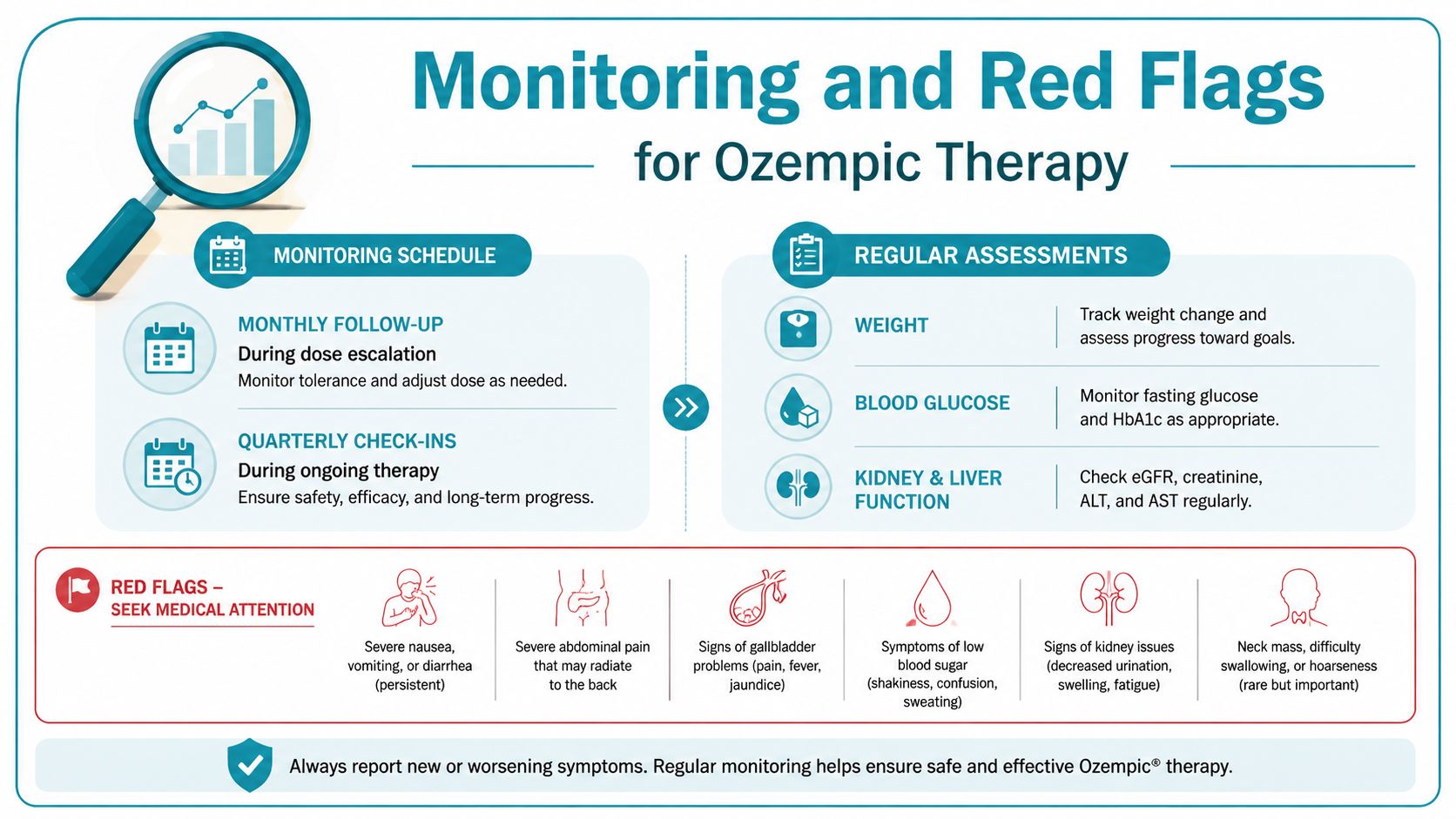
During dose escalation, monthly check-ins are a reasonable way to track how a patient is tolerating treatment, how meals are going, and whether the dose should stay steady for longer. Once therapy is stable, quarterly follow-up is a common maintenance rhythm in obesity medicine.
Regular reassessment should include weight, blood glucose when relevant, and kidney and liver function when clinically indicated. For patients with diabetes, eye care matters too, especially if there's known retinopathy or new vision symptoms.
Red flags that need prompt evaluation
Some symptoms do not belong in the “wait and see” category. Severe abdominal pain, persistent vomiting, acute vision changes, signs of pancreatitis, and signs of an allergic reaction should trigger immediate medical evaluation. That is true whether the person is early in therapy or has been stable for months.
Procedure planning also matters. The FDA warns that GLP-1 medicines can delay gastric emptying, which can raise the risk of pulmonary aspiration during general anesthesia or deep sedation even when standard fasting has been followed FDA safety communication summarized in health safety source. Patients should always tell procedural teams they use a GLP-1 medicine.
Do not wait on vision changes or severe abdominal pain. Those symptoms need a clinician, not a search engine.
Patient education prevents confusion. Mild nausea during escalation is common. Severe pain, repeated vomiting, or abrupt visual symptoms are not. The distinction sounds simple, but it's easy to blur when someone is worried or tired.
Comparing Ozempic with Other GLP-1 Agonists
Similar class, different practical tradeoffs
Ozempic shares a class with other GLP-1 medicines, so the digestive side effects are familiar across the group. What changes is the dosing rhythm, the approved indication, and how each medicine fits a person's routine.
For example, semaglutide is once-weekly, which some people find easier to manage than daily injections. That convenience can matter when someone is already trying to build a new eating pattern and keep side effects predictable.
Where differences usually show up
Liraglutide products and tirzepatide are often discussed in the same clinical space, especially in obesity care conversations. The side-effect conversation is still mostly about stomach tolerance, but the dose-escalation schedules and the way patients experience each medication can differ.
For readers comparing Ozempic with tirzepatide, the most useful practical point is that one person's experience on one GLP-1 medicine doesn't always predict the next one. If nausea or constipation was a problem on one agent, a clinician may think differently about escalation pace or choice of medication.
Comparison point: The class effect is digestive intolerance, but the day-to-day experience can still differ from one medication to another.
People who want a side-by-side discussion often ask whether another GLP-1 would fit better if Ozempic feels rough. That's a legitimate clinical conversation, and it should focus on tolerance, indication, and follow-up rather than on internet rankings.
For a practical contrast with another commonly discussed option, see Mounjaro side effects.
Empire Medical Wellness Approach to Assessment and Follow-Up
A careful obesity medicine visit starts with more than a prescription. It begins with a medical history, a weight history, and a metabolic assessment so the clinician can see whether the patient's side-effect risk looks straightforward or more complicated. That matters because the same medication can be easy for one person and difficult for another.
In a private-pay, physician-led setting, the advantage is time. The standard structure at Empire Medical Wellness includes a 50-minute initial evaluation and 25-minute follow-up visits, which gives room to talk through tolerance, meal patterns, prior medication reactions, and whether a slower pace would be safer and more sustainable. Current telemedicine support is available for adults physically located in New York, New Jersey, Connecticut, Pennsylvania, or Virginia.
Dr. Chhatpar's role in obesity medicine is especially relevant here because follow-up is where side effects become manageable. If nausea starts during titration, the next question isn't just whether the patient can “push through.” It's whether the dose, timing, nutrition pattern, or monitoring plan needs to change.
That approach fits the nature of semaglutide care. People rarely need drama. They usually need a clinician who can sort out what's expected, what's not, and what to do next without overreacting or minimizing their symptoms.
For readers who want to understand the practice's broader obesity medicine framework, the best place to start is the Empire Medical Wellness obesity medicine page. This article is educational and not personal medical advice.
If you're trying to understand whether your symptoms are a normal part of Ozempic treatment or something that deserves more attention, Empire Medical Wellness can help you think it through in a physician-led setting. Visit Empire Medical Wellness to learn more about obesity medicine care, side effect follow-up, and long-term monitoring.