
Can alcohol treatment begin before a person commits to abstinence? The question helps explain interest in the Sinclair Method, but it does not determine whether the approach is medically appropriate.
The method involves taking naltrexone before anticipated drinking. That is a targeted schedule, distinct from the FDA-described once-daily regimen. The distinction matters: evidence for naltrexone does not automatically establish the evidence for every way of taking it.
By Empire Medical Wellness Editorial Team
Table of Contents
- What the Sinclair Method Means
- Labeled Daily Naltrexone Versus Targeted Use
- What Targeted Naltrexone Studies Reported
- Safety Checks Before Naltrexone Is Considered
- Claims That Go Beyond the Evidence
- How Outpatient Monitoring Is Organized
- Questions to Bring to an Evaluation
What the Sinclair Method Means
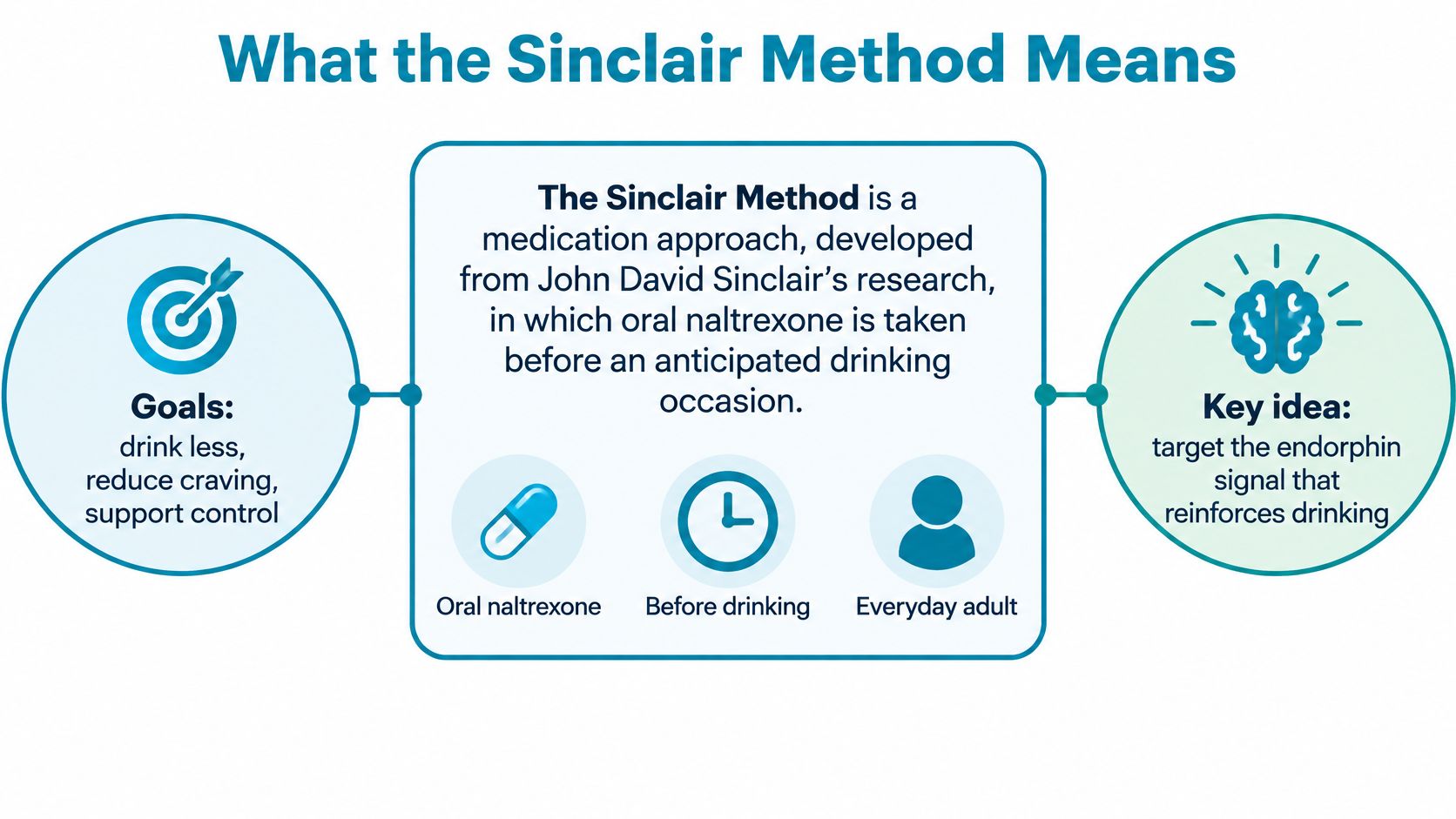
The Sinclair Method developed from John David Sinclair's research on alcohol reinforcement. It describes a medication approach in which oral naltrexone is used in relation to anticipated drinking, rather than requiring complete abstinence before treatment begins.
Naltrexone is an opioid-receptor antagonist, a medicine that blocks opioid receptors. These receptors participate in alcohol-related reward. The proposed mechanism, called pharmacological extinction, is that reducing this reinforcement may gradually weaken the learned connection between drinking and reward.
A hypothetical habit analogy helps distinguish the theory from a promise. If a familiar cue repeatedly stops producing its expected reward, the person may become less likely to respond to that cue. Human drinking behavior is more complicated than a simple habit, however, so this analogy doesn't predict an individual's response.
What Made the Approach Distinctive
Sinclair's 2001 review in Alcohol and Alcoholism synthesized eight double-blind, placebo-controlled trials across five countries. The review emphasized these features:
- Treatment could begin during active drinking. Abstinence wasn't a prerequisite in the original approach.
- Medication use was targeted. The research connected medication use with expected drinking rather than treating daily dosing as the defining feature.
- Treatment continued over time. Sinclair described extinction as commonly requiring approximately four to six months or longer, not an immediate change.
The review also reported that 78% of treatment completers in Sinclair's clinical work eventually reached extinction after several months. That figure describes a particular reported group, not everyone who started treatment, and it isn't a universal success rate or personal guarantee.
What Extinction Doesn't Mean
Extinction describes a proposed change in learned reinforcement. It doesn't mean that alcohol becomes harmless, that withdrawal risk disappears, or that every reason for drinking has been addressed.
Clinical distinction: A theory about weakening alcohol reinforcement isn't a detoxification plan or a complete recovery plan.
The approach also shouldn't be framed as a test of willpower. A qualified clinician must assess medical fit, medication risks, treatment goals, and follow-up needs before considering any medication strategy.
Labeled Daily Naltrexone Versus Targeted Use
FDA-labeled oral naltrexone compared with the Sinclair Method
| Question | FDA oral naltrexone labeling | Sinclair Method as researched |
|---|---|---|
| Main idea | Adjunct treatment for alcohol dependence | Weaken alcohol reinforcement while drinking may continue |
| Schedule described | Daily oral treatment, with the labeled study regimen described below | Medication timed to anticipated drinking and continued over an extended period |
| Start while still drinking | Not the method's defining feature | Original approach didn't require abstinence first |
| Regulatory status | FDA-approved medicine with a described daily regimen | Targeted timing isn't the labeled daily regimen |
| Role of other care | Benefit hasn't been shown outside an appropriate addiction-management plan | Not a stand-alone cure or guaranteed extinction protocol |
| Strongest supported aim | Reduce heavy drinking more reliably than produce complete abstinence | Similar medication aim, with narrower evidence for the exact schedule |
The FDA oral naltrexone labeling describes a 50-mg once-daily regimen studied for up to 12 weeks as an adjunct to treatment for alcohol dependence. These are labeling and study details, not instructions for a reader to take that dose.
The label also states that therapeutic benefit hasn't been shown except as part of an appropriate addiction-management plan. That wording matters: prescribing a medicine and organizing adequate treatment aren't the same task.
Approved Medication Doesn't Mean Every Schedule Is Approved
Oral naltrexone is FDA-approved for alcohol dependence. The targeted schedule associated with the Sinclair Method is an off-label dosing approach relative to the described daily regimen, not a separately FDA-approved Sinclair protocol.
Off-label doesn't automatically mean inappropriate. It does mean that the clinician should explain the rationale, the supporting evidence, the uncertainties, and the alternatives. Patients should be able to distinguish the medicine's approval from the evidence for the proposed way of using it.
Extended-release injectable naltrexone is a separate formulation with different labeling considerations. It shouldn't be treated as an interchangeable version of the Sinclair Method.
What the Comparison Means in Practice
The broader evidence for naltrexone supports reducing heavy drinking more clearly than guaranteeing abstinence. Neither column represents a promise that a person can safely continue drinking, and neither replaces assessment for withdrawal or opioid-related risks.
Empire's educational overview of naltrexone provides related medication context. A Harvard Health plain-language overview is another companion explanation, rather than a substitute for primary evidence or prescribing information.
A prescriber, not an article or comparison table, decides whether any formulation or schedule belongs in an individual treatment plan.
What Targeted Naltrexone Studies Reported
Targeted-use studies asked different questions about drinking outcomes, treatment support, and participant groups. Their results are a snapshot, not a ranking of success rates. Differences in design and outcome measures make direct comparisons difficult.
Targeted naltrexone findings and their limits
| Source snapshot | Who was studied | Reported result | Why it is limited |
|---|---|---|---|
| Heinälä and colleagues | Non-abstinent outpatients with alcohol dependence | A medication advantage appeared with coping-skills therapy | The same advantage wasn't seen with supportive therapy |
| Targeted-dosing factorial trial | Problem drinkers seeking reduction rather than immediate abstinence | Less alcohol consumed on drinking days in an exploratory analysis | The result reflects a specific protocol and analysis, not a universal benchmark |
| Young-adult controlled study | Young adults | Lower likelihood of intoxication versus placebo | Doesn't establish abstinence or the same effect in every adult |
| Targeted trial with counseling | Sexual- and gender-minority men with mild-to-moderate alcohol use disorder who binge drank | Fewer binge-drinking days and weeks, fewer monthly drinks, and lower craving; some effects persisted after treatment | Counseling was included and the population was narrowly defined |
Behavioral Treatment Changed the Result
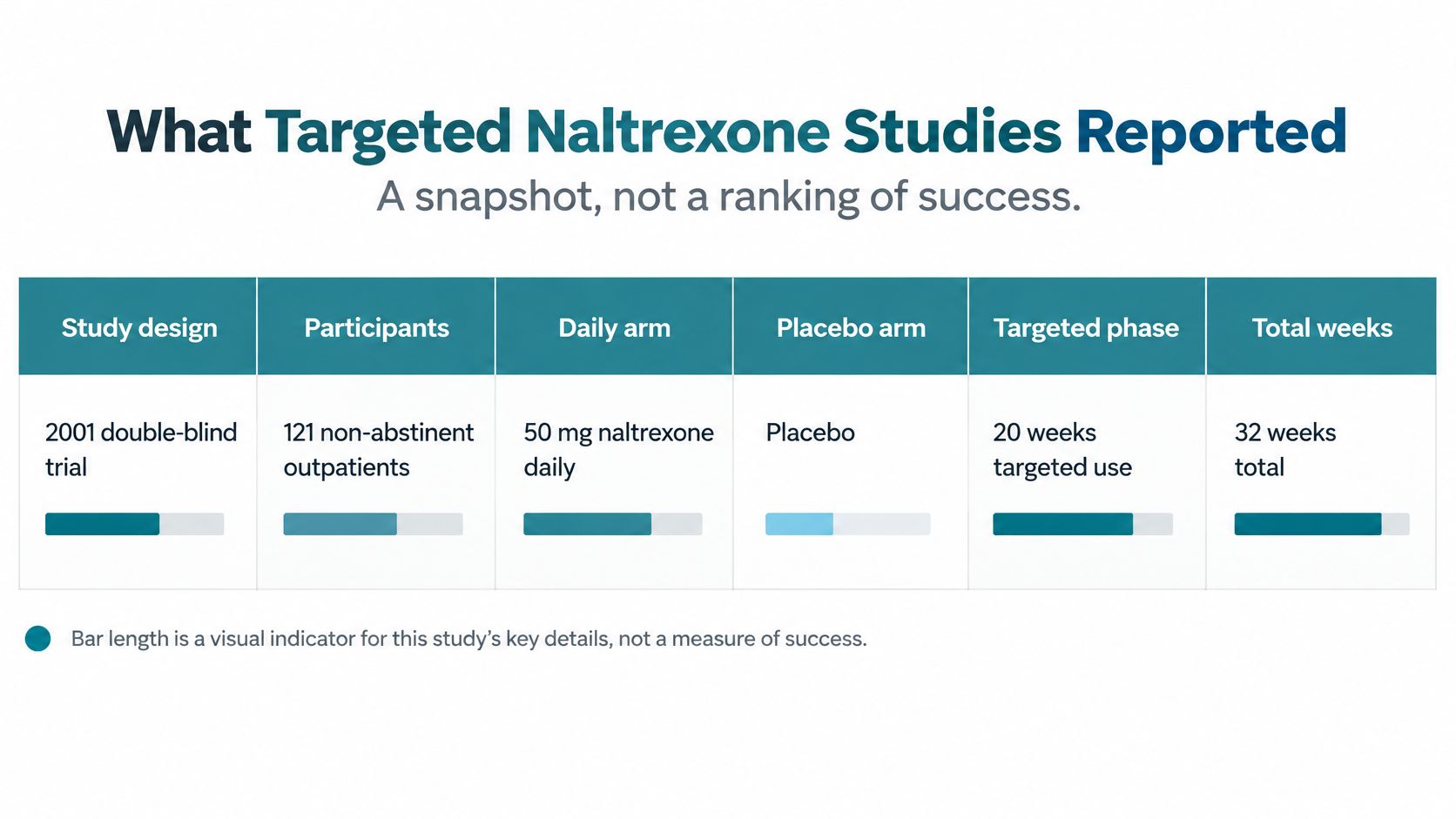
In Heinälä and colleagues' 2001 double-blind randomized trial, 121 non-abstinent outpatients received 50 mg daily or placebo for 12 weeks, followed by 20 weeks of targeted use when craving occurred. Across 32 weeks, 27% of participants assigned to naltrexone with coping-skills therapy had no relapse to heavy drinking, compared with 3% assigned to placebo with that therapy.
The same advantage did not appear with supportive therapy. In other words, the outcome depended in part on the behavioral treatment paired with the medication. That context matters when interpreting the result.
The trial combined daily and targeted phases, so it was not a test of targeted-only treatment from start to finish.
Other Trials Asked Different Questions
A factorial randomized trial available through the National Library of Medicine reported approximately 19% less alcohol consumed on drinking days in the targeted-naltrexone group than in the other treatment groups combined at study end, in an exploratory analysis. Participants were problem drinkers seeking to reduce drinking, not necessarily to stop completely.
The study's targeted protocol used a 50-mg tablet before a high-risk situation, with no more than one tablet per 24 hours. Participants were encouraged to take at least three tablets weekly, and received up to five weekly. These details describe the study design, not a self-treatment schedule.
A separate trial enrolled 120 sexual- and gender-minority men with mild-to-moderate alcohol use disorder who binge drank. The study summary describes 50 mg targeted naltrexone or placebo with weekly counseling for 12 weeks, with some drinking effects persisting at six months.
A young-adult study reported a lower likelihood of intoxication versus placebo, a specific outcome rather than proof of recovery. Across these studies, the participant group, accompanying support, adherence, and definition of improvement shape what the results can reasonably mean.
Safety Checks Before Naltrexone Is Considered
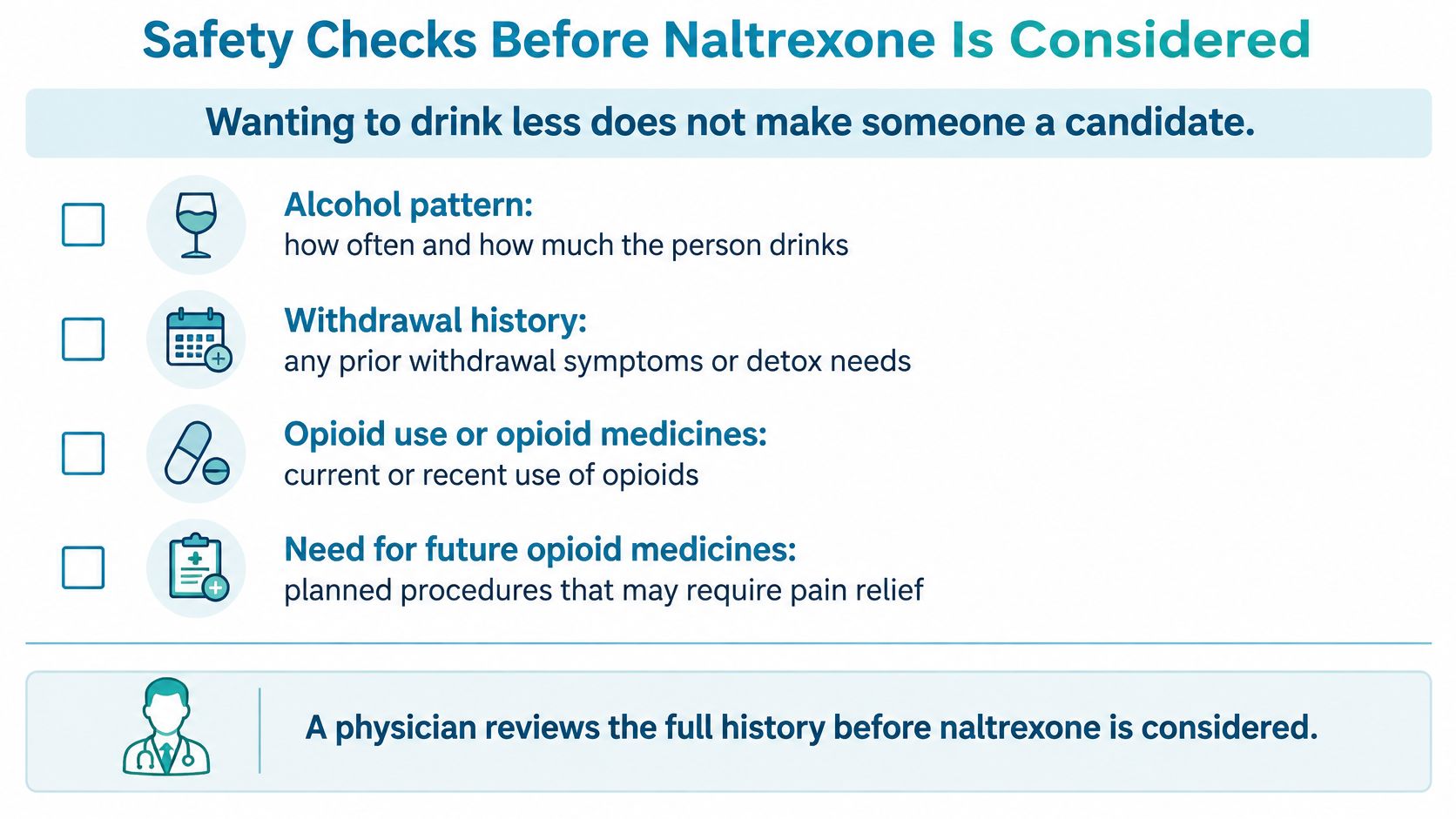
Wanting to drink less doesn't by itself make someone a candidate. A physician needs enough information to judge both medication safety and the appropriate level of alcohol-related care.
The FDA labeling on naltrexone and opioid blockade makes opioid exposure central to treatment planning. It also distinguishes extended-release injectable treatment for alcohol dependence, which is indicated for patients able to abstain in an outpatient setting before treatment begins.
A Discussion Checklist, Not a Qualification Score
- Alcohol pattern and withdrawal history. The clinician reviews drinking frequency, amounts, prior withdrawal symptoms, and previous need for medically supervised withdrawal care.
- Current or recent opioid exposure. Prescription pain medicines, nonprescribed opioids, and opioid-based treatment all need disclosure.
- Future pain treatment. Planned surgery, anesthesia, or other anticipated opioid pain care can change the medication decision.
- Other medications and health conditions. Prescription drugs, over-the-counter products, supplements, liver history, and pregnancy or pregnancy plans belong in the assessment.
- Treatment goals and practical fit. The clinician considers the desired outcome and whether the proposed plan can be followed and monitored reliably.
Naltrexone blocks opioid effects and can complicate pain treatment. Starting it while a person remains physically dependent on opioids can precipitate withdrawal, meaning a sudden medication-triggered withdrawal reaction.
Abruptly stopping opioids to attempt a home switch isn't a safe workaround. Empire's explanation of precipitated withdrawal provides additional context for that risk.
Routine Assessment Versus Urgent Care
Liver-safety assessment, including whether laboratory testing is appropriate, is a clinician decision. A checklist can help organize a history, but it can't clear someone for treatment.
Naltrexone also doesn't replace assessment for alcohol withdrawal. Shaking or severe vomiting after reducing alcohol warrants urgent medical assessment. Confusion, hallucinations, or seizures require emergency care rather than waiting for an appointment.
For a suicidal crisis, 988 provides crisis support in the United States; 911 is appropriate for immediate danger or a medical emergency. These situations take priority over any discussion of targeted medication treatment.
Claims That Go Beyond the Evidence
Consumer descriptions sometimes treat the Sinclair Method and naltrexone treatment as interchangeable. They aren't. Evidence supporting a medicine across several treatment settings can't automatically establish the effectiveness of one particular schedule.
A clinical review in the Australian Journal of General Practice describes targeted dosing as an option for selected patients, while emphasizing follow-up, adherence, side effects, and liver-related considerations. It reports a controlled study of 140 young adults in which targeted naltrexone reduced the likelihood of intoxication by nearly 23% versus placebo, and describes follow-up one week after initiation as reasonable.
Those details support a monitored clinical option, not a universal prescription.
Four Common Overstatements
- It retrains every brain. Pharmacological extinction is the proposed mechanism. It doesn't establish that every patient will experience the same change in craving or behavior.
- The advertised success percentage applies to everyone. A finding among treatment completers doesn't describe every person who begins care or predict an individual outcome.
- It produces moderation or abstinence for all. Reduced intoxication, fewer heavy-drinking days, moderation, and abstinence are different endpoints. Improvement in one doesn't prove all the others.
- Medication alone is enough. Treatment needs can include behavioral skills, recovery planning, outside support, and care for medical or safety concerns.
The Missing Question Is Often the Outcome
A useful medication discussion begins with a specific goal. A person seeking fewer heavy-drinking days needs a way to measure that goal; a person pursuing abstinence needs a plan evaluated against abstinence.
A treatment plan needs a review point and a response to insufficient progress, not just an explanation of why the medicine might work.
Possible benefits include reduced heavy drinking or less alcohol-related reward for some people. The trade-offs include opioid blockade, precipitated opioid withdrawal when opioids are involved, side effects, liver-related concerns, and false reassurance if drinking outcomes aren't tracked.
A return to a harmful pattern should prompt reassessment rather than blame. Empire's discussion of relapse and treatment reassessment offers related recovery context. No fixed timeline can determine whether a person has succeeded or failed.
How Outpatient Monitoring Is Organized
Outpatient monitoring is measurement and reassessment, not a script for combining alcohol and medication. A medical evaluation first identifies a primary outcome, such as fewer heavy-drinking days, a lower-risk pattern, or abstinence.
The clinician then establishes what information will guide follow-up. A vague impression that drinking feels different isn't enough to determine whether the plan is meeting its goal.
What Follow-Up Can Track
- Drinking outcomes. Drinking days, heavy-drinking days, amounts consumed, and movement toward the agreed goal.
- Craving and adherence. Changes in urges and whether the prescribed plan is being followed as intended.
- Adverse effects and medical changes. Symptoms, new medications, opioid exposure, and liver-related assessment when indicated.
- Mood and safety. Emotional distress, suicidal thinking, withdrawal concerns, and whether outpatient care remains appropriate.
Follow-up timing should reflect the patient's response and safety needs. The early review described in clinical literature isn't an Empire appointment schedule, a universal requirement, or a requirement to drink.
Behavioral support may also be relevant. A medical clinician can consider coordination with an outside counselor or treatment program without implying that the medical practice provides psychotherapy.
When the Plan Needs More Than a Routine Visit
Possible severe withdrawal, overdose, chest pain, confusion, or seizure requires urgent or emergency assessment. A routine follow-up slot isn't an appropriate substitute for emergency services.
Monitoring principle: Lack of progress should trigger a treatment discussion, not indefinite continuation without a defined goal.
Empire's overview of outpatient alcohol treatment describes the broader care setting. Describing a targeted approach doesn't establish that Empire, or every outpatient practice, offers that schedule.
This educational discussion doesn't provide an individual dose, a medication-change or taper plan, instructions to combine alcohol and medication, or a month-by-month recovery calendar.
Questions to Bring to an Evaluation
A focused discussion starts with the outcome you want. Written questions can help clarify whether a medication is appropriate and how progress would be judged.
- Goal. Which outcome are you pursuing, and what would count as meaningful progress?
- Medical fit. Could opioid use, pain-treatment needs, liver history, pregnancy considerations, or withdrawal history affect whether naltrexone is appropriate?
- Schedule. Is the proposed regimen labeled daily treatment or targeted off-label use, and why is that schedule being considered?
- Side effects. Which symptoms call for contacting the prescriber, urgent assessment, or a prescriber-directed interruption?
- Measurement. How will heavy-drinking days and other outcomes be counted?
- Reassessment. If the agreed goal isn't reached by the review point, what will the next discussion cover?
- Behavioral support. Would counseling or coping-skills support be useful, and who would provide it?
- Urgent care. Which symptoms should prompt care before the next appointment?
The first addiction medicine appointment can include discussion of relevant medical history and treatment goals.
Is This the Same as Taking Naltrexone Every Day?
No. Daily treatment and targeted treatment use different schedules. Ask why a particular schedule is being considered and what evidence supports it. Targeted use is one narrower approach, not a synonym for naltrexone treatment as a whole.
Can a Published Percentage Predict Personal Success?
No. A published percentage cannot account for an individual's medical history, treatment goal, adherence, or other care. It describes a study result, not a personal forecast.
Does This Mean Empire Provides the Sinclair Method?
No. Educational information about the method does not mean the practice offers that specific schedule. Empire provides outpatient medical assessment, monitoring, and recovery planning; this does not include detoxification, inpatient care, or intensive outpatient treatment.
Evaluation Access and Fees
Empire Medical Wellness is a private-pay, physician-led outpatient practice. Adults physically located in New York, New Jersey, Connecticut, Pennsylvania, or Virginia may request a confidential evaluation with Dr. Chhatpar. The addiction medicine service page describes the service, and the addiction medicine specialist page provides clinician information.
A 50-minute initial evaluation costs $350, and a 25-minute follow-up costs $225. The practice does not bill insurance directly. An itemized receipt is available through the patient portal, but reimbursement is not guaranteed. See the fees and appointment process for details.
For severe withdrawal or immediate danger, seek emergency care. Call 911 for a medical emergency; 988 provides suicidal-crisis support. For a nonurgent evaluation request, call or text the practice at 929-930-3636, or use the appointment request page.
Sources
The linked references include FDA oral and injectable naltrexone labeling, Sinclair's review in Alcohol and Alcoholism, Heinälä and colleagues' randomized trial, a targeted-treatment factorial trial, and a clinical review in the Australian Journal of General Practice. Harvard Health provides additional patient education.
This article is educational and isn't personal medical advice.
Empire Medical Wellness offers confidential outpatient addiction medicine assessment, monitoring, and recovery planning. Adults researching the Sinclair Method can learn about an evaluation focused on medical safety, treatment goals, and appropriate next steps, without assuming that a particular medication schedule will be offered.