
No, the evidence does not show that SNRIs are more effective than SSRIs for every person. In adults with major depressive disorder, one head-to-head analysis found remission in about 48.5% of people taking SNRIs versus 41.9% taking SSRIs, and the authors judged that gap not clinically significant.
Popular advice treats the extra norepinephrine effect as proof that an SNRI is the stronger antidepressant. That story is tidy, and it does not hold for most decisions. A class average cannot tell a prescriber which medicine fits one person's diagnosis, earlier response, blood pressure, pain, drug interactions, or ability to stay on treatment.
SSRIs are selective serotonin reuptake inhibitors. SNRIs are serotonin-norepinephrine reuptake inhibitors. Both are widely used for depression and several anxiety disorders. The useful question is which specific medicine matches the problem, not which class wins on a chart.
Empire Medical Wellness Editorial Team. Published 8 October 2026. Updated 8 October 2026.
Table of Contents
- What the Trials Show About Effectiveness
- SSRIs and SNRIs Compared Side by Side
- How the Evidence Differs for Depression, Anxiety and Pain
- Tolerability, Blood Pressure and Drug Interactions Compared
- When an SSRI Has Not Worked and What Comes Next
- Which Class May Fit Different Situations
- Questions to Bring to a Medication Review
- Confirm the Medication Choice With Your Clinician
What the Trials Show About Effectiveness
No. The trials do not show that SNRIs are more effective than SSRIs for every person, and no class wins across every condition.
In adults with major depressive disorder, a head-to-head meta-analysis of randomized clinical trials found pooled remission of approximately 48.5% with SNRIs versus 41.9% with SSRIs, an absolute difference of 5.7 percentage points, with a pooled odds ratio for remission or response of 1.27 (95% CI, 1.06 to 1.52), as reported in the 2010 analysis in the Journal of Clinical Pharmacy and Therapeutics. Remission means a near-complete loss of depressive symptoms on a standard rating scale. The same analysis notes that a Department of Veterans Affairs and Department of Defense guideline recommends choosing among several antidepressants, without evidence that one agent is consistently superior across patients.
The authors called the difference statistically significant but not clinically significant. The average edge was too small to rank one class above the other for each patient. A P value of 0.007 means the gap was unlikely to be chance in those trials. It does not mean a person will feel a meaningful difference.
Why a group average does not settle the choice
- Medicines inside a class are not interchangeable. Venlafaxine is not duloxetine, and sertraline is not fluoxetine.
- Dose and illness severity change results. Trial pools mix many doses and many levels of illness.
- Earlier response and side effects carry more weight. What someone tolerated last time is more informative than a class name.
- A pooled result is not a personal forecast. Several trials cannot predict what one person will experience.
Selection still has to weigh prior response, adverse effects, pain symptoms, drug interactions, blood-pressure risk, withdrawal considerations, and preference. SNRIs are a credible option alongside SSRIs. The class name alone does not make the decision.
Practical rule: Treat a small average remission gap as background, then ask which medicine fits this history.
SSRIs and SNRIs Compared Side by Side
SSRIs primarily reduce reuptake of serotonin, which increases serotonin signaling between nerve cells. SNRIs reduce reuptake of serotonin and norepinephrine, a messenger involved in attention, arousal, and stress responses. How strong that second effect is varies by medicine and by dose. A broader mechanism is not the same thing as a stronger result for every person.
The National Institute of Mental Health identifies both classes as commonly prescribed antidepressants used for a broad group of depressive and anxiety disorders. Medication response still varies, so the comparison belongs at the level of a named drug and a clinical evaluation.
SSRIs and SNRIs compared at a glance (examples checked against commonly listed FDA indications, 8 October 2026; confirm the current label before any decision)
| Feature | SSRIs | SNRIs |
|---|---|---|
| Main neurotransmitter target | Serotonin reuptake | Serotonin and norepinephrine reuptake |
| Example medicines | Sertraline, escitalopram, fluoxetine, paroxetine | Venlafaxine, desvenlafaxine, duloxetine, levomilnacipran |
| FDA-labeled depression use | Yes, for major depressive disorder (listed medicines) | Yes, for major depressive disorder (listed medicines) |
| Examples of other FDA-labeled uses | Sertraline and paroxetine: obsessive-compulsive disorder, panic disorder, PTSD | Duloxetine: generalized anxiety disorder, chronic musculoskeletal pain; venlafaxine: generalized anxiety disorder |
| Typical position in guidelines | Often listed first, largely for safety and tolerability | Listed as reasonable options alongside SSRIs, not as a ranked winner |
How to read each row
Mechanism tells you which signals the medicine slows from being taken back into the nerve cell. It does not rank effectiveness.
Example medicines are common names, not complete lists. A class label does not identify the drug. The specific medicine and its history do.
Depression labeling is shared. Listed SSRIs and listed SNRIs both carry FDA labeling for major depressive disorder. That shared use is why "are SNRIs more effective than SSRIs?" cannot be answered from the label alone.
Other labeled uses differ. Some SSRIs are labeled for obsessive-compulsive disorder, panic disorder, or PTSD. Duloxetine is labeled for generalized anxiety disorder and chronic musculoskeletal pain, and venlafaxine is labeled for generalized anxiety disorder. Prescribers sometimes use a medicine off-label, meaning for a use that is not in that product's FDA labeling. Readers should check current prescribing information for the exact product, because labels change.
Guideline position is not a ranking of strength. SSRIs are often used first because of safety and tolerability, not because they always work better. SNRIs sit beside them as reasonable options.
A class name is a filing label. The prescription is a specific drug, at a specific dose, for a specific problem.
How the Evidence Differs for Depression, Anxiety and Pain
Effectiveness is not one score. It changes with the diagnosis, the age group, the symptom being treated, and the outcome being counted.
Evidence by condition
| Condition | What the evidence shows | What to keep in mind |
|---|---|---|
| Major depressive disorder | Small average remission advantage for SNRIs in one head-to-head meta-analysis | Authors judged the average difference not clinically significant |
| Anxiety and stress-related disorders | Similar efficacy across 80 studies in a network meta-analysis | Side-effect profiles differ by medicine |
| Depression with chronic pain | SNRIs with labeled pain uses, such as duloxetine; limited head-to-head data for depression plus pain | Evidence is limited; confirm labeling and the main symptom to treat |
| Adults 60 and older | Similar response and remission rates; SSRIs showed greater average symptom improvement | Findings apply to this age group and may not apply to younger adults |
Four settings, four different answers
Major depressive disorder is where the modest remission gap lives. It is real inside that analysis and too small to crown a class. For an individual, prior response and tolerability still outrank the average.
Anxiety, obsessive-compulsive, and stress-related disorders look different. A network meta-analysis of 80 studies involving 21,338 participants found similar efficacy for SSRIs and SNRIs across those disorders, while adverse-event patterns differed among individual medicines, according to the 2023 comparative review indexed on PubMed. Similar efficacy is not identical day-to-day feel. Nausea, activation, and sexual effects can still separate one drug from another. People comparing options for worry or panic can also read how anxiety medication decisions are framed, without treating that page as a class ranking.
Depression with chronic pain is the setting where an SNRI label sometimes enters the conversation, because duloxetine has pain indications. Head-to-head evidence for depression that coexists with pain is limited. The first step is to name the main symptom to treat, then confirm the current label, not to assume two neurotransmitters means two problems solved.
Adults 60 and older need their own numbers. A 2025 meta-analysis of 19 randomized trials involving 2,336 participants found that antidepressants produced response or remission in about 40% of participants versus 24% with placebo or waitlist controls. SSRIs produced greater average symptom improvement than SNRIs, but response and remission rates were similar. Those findings belong to this age group. They should not be copied onto younger adults.
A modest difference on a symptom scale still does not describe how a medicine will feel on a workday. The next question is tolerability.
Tolerability, Blood Pressure and Drug Interactions Compared
A medicine that is hard to keep taking is a weak long-term option, even if a trial average looks slightly better. Newer antidepressants, including SSRIs and SNRIs, are commonly used partly because they are tied to fewer side effects than older antidepressants, though effects still differ by drug and by person. The VA/DoD patient resource on depression treatment states that no evidence supports one listed initial pharmacotherapy over another for uncomplicated major depressive disorder.
Tolerability and safety factors to review
| Factor | Class most associated | What to raise with a clinician |
|---|---|---|
| Blood pressure or heart rate | SNRIs, dose-related | Any high blood pressure or heart history, before starting or changing |
| Nausea and gastrointestinal effects | Both classes | Timing and severity, especially early in treatment |
| Sexual side effects | Both classes | Persistent changes; discuss options individually |
| Sleep changes or agitation | Both; SNRIs may add insomnia or restlessness | Sleep pattern and any new anxiety |
| Discontinuation symptoms | Both, if stopped abruptly | Plan any change with the prescriber |
| Serotonin-related interactions | Both | Triptans, tramadol, St. John's wort, and other serotonergic medicines |
| Bleeding risk | Both | NSAIDs, anticoagulants, and antiplatelet medicines |
What most often changes the decision
Blood pressure and heart rate come first when an SNRI is on the table. Increases can be dose-related. Anyone with high blood pressure or heart disease should raise that history before a start or a change. A separate look at blood pressure monitoring is useful context, not a reason to pick a class from a webpage.
Nausea and other stomach effects are common with both classes and often loudest early. Timing, food, and whether the effect is fading are practical details for a visit.
Sexual side effects are reported with both SSRIs and SNRIs. Persistent change is a reason to talk, not a reason to stop a medicine alone. No single next step is settled for every person.
Sleep and restlessness can show up in either class. Noradrenergic activity may add insomnia, anxiety, or agitation for some people on an SNRI.
Stopping suddenly can cause discontinuation symptoms with either class. Any change belongs with the prescriber.
Interactions cut across both classes. Monoamine oxidase inhibitors are a combination to avoid. Triptans, tramadol, St. John's wort, and other serotonergic products need a full review. NSAIDs, anticoagulants, and antiplatelet drugs raise a bleeding concern.
These are general patterns, not a personal risk score. A clinician weighs benefits, harms, earlier treatment, and preference rather than assuming an SNRI is the stronger result.
When an SSRI Has Not Worked and What Comes Next
Switching to an SNRI is one possible next step. It is not an automatic upgrade.
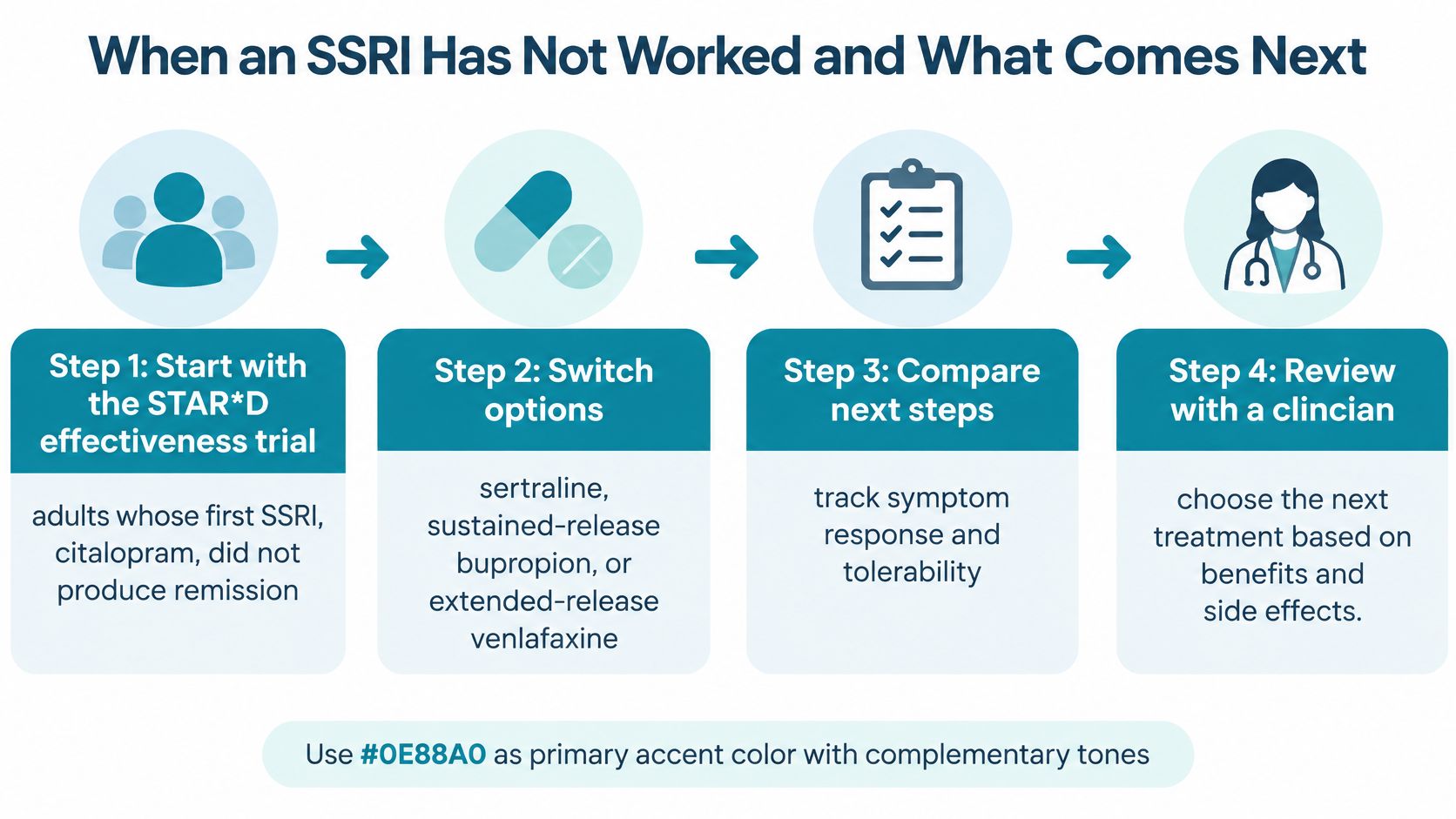
In the STAR*D effectiveness trial, adults whose first SSRI, citalopram, did not produce remission were assigned to switch to sertraline, sustained-release bupropion, or extended-release venlafaxine, with remission of approximately 27%, 26%, and 25% and no statistically significant difference among those strategies. About one-third remitted in the first step, and approximately 67% of participants who remained in treatment across as many as four steps eventually achieved remission. A 2018 network meta-analysis of 21 antidepressants compared individual drugs rather than classes, as summarized with those trial findings in the PubMed record for that comparative analysis. STAR*D was an open-label, pragmatic effectiveness study, closer to routine care than to a tightly controlled lab trial.
Plain reading: a switch can help some people, and venlafaxine did not show a clear remission advantage over another SSRI at that step. People who stay in a sequence of careful trials do better as a group than people judged after a single medicine. That is not a promise for any one person, and it is not a schedule to copy.
Questions a clinician may weigh
- Is the target still clear? Depression, an anxiety disorder, pain, or a mix can point to different labels and different safety checks. Background on depression medication can help name the question. It does not replace the visit.
- Has the current trial been fairly tested? Adherence, side effects, other medicines, and time on the dose all belong in the review.
- Would a change inside the SSRI class, or a move to an SNRI, fit this history? Neither path is the default.
- Is adding a different medicine a reasonable question? That depends on the original diagnosis, suicide-risk assessment when it is relevant, and what the person most wants to protect, such as sleep, sexual function, or blood pressure.
Readers should not stop, switch, or adjust an antidepressant on their own. Changes should be gradual and supervised.
Which Class May Fit Different Situations
Real visits stack several factors. These hypothetical sketches isolate one factor each. None of them names a real patient, and none guarantees a class or an outcome.

Hypothetical 1, depression with ongoing musculoskeletal pain. A clinician may look at SNRIs that carry pain labeling, because the pain symptom is part of the target. The mood trial gap is still small, and the pain label has to match the actual pain problem. The reasoning is symptom match, not a claim that every SNRI treats every ache.
Hypothetical 2, an SSRI already causing sexual side effects. Both classes can cause those effects, so a switch to an SNRI is not a guaranteed escape. The useful discussion is timing, severity, and whether another medicine or another plan fits. A page on whether desvenlafaxine helps anxiety is a reminder that one SNRI still needs its own review.
Hypothetical 3, depression with high blood pressure that is not well controlled. Dose-related blood-pressure effects make many SNRIs a heavier factor to weigh. An SSRI may be easier to consider first, but only after the prescriber sees the blood-pressure record and the rest of the medicine list.
Hypothetical 4, an older adult with depression. In adults 60 and older, response and remission rates were similar across classes, while average symptom improvement favored SSRIs in one 2025 meta-analysis. That tilt is age-specific. Heart history, falls, and other medicines often matter as much as the score.
Hypothetical 5, an anxiety disorder without pain. Efficacy is broadly similar, so tolerability, earlier response, and preference usually decide. Activation, sleep, and sexual effects are the practical separators.
No sketch is a verdict. A real decision holds diagnosis, history, medical risk, and preference at the same time.
Questions to Bring to a Medication Review
A useful visit starts with a list, not a request for a class. At Empire Medical Wellness, mental health care begins with a thorough review of symptoms, medical history, current functioning, previous treatment, and current and past medications. Sleep, substance use, and lifestyle are considered when they affect diagnosis or treatment response. The physician reviews medical history, other medicines, pregnancy plans, and potential side effects before prescribing.
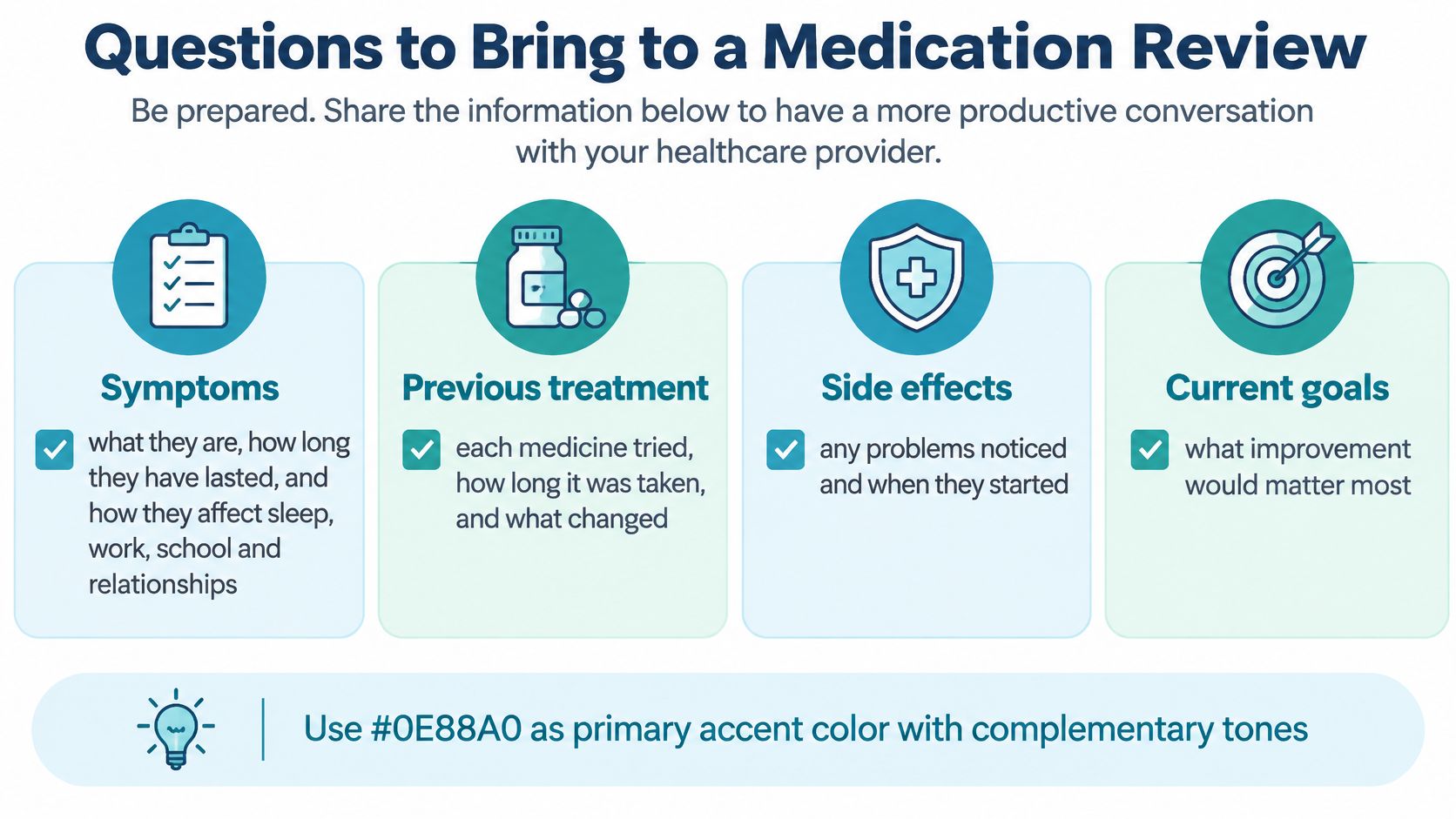
For a first visit, bring an updated medication list, including supplements and any side effects already noticed. A mental health medication review is the place to sort that list. It is not a promise of a particular drug.
Checklist to copy
- Symptoms: Write what they are, how long they have lasted, and how they affect sleep, work, school, and relationships.
- Previous treatment: List each medicine, the dose range used, why it stopped, and what helped or caused trouble.
- Priorities: Name the outcome that matters most, such as symptom relief, daily functioning, sleep, pain, sexual side effects, or staying on treatment.
- Medical factors: Include blood pressure, heart rhythm, bleeding history, pregnancy plans, and other conditions.
- Medicines and substances: List prescriptions, over-the-counter pain relievers, supplements, and alcohol or other substance use. State them plainly. There is no need to editorialize.
- Follow-up: Ask how improvement will be measured, which side effects to report between visits, and when routine follow-up should happen.
- The pivot question: Ask which facts would change the recommendation.
That last question keeps the visit from turning into a debate about class nicknames.
Confirm the Medication Choice With Your Clinician
No class is universally more effective. SNRIs are a credible alternative to SSRIs, and SSRIs remain commonly used first partly because of their tolerability record.
The right choice comes from an individual evaluation of diagnosis, prior response, coexisting pain or other symptoms, medical conditions, interactions, tolerability, and preference. Medication review visits discuss whether current treatment is helping, any side effects, and concerns about the medication plan. A visit does not guarantee a particular medication, and recommendations are individualized. Routine follow-up for adults can be arranged through mental health medication management or by using the scheduling page when the question is not urgent.
When to get urgent help instead
Thoughts of self-harm or suicide need immediate help. In the United States, call or text 988, or call 911 if there is immediate danger. Severe reactions such as fainting, chest pain, seizures, confusion, or high fever need emergency care. Do not wait for a routine appointment for those problems.
Sources
Comparative remission figures come from a 2010 head-to-head meta-analysis in the Journal of Clinical Pharmacy and Therapeutics. Mechanism descriptions draw on the National Institute of Mental Health. Anxiety and older-adult findings come from published meta-analyses. Uncomplicated depression guidance draws on VA/DoD patient materials. Sequential-treatment figures come from the STAR*D trial, read alongside a 2018 network meta-analysis of 21 antidepressants. Labels change, so confirm current FDA prescribing information for any named medicine.
This article is educational and is not personal medical advice.
Empire Medical Wellness provides private-pay, physician-led outpatient care for adults, including evaluation and medication management when depression or anxiety treatment needs a careful look at SSRIs, SNRIs, and other evidence-based options. A visit reviews history, other medicines, and side effects, and it does not guarantee a particular prescription. When a routine medication question is the reason for care, visit Empire Medical Wellness to see how appointments work.