
Does a video visit mean a prescription is waiting at the end of the call? It doesn't. What to expect from online addiction treatment is a confidential outpatient medical process: a structured assessment first, a plan only if it fits, and clear limits when risk is too high for remote care.
Online care can reduce travel and some of the stigma of sitting in a waiting room. It doesn't erase pharmacy rules, household privacy, a dropped connection, or the need for emergency care. An appointment isn't a promise of medication, and a booked visit isn't the right response to overdose, suicidal thoughts, or severe withdrawal.
Table of Contents
- What Happens at Your First Online Evaluation
- How to Prepare for a Telehealth Visit
- Treatment Pathways and Monitoring Over Time
- Coordinating With Outside Clinicians and Pharmacies
- Privacy and Connectivity at Home
- When Online Care Is Not the Right Level of Care
- Frequently Asked Questions About Online Treatment
- Check Eligibility and Fees Before You Book
- Confirm Fees and Access Before You Book
What Happens at Your First Online Evaluation
The first online visit is a confidential outpatient assessment, not a guaranteed prescription. The purpose is to understand the situation, medical risks, prior treatment, medications, and goals before any treatment decision.
At Empire Medical Wellness, addiction medicine care begins with that confidential assessment. Evaluations are outpatient. At the initial evaluation, the patient receives an explanation of appropriate options and next steps, including whether online care fits or a higher level of care should be considered.
A medication-only video visit skips the checks that keep outpatient care safe. SAMHSA guidance on opioid treatment program assessment indicates that telehealth screening can support diagnosis and treatment-entry decisions when the clinician can determine clinical need and suitability. For opioid treatment programs, that assessment is meant to identify contraindications before buprenorphine or methadone is started. The same logic applies more broadly: history, interactions, and risk come before a prescribing decision.
What a structured assessment covers
| Assessment area | What the clinician reviews | Why it matters |
|---|---|---|
| Presenting concern | Main reason for the visit and the patient's goals | Sets the scope of care |
| Substance-use history | Type, pattern, and timing of use, as relevant to the patient | Shapes risk assessment and treatment options |
| Prior treatment | Earlier programs, medications, and outcomes | Avoids repeating what didn't work and informs the plan |
| Medical and medication history | Conditions, current medications, and past medication reactions | Checks for interactions and contraindications |
| Mental-health symptoms | Mood, anxiety, sleep, and daily functioning | Identifies co-occurring conditions that may need coordination |
| Overdose and withdrawal risk | Recent overdose, withdrawal history, and supports at home | Determines whether outpatient care is appropriate |
| Identity and location | Verification of identity and the patient's physical location during the visit | Required for telehealth and for planning emergency response |
A responsible program also documents treatment goals, measurable follow-up indicators, medication response and adverse effects, and a contingency plan if risk rises. Telehealth doesn't replace emergency, detoxification, or inpatient capability. Clinicians need referral pathways when withdrawal risk, overdose risk, suicidality, severe intoxication, or unstable medical illness exceeds outpatient capacity.
Patients should expect confidentiality procedures, identity and location verification, reliable technology, medication reconciliation, and authorized coordination with outside clinicians when that's clinically useful. Preparing for a first addiction medicine appointment is easier when those topics are already on the list.
Practical rule: Leave the visit with the options explained, the reasons for each, and a next step. If outpatient online care isn't a fit, that conclusion is part of a complete evaluation, not a failed one.
How to Prepare for a Telehealth Visit
Preparation is paperwork plus a safety setup. Before the appointment, patients complete the patient forms and provide medication, pharmacy, and treatment information through the secure portal. Don't change or stop any medication before the visit unless the prescribing clinician has already said to do so.
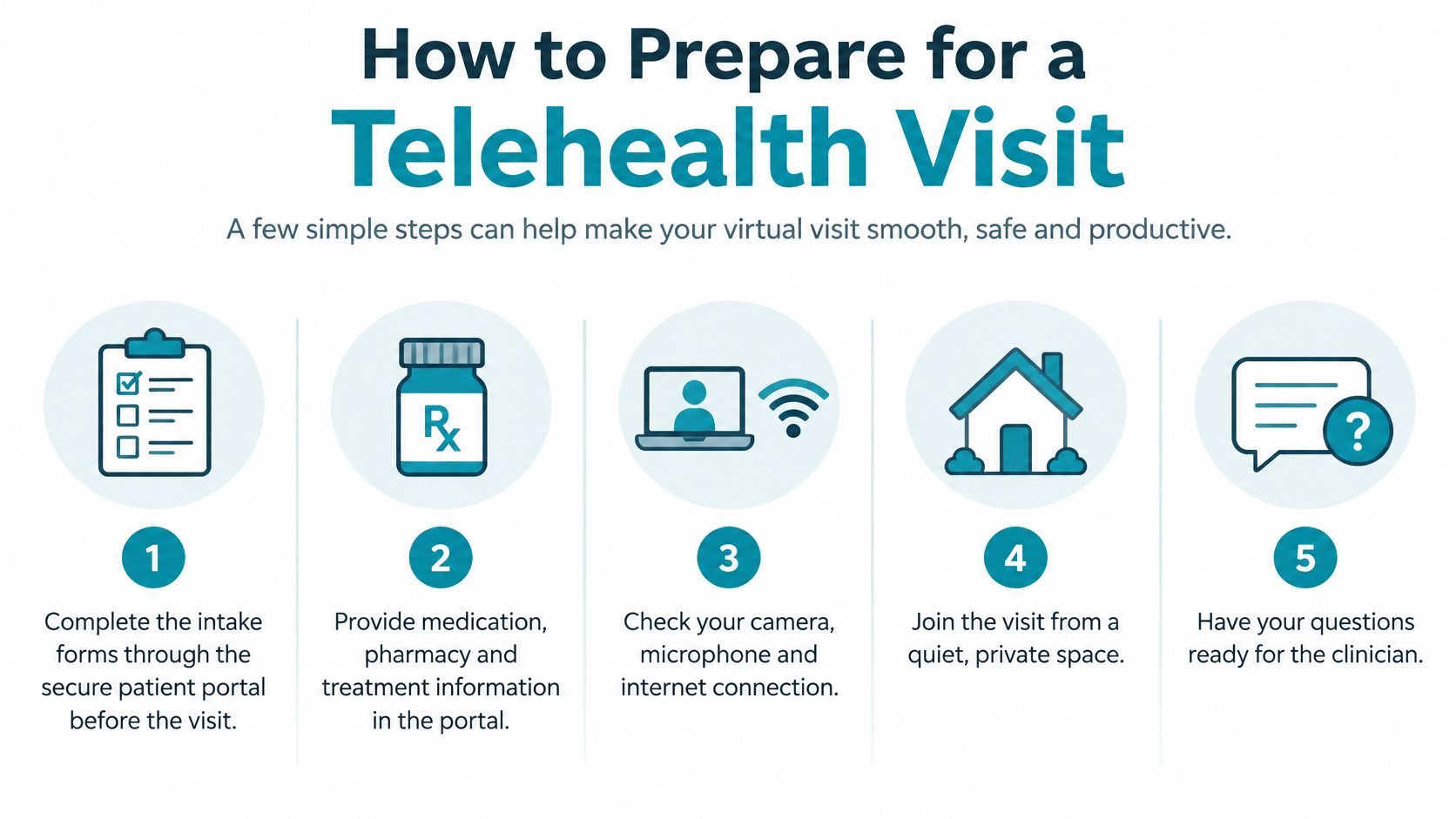
- Complete the intake forms through the secure patient portal before the visit. Early forms give the clinician time to read history instead of spending the whole visit collecting it.
- Enter medication, pharmacy, and treatment information in the portal. Use the medication name exactly as it appears on the label, including strength if it's printed there. Guessing a name leads to the wrong interaction check.
- Gather dates and details of prior treatment. Note programs, clinicians, and what was tried. Approximate dates are still useful if old records aren't in hand.
- Test the device, camera, microphone, and internet connection at least a day ahead. A failed login on the morning of the visit eats the time meant for clinical questions.
- Choose a private space where you can speak freely and be seen clearly. Write down a backup phone number in case the video drops.
- Confirm the pharmacy, and identify the nearest emergency department and the crisis numbers. Those details matter if a prescription can't be filled or symptoms worsen after the visit.
- Write the top three questions and the goals for care. A short list keeps the visit focused on what the patient needs decided.
A blank planning aid
Copy these lines into a note before the visit:
- Medications (name on the label, how taken): _______________
- Pharmacy name, address, and hours: _______________
- Backup phone if video drops: _______________
- Nearest emergency department: _______________
- Top three questions: _______________
- Goals for this visit: _______________
A quiet room and a tested camera do more for the visit than a perfect medical history. Missing details can be filled in. A conversation someone else is listening to cannot be undone.
Treatment Pathways and Monitoring Over Time
The evaluation leads to one or more pathways. It doesn't assign a prescription in advance. Evidence-based medication can be part of addiction medicine care when it's clinically appropriate, with monitoring and follow-up. Recovery planning and coordination with therapists, recovery professionals, and treatment programs can be included when that's clinically useful and the patient authorizes it. Medication decisions come after history, current condition, safety, and goals are reviewed. An appointment doesn't guarantee a prescription.
Drug-specific claims depend on current FDA labeling and MedlinePlus. Whether a medicine is FDA-approved for a particular substance-use disorder, or would be an off-label use, has to be checked against that labeling at the time of care. This article doesn't recommend a drug, a dose, or a start or stop date.
Three outpatient pathways, plus a limit
| Pathway | What it involves | Evidence status |
|---|---|---|
| Medication-based treatment when appropriate | Evaluation, a prescribing decision, and monitoring of response and side effects | Online delivery supported as comparable for some outcomes; drug-specific claims depend on current FDA labeling |
| Outside counseling or therapy | Referral to a licensed therapist or program, with authorized coordination | Mixed; many clinicians rate telehealth group counseling as less effective than in person |
| Recovery planning and support | Relapse-prevention goals, supports, and a plan for missed visits or setbacks | Limited direct trial data for this format; use it with clinical monitoring, not as a standalone treatment |
| Higher-level care | Referral when needs exceed outpatient care, such as detoxification or residential treatment | Coordinated with outside programs; not delivered as an in-house service |
Medication-assisted treatment is one pathway among these, not a default outcome of booking.
What follow-up actually watches
Monitoring looks at response to the plan, side effects, cravings, use patterns when relevant, sleep, mood, functioning, and safety. Follow-up visits build on earlier decisions, name obstacles, and adjust treatment when needed. Frequency and visit length follow the plan and progress. No fixed schedule is promised.
Where the evidence stops
A review summarized by the American Psychiatric Association identified eight published studies comparing synchronous telehealth addiction treatment with in-person treatment. Most enrolled fewer than 150 patients. Seven found telehealth similarly effective, not more effective, for retention, satisfaction, therapeutic alliance, and substance use. Clinician confidence was mixed: approximately 46% considered individual telehealth counseling equally or more effective than in-person counseling, while 45% considered it less effective. For group counseling, only 25% rated telehealth equally or more effective, compared with 62% who rated it less effective.
In a Medicaid analysis summarized by NIDA, 48% versus 44% in Kentucky and 32% versus 28% in Ohio remained continuously in buprenorphine treatment for at least 90 days when treatment began via telehealth rather than a non-telehealth setting. Those are observational state-level comparisons, not a guarantee for one person. Outcomes still depend on clinical complexity, treatment type, engagement, privacy, technology, and access to in-person care when risk changes.
Coordinating With Outside Clinicians and Pharmacies
Coordination with therapists, primary care clinicians, and treatment programs happens only when the patient authorizes it. Consent comes before information is shared. When detoxification, residential treatment, partial hospitalization, or intensive outpatient care is appropriate, the practice can help coordinate the next step with outside programs. That coordination isn't the same as providing those levels of care.
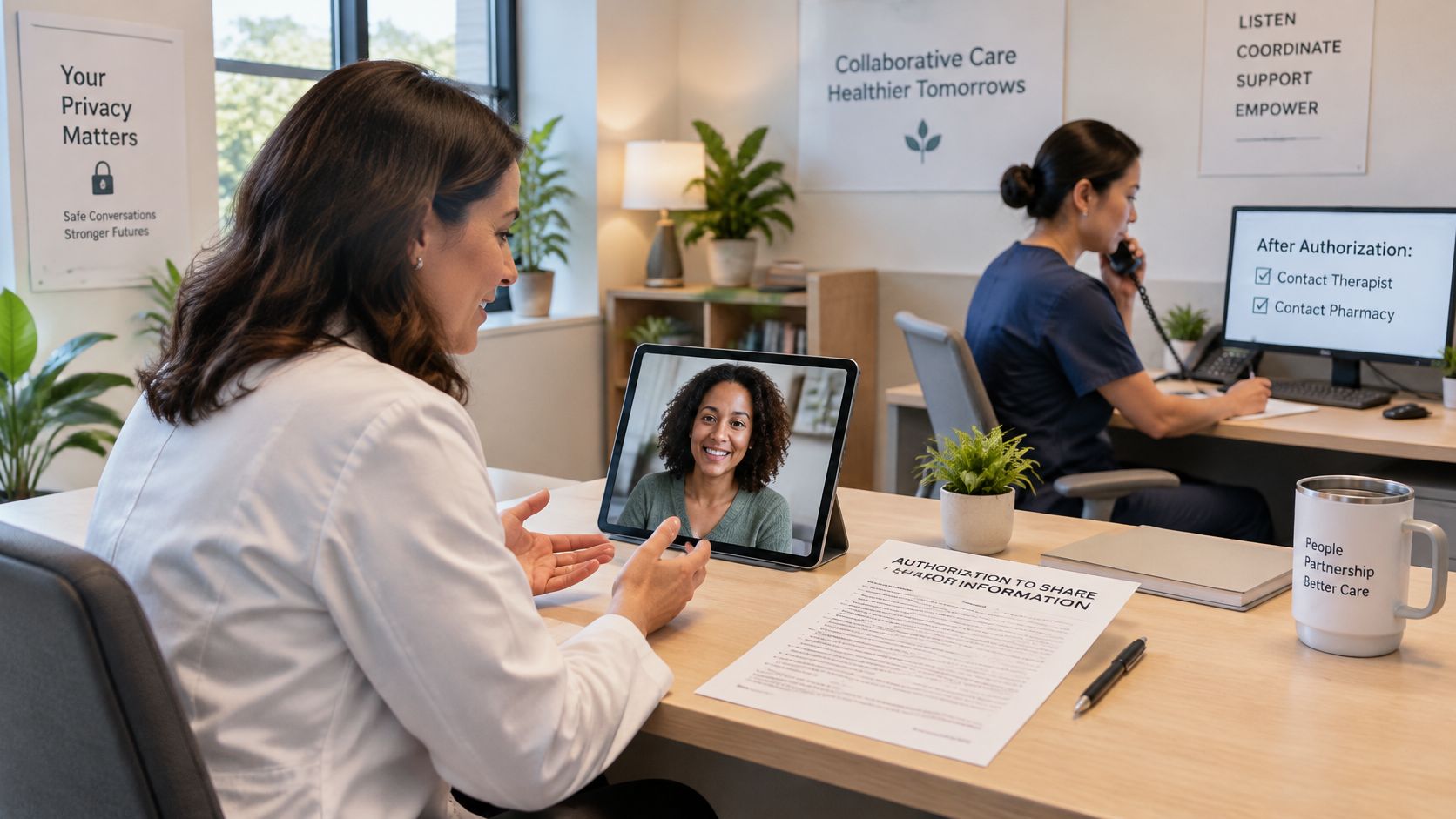
A telemedicine visit can remove travel and some stigma. It doesn't guarantee that a prescribed medication can be filled promptly. A 2025 study of telemedicine addiction treatment, discussed in HHS telehealth research articles, examined pharmacy-level barriers that could make buprenorphine prescriptions inaccessible or lead to missed doses, for both rural and nonrural patients. Local stock, pharmacy policy, and distance still sit between a prescription and a dose.
Five steps that keep a fill from stalling
- Confirm the pharmacy before the visit. Name, hours, and whether it stocks the medication class under discussion.
- Ask how refill requests and pharmacy calls work. Know which channel the practice uses, and which one the pharmacy prefers.
- Decide what happens if the pharmacy needs more information. A missing diagnosis code or a callback can delay a fill by a day.
- Plan for a pharmacy that's out of stock or too far away. Identify a second pharmacy before that day arrives.
- Know who to contact the same day. A portal message sent after hours isn't the same as a same-day clinical contact.
Hypothetical example, not a real patient: Someone whose only pharmacy is an hour away, and closed on weekends, agrees in advance to ask what options exist if a different pharmacy is needed. The agreement is made during the visit, not after a missed dose.
An addiction medicine specialist visit can remove the drive to the clinic and still leave the drive to the pharmacy. Online care shifts that logistical work to the patient unless the steps above are written into the plan.
Privacy and Connectivity at Home
42 CFR Part 2 is the federal rule that protects records identifying a patient and relating to substance-use-disorder diagnosis, prognosis, or treatment when a covered program maintains those records. HHS privacy guidance for telehealth states that Part 2 providers generally may disclose these records for treatment, payment, and health-care operations only with the patient's written consent. A consent may cover future uses until it's revoked. The 2024 final rule also keeps restrictions on using Part 2 records against patients in civil, criminal, administrative, or legislative proceedings unless the patient consents or a court order applies.
Community privacy isn't household privacy
Telehealth can lower exposure to community stigma and still reduce privacy inside the home. Research on virtual recovery services, including work published in INQUIRY, identifies privacy breaches as capable of undermining trust. Poor connectivity, limited data or minutes, and lack of a suitable device can interrupt care, especially for people facing housing instability or digital exclusion.
Before the visit, ask whether someone at home can overhear or monitor the conversation. The clinician should verify physical location, set a backup communication plan when that's appropriate, and decide when an in-person evaluation is needed. A dropped video call during a safety discussion isn't a minor glitch. It's a reason to switch to the backup phone and, if risk is acute, to emergency services.
People who need addiction treatment while working often join from a car, a break room, or a shared apartment. Those settings need a plan, not a hope that nobody walks in.
Questions worth asking the practice:
- Electronic messages: Which portal or phone channel is used, and what shouldn't be sent by ordinary email or text?
- Records: Who can see substance-use records, and what written consent is required before they're shared?
- Revoking consent: How is a consent limited or withdrawn, and what happens to future disclosures after that?
- Location checks: How is physical location confirmed, and what backup is used if video fails?
When Online Care Is Not the Right Level of Care
Online outpatient care doesn't replace emergency care, medically supervised withdrawal management, or higher-acuity services. A responsible program defines referral pathways and coordinates with authorized outside programs when needs exceed telehealth. A booked appointment is never a substitute for the responses below.
| Situation | Right response | Reason |
|---|---|---|
| Suspected overdose or unresponsiveness | Call 911 and use naloxone if it's available | Requires immediate medical help |
| Thoughts of suicide or self-harm | Call or text 988, or call 911 if in immediate danger | Requires immediate crisis support |
| Severe withdrawal or serious medical symptoms | Go to the nearest emergency department or call 911 | Outpatient telehealth can't provide emergency management |
| Medication can't be filled or is interrupted | Contact the practice and the pharmacy the same day | Prevents missed doses and allows a plan |
| Worsening symptoms between visits without immediate danger | Contact the practice the same day through the portal or phone | Allows a timely plan change |
| Routine questions about the treatment plan | Portal message or scheduled follow-up | Non-urgent and handled within the plan |
Warning signs that shouldn't wait for the next visit
Reach out the same day, or use emergency services if danger is immediate, for confusion, trouble breathing, chest pain, uncontrolled vomiting, seizures, severe agitation, fainting, or a return of withdrawal that feels unsafe to manage at home. Also reach out after a lapse if overdose risk is now higher, including any use of opioids after a period of abstinence.
Outpatient alcohol treatment and similar remote medical visits assume the person can participate safely by phone or video. Severe intoxication, unstable medical illness, and active suicidality fall outside that assumption. Waiting for a portal reply in those situations delays the care that can respond.
If you're unsure whether a symptom is an emergency, treat it as an emergency. A later visit can sort out the plan. It can't reverse an overdose that wasn't called in.
Frequently Asked Questions About Online Treatment
What should I have ready if I don't have old treatment records?
Names of past programs, approximate dates, and medication names can help the clinician understand your history. The initial evaluation includes a review of medical and treatment history, a clinical assessment, and discussion of an initial plan. If outside records may help, discuss them with the clinician so consent and the right recipient are clear.
How do I reach the practice between visits?
Use the contact channels provided in your intake instructions, and do not assume a response time unless one is stated. For urgent danger, overdose, suicidal thoughts, or severe symptoms, use emergency or crisis services rather than waiting for a message. A portal is for communication within outpatient care, not emergency response.
What if online care turns out not to fit my situation?
The evaluation helps determine whether outpatient care is appropriate. Ask the clinician to explain the reasons and discuss possible next steps, including coordination with other treatment professionals when appropriate. Online care has limits: if a higher level of support is needed, the practice can help coordinate the next step. A mismatch should leave you with a clear plan, not an unanswered question.
Check Eligibility and Fees Before You Book
A telehealth visit follows the room you are sitting in, not the address on your mail. Adults can be seen by telemedicine while physically located in New York, New Jersey, Connecticut, Pennsylvania, or Virginia. Use the scheduling page to confirm the practice can see someone in that place before you reserve a time.
The visit type has to match the question you are bringing. The addiction medicine service page describes confidential outpatient medical care: assessment, treatment planning, and follow-up. Medication is considered only when it is clinically appropriate. Obesity medicine, addiction medicine, and mental health can each be booked as its own focused service. One area of care does not stand in for another.
Current private-pay fees are a 50-minute initial evaluation for $350 and a 25-minute follow-up for $225. Empire does not bill insurance directly. An itemized receipt is available through the patient portal. The practice does not promise that an insurer will reimburse those amounts. An appointment does not guarantee a prescription.
Location, visit type, and fee are booking checks, not a clinical clearance. Overdose, suicidal thoughts, or severe symptoms need emergency care rather than a new appointment.
Empire Medical Wellness Editorial Team
Published 8 October 2026. Updated 8 October 2026.
Confirm Fees and Access Before You Book
Empire Medical Wellness is a private-pay, physician-led outpatient practice. Standard appointments are a 50-minute initial evaluation for $350 and a 25-minute follow-up for $225. The initial visit includes discussion of your concern, review of medical and treatment history, clinical assessment, and an initial plan. An appointment does not guarantee a prescription.
| Visit | Length |
|---|---|
| Initial evaluation | 50 minutes ($350) |
| Follow-up visit | 25 minutes ($225) |
The practice does not bill insurance directly. An itemized receipt is available through the patient portal, but reimbursement is not guaranteed. Review the fees and how it works page for the current fee and process details before scheduling.
Telemedicine is available to adults who are physically located in New York, New Jersey, Connecticut, or Pennsylvania during the visit. Your location at appointment time matters. Before the appointment, patients provide medication, pharmacy, and treatment information through the secure portal. Having the pharmacy details ready can help clarify practical next steps if medication is considered. Treatment decisions follow the evaluation, and medication is included only when clinically appropriate.
Online care has limits. If the evaluation indicates that detoxification, residential treatment, partial hospitalization, or intensive outpatient care is appropriate, the practice can help coordinate the next step with treatment partners. For an emergency, seek emergency help rather than waiting for a scheduled outpatient appointment.
Empire Medical Wellness provides addiction medicine as a confidential outpatient service, with assessment, treatment planning, follow-up, and coordination when appropriate and authorized. Visit Empire Medical Wellness to review its services and schedule an appointment.