
Pristiq (desvenlafaxine) is FDA-approved for adult major depressive disorder, not for an anxiety disorder, so any use for anxiety is off-label and depends on an individualized physician assessment.
But does improvement in depression necessarily mean a medication treats a separate anxiety disorder? Not necessarily. The answer to “Does Pristiq work for anxiety?” changes depending on whether anxiety occurs during depression, represents a primary anxiety disorder, or comes from another condition, medication, or substance.
Table of Contents
- What the FDA Label Says About Pristiq and Anxiety
- Anxiety During Depression Versus a Primary Anxiety Disorder
- Other Established Treatments for Anxiety Disorders
- Side Effects, Monitoring and When to Get Help
- Onset, Expected Benefits and Realistic Limits
- Discuss Pristiq Options With a Qualified Clinician
What the FDA Label Says About Pristiq and Anxiety
What does an FDA approval cover? It applies to a particular medication for a particular condition. Pristiq's U.S. prescribing information identifies its approved use as major depressive disorder in adults. It doesn't list generalized anxiety disorder, panic disorder, or social anxiety disorder as approved indications.
Pristiq is a serotonin-norepinephrine reuptake inhibitor, or SNRI. That means it affects the availability of serotonin and norepinephrine, chemical messengers involved in communication between nerve cells. The U.S. prescribing information for Pristiq describes its mechanism, approved indication, and safety requirements.
A medication's mechanism isn't proof that it works for every condition involving mood or anxiety. Two medications can belong to the same class but have different clinical evidence and FDA approvals.
What the depression studies establish
The FDA labeling supporting Pristiq's depression indication describes four short-term, placebo-controlled studies lasting 8 weeks, plus two maintenance studies, in adults with major depressive disorder. A placebo-controlled study compares a medication with an inactive treatment, so researchers can see whether the drug itself produces the improvement.
Those studies support treatment of depression. They don't establish Pristiq as an effective stand-alone treatment for a primary anxiety disorder, and they say nothing about anxiety that originates in another medical condition, a medication, or a substance.
Pristiq approval status and evidence by condition
| Condition | FDA-approved for Pristiq? | What the evidence shows |
|---|---|---|
| Major depressive disorder in adults | Yes | Short-term placebo-controlled trials and maintenance studies support its depression indication |
| Generalized anxiety disorder | No, use is off-label | Evidence for primary generalized anxiety disorder is limited |
| Panic disorder | No, use is off-label | Evidence is minimal |
| Social anxiety disorder | No, use is off-label | Limited evidence doesn't establish a reliable benefit over placebo |
| Anxiety symptoms during major depression | Not a separate indication | Symptoms may ease as depression responds; improvement isn't guaranteed |
The anxiety rows describe the limits of the evidence, not a prediction that an individual will or won't improve. Read down the table and the answer shifts row by row: an approved use for depression, an off-label question for each named anxiety disorder, and a symptom that may follow the depression's response. Off-label means prescribing an approved medication for a use outside its FDA-approved labeling. It can be clinically appropriate, but it requires a reasoned assessment rather than an assumption.
Why a similar medication isn't interchangeable evidence
Venlafaxine and desvenlafaxine are related medications, but they aren't the same product. Venlafaxine's anxiety indications cannot be transferred to desvenlafaxine. Separate products require separate evidence and labeling.
The practice's overview of antidepressant medications provides broader context for this medication category. For a separate anxiety disorder, however, Pristiq's depression approval doesn't answer the treatment question.
Prescribing information can change over time, so the current U.S. label linked above is the reference for prescribing decisions.
Anxiety During Depression Versus a Primary Anxiety Disorder
A fever associated with a respiratory infection and a fever from another medical condition may look similar, but the cause changes the treatment plan. Anxiety presents a similar diagnostic problem: the symptom alone doesn't identify its source.
Anxiety may occur within a depressive illness, exist as an independent anxiety disorder, or reflect another condition, medication, or substance. The Pristiq prescribing highlights support its role in depression, not an assumption that every presentation involving worry has the same treatment needs.

The questions that clarify the diagnosis
A physician considers the relationship between symptoms, not just which symptom feels strongest during the appointment. A useful conversation may cover:
- Order of onset: Whether persistent worry began before, during, or after low mood.
- Periods of better mood: Whether anxiety remains disruptive when depressive symptoms improve.
- Medical and family history: Conditions and patterns that could change the assessment.
- Medication and substance history: Prescription drugs, supplements, alcohol, cannabis, stimulants, and changes in their use.
- Previous treatment: What was tried, whether it helped, and why it ended.
Generalized anxiety disorder involves more than an occasional stressful day. An overview of generalized anxiety disorder can help adults prepare language for an evaluation, but reading a symptom description doesn't establish a diagnosis.
Practical distinction: Improvement in low mood with persistent worry calls for a different discussion than improvement in both symptoms together.
A hypothetical shared-decision discussion
Hypothetical example: An adult describes months of constant worry, poor sleep, and low mood. The physician explores whether depression and anxiety began together, whether a separate anxiety disorder is present, and whether another contributor needs attention.
The discussion then considers previous treatment, possible benefits and risks, personal preferences, and what would be monitored. No successful outcome is assigned to this example. It contains no identifying details and doesn't describe a real patient.
A dated timeline of mood and worry can make that conversation more precise. Approximate dates, changes in daily functioning, and periods of improvement are more useful than a general statement that symptoms have always been present.
Other Established Treatments for Anxiety Disorders
The choice isn't just Pristiq or no treatment. Anxiety care may involve psychotherapy, medication, or a combination, depending on the diagnosis and the person's circumstances.
Cognitive behavioral therapy, or CBT, is a structured psychotherapy that helps people recognize and change patterns of thinking and behavior associated with anxiety. Empire doesn't provide psychotherapy; therapy would involve an outside treating professional.
Comparing options without choosing for every reader
The table below summarizes commonly encountered treatment categories and U.S. indications. It isn't an exhaustive prescribing reference, and no independent current-label check is claimed. Indications can differ by formulation and age group, so a prescriber must confirm the product-specific label.
Established anxiety treatments and their U.S. anxiety indications
| Option | Type | Anxiety indications on U.S. labeling |
|---|---|---|
| Cognitive behavioral therapy | Psychotherapy, not medication | No drug label; an established treatment approach for anxiety disorders |
| Desvenlafaxine, Pristiq | SNRI | None; its approved indication is major depressive disorder |
| Escitalopram | Selective serotonin reuptake inhibitor, or SSRI | Generalized anxiety disorder; also approved for major depressive disorder |
| Paroxetine | SSRI | Generalized anxiety, panic, and social anxiety disorders, depending on formulation |
| Sertraline | SSRI | Panic disorder and social anxiety disorder; not generalized anxiety disorder |
| Venlafaxine extended-release | SNRI | Generalized anxiety, social anxiety, and panic disorders; separate labeling from desvenlafaxine |
| Duloxetine | SNRI | Generalized anxiety disorder; also approved for major depressive disorder |
| Buspirone | Non-SSRI antianxiety medication | Management of anxiety disorders, with efficacy demonstrated in patients corresponding to generalized anxiety disorder |
SSRIs primarily inhibit serotonin reuptake. SNRIs affect both serotonin and norepinephrine reuptake. Neither category is automatically preferable for every person, and a broader mechanism doesn't establish greater benefit.
The National Institute of Mental Health's mental health medications overview explains antidepressants, antianxiety medications, off-label prescribing, and the need for individualized medication selection.
What changes the choice
Selected SSRIs and SNRIs such as venlafaxine or duloxetine have a more established role in anxiety treatment than desvenlafaxine. Pristiq's evidence for primary anxiety disorders remains comparatively limited. That difference belongs in the discussion before a medication is selected.
Benzodiazepines are another category with distinct trade-offs. Their FDA boxed warnings address abuse, misuse, addiction, physical dependence, and withdrawal. They shouldn't be treated as interchangeable with longer-term antidepressant approaches.
A medication that helped a relative, or a closely related medication with an anxiety indication, doesn't establish the right choice for another adult.
Diagnosis, prior response, interactions, blood pressure, other conditions, and preferences all matter. Information about anxiety medication options can support a physician conversation, not a self-directed switch.
Side Effects, Monitoring and When to Get Help
Pristiq can cause manageable side effects, but it also carries warnings that require attention. The important distinction is not whether a symptom appears, but how severe it is, whether it persists, and whether it represents a safety concern.
The DailyMed prescribing information for Pristiq describes adverse effects, blood pressure monitoring, behavioral changes, serotonin syndrome, and discontinuation symptoms. Current frequency estimates belong in the prescribing information rather than an assumed personal risk estimate.
Side effects and warnings by urgency
| Concern | What it can look like | When to contact a clinician or get help |
|---|---|---|
| Nausea | Upset stomach, sometimes noticeable early in treatment | Contact the clinician if it persists or interferes with eating or sleep |
| Sweating | Increased sweating | Mention it at follow-up, or sooner if severe or bothersome |
| Sleep changes | Trouble sleeping or daytime sleepiness | Report a sustained change |
| Blood pressure increase | Often no symptoms; detected through measurement | Follow the clinician's monitoring plan and report readings outside the agreed range |
| Activation or worsening anxiety | Restlessness, agitation, panic attacks, irritability, or new behavioral changes | Contact the clinician promptly; seek urgent care for severe symptoms |
| Suicidal thoughts | Thoughts of self-harm or suicide | Call or text 988 in the United States; call 911 for immediate danger |
| Serotonin syndrome | A combination of confusion, agitation, fever, rapid heartbeat, tremor, muscle twitching, heavy sweating, or diarrhea | Call 911 or seek emergency department care for suspected serotonin syndrome |
| Discontinuation symptoms | Dizziness, nausea, irritability, disturbed sleep, or electric-shock-like sensations | Contact the prescriber; stopping or tapering shouldn't be self-directed |
Activation means becoming unusually restless, agitated, or behaviorally unsettled after treatment begins or changes. It shouldn't automatically be dismissed as an expected adjustment, especially when symptoms are intense or worsening.
The antidepressant boxed warning addresses increased risk of suicidal thoughts and behaviors in children, adolescents, and young adults. Monitoring for worsening depression and unusual behavioral changes matters across age groups, particularly around treatment initiation and changes.
Serotonin syndrome is a potentially life-threatening medication reaction. Risk increases with other serotonin-raising medicines or supplements, although it can occur without such combinations. An isolated episode of sweating isn't the same as a concerning cluster involving fever, confusion, and neuromuscular symptoms.
A useful monitoring checklist
A mental health medication review can organize benefits, adverse effects, interactions, and unanswered questions. Monitoring frequency should follow the treating clinician's plan.
Useful material includes:
- A dated symptom log: Changes in worry, low mood, functioning, and new symptoms.
- Sleep patterns: Bedtime, waking, daytime sleepiness, and substantial changes.
- Requested blood pressure readings: Measurements collected when the clinician recommends them.
- A complete product list: Prescription drugs, over-the-counter medicines, and supplements, including St. John's wort.
- Alcohol and cannabis use: Candid information that helps the physician assess symptoms and safety without judgment.
The next visit can focus on specific questions: What is the primary diagnosis? Is depression also present? What would count as meaningful improvement, and when will it be assessed? What alternatives include therapy? What is the contact plan if side effects appear?
Medication changes, including starting, adjusting, tapering, or switching, require prescriber oversight.
Onset, Expected Benefits and Realistic Limits
Antidepressant benefit usually develops gradually rather than appearing immediately. The National Institute of Mental Health describes a several-weeks pattern for full antidepressant effects, but that general guidance isn't a Pristiq-specific promise for anxiety.
A dimmer switch is a better analogy than an on-off switch. Changes may be uneven, and an isolated good or bad day doesn't establish whether treatment is working.
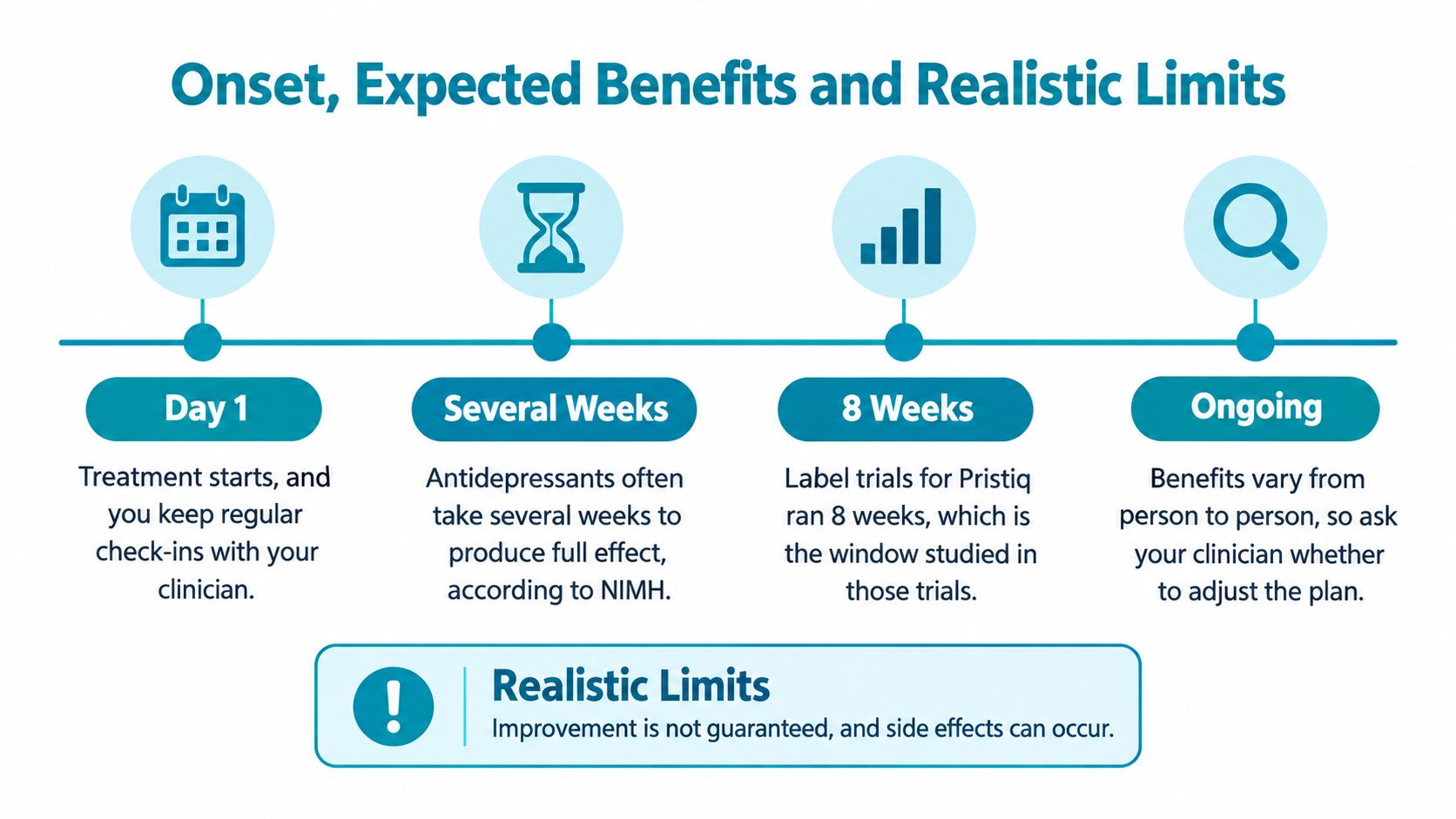
A monitoring sequence, not a response deadline
The graphic illustrates broad stages of follow-up, not a guaranteed timetable for relief. The depression trial duration described in the FDA labeling is a study window, not a deadline by which an anxiety disorder should respond.
A practical sequence is:
- At treatment initiation: Establish the symptoms being targeted, starting level of functioning, and follow-up plan.
- During early follow-up: Discuss tolerability and changes in sleep, energy, appetite, mood, or worry without assuming that every change proves benefit.
- At the planned reassessment: Compare current symptoms and functioning with the starting point.
- During ongoing care: Consider whether the treatment remains useful, whether the diagnosis needs clarification, and whether another approach merits discussion.
A fixed week-by-week schedule would imply more certainty than the anxiety evidence supports. A partial response doesn't automatically mean the dose should increase, and a poor response doesn't by itself establish that all medications will fail.
Measuring meaningful improvement
Clinicians may use questionnaires such as the GAD-7, which tracks anxiety symptoms, and the PHQ-9, which tracks depressive symptoms. These tools can organize repeated assessments, but they don't replace a diagnostic interview or a discussion of functioning.
Useful change might include less time lost to worry, improved concentration at work, or greater ability to complete ordinary responsibilities. Mood and anxiety should be assessed separately rather than combined into a vague impression of feeling better.
Realistic expectation: Treatment deserves reassessment when the main impairment remains, even if another symptom has improved.
No predictable response percentage is available here for adults presenting primarily with anxiety. No practice-specific effectiveness result or patient outcome is claimed.
Discuss Pristiq Options With a Qualified Clinician
The decision is whether a qualified clinician should consider Pristiq, another medication, psychotherapy, or a different approach after clarifying the diagnosis. That answer changes with the situation. Anxiety that occurs during depression raises different questions than a primary anxiety disorder, and anxiety driven by another medical condition or a substance may call for treating the underlying cause first. Approval status, condition-specific evidence, safety, and personal goals each contribute something different to the decision.
An evaluation is more useful when the adult can describe what symptoms prevent, beyond how symptoms feel. Avoiding ordinary activities, losing concentration, or struggling to maintain sleep gives the physician concrete targets for discussion. A first conversation may also sort out which treatments have already been tried and how the diagnosis is currently understood.

Preparing for an evaluation
A concise preparation summary can bring together:
- The symptom history: A dated account of anxiety, mood, and sleep.
- Previous treatment experience: Benefits, difficulties, and reasons treatment ended.
- Current products: All prescription medicines, nonprescription products, and supplements.
- Relevant medical information: Blood pressure history, if known, and other conditions.
- Personal priorities: Desired improvements, preferences, and concerns about side effects.
Bringing this material to one visit lets the clinician spend more time on the clinical questions and less on reconstructing history. The guide to getting an anxiety medication evaluation explains how that first appointment typically works.
Empire Medical Wellness offers physician-led adult mental health evaluation, diagnostic clarification, medication review, and ongoing medication management. To discuss whether Pristiq or another option fits your symptoms and history, you can book a 50-minute initial evaluation with Dr. Chhatpar at Empire Medical Wellness for $350. The practice does not bill insurance directly, and an itemized receipt is available through the patient portal.