
Does losing weight require a strict diet, or can ordinary routines make a meaningful difference? Adults researching how to lose weight without dieting can pursue sustainable eating, movement, and sleep changes without following a restrictive fad plan. Weight loss still requires changes in energy intake, energy use, or both, and no routine guarantees a particular result.
A useful distinction is between improving health, starting weight loss, and preventing regain. Those goals overlap, but they aren't interchangeable. Physician-led assessment can help someone choose realistic priorities without treating body weight as a measure of effort or character.
Table of Contents
- Non-Diet Approaches Compared by What They Can Deliver
- How Much Movement Each Goal Requires
- Build a Non-Diet Routine Step by Step
- Track Progress and Handle Plateaus Without Restriction
- Maintenance, Regain and Realistic Expectations
- Bring Your Plan to a Physician for Individual Review
- Sources and Review Dates
Non-Diet Approaches Compared by What They Can Deliver
Losing weight without dieting usually means replacing rigid food rules with repeatable behaviors. A 2024 CDC systematic review and meta-analysis found that short-term interventions combining physical activity and nutrition produced a pooled mean weight change of −2.59 kg among adults with overweight or obesity. That's an average across studies, not an individual forecast.
Non-diet doesn't mean no structure. Someone might plan lunch before a busy workday, notice when eating becomes distracted, or choose movement that fits existing responsibilities. These changes can alter eating and activity without requiring forbidden-food lists.
Non-diet approaches compared by target and evidence
| Approach | Main target | What the evidence shows | Key limit |
|---|---|---|---|
| Physical activity | Fitness, metabolic health, and weight maintenance | Improves fitness; alone doesn't reliably produce large weight loss | Rarely enough for large loss without eating changes |
| Eating awareness, including hunger and fullness cues | Eating behaviors and disordered-eating patterns | Four of seven randomized trials in a 2024 Journal of Eating Disorders review found greater improvement in disordered-eating behaviors | Weight effects are mixed; not a weight-loss guarantee |
| Sleep improvement | Sleep quality and appetite-related habits | Sleep-support findings haven't established a reliable weight-loss advantage | Better sleep isn't a stand-alone weight-loss treatment |
| Routine and self-monitoring | Consistency and feedback on behavior | NIH-reviewed evidence associates consistent monitoring with larger losses or better maintenance | Frequent weighing can affect mood in some people |
| Physician evaluation and medication | Medical factors and individualized options | Approved medication options have product-specific indications; assessment helps identify appropriate choices | Eligibility requires clinical review; medication doesn't replace a sustainable routine |
Eating awareness means noticing hunger, fullness, satisfaction, and the circumstances surrounding eating. It isn't a requirement to wait until hunger becomes intense or to stop at a prescribed point regardless of nutritional needs.
For adults with a history of disordered eating, changing eating patterns warrants clinician discussion before introducing tracking or appetite rules. A non-diet approach should reduce unnecessary rigidity, not disguise it.
Practical distinction: A behavior can improve health without producing substantial weight loss. That doesn't make the behavior pointless.
Empire's explanation of metabolism and weight management provides related background. The practical question remains whether a routine is sustainable and medically appropriate, not whether it earns a particular label.
How Much Movement Each Goal Requires
Activity advice becomes confusing when a health recommendation is presented as a weight-loss prescription. A baseline for general fitness doesn't predict how much weight someone will lose, especially when eating patterns stay unchanged.
The CDC's physical activity and weight guidance describes a baseline of 150 minutes of moderate activity weekly plus muscle-strengthening activity on at least two days, while explaining that substantial weight loss may require more activity unless eating patterns change.
Weekly activity reference by goal
| Goal | Weekly activity reference | Source basis | Check first |
|---|---|---|---|
| Better health and fitness | The baseline described above, including strength work | CDC and HHS physical activity guidance | Medical conditions, joint limitations, and current medications |
| Initial weight loss with eating unchanged | Activity above the baseline may be needed | CDC guidance on substantial weight loss | Whether eating patterns and activity are both understood |
| Preventing regain | More than 250 minutes of moderate activity may be needed for many people, according to the NIH-hosted evidence summary | Evidence on long-term weight maintenance | Sleep, stress, medical circumstances, and feasibility |
These references aren't instructions to begin at the highest activity level. Someone returning to movement after a long interruption may need a gradual progression that accounts for pain, balance, endurance, and medical history.
Moderate activity generally makes breathing noticeably faster while still allowing conversation. Walking, cycling, swimming, and adapted exercise can all fit a practical plan. The best choice is an activity the person can access and repeat without repeatedly exceeding current capacity.
Strength work involves moving against resistance, such as body weight, bands, or weights. Empire's guide to resistance exercise for weight loss addresses this part of an activity routine.
Before substantially increasing activity, adults with heart or lung conditions, recent injuries, joint problems, or medication-related limitations should discuss suitable progression with a clinician. Tracking completed activity is more useful than repeatedly setting a target that doesn't fit daily life.
Build a Non-Diet Routine Step by Step
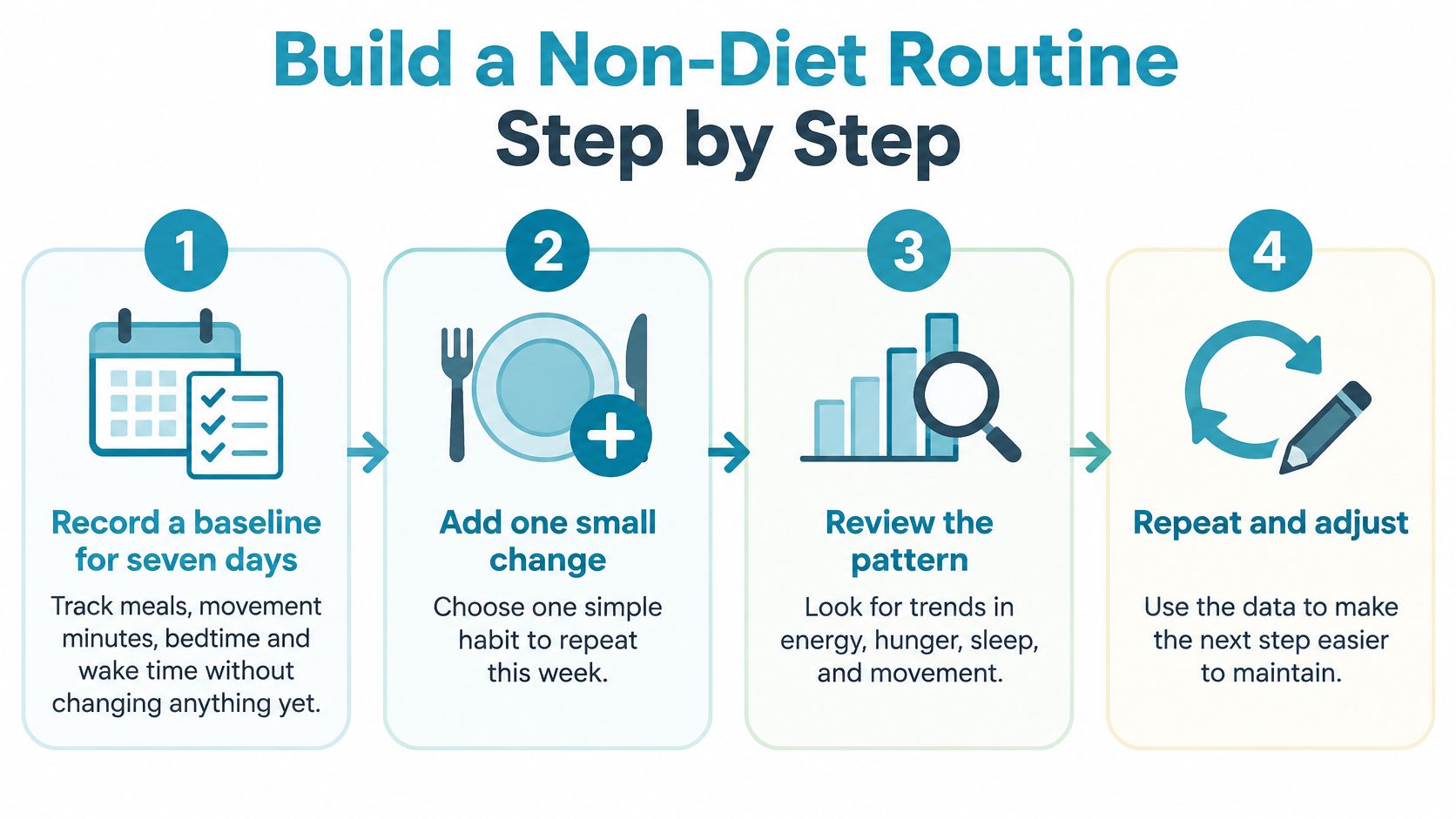
A sustainable routine starts with observation rather than an overhaul. The aim is to identify a manageable change, repeat it under ordinary conditions, and adjust when practical obstacles appear.
Establish a workable starting point
Record an ordinary baseline. A notebook, phone note, or calendar can capture meals, movement, bedtime, wake time, and situations involving unusually strong hunger. The purpose is to understand the pattern, not to grade food choices or deliberately eat differently for the record.
Add a short, repeatable walk or another accessible activity. A useful starting point is an amount that feels manageable on a busy day, with gradual increases as tolerated. Starting with an exhausting session often makes repetition harder.
Make meals easier to assemble. A flexible meal can include vegetables or fruit, a protein food, and a whole-grain or other satisfying carbohydrate source. Frozen vegetables, canned beans, eggs, yogurt, and leftover rice are practical ingredients, not a mandatory menu.
Skipping meals to compensate for previous eating can turn a flexible plan into restriction. Instead, meal planning can address predictable problems, such as a workday with no lunch break or an evening without groceries. Empire's healthy eating guidance offers related context.
Add supportive habits without creating new rules
Create a consistent sleep opportunity. A repeatable bedtime routine might include dimmer lighting, putting work aside, and preparing for the next morning. Sleep deserves attention, but it shouldn't carry a weight-loss promise: in Stanford Medicine's 2025 summary of an eight-month randomized study, the sleep-support group lost an average of 4 kg, compared with 5 kg in the attention-control group, a difference that wasn't statistically significant.
Notice hunger and satisfaction without enforcing a test. A brief pause can help distinguish physical hunger from distraction or habit. It shouldn't become a rule that prevents eating when meals are available or when a medical plan requires regular intake.
Include appropriate strength work. Bodyweight movements, resistance bands, or light weights can make strength activity accessible. Exercise selection should reflect mobility, experience, and clinical limitations.
Review one change at a time. If a walk rarely happens, changing its timing may be more useful than making it longer. If meal preparation is burdensome, simplifying the meal may help more than adding another food rule.
Success initially looks like a routine that survives ordinary disruptions. More consistent meals, manageable movement, and less stressful planning are useful outcomes even before a weight trend becomes clear.
Track Progress and Handle Plateaus Without Restriction
Activity, sleep, meal timing, and hunger patterns can explain more than an isolated scale reading. A record is useful when it helps someone make a decision, not when it becomes a source of constant judgment.
NIH behavioral weight-management guidance describes self-monitoring, goal setting, and stimulus control as behavioral tools, and associates more consistent monitoring with larger losses or better maintenance. The same guidance notes that frequent weighing can adversely affect mood, self-esteem, or body image in some people.
Stimulus control means changing surroundings to support an intended behavior. Examples include keeping walking shoes near the door or making lunch ingredients easy to reach. It doesn't require removing every enjoyable food from the home.
A plateau review checklist
A plateau is a sustained period without the expected downward trend, rather than a single unchanged measurement. There isn't a universal interval that establishes a plateau for every person.
- Check the record. Determine whether entries reflect ordinary days, including weekends and schedule changes.
- Review feasibility. Identify habits that repeatedly conflict with work, caregiving, pain, or fatigue.
- Check sleep and stress. Note recent changes rather than assuming the original plan still fits.
- Review medication changes. Bring a current medication list to the prescriber; don't alter treatment independently.
- Choose a review date. Make a modest adjustment and allow enough time to evaluate the pattern.
Empire's discussion of weight-loss plateaus provides related background. Persistent regain, intense hunger, or distress around eating warrants clinician discussion rather than automatic escalation of restriction.
Monitoring rule: A useful record supports a decision. If tracking creates distress or rigid behavior, its format and purpose need reassessment.
Weekly tracking sheet
This is a blank planning aid, not a prescribed monitoring schedule. Weight or waist measurements are optional, and hunger ratings are descriptive.
| Week | Activity minutes, goal / actual | Average sleep hours | Meal times and hunger ratings 1–10 | Weight or waist, optional | Notes and questions |
|---|---|---|---|---|---|
| Week 1 | ___ / ___ | ___ | ___ | ___ | ___ |
| Week 2 | ___ / ___ | ___ | ___ | ___ | ___ |
| Week 3 | ___ / ___ | ___ | ___ | ___ | ___ |
| Week 4 | ___ / ___ | ___ | ___ | ___ | ___ |
Maintenance, Regain and Realistic Expectations
Maintenance requires ongoing support, not just finishing a temporary plan. NIH guidance on lifestyle treatment reports that regain commonly occurs after six to twelve months, and that continuing contact, including at least monthly counseling in the cited review, can help mitigate it.
The same guidance describes intensive lifestyle interventions producing approximately 5% to 10% loss of initial body weight, with associated improvements in cardiovascular risk factors and other obesity-related conditions. These are population-level outcomes, not promises or minimum requirements for worthwhile care.

Illustrative image; the people shown aren't identified as Empire patients or clinicians.
A 2025 systematic review and meta-analysis of 56 randomized trials involving 13,270 participants found a modest average maintenance effect from lifestyle interventions, with substantial variation between studies, while reporting favorable effects from behavior-based interventions and anti-obesity medications. That variation supports individualized follow-up rather than a single maintenance formula.
A written maintenance outline
A practical outline can fit on a calendar or a short document:
- Behaviors worth keeping. Record the meals, activity options, and sleep arrangements that remain workable.
- Optional measurements. Agree on whether weight, waist, or behavioral indicators are useful.
- Review dates. Enter planned check-ins and a date for reassessing the overall approach.
- Response to regain. Identify what to review and when to contact the clinician.
- Changing circumstances. Revisit the plan after major schedule, health, or medication changes.
Hypothetical example: An isolated higher reading after travel doesn't establish persistent regain. A continuing upward pattern alongside disrupted meals and reduced movement provides a reason to review what changed and arrange follow-up.
Maintenance isn't all-or-nothing. A person can preserve meaningful improvements while needing additional help with hunger, medical factors, or a routine that no longer fits.
Bring Your Plan to a Physician for Individual Review
| Situation | Action | Timing |
|---|---|---|
| Plateau or regain despite consistent habits | Arrange clinician follow-up | Routine; not an emergency |
| Intense hunger or distress around eating | Raise the concern early with a clinician | Routine; sooner if distress feels severe |
| Thoughts of self-harm or feeling unable to stay safe | Seek immediate crisis help or emergency services | Immediate |
| Severe or persistent abdominal pain, especially with vomiting | Seek urgent or emergency evaluation | Don't wait for a routine visit |
| Chest pain, shortness of breath, or fainting | Contact emergency services | Emergency; act now |
| New neck lump, trouble swallowing, or persistent hoarseness | Contact a clinician promptly | Same-day contact advised |
Routine evaluation can examine weight history, eating patterns, sleep, health conditions, and medication effects without assuming that more restriction is the answer. Medication eligibility is a separate decision based on the specific product, age, health history, and clinical assessment.
A personal or family history of medullary thyroid carcinoma, a type of thyroid cancer, or MEN2, an inherited endocrine condition, can make some obesity medications unsuitable. Any medication discussion should distinguish an FDA-approved indication from off-label prescribing, which means use outside the approved labeling.
Questions for the appointment
- Likely benefit. Which parts of the current routine are most likely to support the person's goals?
- Medical context. Which health conditions or medications could affect the approach?
- Treatment options. Would additional medical treatment be appropriate, and what are its limitations?
- Monitoring. Which measurements would be useful without increasing distress?
- Follow-up. What changes should trigger reassessment, and when should the next review occur?
Empire Medical Wellness's first obesity medicine appointment lasts 50 minutes and focuses on weight history, health concerns, previous approaches, current medications, goals, and appropriate treatment options. Patients leave with recommended next steps and a follow-up plan; the first obesity medicine appointment guide explains preparation.
The obesity medicine service page provides service information. Separate pages explain private-pay care and how appointments work and provide appointment scheduling.
Sources and Review Dates
Byline: Empire Medical Wellness Editorial Team
Publication date: Pending clinical review and sign-off
Updated date: Pending clinical review and sign-off
Clinical review: Required before publication; no reviewer attributed.
Core references include the CDC's activity guidance and intervention review, NIH summaries on behavioral treatment and maintenance, the Journal of Eating Disorders review, and the Nutrition Reviews maintenance meta-analysis linked alongside their findings.
The NIDDK guide to choosing a safe and successful weight-loss program provides additional guidance on realistic goals, ongoing support, and evaluating programs.
The sleep finding is drawn from a secondary Stanford Medicine summary. Its underlying primary report requires review before publication. Current FDA labeling or MedlinePlus should also be checked before adding any product-specific medication information.
Empire Medical Wellness offers private, physician-led obesity medicine care that can include medical assessment, individualized planning, appropriate medication management, and maintenance support. Adults considering a sustainable alternative to restrictive dieting can visit Empire Medical Wellness to learn about evaluation and next steps. This article is educational and isn't personal medical advice.