
No over-the-counter product is an established treatment for an anxiety disorder, and the evidence for common supplements ranges from preliminary to inconclusive. Feeling sleepy after taking a product doesn't necessarily mean that anxiety has been treated.
The useful question isn't which product feels calming. It's whether the concern is temporary stress, a sleep problem, or persistent anxiety that deserves assessment, and whether an added product could create an interaction.
By Empire Medical Wellness Editorial Team
Published July 17, 2026 | Updated July 17, 2026
Table of Contents
- The Short Answer on Over-the-Counter Options for Anxiety
- Supplement Evidence and Safety at a Glance
- Why Sedating Antihistamines Are Not Anxiety Treatments
- Interactions and Liver Risks to Check Before Use
- Non-Drug Approaches and Their Limits
- Signs That Call for a Clinician or Urgent Care
- Confirm Your Medication and Supplement List Before Your Visit
The Short Answer on Over-the-Counter Options for Anxiety
Over-the-counter availability isn't evidence of effectiveness for anxiety. The National Center for Complementary and Integrative Health describes limited or inconclusive findings for many commonly marketed supplements and emphasizes that natural products aren't necessarily safe.
An anxiety disorder involves more than ordinary, short-lived worry. Persistent or excessive fear, worry, or avoidance can interfere with everyday activities. A clinician considers the pattern, its context, and its effect on functioning rather than deciding from a single difficult day.
What people usually mean by OTC anxiety relief
Products and approaches commonly grouped under this phrase belong to different categories:
- Sedating antihistamines. Allergy or sleep products may cause drowsiness. That effect doesn't establish that they treat an anxiety disorder.
- Herbal and dietary supplements. Some have preliminary findings for particular anxiety symptoms. Evidence for one ingredient or preparation doesn't establish that every calming blend works.
- Non-drug approaches. Relaxation and mindfulness may help some anxiety-related symptoms. Their role differs from that of a treatment chosen after a medical evaluation.
This distinction prevents a common misunderstanding: a product that helps someone feel tired, settle before a procedure, or sleep differently hasn't necessarily addressed ongoing daytime anxiety.
Why the pattern matters
A brief period of worry around a clear stressor raises different questions from repeated panic-like episodes or avoidance that limits work and relationships. Persistence and impairment change the decision, even when the symptoms initially seem manageable.
Prescription anxiety medicines are a separate category. Choosing among them requires a clinician's assessment, consideration of FDA-approved labeling, and a discussion of risks and monitoring. The anxiety medication overview provides related background without making an OTC product a substitute for evaluation.
Practical distinction: Relief from a sensation and treatment of a disorder aren't interchangeable outcomes.
This article is educational. It doesn't recommend a specific product, dose, or medication change.
Supplement Evidence and Safety at a Glance
Common supplements: evidence and main safety concern
| Product | Evidence for anxiety | Main safety concern |
|---|---|---|
| Chamomile | Preliminary. Some findings suggest possible benefit for generalized anxiety disorder, but findings for situational anxiety are inconsistent. | Possible allergic reaction in people sensitive to related plants. |
| Oral lavender | Possible benefit from particular oral preparations, with limitations in the evidence. | Added drowsiness with sedatives; pregnancy and breastfeeding safety aren't well established. |
| Kava | Some findings suggest small or short-term symptom reduction; benefit for generalized anxiety disorder remains unclear. | Rare liver injury, including serious or fatal cases; shouldn't be combined with alcohol or sedating substances. |
| Valerian | Not established for anxiety. | Appears generally safe for short-term use by most adults; long-term safety is unknown. |
| Melatonin | Research mainly concerns sleep problems and anxiety around medical procedures, not general daytime anxiety. | Doses above the body's normal physiological levels lack sufficient long-term safety data. |
| Ashwagandha | Inconclusive. | Rare reports of liver injury and concerns during pregnancy. |
The evidence column describes certainty, not a recommendation. Preliminary means that an early signal deserves further study, not that a product has been established as an anxiety treatment.
Why lavender findings need careful interpretation
A 2019 synthesis of 37 randomized trials involving 3,964 participants found benefit for oral lavender preparations, while findings for inhaled lavender were less consistent, according to the NCCIH clinical science summary. Differences among studies make a broad claim about lavender inappropriate.
A standardized preparation labeled for ingestion isn't interchangeable with aromatherapy oil or culinary lavender. Evidence from an oral preparation cannot establish that smelling a fragrance, drinking a tea, or swallowing another formulation produces the same result.
Oral lavender can also cause digestive symptoms, headache, burping, or appetite changes. Its possible effects don't remove the need to consider other medicines and pregnancy or breastfeeding.
Why the condition studied matters
Chamomile illustrates another problem: generalized anxiety disorder and situational anxiety aren't identical study populations. A finding in one setting doesn't automatically apply to another.
Similarly, sleep evidence isn't daytime-anxiety evidence. A person researching melatonin because worry disrupts sleep still needs to distinguish difficulty sleeping from the reason that difficulty developed.
The table also cannot establish the quality or ingredient content of an individual bottle. A label amount isn't a personal recommendation, and a pharmacist or clinician should review the exact preparation rather than only the ingredient's name.
Why Sedating Antihistamines Are Not Anxiety Treatments
The assumption that “sleepy means treated” is understandable, but misleading. Diphenhydramine, the active ingredient in products such as Benadryl, is used for allergy symptoms and can cause sedation. Sedation isn't an established treatment for an anxiety disorder.
The distinction resembles silencing a smoke alarm without identifying why it sounded. The immediate experience changes, but that doesn't establish that the underlying problem has been addressed.
Drowsiness comes with trade-offs
Diphenhydramine can cause dizziness, impaired coordination, dry mouth, constipation, blurred vision, and next-day grogginess. Older adults may be particularly vulnerable to confusion and falls.
The FDA warns that higher-than-recommended doses can cause serious heart problems, seizures, coma, or death. Taking more to obtain a stronger calming effect is dangerous, not a substitute for anxiety treatment.
- Active ingredients matter. Cold, allergy, and sleep products can contain overlapping ingredients despite different brand names.
- Combination products need scrutiny. An added sleep product may duplicate an ingredient already present in an occasional cold medicine.
- Repeated use deserves review. Relying on a sedating product for nerves or sleep should prompt an evaluation rather than another product purchase.
Persistent symptoms deserve more than sedation
Anxiety disorders are common, not a sign that someone has failed to manage stress. The World Health Organization estimated that 470 million people had an anxiety disorder in 2023, representing about 5.8% of the world's population.
Those are global estimates, not U.S. adult prevalence figures. Their practical relevance is that persistent anxiety is a recognized health concern deserving assessment.
A product that makes daily functioning harder isn't a useful substitute for understanding why anxiety keeps returning.
A medication review can clarify what a person is taking, whether ingredients overlap, and whether the perceived benefit is mainly sedation. It can also separate a temporary sleep concern from a recurring pattern that needs a different plan.
Interactions and Liver Risks to Check Before Use
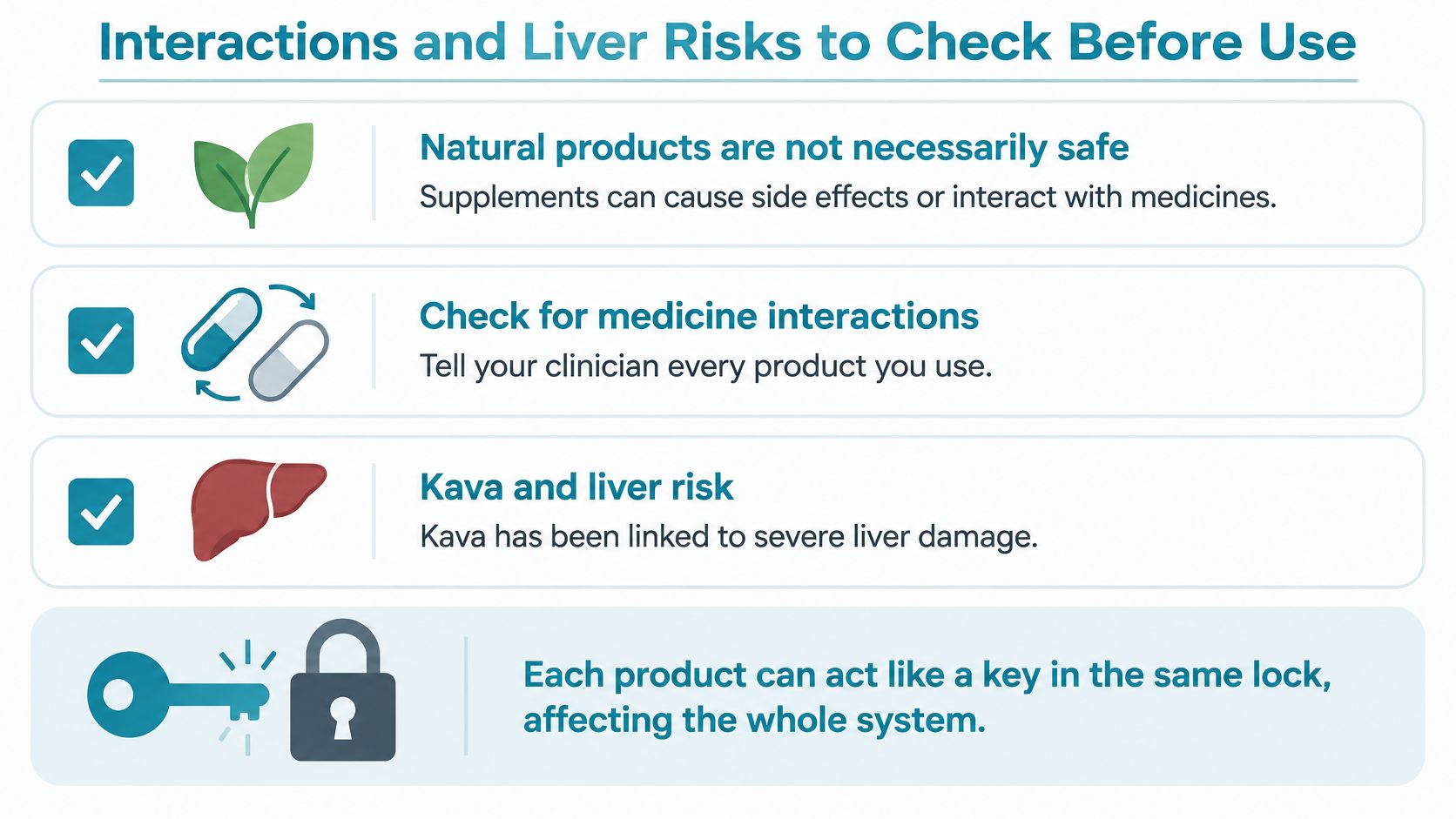
Natural doesn't mean interaction-free. The NCCIH guide to stress and complementary approaches warns that supplements can cause adverse effects, interact with medicines, and, in the case of kava, cause severe liver damage.
Adding several calming products can resemble turning up several volume controls at once. Each contributes to the total effect, even when the products have different names or come from different shelves.
A medication-safety checklist
- Identify the exact product. Record every ingredient and the labeled amount. A name such as calming blend doesn't provide enough information for an interaction check.
- Include occasional medicines. The list should cover prescriptions, OTC medicines, supplements, sleep aids, and products used only during illness.
- Describe alcohol and other substance use. This information helps a clinician assess combined sedation without guessing.
- Flag relevant health circumstances. Liver disease, pregnancy, breastfeeding plans, and planned surgery belong in the discussion.
- Avoid stacking calming products. Combining several products makes both interactions and the cause of a new symptom harder to assess.
- Request an ingredient-level review. A pharmacist or clinician needs the actual labels, not just a general description of herbal use.
Kava warrants particular caution
The NCCIH kava safety summary describes rare liver injuries, including serious or fatal cases, and warns against combining kava with alcohol or other sedating substances, including benzodiazepines. Benzodiazepines are prescription medicines that can have sedating effects.
Yellow skin or eyes, dark urine, abdominal pain, or unusual fatigue after supplement use require prompt medical attention. Confusion, marked drowsiness, or rapid deterioration calls for emergency assessment rather than waiting for a routine visit.
Existing liver concerns should be disclosed before an ingredient review. Background information about fatty liver and medical assessment may help frame that history, but it cannot determine whether a particular supplement is safe.
A label alone doesn't prove purity, ingredient accuracy, or suitability. Useful pharmacist questions include whether the preparation has independent quality verification and whether that verification applies to the exact product. Decisions about prescribed medicines should remain with the prescriber.
Non-Drug Approaches and Their Limits
Some adults looking for an OTC answer are looking for a way to feel calmer without another medicine. That's a reasonable preference, but non-drug approaches also need appropriately limited claims.
The NCCIH overview for health professionals describes some evidence for mindfulness or meditation, music, and relaxation techniques for certain anxiety-related symptoms, especially those associated with medical procedures or chronic medical problems. It also states that complementary approaches haven't been proven effective for treating anxiety disorders generally.
Match the approach to its limits
- Mindfulness and meditation. These may help some anxiety-related symptoms, but symptom improvement doesn't establish treatment of a diagnosed disorder.
- Music and relaxation techniques. Findings in a medical-procedure setting shouldn't be treated as proof of effectiveness for persistent everyday anxiety.
- Yoga and acupuncture. Evidence is limited or mixed, so neither should be presented as a reliably established substitute for clinical assessment.
These approaches can have a supporting role without carrying the entire treatment plan. The distinction is especially useful when a person prefers self-directed strategies but is also missing work, avoiding activities, or experiencing recurrent panic-like symptoms.
The stress-management resource offers related context. A symptom record can make a later discussion more specific than a general statement that stress has become difficult.
A blank symptom log
| Field | Notes |
|---|---|
| Date and approximate time | |
| Trigger, if known | |
| Duration of worry or panic-like symptoms | |
| Intensity, using a personally consistent scale | |
| Sleep quality | |
| Medicines, supplements, or other products taken and timing | |
| Effects on work, school, home responsibilities, or relationships | |
| Questions for the clinician |
The log is a personal record, not a diagnostic tool. No particular entry establishes an anxiety disorder, and there's no need to wait until the record feels complete before seeking care.
Concrete observations are more useful than a perfect record.
Even mild symptoms can be described this way. The purpose is to clarify patterns and daily effects, not to monitor every sensation or assign a diagnosis independently.
Signs That Call for a Clinician or Urgent Care
Routine evaluation versus urgent care by situation
| Situation | Routine evaluation | Urgent or emergency care |
|---|---|---|
| Persistent worry, avoidance, or sleep disruption that limits daily life | Schedule a medical evaluation soon. | Not usually emergency care unless symptoms escalate or warning signs develop. |
| New or frequent panic-like episodes | Schedule evaluation to clarify the cause. | Seek emergency assessment for chest pain, trouble breathing, fainting, or other severe symptoms. |
| Anxiety alongside low mood, substance use, or a recent medication change | Arrange evaluation and medication review. | Contact a clinician the same day if safety concerns arise; use emergency services for immediate danger. |
| Possible overdose from any product | Don't wait for a routine appointment. | Contact Poison Control immediately or emergency services for severe symptoms. |
| Thoughts of self-harm or suicide | Contact a clinician the same day. | Use crisis support immediately; call emergency services if danger is immediate. |
| Confusion, severe drowsiness, or yellow skin or eyes after a supplement | Contact a clinician promptly. | Confusion or severe drowsiness requires emergency care; yellow skin or eyes needs urgent medical assessment. |
When an appointment is appropriate
Persistent symptoms, substantial difficulty functioning, or recurrent panic-like episodes deserve evaluation even when an OTC product seems to help temporarily. Anxiety appearing with depression, substance use, a medication change, or medical illness also warrants a broader assessment.
The NCCIH guidance on complementary approaches for anxiety underscores that complementary approaches aren't established treatments for anxiety disorders. Continuing to try products can delay clarification of the actual concern.
A routine visit can address the symptom pattern, medication questions, and next steps. The guide to getting an anxiety medication evaluation explains the assessment pathway without implying that a prescription is inevitable.
When waiting isn't appropriate
Chest pain, breathing difficulty, fainting, confusion, severe drowsiness, or suspected overdose shouldn't be assumed to be anxiety. In the United States, call 911 for immediate danger or severe symptoms.
For a suspected overdose, Poison Control is available at 1-800-222-1222. A person shouldn't wait for symptoms or a scheduled appointment before obtaining guidance.
For thoughts of self-harm or suicide, call or text 988 for immediate crisis support and contact a clinician the same day. Call 911 when there's immediate danger or an attempt is underway.
Yellow skin or eyes and other possible liver warning signs also require prompt action. A routine appointment request must never delay urgent or emergency care.
Confirm Your Medication and Supplement List Before Your Visit
The most useful thing you can bring to an anxiety evaluation costs nothing: an accurate account of everything you already take. A complete list lets the physician see the full picture, including supplements, products used only occasionally, and any side effects you have already noticed. The occasional items deserve extra attention, because they are the easiest to forget and the ones most likely to overlap with a new prescription.

What belongs in the visit materials
- Product details. Write down the exact name, ingredient list, labeled strength, and how often you use each item. Photographs of labels work well when packaging is hard to describe.
- Observed effects. Note what seemed to help, what caused problems, and when each effect appeared.
- Relevant history. Include previous treatments, medical conditions, pregnancy plans, and alcohol or other substance use.
- Daily-function information. Bring the symptom log, including how symptoms affect responsibilities and relationships.
- Treatment goals. Identify what has become difficult and what meaningful improvement would look like for you.
The psychiatric medication management worksheet can help organize these details before the visit. A complete account serves you better than a list limited to daily prescriptions, because interaction checks only work when every product is on the table.
Questions worth bringing
- Symptom priorities. Which symptoms affect daily life most, and which need clarification first?
- Interactions. Could any OTC product or supplement interact with current prescriptions or with alcohol use?
- Possible contributors. Could sleep problems, a medical condition, medication effects, or substance use be part of the picture?
- Monitoring. What follow-up and safety monitoring would fit the assessment?
- Non-drug support. Which approaches could complement the recommended plan?
At Empire Medical Wellness, the first mental health appointment runs 50 minutes and covers symptoms, medical and treatment history, current medications, daily functioning, and goals. Before any prescribing decision, the physician reviews medical history, other medicines, pregnancy plans, and potential side effects. Anxiety medication management takes place during a secure telehealth visit in which the physician assesses whether medication is appropriate and explains options, monitoring, and follow-up. A visit does not guarantee a particular medication.
Adults exploring care can review mental health medication management, while those already taking treatment may find the medication review information more relevant. The fees and care process explains practical arrangements, and the appointment page provides the next step for routine care.
This article is educational and isn't personal medical advice. Medication changes should be made only with a prescriber.
Empire Medical Wellness offers physician-led mental health evaluation, medication review, and medication management when clinically appropriate. Adults seeking clarification about persistent anxiety or OTC supplement concerns can visit Empire Medical Wellness to learn about the evaluation process and prepare for a routine appointment.