
Getting anxiety medication starts with an evaluation by a licensed clinician, who reviews symptoms, medical history, and current medicines. A prescription may or may not follow the first visit. The evaluation helps determine what care fits, and follow-up checks whether the plan is helping.
Thoughts of self-harm or immediate danger need crisis or emergency support, not a routine appointment. In the U.S., call or text 988, or call 911 for immediate danger.
This guide explains what to prepare, how clinicians compare medication options, and what follow-up involves.
By Empire Medical Wellness Editorial Team
Publication date: October 8, 2026
Updated: October 8, 2026.
Table of Contents
- Start With a Clinical Evaluation, Not a Prescription Request
- What to Bring to Your First Evaluation
- Medication Options Clinicians Compare
- Follow-Up Timing and What Gets Reviewed
- Why Benzodiazepines Follow a Stricter Process
- Location, Telehealth and Private-Pay Costs
- Prepare Your Questions and Book the Evaluation
Start With a Clinical Evaluation, Not a Prescription Request
A licensed clinician reviews symptoms, medical history, current medicines, alcohol and other substance use, and safety concerns before considering a prescription. The purpose is to understand what needs treatment, not merely to match a symptom with a drug.
Immediate safety concerns require a different pathway from a routine appointment. The situations below are examples, not a diagnostic checklist.
Routine appointment or urgent care by situation
| Situation | Right next step |
|---|---|
| Anxiety symptoms with no immediate safety concern, and a wish to be evaluated | Routine evaluation with a licensed clinician; schedule promptly |
| Symptoms worsening or interfering with work, sleep, or relationships, with no immediate danger | Contact a clinician about an evaluation soon, and ask about follow-up timing |
| Thoughts of self-harm or suicide | Call or text 988 in the U.S.; call 911 or go to the nearest emergency department for immediate danger |
| Severe confusion, slowed or troubled breathing, fainting, or seizure | Call 911 or local emergency services |
| Unusual sedation, severe withdrawal-type symptoms, or sedation combined with alcohol or other drugs | Urgent medical evaluation; don't wait for a routine appointment |
A routine booking form isn't an emergency service. Someone with immediate safety concerns needs crisis or emergency support rather than an appointment for future medication access.
What the clinician is trying to clarify
A diagnosis identifies the condition that best explains the symptoms. Comorbidity means another condition occurs alongside it. A treatment goal describes what should improve, such as less avoidance or better participation in daily activities.
These distinctions matter because anxiety symptoms don't automatically establish an anxiety disorder. An assessment may identify another mental-health condition, a medical contributor, a medication effect, or substance-related symptoms.
The National Institute of Mental Health's guidance on generalized anxiety disorder describes treatment as psychotherapy, medication, or both. The choice depends on the person's needs, preferences, and medical situation, and finding an effective plan can involve trial and error.
A useful first-visit outcome is a clear next step, not necessarily a prescription.
The clinician may recommend monitoring, psychological treatment, medication, further evaluation, or coordinated care. A decision to gather more information should come with an explanation of what remains uncertain and how that uncertainty will be addressed.
Adults comparing care options can review the practice's mental-health evaluation information for its approach to assessment and ongoing management. A service description doesn't mean every anxiety condition or level of care is managed there.
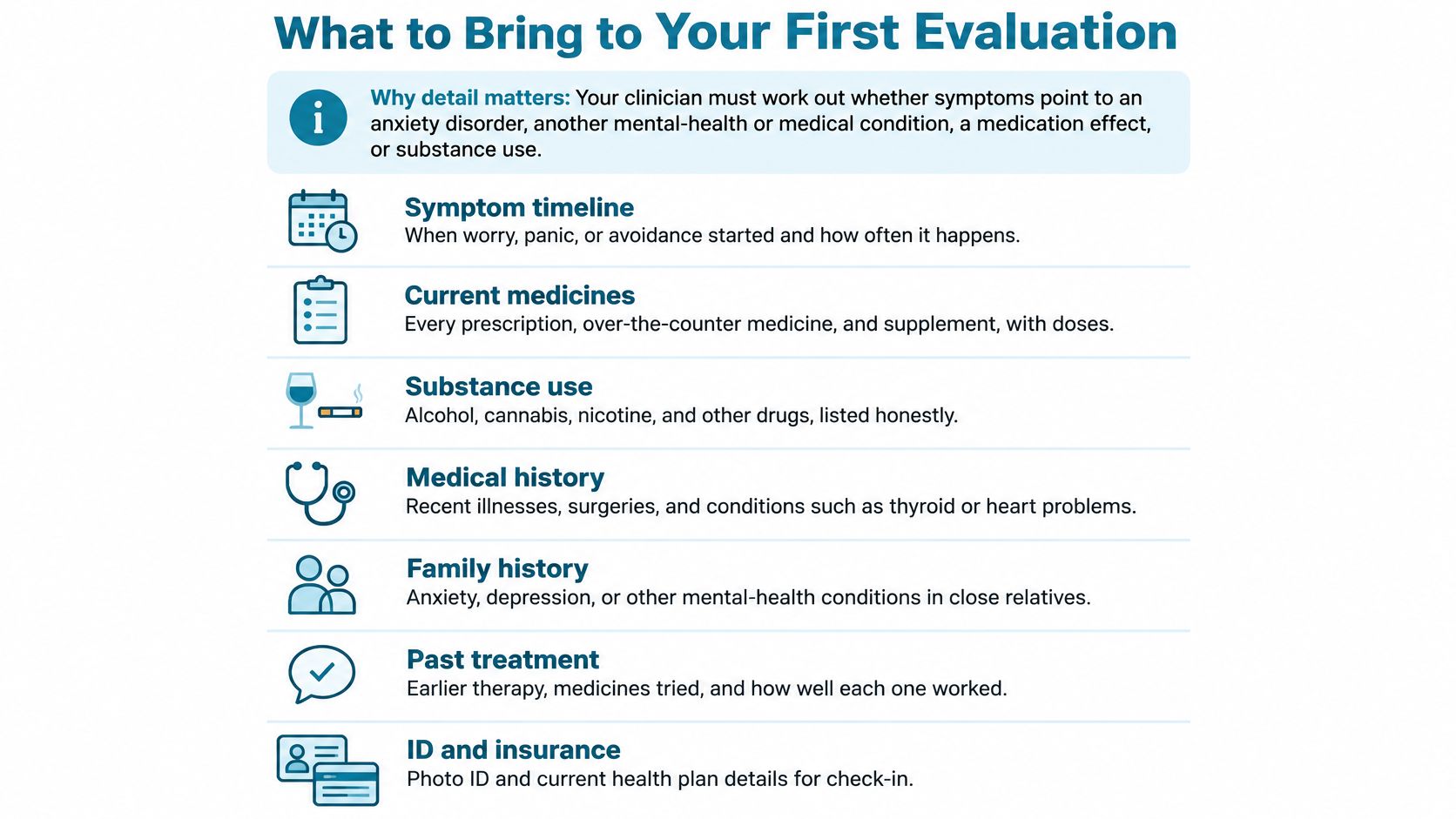
What to Bring to Your First Evaluation
Specific information helps the clinician distinguish an anxiety disorder from other possible explanations. Preparation isn't a test, and incomplete records shouldn't prevent someone from asking for care.
First-visit planning aid
The blank column can be completed before the appointment. This worksheet supports a conversation rather than a rehearsed request for medication.
| Item to gather | Why the clinician asks | Your notes |
|---|---|---|
| Main symptoms and when they started | Duration and pattern help distinguish possible conditions | |
| Triggers, avoided situations, and panic episodes | Shows effects on daily function | |
| Sleep, appetite, and mood changes | Helps assess depression or bipolar-spectrum symptoms | |
| Current prescriptions, over-the-counter products, and supplements | Supports interaction review | |
| Alcohol, cannabis, nicotine, and other substance use | Informs safety and treatment choice | |
| Medical conditions and recent test results | Helps identify possible medical contributors | |
| Past medications and therapy, including dates, response, side effects, and reasons stopped | Prior response helps guide options | |
| Thoughts of self-harm, now or in the past | Supports safety assessment | |
| Family history of mental-health conditions, if known | Adds diagnostic context | |
| Pregnancy possibility, when relevant | Affects medication review |
Details that make the worksheet more useful
- Describe timing: Note whether symptoms began weeks or months ago and whether a life change or new medicine preceded them.
- Use exact product information: Bring names and strengths from labels, including supplements and products described as sleep aids.
- Describe substance use candidly: Estimate drinks during a typical week and record other substances. This information supports safety, not judgment.
- Record prior treatment: Include approximate start and stop dates, benefits, unwanted effects, and reasons treatment ended.
Check-in requirements vary by practice. Photo identification or health-plan information shown in the infographic shouldn't be interpreted as evidence that a practice accepts insurance.
Medication Options Clinicians Compare
Anxiety medicines aren't interchangeable. Diagnosis, medical history, and the intended treatment time frame shape the choice.
The NIMH overview of mental-health medications describes SSRIs, SNRIs, selected short-term benzodiazepine use, and off-label beta-blocker use. It also notes that clinicians typically begin with SSRIs or other antidepressants for panic disorder or social anxiety disorder because they have fewer side effects than some alternatives.
Anxiety medication classes compared
Drug names below are examples, not recommendations. The prescriber must confirm the specific indication, risks, and current FDA labeling.
| Option | Typical role in anxiety care | Points a clinician checks | Labeling status |
|---|---|---|---|
| SSRIs, such as sertraline or escitalopram | Often an initial medication option for several anxiety disorders | Early side effects, activation, adherence, and suicidal thoughts | Some agents have FDA approval for specific anxiety disorders |
| SNRIs, such as extended-release venlafaxine | An alternative depending on diagnosis and prior response | Blood pressure, nausea, sleep, and discontinuation effects | Extended-release venlafaxine has FDA approval for generalized anxiety disorder |
| Benzodiazepines, such as alprazolam or lorazepam | Selected short-term symptom relief, not routine first-line long-term care | Sedation, interactions, dependence, and withdrawal | Some have FDA-approved anxiety indications; boxed warnings apply |
| Beta-blockers, such as propranolol | Selected short-term physical symptoms | Heart rate, blood pressure, and conditions such as asthma | Off-label for anxiety symptoms |
| Psychological treatment without medication | An option alone or alongside medication | Symptoms, skill practice, and response | Not a medication; outside coordination when authorized |
Off-label means a medicine is used for a purpose not specifically included in its FDA-approved labeling. Approval for one anxiety condition doesn't establish approval for every anxiety condition.
The practice's antidepressant information provides related background. Psychological treatment remains a separate option; the practice doesn't provide psychotherapy, though authorized coordination with an outside therapist may be useful.
Follow-Up Timing and What Gets Reviewed
How follow-up is set
How often should a clinician review treatment after medication starts? The answer depends on the condition, the medicine, and the person's response. Follow-up is part of the medication pathway: it gives the clinician a chance to assess benefit, check for unwanted effects, and decide whether the plan still fits.
The NICE guidance on generalized anxiety disorder and panic disorder describes regular review during treatment. It is UK guidance, not a U.S. prescribing standard. It supports the general principle of ongoing review, not one schedule that applies to every person or medication. The treating clinician sets the timing based on the treatment and the patient's circumstances.
Tolerability means how manageable a treatment's unwanted effects are. Activation can include increased restlessness or feeling unusually keyed up. At a review, the clinician may ask about symptoms, daily functioning, side effects, adherence, and any changes in health or other medicines. These details help distinguish an early adjustment from a reason to reconsider treatment.
A scheduled appointment is not a requirement to wait silently through troubling effects. Contact the prescriber if concerns arise between visits. The clinician can advise whether an earlier review or another step is appropriate.
Between appointments
A few common situations are worth discussing with the prescriber:
- Early discomfort: Report nausea or activation before changing or stopping medication on your own.
- New medicines or substances: Tell the clinician about prescriptions, over-the-counter products, supplements, and alcohol, since they can affect the safety review.
- No early improvement: A few days without noticeable benefit may not be enough to judge whether treatment is working. Ask the prescriber what response to expect and when to review it.
Follow-up is part of safe access to medication, not a hurdle after prescribing. Older adults, pregnant patients, and people with significant medical conditions or substance use may need additional safeguards. Children and adolescents need age-specific assessment and are outside this adult guide.
What the plan should cover
If medication is selected, the first visit should end with a written plan. It should explain when benefit may become noticeable, what early effects to watch for, potential interactions, what to do in a crisis, and how to contact the clinician. It should also identify when the next review is expected.
If medication is not selected, the plan should still name a next step and who will arrange it. That could involve further assessment, monitoring, or discussion of psychological care.
The practice's mental-health medication review process describes reviews of existing treatment. The treating clinician should direct dose changes and stopping plans, rather than leaving them to a self-directed calendar.
Why Benzodiazepines Follow a Stricter Process
A faster prescription isn't necessarily a safer prescription. Benzodiazepines require particular care because misuse, physical dependence, withdrawal, and dangerous interactions can occur.
The FDA's benzodiazepine boxed-warning communication warns that physical dependence can develop even with recommended use, sometimes after steady use for several days to weeks. Physical dependence means the body has adapted to a medicine; it isn't identical to addiction.
Checks before a prescribing decision
A careful evaluation includes the following sequence:
- Confirm the indication. Identify the symptom or condition being treated.
- Assess alcohol, opioid, and other sedative exposure.
- Review overdose and misuse risks without assuming that a request establishes misuse.
- Check prescription-monitoring information where applicable.
- Define the intended duration.
- Document a clinician-directed discontinuation strategy.
Abrupt stopping or overly rapid reduction can cause serious withdrawal, including seizures. FDA advises using the minimum necessary dose and duration and a gradual, individualized reduction when treatment is being discontinued.
Combining benzodiazepines with opioids, alcohol, or other drugs can cause profound sedation, respiratory depression, overdose, or death. Respiratory depression means breathing becomes dangerously slowed or suppressed.
Safety habits that remain essential
- No sharing: Medication prescribed for one person shouldn't be given to another.
- No independent changes: Dose or schedule changes require medical guidance.
- No driving while impaired: Sedation can make driving or hazardous equipment unsafe.
The urgent-care table above identifies situations that shouldn't wait for routine follow-up. For persistent anxiety, the clinician should reassess the diagnosis and longer-term options rather than allow a short-term sedative plan to continue without review.
The practice doesn't promise access to controlled medication. Any prescribing decision depends on an individual evaluation.
Location, Telehealth and Private-Pay Costs
Can the appointment take place wherever the patient happens to be? Telehealth eligibility depends on the patient's physical location at the time of the visit, the clinician's authorization there, and whether an in-person examination is needed. Before booking, confirm these details, along with follow-up arrangements and pharmacy coordination.
Telehealth prescribing also depends on the medication's legal classification and applicable state and federal rules. Many anxiety medicines aren't controlled substances; some are. That means online prescribing has no universal yes-or-no answer.

The federal telemedicine extension for controlled-substance prescribing describes specified flexibilities. It doesn't remove requirements for a legitimate medical purpose, an interactive telemedicine encounter, appropriate practitioner authorization, or compliance with other applicable rules. Requirements can change, so check current rules before relying on an online prescribing arrangement, particularly for controlled medication.
Questions about access and payment
Check the practice's location and telehealth information for appointment-location requirements. A patient traveling across state lines shouldn't assume an existing appointment remains eligible for telehealth.
Private-pay costs may include the initial visit, follow-up appointments, and expenses outside the visit, such as pharmacy costs. Ask whether receipts are available, and review the fees and how-it-works page for the practice's payment information.
Ask the insurer directly about possible reimbursement. A receipt alone doesn't guarantee coverage or payment.
The image illustrates a telehealth setting and doesn't identify an actual practice patient.
Prepare Your Questions and Book the Evaluation
Written questions can keep an evaluation focused without turning it into a request for a particular drug.
- Diagnosis: Which condition is being considered, and why?
- Options: Which approaches fit the situation, and what are their trade-offs?
- Early effects: Which unwanted effects should prompt a call?
- Progress: How will benefit be measured and reviewed?
- Additional checks: Are tests or records needed before a decision?
- Coordination: How could an outside therapist be involved with authorization?
- Between visits: What information should the patient record?
- Safety: What should happen if symptoms worsen?
The practice's discussion of mental-health medication benefits and trade-offs offers related preparation.
- Complete the planning aid with available information and unanswered questions.
- Confirm the physical location for telehealth and whether in-person care is preferable.
- Use the appointment scheduling page when ready for a routine evaluation.
Urgent symptoms belong with crisis or emergency services, not a booking form.
Sources
Clinical references include NIMH guidance on generalized anxiety disorder and mental-health medications, NICE guidance on anxiety and panic disorder, FDA benzodiazepine safety communications, and the Federal Register telemedicine extension. Each is linked where its information is discussed.
Empire Medical Wellness offers private-pay, physician-led outpatient mental-health evaluation, medication review, and ongoing medication management. Adults considering an evaluation can visit Empire Medical Wellness to review its services and appointment process; an evaluation doesn't guarantee a prescription. This article is educational and isn't personal medical advice.