
Feeling well and seeing a normal ALT result doesn't prove that the liver is healthy. Fatty liver can exist without symptoms, and clinically meaningful fibrosis, or liver scarring, can develop while routine blood tests appear reassuring. The useful question is whether fat is present. It's whether inflammation or fibrosis has developed, and what level of evaluation that risk requires.
This distinction matters for adults considering physician-led obesity care. Weight management can improve metabolic health and liver fat, but it shouldn't replace an assessment of fibrosis risk. Modern care combines medical history, metabolic evaluation, laboratory data, noninvasive fibrosis tools, and specialist referral when findings warrant it.
Table of Contents
- The Hidden Reality of Liver Health
- Understanding MASLD and MASH Terminology
- Evaluating True Risk Beyond Basic Lab Tests
- Weight Management as a Medical Intervention
- Navigating New Medication Approvals and Therapies
- The Structure of a Comprehensive Clinical Evaluation
- Answers to Common Questions About Liver Monitoring
The Hidden Reality of Liver Health
A fatty liver diagnosis often arrives unexpectedly. An ultrasound performed for another reason may show liver fat, or a routine laboratory panel may reveal a raised enzyme. Some adults have no symptoms at all. Others notice vague fatigue or discomfort, but those experiences don't reliably indicate how much liver injury is present.
The more consequential problem is fibrosis, which means scar tissue formed in response to ongoing liver injury. Fibrosis can progress toward cirrhosis, a severe and permanent pattern of scarring, even when a person feels physically well. The National Institute of Diabetes and Digestive and Kidney Diseases explains that fatty liver and its more advanced forms may occur with few or no symptoms.
A normal ALT or AST result doesn't exclude important disease. These enzymes can support an evaluation, but they don't measure liver stiffness or directly stage scarring. The same applies to appearance. Body size, fitness, and symptom burden can't establish whether inflammation or fibrosis is present.
Practical rule: A normal liver enzyme result is reassuring only within the limits of the test. It isn't a clearance certificate for the liver.
Adults with insulin resistance, type 2 diabetes, hypertension, dyslipidemia, or excess weight may have a higher likelihood of metabolic liver disease, but risk assessment shouldn't depend on a single visible trait. Some people with fatty liver don't have obesity, while others have several metabolic risks without obvious liver symptoms. A clinician should also consider alcohol exposure, medications, viral hepatitis risk, and other competing causes of liver injury.
The term visceral fat and metabolic health is useful in this context, but it shouldn't turn into a diagnosis based on body shape. The appropriate next step is a structured review of risk and available data. That may include calculating FIB-4, arranging elastography, or involving hepatology when the findings suggest a higher risk of advanced fibrosis.
Understanding MASLD and MASH Terminology
The older term non-alcoholic fatty liver disease, or NAFLD, described excess liver fat in people without significant alcohol-related liver disease. It was useful historically, but it defined the condition partly by what wasn't causing it. In 2023, international terminology increasingly shifted toward metabolic dysfunction-associated steatotic liver disease, or MASLD, to emphasize the role of metabolic risk factors rather than relying primarily on alcohol exclusion. The terminology history and its clinical implications are reviewed in the Gut publication on the MASLD nomenclature shift.
MASLD means hepatic steatosis, or excess fat in the liver, together with at least one cardiometabolic risk factor. Examples include overweight or obesity, type 2 diabetes, hypertension, dyslipidemia, or other evidence of metabolic dysfunction. MASLD describes a broad condition. It doesn't by itself tell a patient whether inflammation or scarring is present.
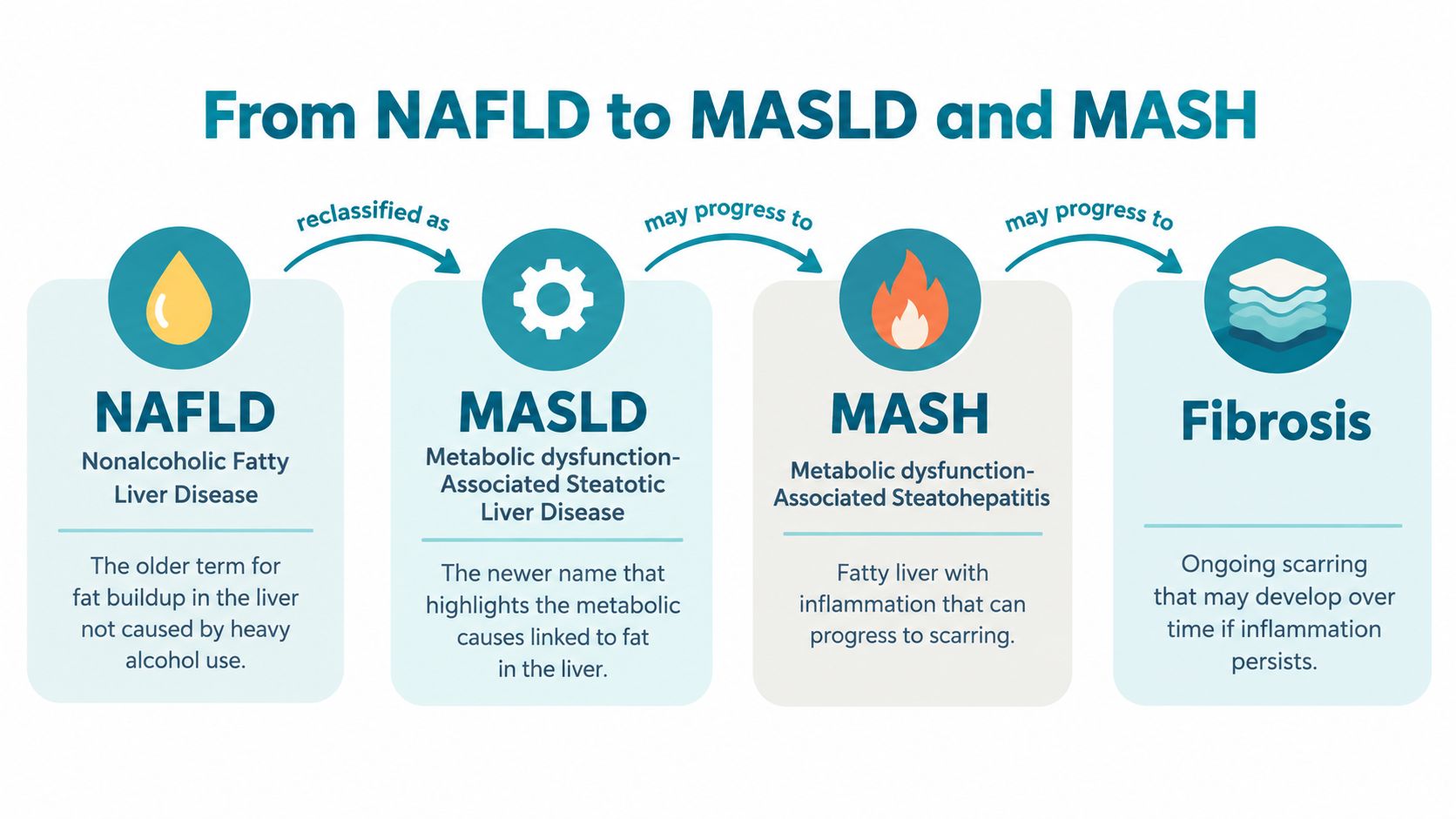
Fat, inflammation, and scarring are different findings
Steatosis is fat accumulation. It may remain relatively stable, or it may occur alongside cellular injury. Metabolic dysfunction-associated steatohepatitis, or MASH, is the more active form, involving liver-cell injury and inflammation. Ongoing inflammation can stimulate fibrosis, the buildup of scar tissue.
These terms describe different layers of the same clinical problem:
- Liver fat: Excess fat is present, but fat alone doesn't establish progressive injury.
- MASH: Fat is accompanied by inflammation and hepatocellular injury.
- Fibrosis: The liver develops scar tissue in response to injury.
- Cirrhosis: Fibrosis becomes severe and alters the liver's structure and function.
The distinction between MASLD and MASH matters because fibrosis is a major determinant of long-term liver risk. A person can have considerable liver fat without advanced scarring, while another person with less obvious fat may have clinically important fibrosis. The label “fatty liver” is therefore a starting point, not a complete prognosis.
Metabolic health remains central. Insulin resistance, abnormal glucose regulation, blood pressure problems, and lipid abnormalities can contribute to liver fat and influence cardiovascular risk. A thoughtful plan addresses those issues without assuming that every patient has the same cause, stage, or treatment need. More information about this connection is available through Empire Medical Wellness metabolic syndrome care.
Evaluating True Risk Beyond Basic Lab Tests
The central limitation of routine liver enzymes is simple: ALT and AST reflect cellular leakage, not the full amount of liver scarring. Levels may fluctuate, and normal results can occur in people with clinically meaningful fibrosis. An ultrasound can identify steatosis, but conventional ultrasound doesn't stage all fibrosis or reliably distinguish every level of scarring.
Risk-based evaluation adds a second layer. One common starting point is FIB-4, a calculation using age, AST, ALT, and platelet count. It estimates the likelihood of advanced fibrosis. It doesn't diagnose MASH, prove that cirrhosis is absent, or replace clinical judgment.
For adults generally under 65, the cited clinical pathway commonly uses 1.3 as a threshold for secondary assessment and 2.67 as a higher-risk threshold. For adults older than 65, a cutoff above 2.0 is used in that pathway. These thresholds come from the clinical FIB-4 pathway.
Interpreting FIB-4 risk categories
| FIB-4 Score | Risk Level | Typical Clinical Action |
|---|---|---|
| Below 1.3 in adults generally under 65 | Lower estimated risk | Continue clinical management and reassess when the person's risks, symptoms, laboratory findings, or prior results justify it |
| 1.3 or higher in adults generally under 65 | Indeterminate or increased risk | Consider a secondary assessment, such as elastography or another validated noninvasive fibrosis test |
| Above 2.67 in adults generally under 65 | Higher likelihood of advanced fibrosis | Arrange further evaluation and consider referral to a liver specialist |
| Above 2.0 in adults older than 65 | Higher-risk age-adjusted pathway threshold | Seek secondary assessment or specialist evaluation based on the full clinical picture |
A low FIB-4 reduces concern but doesn't answer every question. Acute illness, unusual platelet counts, age, laboratory variation, and other liver conditions can affect interpretation. A result near a threshold also deserves context rather than automatic reassurance or alarm.
A fibrosis score is a triage tool. It helps decide who needs a closer look, but it isn't a diagnosis by itself.
Elastography, including transient elastography commonly known as FibroScan, measures liver stiffness without a biopsy. Stiffness can be influenced by factors other than fibrosis, so clinicians interpret the result alongside history, laboratory findings, imaging, and metabolic risk. When noninvasive results remain unclear, hepatology consultation may help determine whether additional testing is appropriate.
Adults concerned about insulin resistance can review insulin resistance and metabolic risk with a qualified clinician. The practical goal isn't universal testing at an identical interval. It is matching the depth and timing of evaluation to the person's risks, prior results, treatment, and evidence of progression.
Weight Management as a Medical Intervention
Weight reduction functions as a metabolic and liver intervention, not a cosmetic obligation. For adults with overweight or obesity and MASLD, gradual loss can reduce liver fat and may improve the inflammation and fibrosis associated with MASH. The effect depends on disease stage and metabolic health, so a lower weight alone does not establish that fibrosis has improved.
The NIDDK treatment guidance reports that losing approximately 3% to 5% of body weight can reduce hepatic fat. Roughly 7% to 10% may be needed to improve MASH-related inflammation and fibrosis, although that degree of loss does not guarantee reversal for an individual. A peer-reviewed review of lifestyle treatment similarly emphasizes that outcomes depend on disease stage, adherence, and broader metabolic health.
What tends to help
Effective care usually combines nutrition changes, physical activity, glucose and lipid management, blood-pressure treatment, and medication review. Activity can support liver and cardiometabolic health even without substantial weight loss. Dietary quality matters, but one eating pattern will not suit every adult.
Rapid loss and severe restriction have trade-offs. They can be hard to maintain and may increase the risk of inadequate nutrition. Gradual loss through nutritious food choices, appropriate portions, and physical activity is generally more practical than crash dieting.
Physician-led obesity care can review weight history, consider anti-obesity medication when appropriate, monitor metabolic measures, and establish a maintenance approach. Adults comparing options may consult this overview of Weight management medication, while remembering that general weight-loss treatment is distinct from a liver-specific indication.
The scale is one measure, not the whole assessment. Empire Medical Wellness weight-loss care is one private physician-led option for adults seeking an obesity-medicine evaluation. Follow-up should track glucose regulation, lipids, blood pressure, liver enzymes, medication effects, weight trajectory, and fibrosis risk rather than the scale alone.
Navigating New Medication Approvals and Therapies
Medication choices now depend on the distinction between liver fat and progressive fibrosis. A drug approved for obesity may improve metabolic health and reduce liver fat without treating every stage of MASLD. A liver-directed therapy may require a confirmed diagnosis and a particular fibrosis stage.
The FDA approved Rezdiffra, the brand name for resmetirom, in 2024 for selected adults with noncirrhotic MASH and moderate to advanced fibrosis, alongside diet and exercise. The FDA drug trials snapshot for Rezdiffra explains the approval context. Liver fat on imaging alone does not establish that this treatment is appropriate.
In 2025, the FDA also approved injectable semaglutide under the Wegovy brand for selected adults with noncirrhotic MASH and moderate to advanced fibrosis, as reflected in the FDA accelerated-approval indication listing. This indication applies to a defined population. MASLD, obesity, or a raised ALT alone does not establish eligibility.
Comparing the clinical roles
| Treatment category | What it may address | What it doesn't establish |
|---|---|---|
| Lifestyle and metabolic care | Liver fat, cardiometabolic risk, physical function, and long-term weight maintenance | That fibrosis has reversed merely because weight or enzymes changed |
| General anti-obesity medication | Obesity treatment when clinically appropriate, with possible metabolic and liver benefits | A liver-specific indication for every patient |
| Resmetirom | Selected noncirrhotic MASH with moderate to advanced fibrosis | Eligibility without appropriate diagnostic assessment |
| Semaglutide (Wegovy, MASH indication) | Selected noncirrhotic MASH with moderate to advanced fibrosis | That all semaglutide users are receiving treatment for MASH |
Choice of therapy requires review of contraindications, adverse effects, interactions, comorbidities, pregnancy considerations when applicable, and diagnostic certainty. This GLP-1 medication discussion offers general context, but it does not replace an assessment of fibrosis stage and treatment goals.
Important uncertainties remain. Combination use of resmetirom and semaglutide has not been established in the cited guidance. Evidence also does not establish what happens to steatosis, MASH, or fibrosis after treatment stops. Noninvasive tests cannot reliably predict an individual patient's histologic response. Medication can support a treatment plan, but it does not guarantee a cure.
The Structure of a Comprehensive Clinical Evaluation
A useful evaluation begins before a prescription or imaging order. A clinician reviews when weight changed, which interventions were tried, whether weight returned, and how glucose, blood pressure, lipids, sleep, activity, and medications fit together. The assessment should also include alcohol exposure and other potential causes of abnormal liver tests.
A hypothetical adult with an incidental high ALT shouldn't assume that MASLD is the explanation. The clinician may review viral hepatitis risk, medication and supplement exposure, alcohol use, autoimmune or inherited conditions when relevant, and the pattern of other laboratory results. FIB-4 may help estimate fibrosis risk, while elastography or hepatology referral may be appropriate if the overall picture warrants it.

What a patient can reasonably expect
- A focused history: Weight trajectory, diabetes risk, alcohol exposure, medications, supplements, family history, and prior imaging all affect interpretation.
- Targeted testing: Blood tests may assess liver injury and metabolic health, while FIB-4 and elastography address fibrosis risk from different angles.
- A clear explanation: The clinician should distinguish liver fat from MASH, fibrosis, and cirrhosis rather than treating “fatty liver” as one uniform diagnosis.
- Coordinated care: Uncertain or raised fibrosis risk may require gastroenterology or hepatology involvement.
Follow-up should be tied to clinical findings and treatment response, not an assumed universal schedule. A person with lower estimated risk and stable findings may need a different plan from someone with diabetes, abnormal fibrosis testing, or an unclear diagnosis. Readers comparing structured private care models may also review information about evaluating private longevity programmes, while recognizing that liver-risk decisions still require qualified medical assessment.
Answers to Common Questions About Liver Monitoring
How often should liver tests or imaging be repeated?
There isn't one appropriate interval for every adult. The plan depends on metabolic risks, alcohol and medication history, previous laboratory results, FIB-4, elastography findings, symptoms, and whether fibrosis is suspected. Liver enzymes alone can't determine when imaging is unnecessary, and ultrasound findings alone can't stage every level of fibrosis.
Does alcohol matter if the condition is metabolic?
Yes. MASLD terminology emphasizes metabolic dysfunction, but alcohol exposure remains clinically relevant. A clinician should receive an accurate, nonjudgmental account of alcohol use because alcohol-related injury, metabolic disease, and medication safety can overlap.
What does an elevated ALT mean?
A rising ALT signals that further evaluation may be appropriate, but it doesn't identify the cause by itself. The clinician should consider fatty liver, alcohol, medication or supplement effects, viral hepatitis, autoimmune disease, muscle injury, and other possibilities. A falling ALT can be encouraging, but it doesn't prove that fibrosis has improved.
Can normal enzymes rule out advanced disease?
No. Normal ALT and AST don't reliably exclude advanced fibrosis. Risk assessment may still require FIB-4, elastography, another validated noninvasive test, or specialist input when the history and metabolic profile create concern.
When is urgent care appropriate?
New jaundice, confusion, vomiting blood, black stools, severe abdominal swelling, or rapidly worsening illness requires urgent medical attention. Those symptoms aren't typical questions of routine fatty-liver monitoring and shouldn't wait for a scheduled outpatient appointment.
Empire Medical Wellness offers physician-led obesity-medicine evaluation, metabolic assessment, individualized weight-management planning, and follow-up for adults seeking structured care around conditions such as fatty liver. Adults can visit Empire Medical Wellness to review the practice's current services and determine whether a private consultation is appropriate.
Byline: Empire Medical Wellness Editorial Team
Published: October 14, 2026
Updated: October 14, 2026
Sources
- NIDDK information on fatty liver treatment
- AASLD clinical assessment and management guidance
- FDA Rezdiffra drug trials snapshot
- FDA accelerated-approval indication listing
- Lancet Gastroenterology and Hepatology prevalence analysis00165-0/abstract)
This article is educational and isn't personal medical advice.