
A workday ends, but the mind keeps returning to tomorrow's deadlines. Sleep comes late, patience runs short, and small decisions feel harder than usual. Stress management starts by recognizing this pattern as a response to pressure, then testing one practical action and checking whether everyday functioning changes.
Table of Contents
- What Stress Is and When It Becomes a Problem
- A Simple Preparation Checklist Before You Act
- Choosing One Feasible Coping Action
- A Short Illustrative Day and a Tracking Template
- When the Stressor Is Structural and Self-Help Is Not Enough
- Recognizing When Professional Assessment Is Needed
- Putting It Together and Knowing What Comes Next
What Stress Is and When It Becomes a Problem
Stress is the body and mind's response to a demand or challenge. For a short time, it can help someone focus and act. Muscles may tighten, the pulse may rise, and the body may become more alert. These changes can help meet an immediate demand. If pressure continues, the body may stay on alert, like an alarm that does not switch off. MedlinePlus explains the body's stress response and the health problems associated with long-term stress.
A demanding week alone does not mean someone has a mental-health condition. Look at whether the pressure is easing and how daily life is going. Ongoing stress may affect sleep, work, relationships, concentration, or judgment. It can also come with changes in appetite or energy, headaches, or stomach problems. The CDC describes these possible effects of long-term stress.
Stress deserves attention when it repeatedly interferes with daily life, even if it does not feel intense.
The National Institute of Mental Health explains that stress can affect health and functioning, and that support may help when it becomes difficult to manage. Its guide to stress and coping includes coping ideas and guidance on seeking help. If low mood is also a concern, learn about adult depression evaluation.
A symptom alone cannot identify a condition. Instead, treat stress management as a personal experiment: notice one pressure point, try one feasible response, and check whether daily functioning changes. Some stressors are outside an individual's control, so self-help may not be enough. Recognizing that limit is part of deciding what support to seek.
A Simple Preparation Checklist Before You Act
Before choosing a coping action, make a clear note of what's happening. A short record can help separate the pressure itself from the effects it's having on daily life. It can also make a conversation with a clinician more specific, especially if symptoms have lasted or worsened.
Consider these questions:
- Main trigger: What situation or concern is creating the most pressure right now?
- Onset and duration: When did it begin, and has it eased, stayed the same, or grown?
- Daily effects: What has changed in sleep, work, relationships, concentration, or routine?
- Current coping: What has helped, even briefly? What coping habits may be creating other problems?
- Medications and substances: What medicines, alcohol, or other substances are part of the picture? A clinician can consider how these may relate to symptoms.
- Available support: Is there a trusted person, workplace contact, community resource, or clinician who could help?
Then ask whether the symptoms continue even when the main trigger is absent. A stressful deadline may explain feeling tense at work, but it may not explain symptoms that persist across settings or prevent ordinary activities. Also consider whether safety is affected.
Physical symptoms shouldn't automatically be labeled as stress. A clinician can assess other possible contributors and consider the person's medical history, medications, and symptoms. The purpose of this preparation is not to diagnose, but to give a clearer account of what has changed and what kind of help may be useful.
Choosing One Feasible Coping Action
Trying to change everything at once can make an already difficult week feel more demanding. A more workable approach is to choose one action that fits the main stressor and the person's circumstances. NIMH lists options that include physical activity, regular sleep, relaxation or mindfulness, regular balanced meals, reducing excess caffeine, and supportive contact.
The best starting point depends on the problem. If a crowded schedule is cutting into sleep, a steadier bedtime may be a more relevant experiment than adding a complicated routine. If a person feels isolated, reaching out to someone trusted may be more practical than trying to solve the problem alone. No single action works for everyone, and a coping step may help with the body's reaction without changing the source of pressure.
| Stressor pattern | Coping action to try first | What to track |
|---|---|---|
| Work pressure is making it hard to pause | Take a brief walk or add gentle movement where feasible | Whether focus or task completion feels easier |
| Sleep timing has become irregular | Choose a more consistent bedtime routine | Sleep hours and next-day concentration |
| Tension or rumination is prominent | Try a short relaxation or mindfulness practice | Whether the person feels more settled afterward |
| Meals are becoming irregular during busy days | Plan a balanced meal or snack that fits the day | Energy and ability to complete a concrete task |
| Caffeine seems to be part of the routine | Notice when and how much caffeine is used, then discuss concerns with a clinician if needed | Sleep and how the person feels during the day |
| The person feels alone with the problem | Contact a trusted friend, family member, or colleague | Whether support helped with a specific next step |
Adults seeking a simple starting point for younger people may also find this resource on ways young adults can manage stress useful. For adults whose sleep timing is part of the difficulty, learning about circadian rhythm and sleep timing may offer helpful context. The aim is not to follow a perfect plan. It's to choose one feasible action and notice what happens.
A Short Illustrative Day and a Tracking Template
A hypothetical adult has a deadline and notices that work is taking longer because attention keeps shifting to unfinished tasks. Rather than overhaul the day, the person tries one practical action: a brief walk after lunch. The person also aims for a more regular bedtime and asks a colleague for help clarifying one work priority. These are examples, not a prescribed plan or a promise of improvement.
Here, the useful question is specific: Was it easier to complete the next work task? A simple record helps answer that more clearly than a vague impression of whether the day felt good or bad. The self-rating below is a personal tracking tool, not a clinical score or diagnosis.
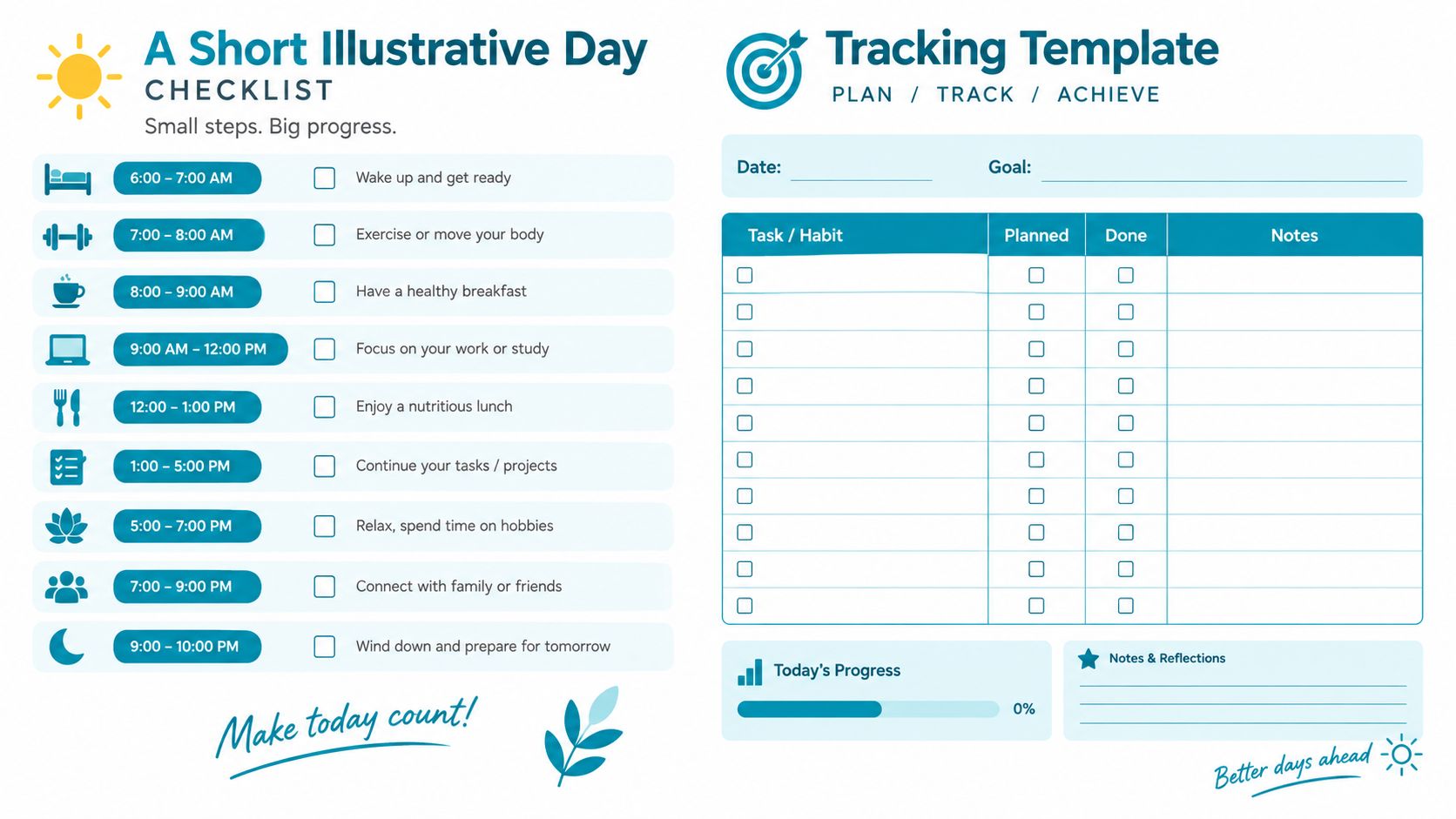
| Date | Main trigger | Personal stress rating | Hours slept | Action chosen and effect on a concrete task |
|---|---|---|---|---|
| Use the same personal scale each time | For example, note whether it was easier to finish a work task |
The scale is for comparing personal experience over time. It doesn't determine whether someone has a disorder, and a wearable or a single body measurement can't establish the cause or severity of stress. If daily functioning stays impaired or symptoms worsen, the record can help a clinician understand the pattern and consider what else may be contributing.
When the Stressor Is Structural and Self-Help Is Not Enough
A person can use healthy coping strategies and still feel strained when the cause remains in place. Financial pressure, caregiving demands, discrimination, unsafe conditions, job insecurity, and excessive workloads may not yield to a walk, breathing exercise, or better schedule. Relaxation can settle the body's stress response, much as easing a car's vibration does not fix the rough road beneath it. Difficulty coping with sustained external pressure is not proof of personal failure.
Work-related stress surveys offer context, though they do not assess any individual's health. In the APA's 2025 Work in America survey, 54% of employed adults surveyed said job insecurity significantly affected their stress levels. A separate 2025 NAMI/Ipsos poll found 52% of employees had felt burned out because of work during the previous year, while 40% had felt overwhelmed enough to affect job performance. The APA's Work in America report provides further context on workplace stress.
A personal experiment can still help clarify what is within reach: identify one stressor, choose one feasible action, then check whether daily functioning improves. If it is safe and practical, someone might document workload concerns, discuss priorities with a manager, set a boundary, or ask a trusted person for support. Depending on the problem, financial, occupational, community, or legal resources may also help. An unsafe environment calls for attention to immediate safety and available support. Uptown Psychology stress therapy describes one form of outside support for work-related stress.
Self-regulation is a tool, not a test of resilience. If stress is contributing to increased alcohol or other substance use, adult addiction-medicine care may be relevant. Support can address the conditions creating stress, as well as the feelings that follow.
Recognizing When Professional Assessment Is Needed
A difficult week can bring worry that eases when the pressure passes. Anxiety may continue even when a specific stressor has changed. Anxiety disorders are health conditions that require professional assessment, and stress and anxiety can overlap. This article cannot determine what explains any one person's symptoms. NIMH's guide to anxiety disorders describes conditions such as generalized anxiety disorder and panic disorder. A qualified clinician can assess symptoms and consider possible causes.
Consider arranging medical or mental-health care if worry persists, sleep or daily responsibilities are repeatedly disrupted, panic-like episodes occur, mood stays low, or coping increasingly involves alcohol or other substances. Worry lasting six months or more may be relevant when assessing for generalized anxiety disorder, but duration alone does not establish a diagnosis. Avoidance, worsening symptoms, and difficulty functioning also help guide an assessment.
Long-term stress is associated with health risks, including high blood pressure, heart disease, diabetes, depression, anxiety, and sleep problems. An association does not mean stress alone caused a particular condition. Persistent symptoms are a reason to ask a clinician whether medical or mental-health factors may be involved. The practice's page on adult mental-health evaluation and care explains its services. For readers comparing structured approaches, stress management techniques for PCOS offers information about clinician-led training.
If there is immediate danger, call 911. In the United States, call or text 988 for suicide or emotional crisis support. Empire Medical Wellness provides outpatient care and is not a crisis center.
Putting It Together and Knowing What Comes Next
Stress management is best treated as a personal experiment, not a promise that every stressor can be removed. Name the main pressure, choose one feasible action, and record whether it changes a concrete part of daily functioning. If it doesn't help, or if symptoms persist or worsen, that information can guide a conversation with a qualified clinician. No single stress rating, wearable reading, or coping technique can replace a thoughtful assessment.
Adults who want to discuss persistent anxiety symptoms can review the practice's information on anxiety evaluation and medication management. Medication decisions depend on an individual clinical assessment; everyday stress alone doesn't establish a need for medication. An educational article cannot provide personal medical advice or determine which care is appropriate for a particular person.
Byline: Empire Medical Wellness Editorial Team
Published: October 17, 2026
Updated: October 17, 2026
Sources
- National Institute of Mental Health, “So Stressed Out! Fact Sheet”
- Centers for Disease Control and Prevention, coping with stress
- MedlinePlus, stress and your health
- American Psychological Association, Work in America survey
- National Institute of Mental Health, anxiety disorders
Empire Medical Wellness offers adult physician-led outpatient mental-health evaluation and medication management, including assessment of anxiety concerns. Visit Empire Medical Wellness to learn about the practice's services and consider whether an evaluation is a helpful next step.