
Is a brighter lamp enough to treat depression, or does the type of depression change what safe treatment involves? Light therapy for depression has its strongest support in winter-pattern seasonal affective disorder, with evidence of benefit in some nonseasonal depression. Possible bipolar depression calls for additional screening because treatment can trigger an unusually high or activated mood state.
Bright light treatment involves a defined device, exposure, schedule, and monitoring plan. It isn't spending more time near an ordinary desk lamp.
Table of Contents
- Where the Evidence Supports Light Therapy
- Light Settings Used in Studies and Guidance
- Bipolar Depression and the Risk of Mood Switching
- How to Start Light Therapy Safely With a Clinician
- Side Effects and When to Contact a Clinician
- Questions to Bring to Your Clinician
- Confirm Whether Light Therapy Fits Your Situation
- Sources and Review Status
Where the Evidence Supports Light Therapy
Evidence varies by depression type, so findings from one group do not automatically apply to another. Seasonal-pattern depression has the strongest support. Evidence for nonseasonal depression is promising but more variable, while bipolar depression calls for particular care in assessing possible mood switching.
Evidence for light therapy by depression type
| Depression type | Evidence strength | Key finding | Main caution |
|---|---|---|---|
| Seasonal affective disorder, winter pattern | Strongest; multiple randomized trials and meta-analyses | In a seasonal-depression study summarized by the National Institute of Mental Health, morning bright light outperformed morning placebo | Consistent daily use matters; improvement may take several weeks |
| Nonseasonal major depression | Promising but more variable; studies differ in intensity, timing, and design | An American Psychiatric Association evidence summary reports 41% remission versus 23% with control or other treatments across 11 trials involving more than 850 participants | Results aren't interchangeable across diagnoses, devices, or comparison treatments |
| Bipolar I or II depression | Limited; small trials and recent dose-escalation research | A dose-escalation randomized trial found hypomanic symptoms in 2 of 38 adults, about 5%, at the 45-minute daily exposure; symptoms improved within three days after reduction | Screen for mania, hypomania, and mixed symptoms before use |
| Prevention of winter depression | Very low evidence quality | A Cochrane prevention review summarized in clinical guidance found an uncertain preventive benefit | Prevention isn't established; a treatment benefit doesn't prove a preventive benefit |
Remission means symptoms fell below the study's threshold for depression. Response generally means meaningful symptom improvement, which isn't necessarily remission. Because studies use different definitions, percentages from separate studies should not be treated as a direct ranking of treatments.
One randomized, double-blind, placebo- and sham-controlled trial compared light alone, fluoxetine alone, their combination, and placebo conditions over eight weeks. Participants were adults aged 19 to 60 with at least moderately severe nonseasonal major depressive disorder. The findings apply to that adult outpatient population and study protocol, not to every form of depression.
A table summarizes groups, not an individual's diagnosis or treatment plan. A discussion of depression evaluation and care can help establish the pattern of illness, including seasonal history, medication response, sleep patterns, and any past high-mood episodes.
Light Settings Used in Studies and Guidance
Which lamp setting is appropriate depends on more than brightness. Intensity, exposure time, distance, and timing work together, so settings from one study should not be treated as a universal schedule.
Lux measures how much visible light reaches a surface. For a light therapy device, the useful figure is the illuminance delivered at the specified distance, not just the number printed on the package.
Light therapy settings described in research and guidance
These settings are reference points, not personal treatment instructions.
| Setting | Intensity | Duration and timing | Context |
|---|---|---|---|
| Seasonal depression guidance | 10,000 lux | 30 to 45 minutes each morning, usually fall through spring | Described in National Institute of Mental Health guidance on seasonal affective disorder |
| Nonseasonal depression trials | 10,000 lux in most studies; 5,000 to 7,000 lux in others | 30 to 60 minutes daily, often in the morning | A 2024 systematic review of 11 randomized trials |
| Bipolar depression specialist recommendations | 5,000 to 10,000 lux, ultraviolet-filtered | Positioned 30 to 33 centimeters, or 12 to 13 inches, from the eyes | Clinical recommendations for bright light therapy in bipolar disorders describe this specialist approach under clinical supervision |
| Bipolar dose-escalation trial | No fixed lux setting specified in the reported summary | Progressed from 7.5 to 45 minutes daily, morning or midday | A randomized trial of adults receiving mood stabilizers |
Why positioning changes the exposure
Lux decreases as distance from the device increases. A lamp may deliver its advertised intensity only at a particular distance, so the device's positioning instructions matter as much as its brightness setting.
Timing matters too. Light reaching the eyes can affect the body's internal timing system. A person's circadian rhythm and sleep timing can therefore be relevant when discussing a schedule with a clinician. Morning use is common in some protocols, but the table does not establish that it suits every depression type or sleep pattern.
A study setting describes what researchers tested. It does not prescribe a schedule for someone using a similar-looking lamp. Before discussing a device with a physician, note its model, stated specifications, intended distance, and proposed schedule.
Bipolar Depression and the Risk of Mood Switching
Bipolar disorder involves episodes of depression and periods of mania or hypomania, which are irritable or activated mood states. Mania is the more intense form. These episodes don't necessarily alternate in a predictable sequence.
A person seeking help for depression may not recognize an earlier activated period as medically relevant. A physician therefore needs a history that extends beyond current sadness, fatigue, or loss of interest.
When specialist guidance advises against treatment
A 2025 clinical recommendations paper on bright light therapy for bipolar disorders identifies acute mania, recent mania or hypomania, mixed symptoms, and rapid cycling as contraindications to bright light therapy. A contraindication is a circumstance in which treatment shouldn't be used because its risks are unacceptable.
Mixed symptoms means depressive and activated symptoms occur together. Rapid cycling describes a pattern of frequent mood episodes. These aren't distinctions a reader should try to settle through a lamp trial.
The paper describes bright white, ultraviolet-filtered light used under clinical supervision. Its specialist approach shouldn't be replaced by a general consumer schedule.
What the small trial does and doesn't establish
The dose-escalation trial involved adults with bipolar depression who were already receiving mood stabilizers. Participants used morning or midday schedules while exposure increased. That treatment context matters: the findings don't establish the safety of unsupervised light treatment without appropriate bipolar care.
The observed hypomanic symptoms support monitoring for mood switching, meaning a change from depression toward hypomania or mania. They don't prove that light therapy is broadly unsafe, and they don't establish that midday treatment is superior.
Important questions remain:
- Starting exposure: Which patients need a more cautious introduction?
- Monitoring: How should follow-up differ after previous mania or hypomania?
- Response thresholds: Which changes should lead the treating clinician to reconsider the plan?
Information about bipolar disorder and clinical assessment can help patients prepare an accurate history. A complete medication list belongs at the visit, and mood stabilizers shouldn't be changed independently. Reduced need for sleep, racing thoughts, and unusual behavior warrant the response levels described below.
How to Start Light Therapy Safely With a Clinician
A clinician-guided start begins with diagnostic and safety questions, not a purchase. The physician determines whether light treatment belongs among the options and what monitoring would be needed.
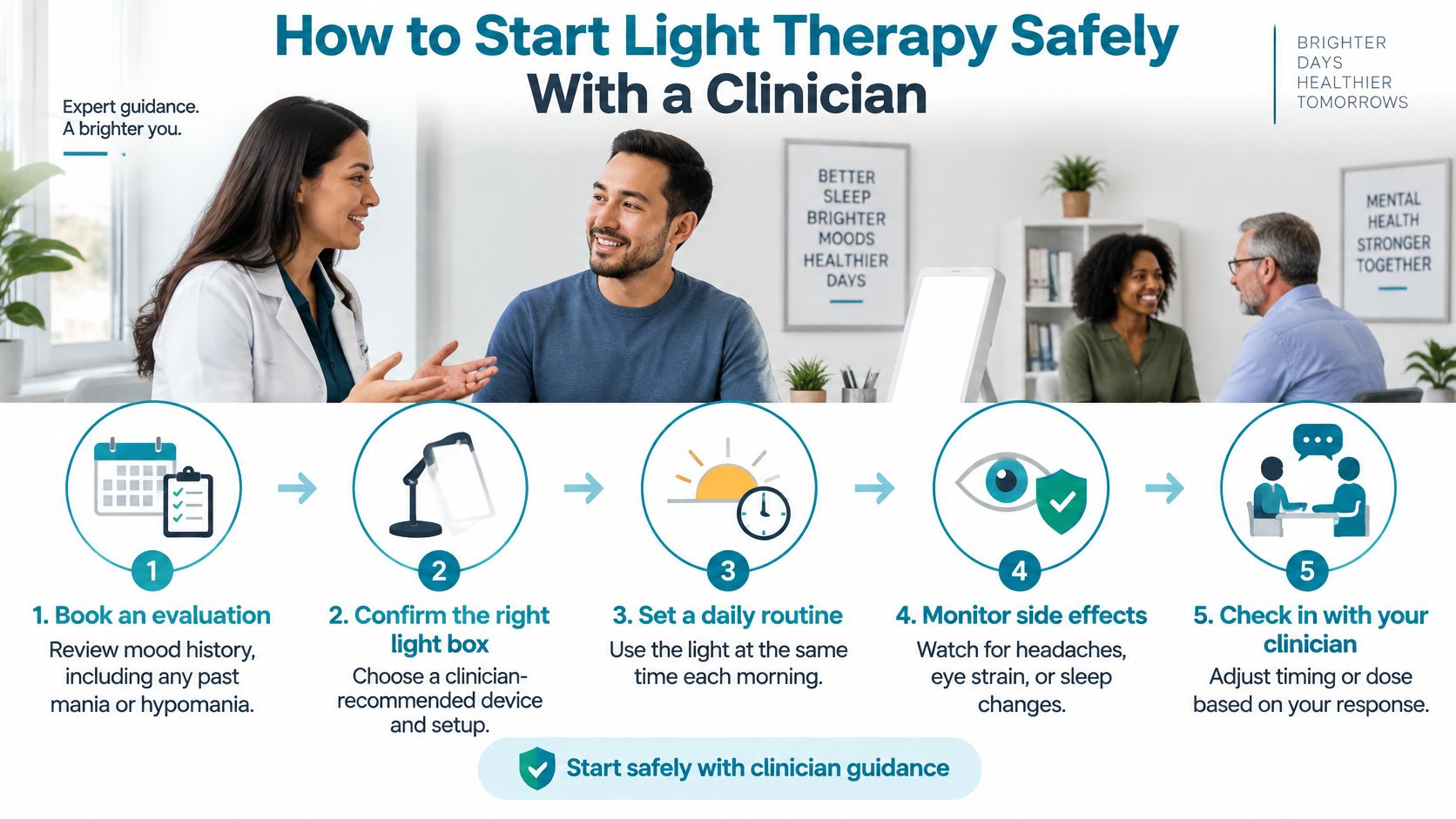
The illustration offers a general overview. Morning treatment isn't appropriate for every patient, and any adjustment belongs with the treating clinician.
A practical preparation sequence
Arrange an evaluation. The history should include previous mania or hypomania, sleep timing, eye conditions, and current medicines. Screening can change whether treatment is suitable at all.
Confirm the depression type under consideration. Seasonal, nonseasonal, and bipolar depression shouldn't be treated as interchangeable because all can involve low mood.
Review the actual device. The physician should examine the model, labeling, intended use, ultraviolet filtering, and stated lux output at a specified distance. FDA clearance and depression-related labeling should be verified for that device rather than assumed from advertising.
Position the device according to its tested instructions and the clinician's plan. MedlinePlus guidance describes a commonly recommended setup of about 60 centimeters, or 2 feet, away for about 30 minutes in early morning, with eyes open and no direct staring. That example isn't a universal distance for every light box.
Confirm the schedule in writing. A useful plan names the time of day, duration, positioning, and frequency. A vague instruction to use a bright lamp leaves too much uncertainty.
Record sleep, mood, energy, headache, and eye discomfort in a simple log. Entries should describe what happened rather than assume the light caused every change.
Agree on reassessment. MedlinePlus states that, when treatment is effective, depressive symptoms may improve within three to four weeks. Progress should be assessed over several weeks rather than judged after isolated sessions.
Contact the treating clinician before changing timing, duration, or distance. Worsening symptoms deserve earlier contact rather than experimentation with a stronger exposure.
Preparation note: A device name and its specifications are more useful at an appointment than a product description promising better mood.
For the first visit, useful materials include the device instructions, intended schedule, current medication and supplement list, and any available sleep or mood entries. Buying a device beforehand isn't necessary to begin the discussion.
Side Effects and When to Contact a Clinician
Light therapy can cause physical discomfort or changes in sleep and mood. The response matters: a mild, stable headache can usually be raised at follow-up, while signs of an activated mood or immediate danger call for faster help.
Side effects sorted by how quickly to respond
| Possible effect | What it can look like | Suggested response |
|---|---|---|
| Headache | Mild headache, sometimes after sessions | Routine: note it and mention it at the next visit; contact sooner if persistent |
| Eye strain or irritation | Tired, sore, or watery eyes | Routine: review positioning and device with the clinician; report persistent symptoms |
| Sleep disruption | Trouble falling or staying asleep, or waking early | Routine follow-up: bring a sleep log and discuss timing; seek earlier advice if worsening |
| Reduced need for sleep or racing thoughts | Feeling energized on much less sleep; rapid speech or thinking | Urgent: contact the clinician the same day |
| Unusually elevated, irritable, or risky behavior | Impulsive decisions, grandiose plans, or agitation | Urgent: contact the clinician right away; seek emergency care if unsafe |
| Thoughts of self-harm or suicide | Thoughts of ending life or hurting oneself | Immediate support: contact crisis services; use emergency care when safety is uncertain or danger is immediate |
Routine means raising a mild, stable symptom at follow-up, or sooner if it persists. Urgent means contacting the clinician the same day rather than waiting for the next appointment. Emergency means obtaining immediate help.
An American Academy of Family Physicians evidence summary lists headache, eye irritation, sleep disruption, and hypomania among reported adverse effects. Evidence about preventing winter depression remains very uncertain, so light therapy should not be assumed to prevent it.
Safety concerns deserve earlier contact
Eye conditions and medicines that increase light sensitivity should be reviewed before treatment. A clinician can assess whether they affect the safety or suitability of light therapy.
For thoughts of self-harm or suicide, call or text 988, the Suicide and Crisis Lifeline in the United States. If danger is immediate, safety cannot be maintained, or an attempt has occurred, call 911 or go to the nearest emergency department.
A severe or rapidly changing symptom should not wait for a scheduled follow-up. An outpatient appointment is not a substitute for emergency care.
Questions to Bring to Your Clinician
A written question list can keep the first visit focused on suitability, practical details, and safety. It needn't function as a script, and not every question will require a lengthy answer.
- Mood history: Given the patient's history of mania, hypomania, mixed symptoms, or rapid cycling, which treatment options fit?
- Which type of depression is being considered, and how was it assessed?
- Could an eye condition or any current medicine raise concern about light sensitivity?
- Device specifications: Which intensity, distance, and timing would the clinician consider, and which device specifications support that setup?
- How long should treatment be assessed before deciding whether it's helping, and what outcomes will be measured?
- Which symptoms require a same-day call, and which require emergency care?
- Treatment coordination: How would light therapy fit with current medications and other treatment?
- With written authorization, should a therapist or primary care clinician participate in coordination?
- What follow-up schedule is appropriate, and what will each visit cover?
Blank planning log for the first visit
| Field | What to record |
|---|---|
| Date | Calendar day of the entry |
| Bedtime and wake time | Clock times for the previous night |
| Minutes of light exposure | Duration used, only if already directed by the clinician |
| Mood rating | A personal rating using the same scale at approximately the same time each day |
| Energy and sleep need | Hours slept and how rested the person feels |
| Headache or eye discomfort | Yes or no, with a brief note |
| Other changes | Racing thoughts, irritability, unusual activity, or spending |
The log is a conversation tool, not a diagnostic instrument. Before treatment begins, the exposure field can remain blank; there's no need to begin light use to complete the record.
Consistent descriptions are more useful than elaborate scoring. An entry such as difficulty falling asleep or unusually energetic despite less sleep gives the clinician something concrete to assess without requiring the patient to interpret it.
A mental health medication review can also organize questions about existing treatment and side effects. The completed log and a current list of medicines and supplements help the physician connect treatment decisions with daily functioning and safety.
Confirm Whether Light Therapy Fits Your Situation
When symptoms are stable and no activated mood symptoms are present, an evaluation can clarify whether light therapy merits discussion alongside medication, psychotherapy, or other appropriate care. Absence of a known bipolar diagnosis doesn't replace a careful mood history.
Current signs of switching require same-day clinical contact. Thoughts of self-harm or inability to remain safe require the crisis or emergency pathway, not a routine appointment.
What a physician-led visit can clarify
Empire Medical Wellness provides private-pay, physician-led outpatient mental health care. The first mental health appointment is 50 minutes and reviews symptoms, medical and treatment history, current medications, daily functioning, and goals. The patient receives an explanation of the assessment, treatment options, and recommended follow-up.
The practice's mental health medication management service describes its evaluation and follow-up work. Information about depression medication decisions provides related context, but medication is considered only when clinically appropriate.
When useful and authorized, the practice can coordinate with a therapist, primary care clinician, or another involved professional. This discussion of light therapy doesn't establish that Empire supplies devices or offers light treatment.
For nonurgent concerns, appointment scheduling information provides a route to an evaluation. A visit can clarify options without requiring a treatment decision beforehand.
Sources and Review Status
The evidence discussed in this article draws on clinical guidance and patient information from several organizations:
- National Institute of Mental Health guidance on seasonal affective disorder
- American Psychiatric Association summary of bright light therapy
- 2025 recommendations for bright light therapy in bipolar disorder
- MedlinePlus information on light therapy
- American Academy of Family Physicians summary of light therapy research
Empire Medical Wellness provides private, physician-led mental health evaluation and medication management for children ages 8 and up, adolescents, and adults. For adults considering how light therapy might fit into a depression assessment, Empire Medical Wellness describes the practice's care process. This article is educational and is not personal medical advice.