
Can a mood that feels like ordinary enthusiasm signal something more serious when energy, sleep, and judgment change together? Bipolar disorder is a mental-health condition involving distinct episodes of altered mood, energy, and activity. Understanding the pattern over time matters: everyday mood changes alone don't establish a diagnosis, and a single symptom or test can't settle the question.
This guide explains bipolar I and bipolar II, what a professional assessment considers, and how treatment and day-to-day tracking can support ongoing care. It's educational and isn't personal medical advice.
Table of Contents
- Understanding Bipolar Disorder as a Clinical Condition
- Bipolar I, Bipolar II, and What Distinguishes an Episode
- How a Professional Assessment Works
- Treatment Goals From Acute Stabilization to Long-Term Stability
- Sleep, Circadian Rhythm, and What to Track Between Visits
- Why Individualized Care Often Looks Different From a Simple List
- Preparing for an Appointment and a Blank Mood and Sleep Log
- When to Seek Urgent Help and How to Connect With Care
Understanding Bipolar Disorder as a Clinical Condition
What makes a change in mood part of a clinical pattern rather than an ordinary response to life? Clinicians look at how mood, energy, and activity shift together over time. Episodes may involve unusually high, expansive, or irritable mood with increased energy or activity, and may also include periods of depression. The change is assessed in context: how long it lasts, how different it is from a person's usual functioning, and whether it affects work, relationships, or safety.
Bipolar disorder occurs across countries and age groups. The World Health Organization estimated that about 36 million people worldwide were living with the condition in 2023, roughly 0.4% of the global population, including around 32 million adults (WHO's bipolar disorder fact sheet). In the United States, the National Institute of Mental Health estimates that 2.8% of adults experienced bipolar disorder in the past year and 4.4% experienced it at some point in their lives (NIMH's bipolar disorder information).
These figures describe populations, not whether a particular person has bipolar disorder or what their future will be like. The U.S. past-year estimate varies by age, and NIMH reports that most affected adults had serious functional impairment. Effects may reach beyond mood, influencing relationships, work, education, and medical care. Individual experiences differ.
Mood variation and clinical episodes
Feeling energized after good news or tired during a demanding period does not by itself indicate a mood disorder. A clinician considers whether there is a distinct mood change alongside changes in energy or activity, other symptoms, and meaningful effects on functioning. Episodes may be hard to recognize as they unfold. Reduced sleep or increased activity can initially feel productive, making changes less obvious to the person experiencing them and those around them.
Bipolar disorder is a clinical condition, not a personality trait or a judgment about someone's choices. Assessment and care can develop over time as a clinician and patient identify patterns together. Tracking changes between appointments can help clarify what is typical for that individual, while medication choices and adjustments require individualized professional care. For information on depression and its treatment, remember that depression and bipolar disorder are not interchangeable and may call for different treatment approaches.
Bipolar I, Bipolar II, and What Distinguishes an Episode
What separates bipolar I from bipolar II? The key distinction is whether a person has experienced mania. Bipolar I requires at least one manic episode. Bipolar II involves at least one major depressive episode and at least one hypomanic episode, with no history of full mania. Hypomania is less severe than mania, but bipolar II can still involve serious depression that disrupts daily life.
| Feature | Bipolar I | Bipolar II |
|---|---|---|
| High-energy episode | At least one manic episode | At least one hypomanic episode, with no full manic episode |
| Depression | May occur, but isn't required for diagnosis | At least one major depressive episode is required |
| Severity and function | Mania causes marked impairment, may require hospitalization, or may include psychosis | Hypomania is less severe and doesn't cause the marked impairment, hospitalization, or psychosis associated with mania |
The American Psychiatric Association's explanation of bipolar disorders describes mania as lasting at least a week, or any length of time if hospitalization is necessary. Symptoms can include reduced need for sleep, unusually rapid or persistent speech, racing thoughts, distractibility, increased goal-directed activity or agitation, inflated self-esteem, and impulsive actions with a high risk of harmful consequences. Diagnosis involves several symptoms and a significant effect on functioning, hospitalization, or psychosis.
Hypomania can involve similar changes: speaking more quickly, sleeping less without feeling tired, or taking on far more activities than usual. A person's mood may feel positive, but that alone does not define an episode. Clinicians consider how clearly behavior differs from the person's usual pattern, how long the change lasts, and its effects on functioning. The APA's bipolar II overview explains that diagnosis is a clinical process, not one routinely established by a blood test, brain scan, or genetic test.
Episodes can be difficult to recognize in the moment, especially when increased energy initially feels productive. Tracking changes over time can help a person and clinician identify patterns and revisit an assessment as understanding develops. Treatment is an ongoing partnership, including individualized medication decisions and follow-up, rather than a one-time fix.
Distinguishing point: Increased energy matters most when it forms part of a sustained change in mood, sleep, activity, and behavior.
How a Professional Assessment Works
A professional assessment builds a lifetime pattern from information gathered over time, rather than relying on how someone feels during one appointment. The clinician may ask about past periods of unusual energy or activity, reduced need for sleep, rapid speech, racing thoughts, irritability, or risky decisions. They'll also ask about depressive episodes, their effects on daily life, and whether hospital care was needed.

Family history, medical conditions, prescribed medicines, supplements, and alcohol or other substances may also come up. These details help a clinician distinguish a mood pattern from other influences. For example, thyroid disease can affect mood, and some medicines or substances may change mood or sleep. NIMH guidance notes the value of reviewing symptoms and medical history.
Why the timeline matters
Memories of an episode can differ from what a relative or partner observed. With the person's permission, someone who knows them well may help clarify changes in sleep, speech, activity, or judgment. Their account adds context, while the person's own perspective and a private, respectful conversation remain central.
Assessment may take more than one visit. Like assembling a timeline from separate observations, the clinician gathers history and considers other explanations before clarifying a diagnosis. A physician-led outpatient evaluation may include diagnostic review and medication assessment, followed by check-ins shaped by symptoms, safety, and response to care. When useful and authorized, the clinician may coordinate with an outside therapist or another treating professional.
There is no self-test that can diagnose bipolar disorder. A structured history helps distinguish episodes from everyday mood variation and supports decisions about care. The assessment can evolve as new patterns emerge, making follow-up part of an ongoing clinical partnership rather than a one-time answer. Severe symptoms or safety concerns may call for a different level of care, determined individually.
Treatment Goals From Acute Stabilization to Long-Term Stability
What does bipolar care look like after an acute episode settles? Treatment usually has two related aims: addressing a current episode and reducing the chance of future episodes. The balance depends on symptoms, safety, episode history, other health conditions, and response to care. Because these factors can change, treatment is an ongoing partnership, not a one-time fix.
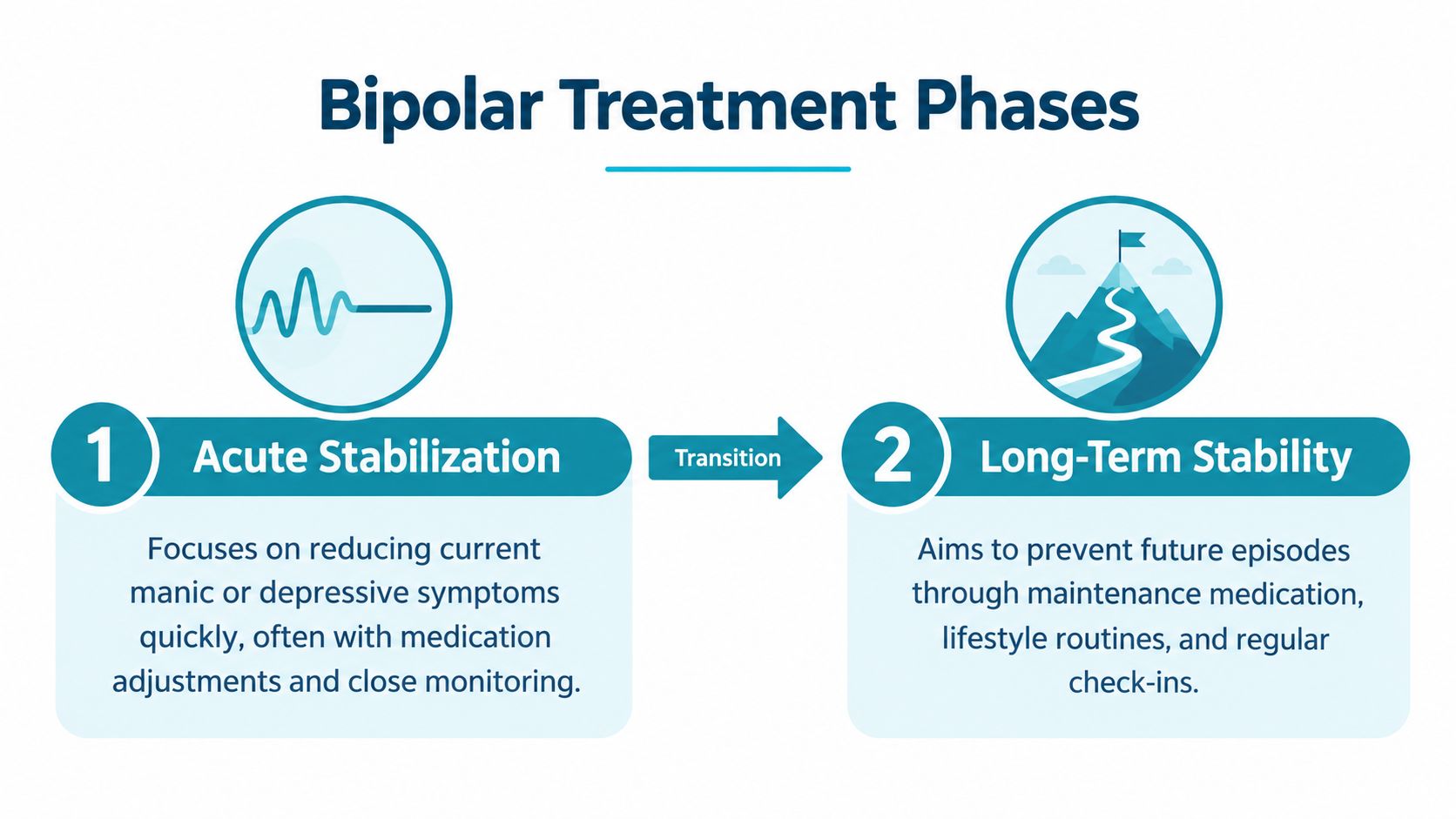
During a manic or depressive episode, a clinician assesses its severity and considers care to reduce current symptoms. Mood stabilizers and some antipsychotic medicines may be used to treat or prevent episodes. The right choice is individual, and medication changes need the treating clinician's oversight.
Maintenance and monitoring
When symptoms improve, care may shift toward preventing recurrence. A 2024 clinical guideline reports that recurrence risk after a year is about 40% when effective medication continues, compared with about 65% after discontinuation (the guideline's review of bipolar treatment). These figures describe groups, not an individual's forecast. Medication also cannot eliminate all relapse risk.
Stopping or changing a mood stabilizer or antipsychotic calls for a careful clinical decision. The prescriber considers episode history, side effects, reproductive considerations, other health conditions, and the possible benefits and risks of a change. If stopping is appropriate, the plan should be individualized and supervised.
Lithium has evidence for reducing suicide risk, while its use requires individualized prescribing and safety monitoring. NIMH describes lithium and valproate as mood stabilizers that may help prevent episodes or reduce their severity. Lithium care also involves attention to toxicity risk, kidney and thyroid health, medication interactions, and blood lithium concentrations (NIMH's lithium and mood-stabilizer information). Monitoring helps clinicians adjust care safely; it does not mean treatment is failing.
Antidepressants taken alone can provoke mania or rapid cycling in some people with bipolar disorder, so a clinician should oversee those decisions. Anyone concerned about medication benefits or side effects can prepare for a review by listing what's working, what isn't, and what has changed. This overview of psychiatric medication benefits and risks explains some of the trade-offs involved.
Sleep, Circadian Rhythm, and What to Track Between Visits
Sleep and daily rhythms are clinically relevant to bipolar disorder. Research reviews describe changes in sleep timing, social-rhythm regularity, melatonin secretion, and other circadian patterns. Irregular routines may persist even when symptoms improve, and disrupted rhythms are associated with episode risk. These findings don't establish that rhythm disruption causes an episode, but they make sleep and routine useful topics to discuss with a clinician (review of circadian rhythms in bipolar disorder).
A useful record captures more than a mood label. It can help a clinician see whether changes in sleep, energy, irritability, impulsivity, medication timing, substance use, or daily functioning appear together. NIMH recommends mood journaling and regular routines as practical supports. A log is for discussion, not self-diagnosis or self-directed medication changes.
- Sleep: Record how long you slept and whether bedtime or wake time shifted.
- Energy and mood: Note changes in activation, low mood, irritability, or anxiety.
- Function: Describe changes in work, relationships, responsibilities, or usual activity.
- Medication and substances: Record medication as taken, side effects, and any alcohol or other substance use that may be relevant.
A major schedule shift, reduced need for sleep, or escalating energy deserves prompt discussion with the treating clinician. A clinician can help interpret the pattern alongside physical health, stress, and treatment history. Readers seeking broader information about sleep can consult sleep health guidance from Pain and Sleep. Information about circadian rhythm and its relationship to health may also help explain why regular timing matters.
Why Individualized Care Often Looks Different From a Simple List
A treatment chart can't capture every person's medical history, priorities, side effects, or access to medication. International prescribing research describes differences in lithium use across countries, with its use declining in some high-income countries while remaining central in others. A separate clinical-practice analysis found that more than one-third of patients with bipolar depression weren't receiving a medication explicitly recommended by guidelines; only 6% received recommended monotherapy, and more than one-third received four or more psychotropic medicines (analysis of global medication-use research). These findings describe particular research and practice settings, not a universal standard or a judgment about any individual's treatment.
A clinician may revisit a diagnosis, simplify a medication plan, or consider another option when symptoms change, side effects become difficult, or health circumstances shift. Comorbid medical conditions, substance use, reproductive considerations, medication interactions, and the person's preferences can all affect the risk-benefit discussion. That flexibility is different from prescribing without a clear rationale.
Monitoring is part of the plan
Follow-up helps the prescriber assess symptom patterns, functioning, side effects, and relevant laboratory or metabolic concerns. The timing depends on the person's needs and treatment response. There's no single schedule or medication combination that fits everyone, and more medicines don't automatically mean better care.
A useful appointment discussion asks what each medicine is intended to address, what changes should be reported, and how benefits and adverse effects will be reviewed. People concerned about weight-related effects can raise the issue without assuming a particular medication will cause them. A guide to psychiatric medication and weight gain offers background for that conversation.
Preparing for an Appointment and a Blank Mood and Sleep Log
A short written summary can make an appointment more focused. Approximate dates and durations are enough to start; exact recall isn't required. The aim is to help a clinician understand changes over time, not to reach a diagnosis independently.
Appointment preparation checklist
- Mood history: Note past periods of depression, unusually high energy, irritability, or major activity changes, including approximate timing and duration.
- Health context: List medical conditions, relevant family history, and any past hospital care.
- Current substances and medicines: Include prescriptions, over-the-counter medicines, supplements, and alcohol or other substance use.
- Questions: Write down concerns about diagnosis, side effects, monitoring, daily functioning, or next steps.
A mood and sleep log can make patterns easier to review. Keep it brief and bring it to an appointment; it doesn't determine a diagnosis or tell someone how to change treatment.
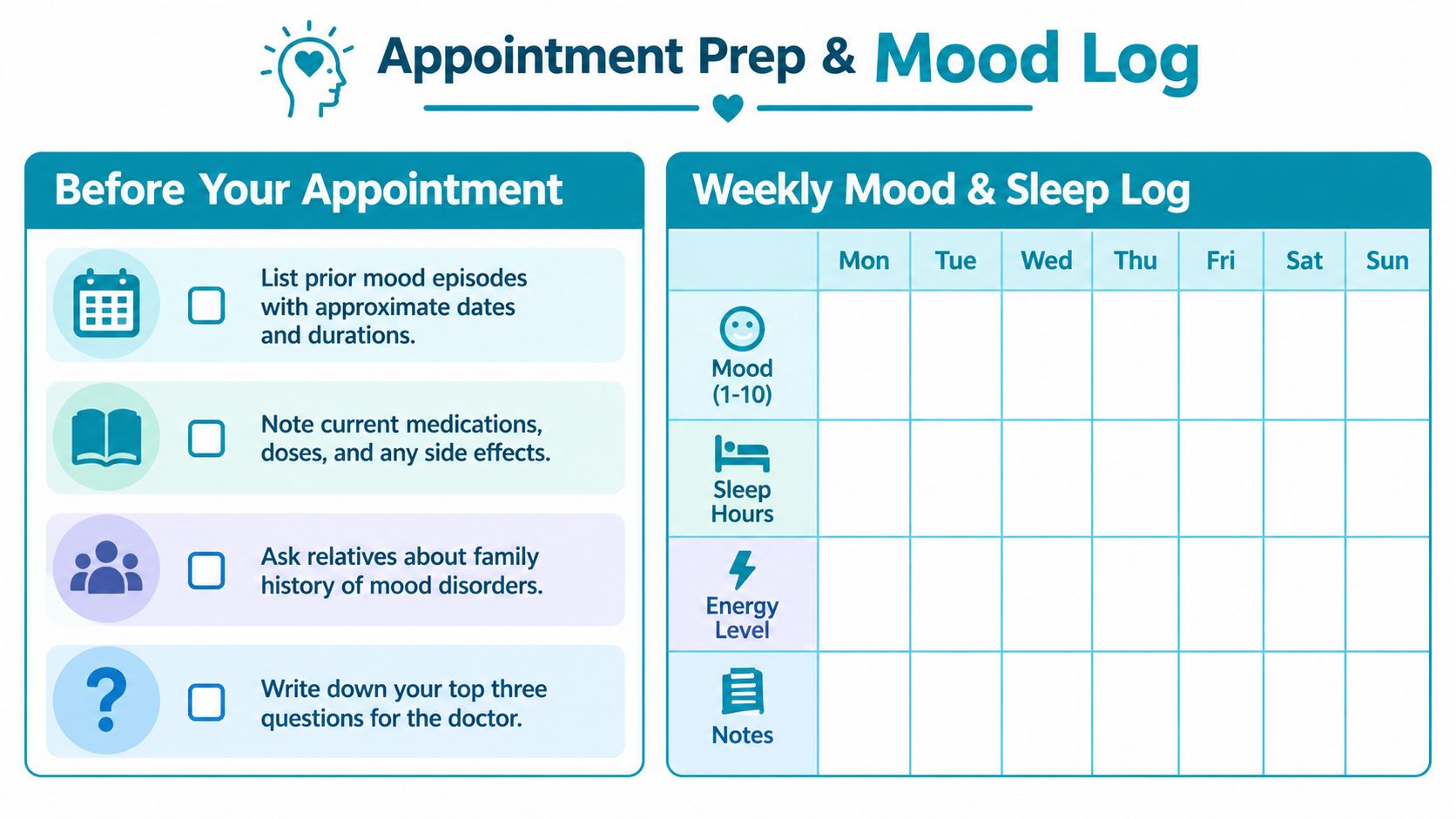
| Date | Mood description | Sleep duration and timing | Energy | Daily functioning | Medication taken as prescribed | Side effects |
|---|---|---|---|---|---|---|
For a medication-focused discussion, a mental-health medication review can provide context. Any changes to prescribed treatment should be discussed with the treating clinician.
When to Seek Urgent Help and How to Connect With Care
Severe mania, psychosis, suicidal thoughts, or inability to remain safe require urgent assessment. Psychosis can involve losing touch with reality, such as experiencing hallucinations or fixed false beliefs. A person who may be at immediate risk needs emergency help rather than waiting for a routine appointment.
In the United States, call or text 988 for crisis support. Call 911 if there's immediate danger or an emergency. If symptoms are worsening quickly, contact the treating clinician promptly; a clinician can assess whether urgent or higher-level care is needed. Outpatient care may not be appropriate for every situation, and level-of-care decisions are individualized.
Medication concerns also deserve timely attention. New activation, serious side effects, or worsening symptoms warrant prompt prescriber review. These changes aren't a reason to adjust medication independently. A treatment plan should be revisited with the clinician who knows the person's history and current risks.
For adults seeking care, Empire Medical Wellness offers physician-led outpatient mental-health evaluation, diagnostic clarification, medication review, and ongoing medication management. Referral and level-of-care decisions are individualized. Visit Empire Medical Wellness to learn about the practice's adult mental-health services.
Byline: Empire Medical Wellness Editorial Team
Published: October 17, 2026
Updated: October 17, 2026
Sources: World Health Organization bipolar disorder fact sheet; National Institute of Mental Health, Bipolar Disorder; American Psychiatric Association, bipolar disorder diagnostic information; 2024 clinical guideline on bipolar disorder.
This article is educational and isn't personal medical advice.