
Physical withdrawal usually peaks within 24 to 72 hours and eases over about a week, while alcohol cravings can continue for weeks or months and sometimes return much later, so there's no single number. Why can someone feel physically better yet still have a strong urge to drink?
The answer starts with separating withdrawal from craving. They can occur together, but they aren't interchangeable. Understanding that distinction helps adults recognize what needs emergency care, what deserves a clinical appointment, and what belongs in an ongoing recovery plan.
Table of Contents
- How Long Cravings Last Phase by Phase
- Why Withdrawal and Craving Are Not the Same
- Why Cravings Return and What Shapes Their Length
- When Cravings Call for Medical Care
- Strategies That Ease Cravings Day to Day
- Common Questions About Craving Duration
- Talk With a Physician About Your Craving Plan
How Long Cravings Last Phase by Phase
Craving timing isn't one number because different processes overlap. The body's adjustment after heavy drinking follows a different course from an urge prompted by an old routine or stressful event.
The NIAAA Alcohol Treatment Navigator describes withdrawal beginning about 6 to 24 hours after stopping or substantially reducing heavy, long-term drinking, with symptoms generally peaking between 24 and 72 hours. Acute withdrawal is commonly described as lasting about 5 to 7 days, but craving can continue beyond that window.
Alcohol withdrawal and craving timeline by phase
| Phase | Typical timing | What it can feel like | When to involve a clinician |
|---|---|---|---|
| Early withdrawal | About 6 to 24 hours after stopping or sharply cutting back | Tremor, sweating, racing pulse, anxiety, nausea | Contact a clinician promptly, especially after heavy, long-term drinking |
| Peak physical withdrawal | About 24 to 72 hours after stopping | Most intense physical symptoms; seizures and delirium tremens are possible | Seek emergency care immediately for confusion, hallucinations, or seizures |
| Acute withdrawal window | Commonly about 5 to 7 days; NIAAA also describes a window of up to five days | Physical symptoms may ease, but cravings and sleep disruption can remain | Stay in contact with a clinician until symptoms settle |
| Subacute period | Weeks | Insomnia, irritability, mood changes, and intermittent craving | Seek care if sleep, anxiety, or craving worsen |
| Protracted craving | Months, sometimes years | Cue-triggered urges linked to familiar situations or reminders of drinking | Seek care if urges are frequent, intense, or hard to control |
These are clinical orientation points, not deadlines. The difference between descriptions of the acute window reflects individual differences and how sources define its end. Neither description establishes when a person's last craving should occur.
Reading the timeline safely
The later rows don't mean that every person develops prolonged symptoms. They also don't mean that new physical symptoms should automatically be attributed to recovery.
Practical rule: Physical withdrawal risk is concentrated in the early period. Later urges require attention to triggers and relapse risk, but dangerous physical symptoms always deserve medical assessment.
Someone who has been drinking heavily for a prolonged period shouldn't assume that stopping abruptly is medically risk-free. Medical guidance before stopping is safer than using a timeline to decide whether withdrawal can be managed alone.
Why Withdrawal and Craving Are Not the Same
Withdrawal is the body's response to reducing or stopping alcohol after becoming physically accustomed to it. Craving is a strong urge or desire to drink. A person can have both, either, or a changing combination.
The end of shaking doesn't establish the end of craving, and craving alone doesn't establish that dangerous withdrawal is occurring.
The NIAAA explanation of the cycle of alcohol addiction describes recovery as a longer process than clearing alcohol from the body. Learned associations and negative emotional states can remain relevant after the most obvious physical symptoms have eased.
As an illustration rather than a medical model, withdrawal resembles an alarm that remains activated after a familiar input disappears. Craving can resemble a familiar song that brings back a memory long after the surroundings have changed. Neither comparison predicts severity, but each highlights a different process.

A hypothetical distinction
Hypothetical example: An adult no longer has shaking after stopping heavy drinking but experiences a strong urge every Friday evening. That pattern raises questions about the former drinking routine, social setting, and expectations attached to the evening. It doesn't, by itself, establish continuing acute withdrawal.
Conversely, someone with confusion and worsening tremor needs medical assessment, not just distraction techniques. The practice's explanation of alcohol withdrawal effects provides related context for distinguishing symptoms.
Persistent craving doesn't automatically mean that treatment has failed. New, worsening, or dangerous physical symptoms need prompt attention; craving calls for a workable plan and follow-up.
Why Cravings Return and What Shapes Their Length
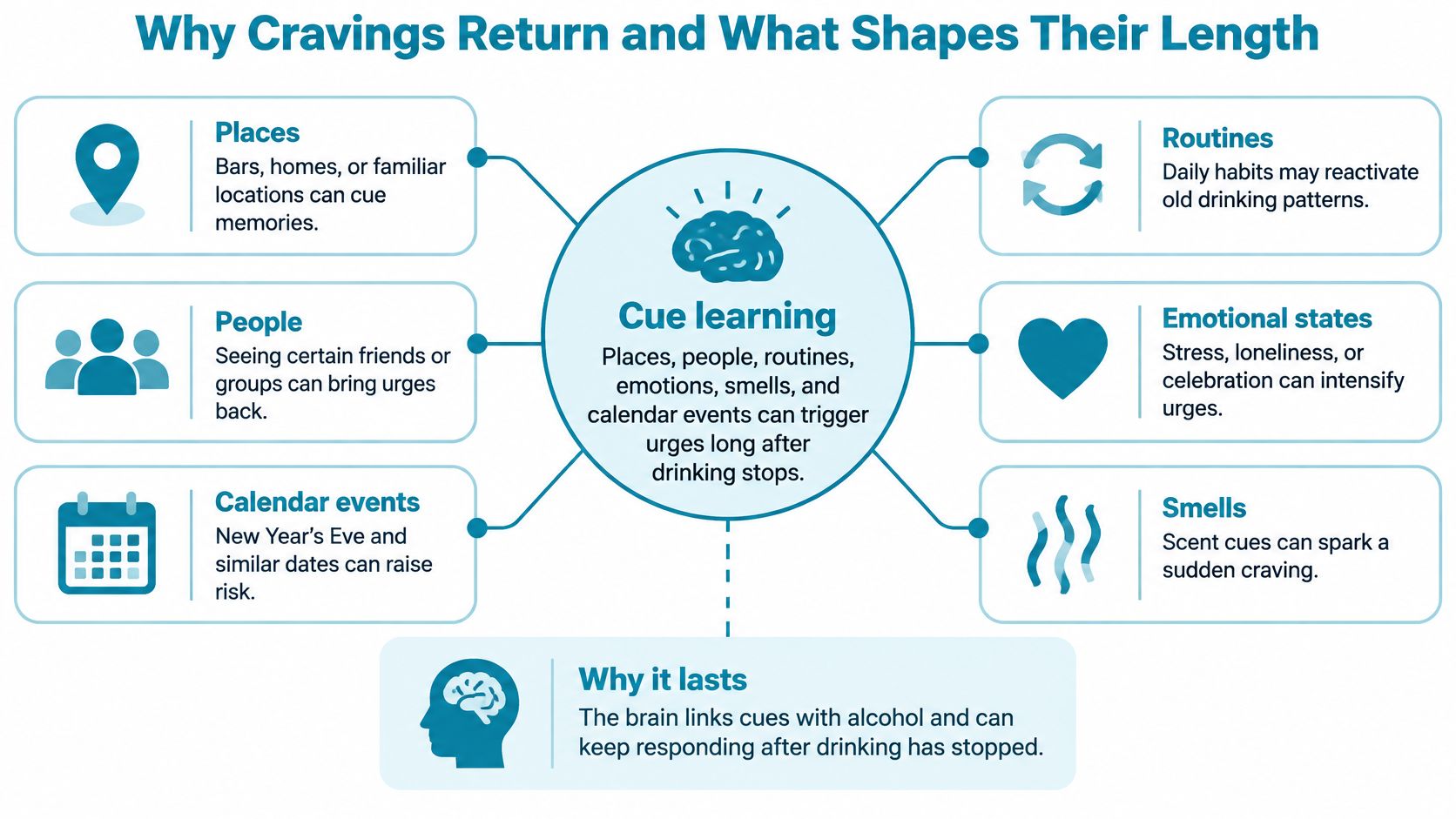
Places, people, routines, emotional states, and sensory reminders can become associated with drinking. When those reminders reappear, an urge may follow even when alcohol hasn't been part of daily life for a long time.
NIAAA recovery research material describes cravings persisting for months or years during abstinence, particularly after repeated heavy drinking. It also explains how alcohol-related cues can provoke renewed craving after a prolonged period without drinking.
The mechanism isn't a lack of willpower. Repeated drinking can strengthen associations between a situation and an expected reward or relief. Stress and negative mood may make that anticipated relief feel especially compelling.
Factors worth reviewing
A clinical assessment can examine several overlapping influences:
- Drinking history: The pattern and intensity of previous alcohol use help establish context.
- Sleep and emotional symptoms: Poor sleep, anxiety, irritability, or low mood may accompany ongoing urges.
- Social surroundings: Familiar drinking companions and settings may create recurring exposure to cues.
- Current stress: Conflict, loneliness, or a major life change may alter the situations in which urges occur.
- Other substance use and support: These belong in an individualized assessment rather than a universal craving forecast.
These factors don't provide a reliable countdown. A difficult evening after a relatively comfortable period doesn't prove that progress has reversed.
Measuring what matters
Frequency, intensity, and control are more useful than just recording whether any urge occurred. An occasional, manageable thought about alcohol is different from repeated urges that interrupt work, undermine sleep, or lead to drinking against a person's intentions.
A returning urge is information for a treatment plan, not a verdict on recovery.
Understanding what relapse means can help separate an internal experience from a return to drinking. The practical question is whether the existing plan still provides enough support for the person's current circumstances.
Evidence about individual trajectories remains limited. No responsible forecast can identify the date on which a particular adult will stop experiencing cravings.
When Cravings Call for Medical Care
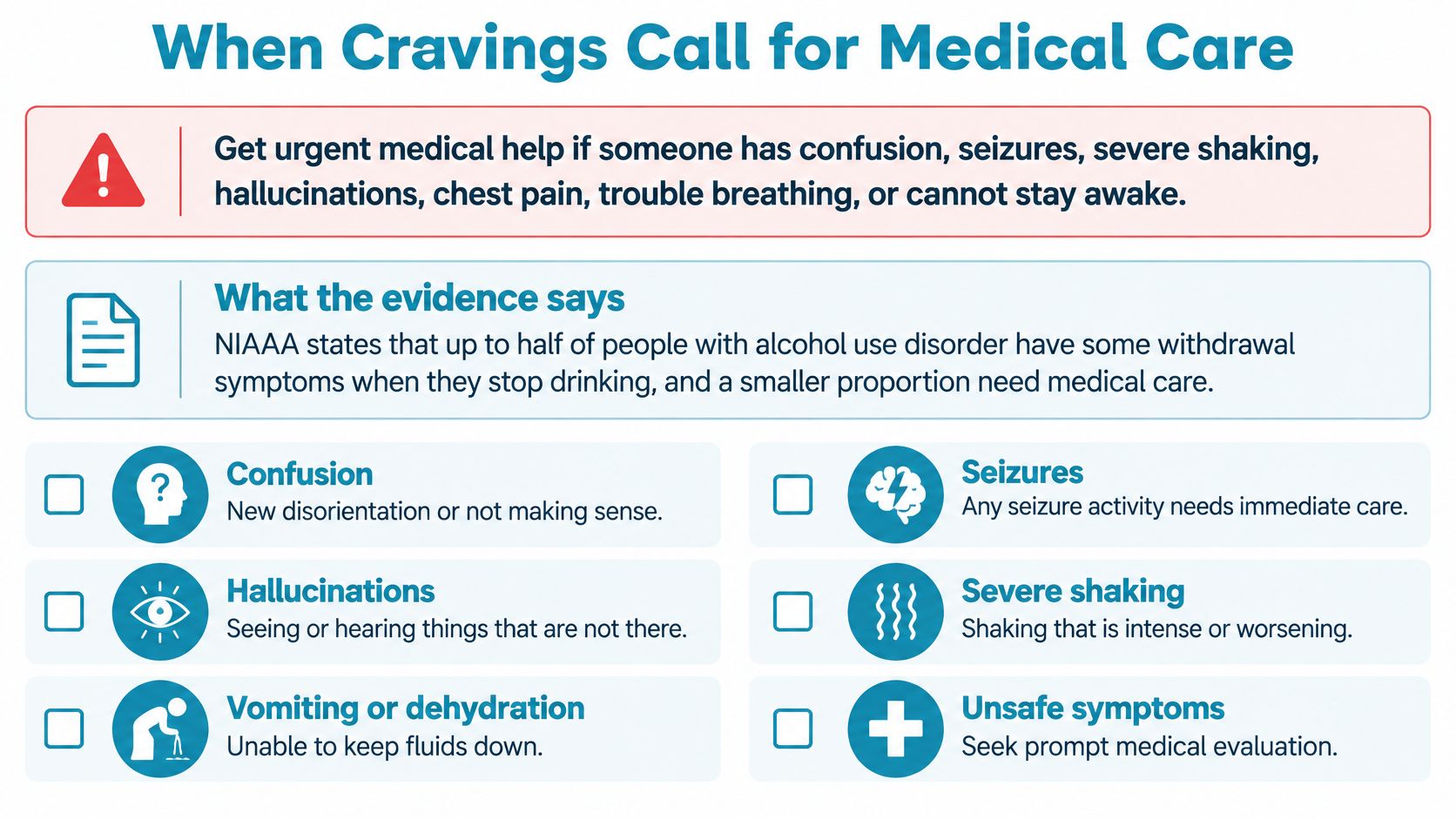
Seizures, confusion, disorientation, or hallucinations after reducing alcohol require emergency care. Delirium tremens is a severe withdrawal complication involving marked confusion and physical instability. It isn't an ordinary urge to drink.
The NIAAA clinical resource on alcohol use disorder states that up to half of people with alcohol use disorder experience some withdrawal symptoms when they stop drinking, while a smaller proportion need medical care and monitoring. That distinction matters: not every craving is an emergency, but severe withdrawal shouldn't be managed as a routine craving.
Warning signs and the right next step
| Sign | Action | Timing |
|---|---|---|
| Seizure, confusion, hallucinations, or delirium tremens | Call 911 or seek emergency care | Now |
| Fever, very fast heartbeat, or vomiting that prevents keeping fluids down | Seek emergency medical evaluation | Now |
| Thoughts of harming oneself | Call or text 988 Suicide and Crisis Lifeline; call 911 for immediate danger | Now |
| Frequent, intense, or hard-to-control cravings, or worsening sleep, anxiety, or low mood | Contact a clinician for a non-emergency visit | Routine, sooner if symptoms worsen |
| Wish to stop after heavy, long-term drinking | Obtain medical guidance before stopping | Before stopping |
Chest pain, trouble breathing, or inability to stay awake also require emergency help. An outpatient appointment isn't a substitute for emergency assessment.
Non-emergency care still matters
Cravings deserve a clinical conversation when they repeatedly overcome a person's coping plan or accompany continued drinking despite a wish to stop. Preparation for a first addiction medicine appointment can make that conversation more concrete.
When detoxification, residential treatment, partial hospitalization, or intensive outpatient care is appropriate, Empire Medical Wellness can help coordinate the next step. Those levels of care are distinct from the practice's outpatient evaluations.
For possible severe withdrawal or immediate danger, call 911. When uncertainty concerns whether symptoms represent an emergency, emergency evaluation is the safer next step.
Strategies That Ease Cravings Day to Day
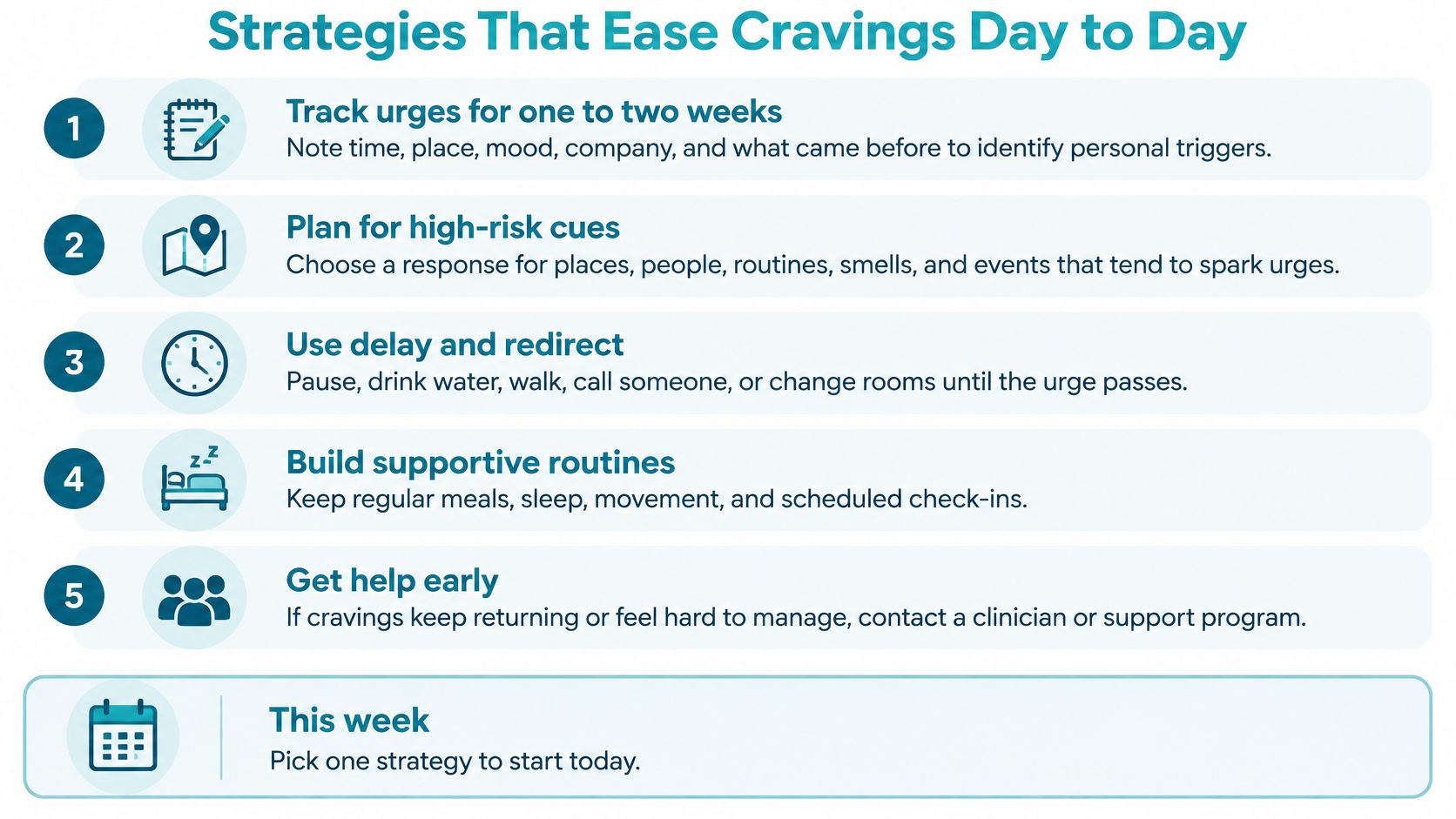
A day-to-day plan should identify likely situations and specify an action before an urge becomes difficult to manage. These options are practical planning tools, not a substitute for withdrawal assessment or individualized treatment.
Five options for a written plan
Keep an urge log. A notebook or phone note can record time, place, mood, company, and what happened beforehand. The purpose is to identify patterns, not to judge the person experiencing them.
Prepare for high-risk situations. A planned departure, independent transportation, and an alcohol-free drink can make a social event easier to handle. Changing a familiar evening routine is another concrete option.
Bring sleep and mood concerns to care. A record of disrupted sleep, anxiety, and low mood helps a clinician assess the full picture. These symptoms shouldn't be dismissed as something a person must tolerate.
Practice observing rather than immediately acting. Urge surfing is a mindfulness-based coping skill: name the urge, notice bodily sensations, and observe changes without treating the urge as a command. A counselor can help adapt coping skills when observation alone feels insufficient.
Arrange specific support. A scheduled counseling visit, peer-support meeting, or check-in with a trusted person creates a defined point of contact. A useful plan names whom to contact and what to do if that person isn't available.
These steps aren't equally useful for everyone. Behavioral treatment involves selecting and practicing skills, then reviewing what helps rather than assuming that effort guarantees a particular outcome.
Medication and emerging approaches
Medication decisions belong in medical care. Naltrexone, acamprosate, and disulfiram are FDA-approved options for alcohol use disorder; they work differently and aren't interchangeable craving remedies. Other medications may be used off-label, meaning outside their FDA-approved indication, after an individualized clinical assessment.
An article shouldn't be used to start, stop, or change medication. A qualified clinician must evaluate health history, other medications, treatment goals, and monitoring needs.
Brain stimulation remains under study rather than a routine craving-management option: a 2024 randomized trial in the Indian Journal of Psychological Medicine found greater craving reduction with active stimulation at week 1 and week 4, but no significant between-group difference at week 8. That finding doesn't establish a durable benefit for an individual patient.
A discussion of outpatient alcohol treatment can help clarify how ongoing assessment differs from emergency withdrawal care.
Common Questions About Craving Duration
Does a craving mean a person has relapsed?
No. A craving is an urge; returning to drinking is a behavior. An urge can prompt a review of the circumstances without being treated as proof that recovery has ended.
The clinically useful questions concern what happened next. Was the urge manageable, was support available, and did the person remain able to follow the plan? Shame doesn't answer those questions.
Can cravings return after a year?
Yes. An extended period without drinking doesn't guarantee that every learned association has disappeared. A familiar setting or a major stressor may reveal a gap in an otherwise useful plan.
A returning urge warrants more attention when it becomes persistent, harder to resist, or associated with resumed drinking. The length of prior abstinence shouldn't prevent someone from requesting help.
Do cravings always fade?
There's no fixed schedule that applies to everyone. Some people experience increasingly infrequent urges, while others need continuing support for intermittent episodes.
A more useful measure is whether daily functioning, safety, and control are improving. Waiting for every thought about alcohol to disappear can obscure meaningful progress.
How long does a single craving episode last?
The sources supporting this timeline don't establish a universal duration for an individual episode. A precise promise that an urge will end after a set number of minutes would overstate the evidence.
An episode that feels prolonged or repeatedly returns deserves a coping plan with a clear escalation step. Severe physical symptoms require medical assessment rather than an attempt to wait out the urge.
Talk With a Physician About Your Craving Plan
A useful appointment starts with a description of what's happening, not a self-diagnosis. The question “How long do alcohol cravings last?” becomes more actionable when paired with information about safety, patterns, and daily impact.
Preparing for an evaluation
- Record the pattern. Note when urges occur, their frequency and intensity, and what happened immediately beforehand. Include whether drinking followed.
- Bring relevant history. List the usual drinking pattern, previous withdrawal symptoms, prior treatment, current medications, and medical or mental health concerns.
- Prepare decision-focused questions. Ask which symptoms need monitoring, which treatment options fit the health history, and what should trigger earlier follow-up.
A medication discussion can include questions about the purpose, limitations, and monitoring requirements of options such as naltrexone. Reading about a medication doesn't establish that it's appropriate for a particular person.
Empire Medical Wellness begins addiction medicine care with a confidential outpatient assessment of the current situation, medical risks, previous treatment, medications, and goals. Evidence-based medication may be part of care when clinically appropriate, and an appointment doesn't guarantee a prescription.
Sources and editorial information
Sources used include the NIAAA Alcohol Treatment Navigator, NIAAA's explanation of the addiction cycle, NIAAA recovery research material, the NIAAA clinical resource on alcohol use disorder, and the peer-reviewed stimulation trial linked above.
Byline: Empire Medical Wellness Editorial Team
Publication and updated dates: Not specified.
This article is educational and isn't personal medical advice. Suspected severe alcohol withdrawal requires emergency care rather than an outpatient scheduling request.
Empire Medical Wellness offers confidential, physician-led outpatient addiction medicine evaluations, individualized planning, and follow-up. Adults concerned about persistent alcohol cravings can visit Empire Medical Wellness to learn about an assessment of their symptoms, medical risks, and next steps.