
Executive dysfunction describes difficulty planning, starting, organizing, and completing tasks. It's a pattern of difficulty with cognitive skills, not a diagnosis by itself, and it doesn't establish ADHD.
If someone knows what needs doing but repeatedly struggles to do it, does naming the difficulty explain its cause? Not necessarily. A useful medical evaluation separates what is happening, how it affects daily life, and why it may be happening.
Table of Contents
- What Executive Dysfunction Means and Its Core Skills
- Everyday Situations That Show Executive Difficulty
- Conditions and Factors That Can Produce Similar Patterns
- How an Adult Evaluation Explores Executive Concerns
- Practical Supports to Test at Home
- A One-Week Task and Context Log to Print
- When to Seek a Physician-Led Evaluation
- Sources and Editorial Information
What Executive Dysfunction Means and Its Core Skills
Executive functions are mental processes that guide goal-directed behavior. They help a person keep information in mind, resist distractions, choose an order of steps, and adjust when circumstances change.
The National Institute of Mental Health's ADHD overview describes difficulties with attention, organization, and completing responsibilities, while emphasizing that assessment must consider other explanations. Recognizing a familiar pattern can help someone describe a concern, but a symptom checklist can't establish its cause.
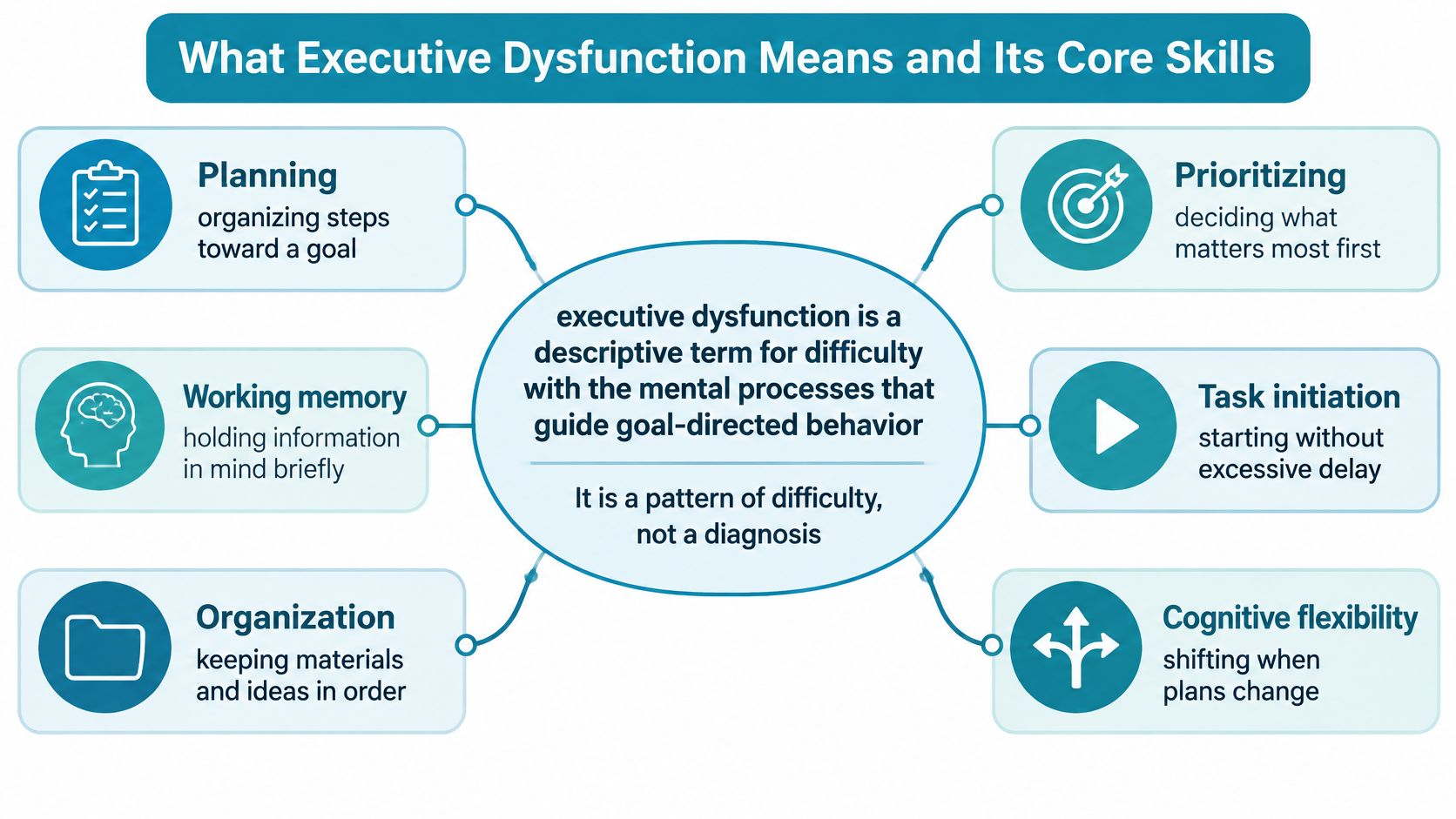
Core executive skills at a glance
Working memory keeps information available while a person uses it. Response inhibition creates a pause before an action, while sustained attention maintains focus. Planning organizes steps, task initiation gets them started, set shifting allows a change of direction, and time management helps pace the work.
The everyday signs below are illustrative, not diagnostic criteria.
| Skill | What it does | Everyday sign of difficulty |
|---|---|---|
| Working memory | Holds and manipulates information for a short period | Losing track of steps partway through a task |
| Response inhibition | Pauses before acting or speaking | Interrupting or buying on impulse before reviewing the choice |
| Sustained attention | Keeps focus over a longer task | Drifting away from long tasks despite meaning to finish them |
| Planning and organization | Sequences steps and sets priorities | Starting a project without a clear order of steps |
| Task initiation | Begins a needed task on time | Repeatedly postponing a task that has a deadline |
| Set shifting | Adapts between rules or tasks | Struggling to switch from one task to another |
| Time management | Estimates and paces the time a task needs | Underestimating how long routine tasks take |
These skills work together, but they aren't interchangeable. A person may create a detailed plan yet struggle to begin, or start promptly and lose track midway through.
A useful distinction: Describing the point where a task breaks down is more informative than calling the entire task impossible.
The term doesn't measure character, caring, or effort. It describes functioning, including difficulties that may not be visible to someone else.
For personal reflection, identifying the hardest skills in a routine is more useful than counting familiar table entries. The table is a vocabulary guide for a conversation, not a self-diagnosis checklist.
Everyday Situations That Show Executive Difficulty
Daily responsibilities rarely isolate a single cognitive skill. A report, appointment, or household chore may require remembering an intention, gathering materials, sequencing actions, and checking the result.
The following situations are hypothetical illustrations, not accounts of Empire Medical Wellness patients.
Work or school
A person knows a report is due Friday but doesn't begin until Thursday night. The deadline is recorded, yet the first action, opening the file and outlining the required sections, was never assigned a place in the schedule.
Another hypothetical situation involves competing assignments. The person starts whichever message arrived most recently rather than deciding which deadline or consequence matters most. Considerable activity may occur without progress on the most important responsibility.
Home and administration
In a hypothetical household example, a bill is opened and placed beside a computer. Paying it requires locating an account number, checking the balance, and completing the payment, so it remains unfinished.
Appointments, refill requests, and recurring chores can involve similar chains of actions. Describing the unfinished step is more useful than grouping every problem under forgetfulness.

Social commitments and transitions
A hypothetical person agrees to send a document during a conversation but never records the commitment. Later, the missed follow-up creates tension because another person was waiting for it.
In a different hypothetical situation, an interruption arrives during a household task. After responding, the person can't readily identify where to resume. The problem is the transition, not necessarily understanding the original task.
Performance can change with structure, stress, sleep, and interest. Success in a highly organized workplace doesn't automatically explain why unstructured responsibilities at home remain difficult.
When reduced interest or mood changes accompany these problems, information about depression may help frame questions for a physician, without determining the diagnosis.
Useful details to record include:
- Frequency: Whether the difficulty is occasional or repeatedly disrupts responsibilities.
- Setting: Whether it happens at home, work, school, or during social commitments.
- Consequences: Whether it causes extra work, missed obligations, financial problems, or relationship strain.
- Onset: Whether it began recently or has been present for years.
Conditions and Factors That Can Produce Similar Patterns
The same complaint can have several explanations. Procrastination, unfinished tasks, and disorganization don't identify a condition on their own.
A 2025 review in Frontiers in Psychiatry describes shared impairments in attention, decision-making, working memory, and long-term memory among adults with ADHD and depression. The review also notes delayed sleep onset and sleeping fewer than six hours as common among adults with ADHD and anxiety. These overlapping findings don't establish which factor explains an individual adult's difficulties.
Common contributors that overlap with executive complaints
The comparison below organizes details worth discussing. It doesn't rank diagnoses or suggest that every person with a listed condition has the same experience.
| Contributor | Overlapping difficulty | Useful detail to note |
|---|---|---|
| ADHD | Attention, task initiation, and organization | When symptoms began and the settings where they occur |
| Depression | Attention, decision-making, and working memory | Changes in mood, interest, and energy over weeks |
| Anxiety | Avoidance, worry-driven delay, and distractibility | Triggers and tasks that are regularly avoided |
| Poor sleep | Lower attention and slower decisions | Usual sleep onset time and total sleep hours |
| Stress and heavy life demands | Overload and reduced planning capacity | Timing relative to life events or new responsibilities |
| Medical conditions and medications | Fatigue, slowed thinking, or side effects | Current and past medications and the timing of changes |
| Neurological injury | Planning, working memory, and self-monitoring | Any history of head injury or neurological illness |
Timing helps distinguish possible explanations. Difficulty that appears during a period of low mood raises different questions from a longstanding pattern that was present before adult responsibilities increased.
Sleep deserves a specific description rather than a general statement that it's poor. Bedtime, time taken to fall asleep, awakenings, and the usual waking schedule can provide useful context. Information about circadian rhythm can help explain questions about the timing of sleep.
Several contributors may need attention
A clinician considers whether impairment is persistent or episodic and whether its severity changes alongside mood, worry, sleep, or demands. Medication and substance-use histories also help clarify the sequence of events.
Reporting several possible contributors isn't a sign of confusion. It gives the physician a more complete account of daily functioning.
The goal isn't to select a label before the appointment. It's to provide enough detail to distinguish a symptom pattern from its possible explanations.
How an Adult Evaluation Explores Executive Concerns
An evaluation is broader than a symptom checklist. The NIMH publication on ADHD explains that assessment considers symptoms, history, functioning, and other conditions that can resemble ADHD.
The companion NIMH guide to attention-deficit/hyperactivity disorder also supports a thorough clinical approach rather than drawing conclusions from difficulty concentrating alone. For an adult seeking private medical care, the central question is how the pattern fits the person's history and present circumstances.
Illustrative opening questions
The following are interview prompts, not a validated screening instrument and not an Empire Medical Wellness diagnostic test:
- Starting a necessary task: What happens between deciding that a task must be done and taking the first action?
- Organizing a multistep task: How are the required steps identified, ordered, and tracked?
- Remembering commitments: How are appointments, promises, and deadlines recorded and followed through?
Answers become more informative when they include a concrete example, its setting, and its consequences. A missed deadline because instructions were forgotten is different from a missed deadline because the person repeatedly revised completed work.
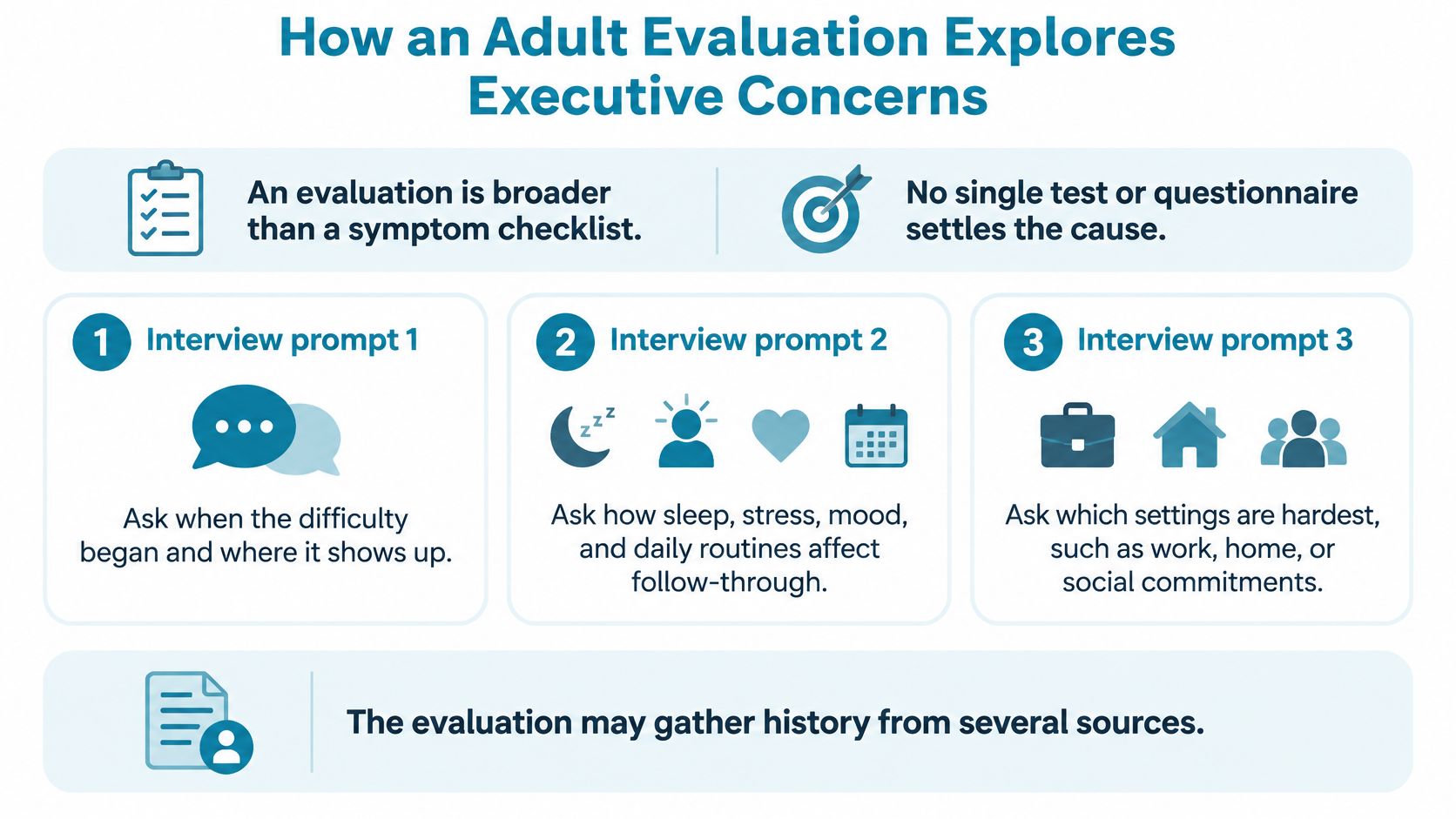
History and testing answer different questions
The European consensus statement on adult ADHD recommends documenting developmental history, current and past symptoms, functional impairment, and coexisting conditions. Information from a family member or another informant can add context and reduce under-reporting.
Rating scales collect reports about behavior. Performance tests measure how someone completes structured cognitive tasks. These approaches measure related but nonidentical aspects of functioning, so neither replaces an account of everyday responsibilities.
The physician may explore childhood and school experiences, previous treatment, changes in work demands, and functioning in relationships. Sleep, mood, substance use, medical conditions, medications, and past neurological injury help establish possible contributors.
Where worry and avoidance are prominent, information about generalized anxiety disorder can help an adult prepare relevant observations. It doesn't determine whether anxiety is the primary explanation.
At Empire Medical Wellness, an evaluation considers symptoms, medical history, sleep, school or work functioning, previous treatment, substance use when relevant, and current and past medications.
Useful materials for the visit include:
- Written observations: A task log and brief descriptions of missed or delayed responsibilities.
- Medication history: Current and past prescriptions, nonprescription products, and relevant effects.
- Sleep notes: Usual sleep timing, disruptions, and daytime difficulties.
- Earlier information: Available records or observations that clarify when the pattern began.
Practical Supports to Test at Home
Home supports can be treated as small experiments rather than a complete productivity overhaul. The aim is to address a defined obstacle and observe what happens, without assuming that a particular tool will work.
NICE rehabilitation guidance recommends matching cognitive support to everyday problems, retained abilities, preferences, and the person's environment. Its rehabilitation context matters: it supports individualized compensatory strategies, not a claim that a particular household technique treats every cause of executive dysfunction.
Small experiments with a clear purpose
- Record an appointment in a single calendar. Add a reminder before the appointment day so preparation can occur separately from attendance. The purpose is to make the commitment visible outside memory.
- Write the next physical action for an overdue project. A hypothetical example is opening the project folder and listing the files needed. This is more concrete than writing a broad instruction such as finish paperwork.
- Prepare materials the evening before. Placing the required form, charger, or bag in a designated spot tests whether gathering materials is part of the delay. Sensitive documents and medications still need appropriate storage.
These are optional supports, not documented Empire patient successes. A complicated app isn't automatically more useful than a paper list that remains visible where the task occurs.
Internal strategies and external supports
Internal strategies include explicit planning, checking for errors, monitoring progress, and using a brief problem-solving routine. For instance, a person might pause to identify the goal, choose the next step, and check whether that step was completed.
External supports include written checklists, calendars, task cues, and a simplified workspace. They place information in the environment rather than requiring it to remain in mind.
Practical rule: Choose a support for a specific barrier, not because it's advertised as a universal solution.
If interruptions are the obstacle, another reminder may not address the problem. If the first action is unclear, reorganizing the calendar may leave the same delay unchanged.
Information about stress management may be useful when overload is part of the context. Home supports complement clinical evaluation; they don't replace it, and prescribed medication shouldn't be started, stopped, or changed without the treating clinician.
A One-Week Task and Context Log to Print
This log is a personal reference sheet, not a validated diagnostic test. It doesn't measure whether someone has ADHD or another medical condition.
Entries should identify the task, when and where it occurred, the barrier noticed, the support attempted, and the observable result. Short factual notes are more useful than self-criticism, and identifying details about other people aren't needed.
One-week task and context log
| Day | Task or commitment | Context and time | Barrier noticed | Support tried | What happened |
|---|---|---|---|---|---|
| Monday | |||||
| Tuesday | |||||
| Wednesday | |||||
| Thursday | |||||
| Friday | |||||
| Saturday | |||||
| Sunday |
A hypothetical entry could describe an appointment form left unfinished because a required document wasn't available. The support tried might be gathering documents beforehand; the outcome should state whether the form was completed, partly completed, or still pending.
Sleep, mood, and medication effects can be noted alongside the table when relevant. Recording an effect doesn't establish that a medication caused it.
Reading the log without overinterpreting it
A systematic review of adult ADHD trials identified 12 different assessment tools, illustrating that executive-function improvement isn't measured consistently. Its findings concern adults with ADHD and shouldn't be assumed to apply to everyone reporting task difficulty.
A cognitive-task score and a daily-life outcome answer different questions. For personal monitoring, it helps to specify what successful functioning would look like before changing a support.
Useful targets might include:
- Attendance: Whether a scheduled appointment was attended.
- Completion: Whether a chosen task reached a clearly defined endpoint.
- Preparation: Whether necessary materials were ready when the task began.
- Resuming work: Whether an interrupted activity was restarted.
A completed log may reveal practical questions rather than answers. A reminder may have been noticed but arrived when action wasn't possible, or a task may have started but stalled while awaiting information.
There's no universal improvement timetable. A clinician can help select meaningful targets and decide when to reassess; persistent or worsening difficulty warrants review rather than an endless sequence of new productivity tools.
When to Seek a Physician-Led Evaluation
Professional evaluation is reasonable when task difficulties repeatedly affect work, school, finances, relationships, or health. Increasing difficulty, a clear change from usual functioning, or problems that remain despite consistently tried supports also deserve attention.
A person doesn't need to prove impairment in every setting before raising a concern. The physician can explore whether the pattern reflects a stressful period, a longstanding difficulty, a medical issue, or overlapping contributors.
Changes that shouldn't wait
Sudden changes in thinking, memory, or behavior require urgent medical attention, particularly after a head injury or alongside a new illness. Call 911 or go to the nearest emergency department rather than waiting for a routine mental-health appointment.
Gradual changes in mood, sleep, or functioning should also be discussed, including whether they followed a medication change. Medication concerns belong with the prescribing clinician rather than being managed through an unsupervised adjustment.
Preparing for a routine visit
- Complete the task and context log. An incomplete log is still useful if keeping it becomes another barrier.
- Write concrete examples and their impact. Include relevant effects on home, work, school, and relationships rather than listing symptoms alone.
- List medications and relevant history. Include current and past medications, usual sleep patterns, and any head injury or neurological illness.
- Bring the notes to a physician. The clinician can clarify missing details and decide what further assessment is appropriate.
At Empire Medical Wellness, mental health care begins with a thorough review of symptoms, medical history, current functioning, previous treatment, and current and past medications. Sleep, substance use, and lifestyle are considered when they affect diagnosis or treatment response.
The practice's mental health care includes diagnostic clarification, medication review, ongoing management, and therapist coordination when clinically useful and authorized. An evaluation doesn't mean that medication is automatically indicated, and task difficulty alone doesn't establish a need for a stimulant.
Information about adult mental health evaluation and medication management can help adults understand the practice's scope before arranging care. The purpose of assessment is to clarify the concern and establish appropriate next steps, not to judge effort or character.
Sources and Editorial Information
Byline: Empire Medical Wellness Editorial Team.
Publication date: Not recorded. Updated date: Not recorded. No named clinician review is documented.
The sources below are linked at their relevant points in the text. Publication or update dates are listed only where established:
- National Institute of Mental Health: ADHD: What You Need to Know. Publication or update date not established.
- National Institute of Mental Health: Attention-Deficit/Hyperactivity Disorder: What You Need to Know. Publication or update date not established.
- European Psychiatry: Updated European consensus statement on diagnosis and treatment of adult ADHD. Publication date not established.
- Frontiers in Psychiatry: Review addressing overlapping adult ADHD, depression, anxiety, and sleep concerns, 2025.
- NICE: Rehabilitation to maintain, improve or support function. Publication or update date not established.
- Adult ADHD intervention systematic review: Review of randomized controlled trials published through November 2024. Publication date not established.
The rehabilitation guidance and adult ADHD trials concern specific populations and clinical contexts. They don't establish that every adult with executive complaints needs the same assessment or support.
This article is educational and is not personal medical advice.
Empire Medical Wellness offers physician-led adult mental health evaluation, diagnostic clarification, and medication management when appropriate. Adults seeking help understanding persistent planning, organization, or follow-through difficulties can visit Empire Medical Wellness to learn about its approach to care. This information is educational and doesn't replace personal medical advice.