
Unsaturated fat includes monounsaturated and polyunsaturated fat, and it helps most when it replaces saturated fat rather than being added on top of a meal. Like other dietary fats, it provides about 9 calories per gram, so choosing a different fat isn't the same as reducing calories.
If a meal already contains butter, what changes when olive oil is poured over it? The useful distinction isn't whether olive oil is a favorable food. It's whether the meal's fat source changed or the meal gained more energy.
By Empire Medical Wellness Editorial Team
Table of Contents
- What Unsaturated Fat Is and Why the Swap Matters
- Monounsaturated Fat Compared With Polyunsaturated Fat
- LDL and Heart Outcomes After a Real Replacement
- Food Sources and Everyday Saturated Fat Swaps
- How to Cook and Store Unsaturated Oils
- Portions When Calories and Weight Matter
- Choose One Swap and Discuss the Pattern
What Unsaturated Fat Is and Why the Swap Matters
Unsaturated fat is dietary fat built from fatty acids with double bonds in their chemical structure. Monounsaturated fatty acids have a single double bond, while polyunsaturated fatty acids have more. Common sources include fish, nuts, seeds, avocado, and liquid plant oils.
Saturated fat is concentrated in foods such as butter, fatty meats, and coconut or palm oil. The practical change is to replace some of those sources, not to add an extra pour of oil to an otherwise unchanged meal. The World Health Organization's guidance on dietary fats favors predominantly unsaturated fat rather than eliminating dietary fat.
A fuel analogy for the meal
A useful educational analogy is changing the type of fuel rather than adding more fuel. A cook who substitutes canola oil for butter changes the meal's fat composition. A cook who keeps the butter and adds canola oil supplies additional fuel.
Consider a clearly hypothetical vegetable sauté. The original version uses butter, followed by a finishing drizzle of olive oil. A replacement version uses a measured amount of olive oil for cooking and skips the butter. The vegetables can remain familiar, while the fat source changes.
Practical rule: A meaningful swap identifies both the food being removed and the food taking its place.
This distinction matters in obesity medicine because food quality and energy intake are related but separate questions. A meal can contain a more favorable fat profile without containing fewer calories. Neither result says anything about a person's effort or character.
The practice's nutrition education provides broader context for food choices. For this particular decision, the useful questions are concrete: which fat is being used, what will replace it, how much goes into the meal, and whether the replacement suits the cooking method.
Monounsaturated Fat Compared With Polyunsaturated Fat
Monounsaturated and polyunsaturated fats at a glance
| Feature | Monounsaturated fat | Polyunsaturated fat |
|---|---|---|
| Main fatty acids | Oleic acid | Linoleic acid, alpha-linolenic acid, and EPA or DHA from fish |
| Common foods | Olive oil, canola oil, avocado, almonds and other nuts | Soybean, sunflower, and corn oils; walnuts; flax; fatty fish |
| LDL change when replacing saturated fat | Lowers LDL in controlled dietary comparisons | Lowers LDL, with a somewhat greater average effect in controlled comparisons |
| Relative evidence | Accepted plant-oil replacement | Somewhat stronger lipid and heart-outcome evidence, especially for linoleic-acid-rich oils |
| Energy | Calorie-dense, like other fats | Calorie-dense, like other fats |
| If an allergy or preference limits a food | Use tolerated oil, avocado, or seeds instead of nuts | Skip fish if allergic and use tolerated plant oils and seeds |
The American Heart Association scientific statement on dietary guidance reports approximately 1.6 mg/dL lower LDL per percentage point of energy replaced with monounsaturated fat, compared with 2.1 mg/dL with polyunsaturated fat and 1.3 mg/dL with carbohydrate; all fats supply approximately 9 calories per gram. These are average responses from controlled dietary comparisons, not forecasts for an individual meal or person.
What the names mean in a kitchen
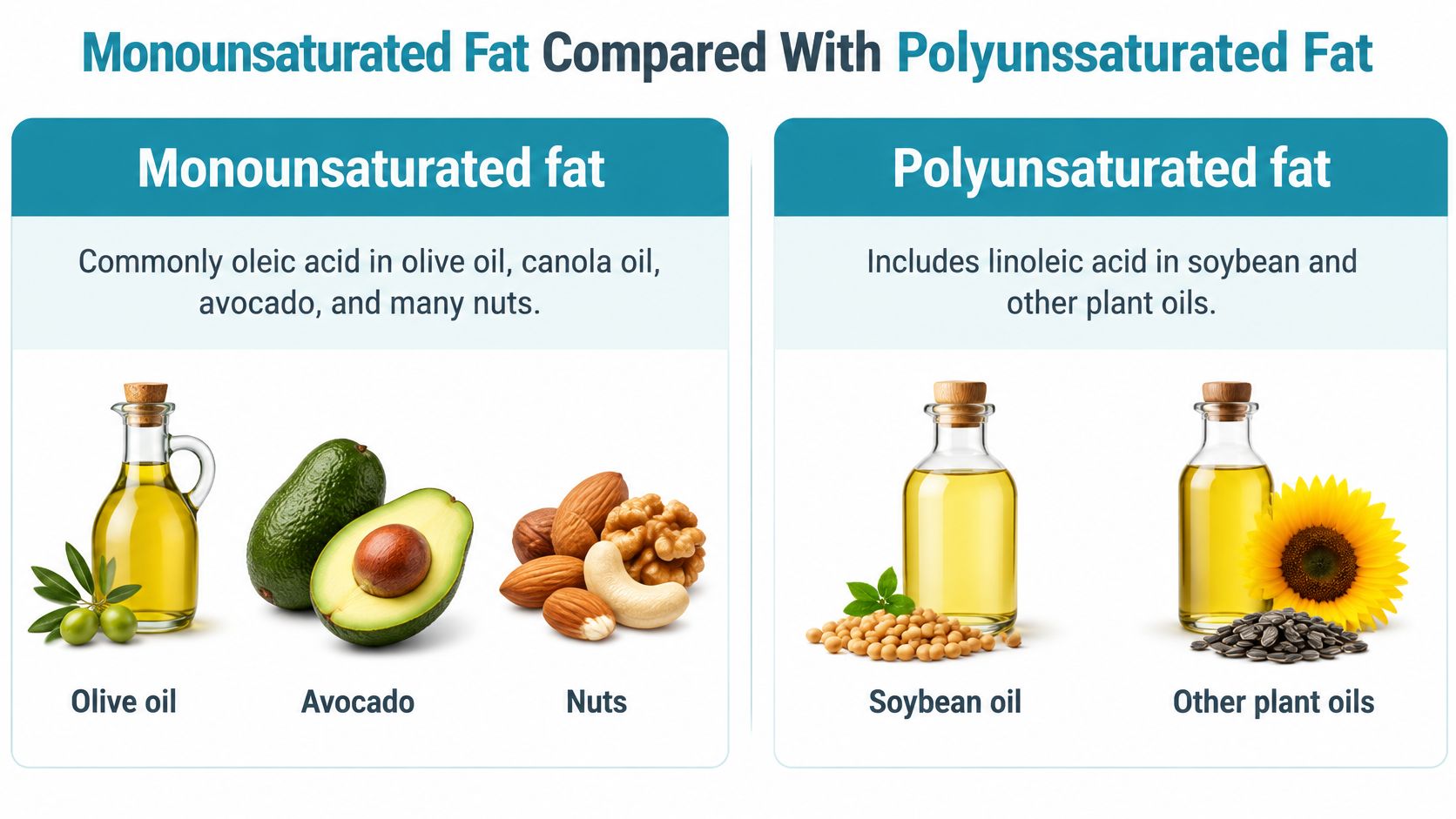
Monounsaturated fatty acids, often shortened to MUFAs, include oleic acid. Olive oil, canola oil, avocado, and many nuts are familiar sources. Polyunsaturated fatty acids, or PUFAs, include several different fats rather than a single ingredient.
Linoleic acid is found in soybean, sunflower, corn, and other vegetable oils. Alpha-linolenic acid, often called ALA, occurs in walnuts, flax, and canola oil. EPA and DHA are long-chain omega-3 fats found in fatty fish.
These categories overlap within foods. Canola oil, for example, doesn't contain only monounsaturated fat. The American Heart Association's explanation of fats in foods helps distinguish food sources without treating each food as a chemically pure fat.
The table works best as a kitchen inventory, not a ranking. A household that already uses olive oil doesn't need to discard it because polyunsaturated fat has somewhat stronger evidence for certain outcomes. Nor does an ordinary food pattern require a supplement because omega-3 fats have unfamiliar names.
Allergy, preference, and cultural fit
A practical pattern must leave room for foods a person can safely eat and reasonably obtain.
- Nut-free choices: Tolerated plant oils, avocado, seeds, or fish can provide alternatives. A seed isn't automatically safe for someone with a nut allergy, so known allergies and cross-contact precautions still matter.
- Fish-free choices: Plant oils, walnuts, and tolerated seeds can supply unsaturated fats. They aren't nutritionally identical to fish, but fish isn't required for every meal pattern.
- Vegetarian meals: Legumes can replace a fatty meat component, while an appropriate plant oil or tolerated seeds supply the meal's unsaturated fat.
- Cultural continuity: Familiar seasonings, grains, vegetables, and preparation styles can remain. Changing the cooking fat doesn't require replacing an entire cuisine.
The strongest choice is often the tolerated, affordable option that fits an existing recipe.
LDL and Heart Outcomes After a Real Replacement
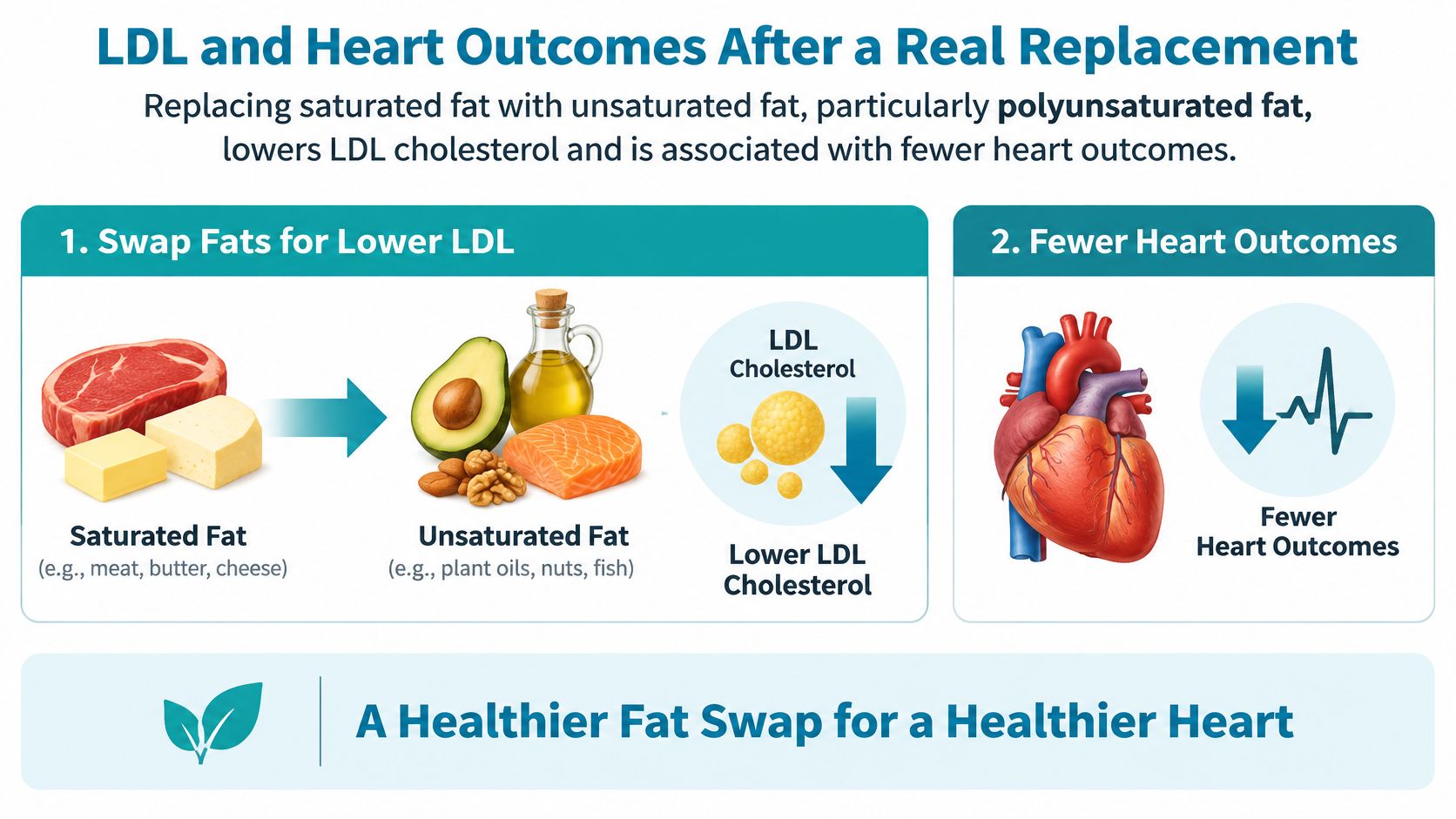
Replacing saturated fat with unsaturated fat, particularly polyunsaturated fat, can lower LDL cholesterol, the cholesterol carried in low-density lipoproteins. Trial evidence also supports fewer coronary events under specific replacement conditions. Neither finding establishes a guaranteed response for every adult.
A 2024 review of randomized-trial evidence reported that replacing saturated fat with polyunsaturated fat was associated with a 29% lower risk of coronary artery disease across four studies, with a pooled risk ratio of 0.71 and a 95% confidence interval of 0.62 to 0.81. This finding concerns a defined substitution, not eating less total fat.
What the result does and doesn't establish
A relative reduction describes the difference between study groups. It doesn't reveal a particular person's starting risk or the absolute benefit that person would receive. Baseline risk, the overall diet, medicines, and other health factors affect how trial findings apply in clinical care.
The finding also doesn't mean that every packaged food containing unsaturated fat has identical effects. A product can contain vegetable oil alongside other ingredients that influence its overall nutritional value. A favorable ingredient doesn't make the whole product interchangeable with nuts, fish, or a measured cooking oil.
The evidence supports a replacement pattern, not a promise attached to an ingredient.
A separate randomized controlled-feeding trial of walnuts and matched oils compared unsaturated-fat diets in adults with increased cardiovascular risk, including a walnut diet providing approximately 57 to 99 grams daily. All the unsaturated-fat diets lowered total, LDL, and non-HDL cholesterol relative to the run-in diet, and the walnut diet also lowered central diastolic blood pressure.
Those walnut amounts were research doses, not a household prescription. The study was controlled, relatively short, and conducted in higher-risk adults. Its results support specific cardiometabolic effects without proving that every person will respond the same way.
How an individual result should be interpreted
No clinic-specific lipid-panel average is documented for this article. Individual changes shouldn't be inferred from a practice name, an infographic, or a food label.
For adults considering medical evaluation of high cholesterol, the useful discussion includes the current lipid panel, relevant history, medicines, and the actual replacement being made. Non-HDL cholesterol means total cholesterol minus HDL cholesterol and captures cholesterol carried in several potentially harmful particles.
An article isn't a reason to start, stop, or change cholesterol or weight-management medication. Food changes and medication decisions belong within an individualized care plan. The practical dietary question remains which everyday food will take the place of the saturated-fat source.
Food Sources and Everyday Saturated Fat Swaps
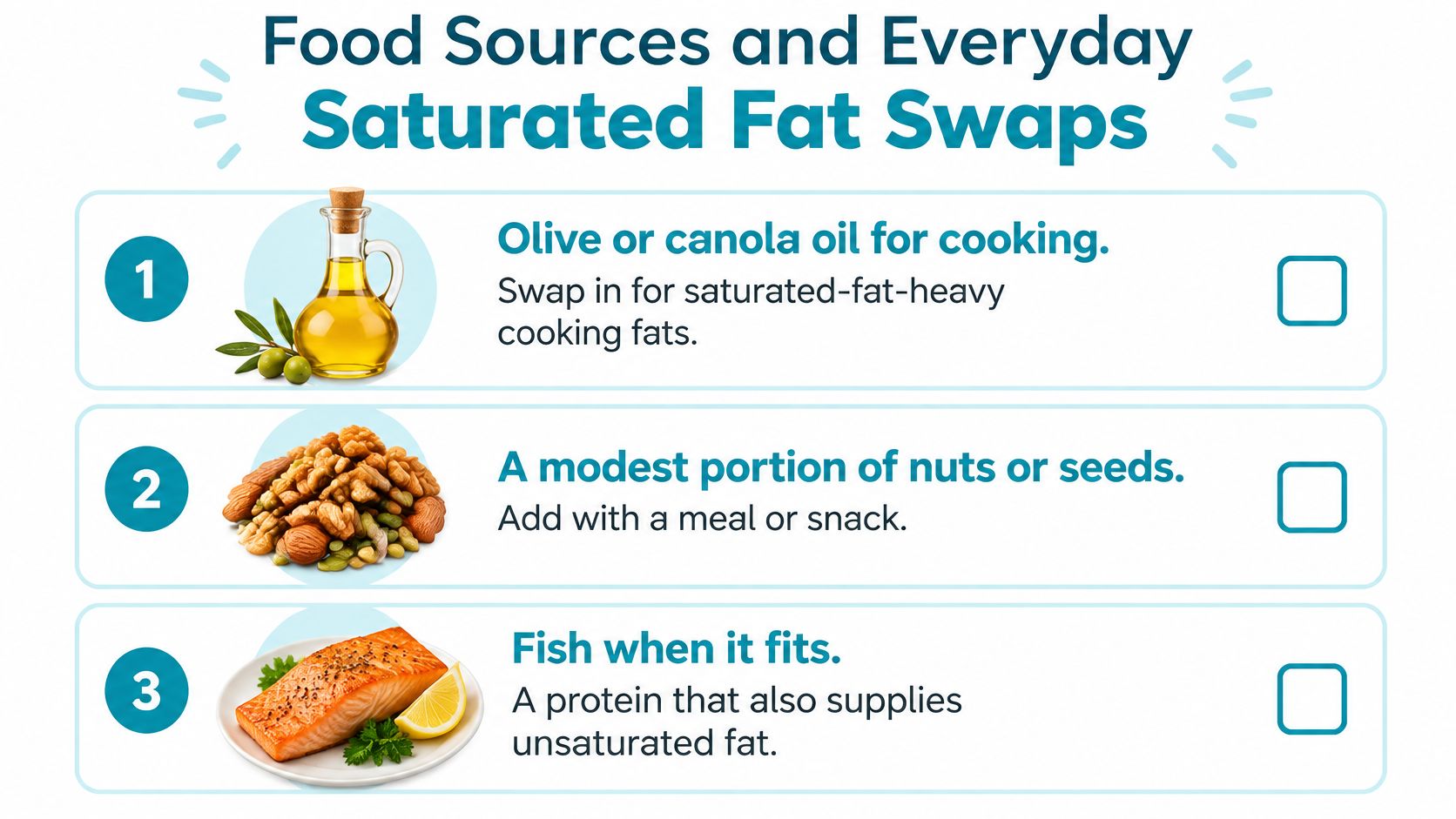
Olive or canola oil for cooking, nuts or seeds with a meal or snack, and fish as a protein source are useful examples. They aren't a practice ranking or a prescription for every adult. Allergy, cost, taste, and customary foods determine which options are workable.
The 2020–2025 Dietary Guidelines for Americans describe an oil pattern of approximately 27 grams daily for a 2,000-calorie eating pattern, because oils provide essential fatty acids and vitamin E. The framework specifies that oils replace solid fats rather than being added on top of existing fat intake.
Saturated-fat foods and unsaturated replacements
| Instead of | Use | What changes | Portion caution |
|---|---|---|---|
| Butter, ghee, or lard for sautéing | A measured spoon of olive, canola, soybean, or another nontropical liquid oil | Less saturated fat and more unsaturated fat | Measure the oil before cooking rather than pouring freely |
| Fatty processed meat | Fish, legumes, or leaner poultry or meat with little added fat | Less solid animal fat; fish also supplies unsaturated fat | Fish and legumes still count toward the meal's energy |
| Pastry, chips, or a cream-based snack | A small handful of nuts or seeds, if tolerated | Unsaturated fat with some protein and fiber | Portion the snack into a bowl rather than eating from the package |
| Coconut or palm oil for routine cooking | Canola, olive, soybean, or sunflower oil suited to the dish | A nontropical liquid oil favored in heart guidance | Match flavor and heat; the oil remains calorie-dense |
The snack comparison requires attention to the original food. Not all chips or pastries have the same fat profile. A substitution makes sense when it improves the actual meal or snack, not merely its name.
Make the change affordable and familiar
The American Heart Association's guide to healthy cooking oils identifies nontropical liquid plant oils as useful alternatives to solid fats. An expensive specialty oil isn't necessary. A familiar canola, soybean, or olive oil can be chosen according to the dish and household budget.
Tinned fish can be an alternative when fresh fish is costly or inconvenient. Seeds and legumes can help build meals when nuts or fish are excluded, although legumes primarily replace the protein component rather than acting as an oil substitute. A culturally familiar bean dish doesn't need to become an unfamiliar salad to fit the pattern.
A recipe may still need adjustment. Butter contributes water, flavor, and structure, so a baking recipe can't always accept a direct oil substitution. Sautéing is often an easier starting point because the cook can measure the oil and observe how much the pan needs.
Read the package rather than the promise
Front-label wording doesn't reveal a food's complete fat profile. The ingredient list identifies the named oils, nuts, or seeds, while the Nutrition Facts label shows saturated fat and serving size.
The practice's heart-healthy eating guidance can support a broader food-pattern discussion. For a manageable first step, changing a repeated saturated-fat use is more informative than adding several new fat-rich foods at once.
How to Cook and Store Unsaturated Oils
For sautéing, a practical default is to replace butter with a measured amount of liquid nontropical plant oil suitable for the dish. The oil takes the butter's place. A second cooking fat or automatic finishing drizzle isn't necessary.
Smoke point isn't a complete health score. Oil composition, temperature, heating duration, exposure to air and light, and reuse all affect what happens during cooking and storage.
Oxidation isn't the same as proof of dietary harm
Polyunsaturated fats have chemical bonds that are more vulnerable to oxidation, a process that can contribute to rancidity. A 2024 scientific review hosted by the World Health Organization discusses improper storage of polyunsaturated oils while finding no clinical-trial evidence that dietary linoleic acid itself increases inflammation or oxidative stress.
That distinction prevents a common misunderstanding. The fact that an oil can deteriorate under poor conditions doesn't establish that ordinary consumption of that oil causes harm. It supports sensible handling rather than blanket avoidance.
Storage check: A bottle belongs sealed in a cool, dark cupboard, not beside a hot stove or in direct sunlight.
A practical oil-handling checklist
- Keep the cap closed: Limit unnecessary exposure to air after pouring.
- Choose a useful bottle size: A household that cooks infrequently may find a smaller bottle easier to use while fresh.
- Check for deterioration: Oil that smells stale, rancid, or paint-like shouldn't be used.
- Match the method: Follow the product's intended cooking use, and reduce heat if the oil begins smoking.
- Avoid repeated deep-frying: Reusing the same oil through repeated heating cycles raises different concerns from an ordinary sauté.
- Store finishing oils carefully: Delicate oils used for dressings or flavor still need protection from heat and light.
Heating can reduce some olive-oil polyphenols, which are plant compounds in the oil. That doesn't make ordinary cooked olive oil nutritionally worthless. A delicate oil may be reserved for finishing because of flavor, while another suitable oil handles cooking.
High heat doesn't automatically make every unsaturated oil dangerous. Conversely, a high smoke point doesn't establish that an oil is healthier overall. No oil reverses disease, and cardiovascular comparisons concern the dietary pattern, not a claim that a particular bottle acts as treatment.
A useful meal check is simple: a measured cooking fat, suited to the method, without an extra drizzle unless another fat was removed.
Portions When Calories and Weight Matter
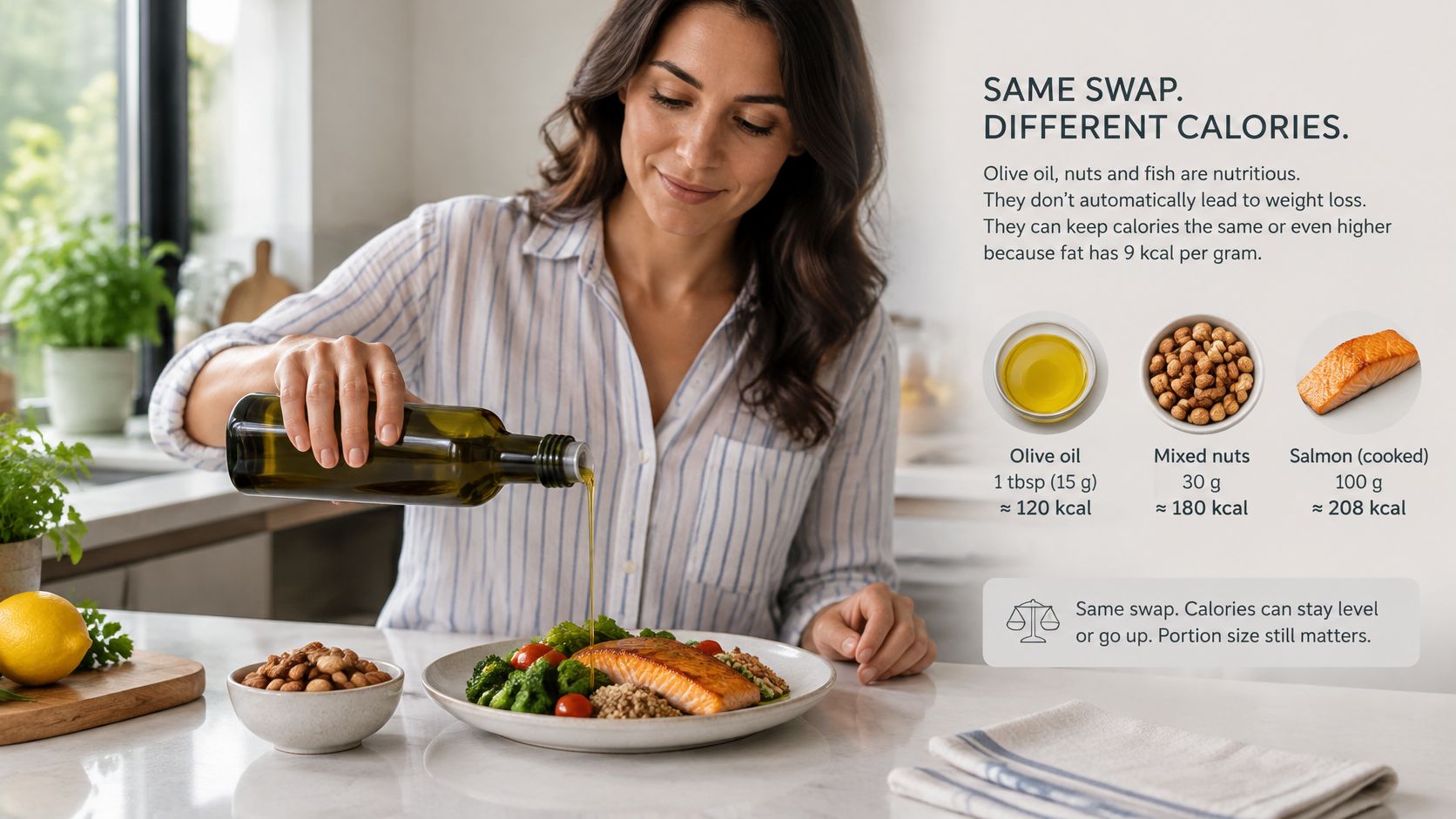
Adding olive oil, nuts, or fish doesn't guarantee weight loss. A change can improve the type of fat consumed while leaving total energy unchanged or increasing it. In obesity care, that isn't a contradiction or a personal failure.
The American Heart Association's guidance on polyunsaturated fats recommends limiting saturated fat to less than 6% of daily calories, approximately 120 calories or 13 grams on a 2,000-calorie pattern. This is population guidance, not an individualized calorie prescription.
Separate fat quality from portion size
A household may replace butter with oil successfully, yet begin using a larger pour because the oil is considered healthy. Another household may replace a pastry with nuts but keep refilling the snack bowl. Both situations call for a practical portion review, not criticism.
A spoon, small bowl, or kitchen scale can make a serving visible. Package serving information provides a reference point rather than a rule that every adult must follow. The useful comparison is between the food removed and the amount added.
The practice's guidance on balanced meals for weight management places individual ingredients within a larger meal pattern. A person doesn't need to make every meal low-fat to choose fats thoughtfully.
A brief plate check can clarify the change:
- Removed food: Identify the butter, fatty meat, cream-based component, or other saturated-fat source.
- Replacement food: Name the oil, fish, avocado, nuts, or seeds taking its place.
- Portion comparison: Check whether the replacement is a measured serving or an additional topping.
- Whole-meal review: Consider sauces, dressings, beverages, and snacks rather than judging the meal by its cooking oil alone.
Questions worth bringing to a visit
A physician-led obesity assessment can consider food choices alongside weight history, relevant medical factors, and current treatment. Recent cholesterol results can help establish what needs monitoring. A favorable food change shouldn't be assumed to explain every laboratory change.
Useful questions include which cooking fat is used most often, whether portions grew after a switch to oil, and which cultural foods should remain central. Nut or fish allergies, food costs, and practical cooking limitations also belong in that discussion.
For adults taking anti-obesity medication, appetite, nutritional intake, and follow-up needs should be reviewed with the prescribing clinician. A food article shouldn't prompt medication changes.
Portion awareness is information, not a character judgment. A realistic plan needs to account for hunger, preferences, budget, and daily routines rather than assuming that nutrition knowledge alone determines intake.
Choose One Swap and Discuss the Pattern
A manageable starting point is a repeated use of butter, fatty processed meat, a saturated-fat-rich snack, or a tropical oil. The matching replacement should fit the same meal or cooking task. Keeping the rest of the meal familiar makes the change easier to assess.
The practice's healthy-diet education offers context for building a broader pattern. A specific substitution is more useful than a vague intention to eat healthier.
A short decision sequence
- Identify the recurring source. Note which saturated-fat-rich food appears regularly in cooking or snacks.
- Choose a workable replacement. Select a tolerated, affordable option and measure it rather than adding it freely.
- Review the result. Check whether the meal remained satisfying and whether its total energy stayed similar.
A brief food note can capture cooking fats, dressings, snack portions, and what each replacement displaced. When cholesterol results, weight history, or medicines are part of care, that note gives a clinician something concrete to discuss.
The useful outcome isn't a larger collection of oils or a list of forbidden foods. It's a repeatable meal pattern with appropriate portions and a clearer understanding of what changed.
Sources
Key references include the American Heart Association's explanations of fats in foods and healthy cooking oils; its scientific statement on dietary guidance and saturated-fat replacement; the review of randomized trials on polyunsaturated-fat replacement and coronary outcomes; the Dietary Guidelines for Americans oil pattern; the controlled walnut-and-oil feeding trial; and the scientific review addressing oil oxidation. Each is linked where its findings are discussed.
This article is educational and isn't personal medical advice.
Empire Medical Wellness offers private, physician-led obesity medicine care that may include metabolic assessment, individualized weight-management planning, and ongoing monitoring. Adults seeking help fitting food choices into a broader care plan can visit Empire Medical Wellness to learn about evaluation and next steps.