
Emotional dysregulation means difficulty influencing the intensity, duration, or expression of emotion. It's a symptom pattern, not a diagnosis or a moral failing, and emotion regulation can be understood through five points where a response may be shaped.
A critical work message can leave an adult tense, distracted, and tempted to send a sharp reply. The useful question isn't whether that person should feel upset. It's what makes the feeling difficult to manage, and which kind of support fits that difficulty.
By Empire Medical Wellness Editorial Team
Table of Contents
- What Emotional Dysregulation Means for Adults
- Five Points Where Emotion Can Be Shaped
- Sleep Stress Substances and Co-Occurring Conditions
- Pause Name Ground and Choose in Adult Moments
- A Between-Visit Log That Is Not a Diagnosis
- What Assessment Therapy and Medication Each Do
- Seek Outpatient Care or Crisis Help
What Emotional Dysregulation Means for Adults
Emotional dysregulation describes difficulty managing an emotional response, rather than the presence of emotion itself. Someone may struggle with how quickly anger rises, how long embarrassment lasts, or what happens when fear creates an urge to escape.
Strong feelings aren't automatically unhealthy. Grief, anger, disappointment, and anxiety can fit difficult circumstances. A pattern becomes more concerning when emotion escalates rapidly, settling takes a prolonged effort, responses become impulsive, or daily responsibilities and relationships are disrupted.
Strong Emotion Compared With a Dysregulation Pattern
The following comparison is an educational aid, not a diagnostic checklist. There's no universal time limit separating an understandable reaction from a problem that needs assessment.
| Feature | Strong emotion that settles | Dysregulation pattern |
|---|---|---|
| Intensity | Can be high and still fit the moment | Rises quickly or feels very hard to turn down |
| Duration | Often limited to minutes or a short period | Stays elevated long after the trigger has passed |
| Recovery | Returns toward baseline with time or support | Prolonged difficulty settling |
| Response | A pause and a chosen action remain possible | Impulsive or hard-to-stop reactions are common |
| Daily life | Uncomfortable, but work and relationships can continue | Work, relationships, or safety are disrupted |
| Meaning | One episode needs context, not a label | A pattern still requires professional assessment before any diagnosis |
Context matters as much as the outward behavior. A clinician needs to understand the person's history, sleep, stress, substance use, medical conditions, and functioning. An isolated argument doesn't establish a diagnosis, and a quiet appearance doesn't show how much effort someone is using internally.
People can also experience difficulty in different ways. One person may speak sharply before recognizing anger. Another may remain outwardly composed while repeatedly replaying the event and losing the ability to concentrate.
A Hypothetical Adult Moment
Hypothetical example: An adult receives a critical work message. An initial surge of frustration eases after clarification, allowing a measured response and a return to work.
In another possible pattern, the same message leads to prolonged rumination, meaning repetitive thinking that doesn't resolve the concern. A sharp reply follows, and attention remains stuck on the exchange long afterward. The difference calls for understanding, not a character judgment.
Practical distinction: The feeling, the action urge, and the eventual behavior are related, but they aren't the same thing.
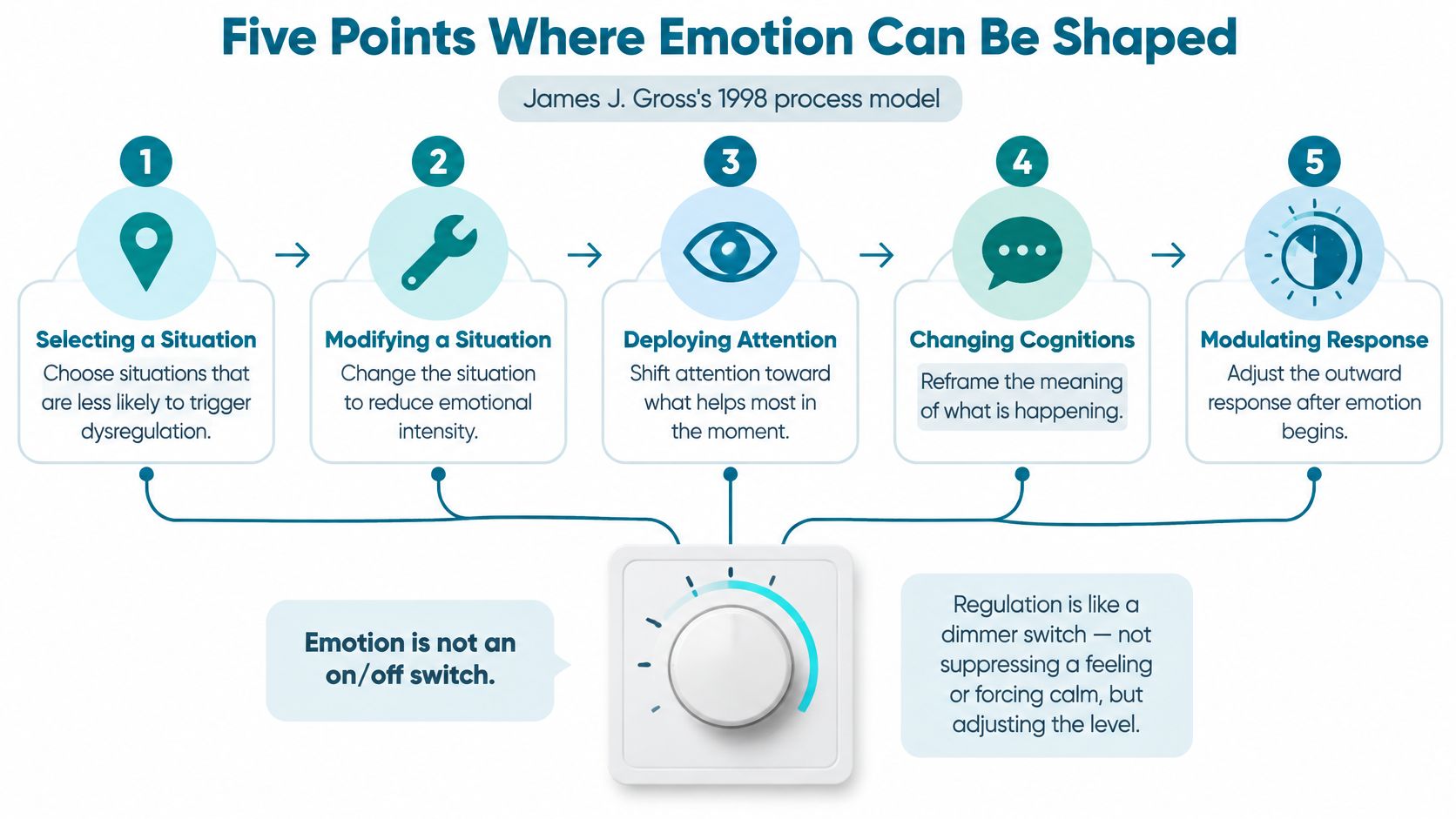
A useful framework separates the emotion sequence into selecting a situation, modifying it, directing attention, changing its meaning, and modulating the response. That distinction makes it easier to identify where support might be useful.
Five Points Where Emotion Can Be Shaped
Emotion regulation is more like adjusting a dimmer switch than turning a feeling off. The aim isn't constant calm or hiding every sign of distress. It's greater flexibility in responding to what's happening.
James J. Gross's 1998 review in Review of General Psychology organized regulation around five points in the emotion-generative sequence. The model allows for changes before a full emotional response develops and after it's already underway.
Matching the Skill to the Moment
Consider a hypothetical adult work situation involving a tense project discussion. Different actions address different parts of the sequence:
- Selecting a situation. An adult may leave an optional heated message thread rather than continue reading it. Selection changes exposure to the situation, although necessary conversations may still need to happen.
- Modifying the situation. A difficult meeting could use a clear agenda, fewer interruptions, or a quieter setting. The concern remains, but the conditions become more manageable.
- Directing attention. Instead of repeatedly checking a colleague's facial expression, the adult could focus on the specific decision being discussed.
- Changing the meaning. A brief email might reflect time pressure rather than hostility. Considering that possibility is cognitive reappraisal, or changing the interpretation of an event.
- Modulating the response. Once anger is underway, the adult could slow the reply, lower the speaking volume, or postpone sending a message.
These options aren't interchangeable. Reinterpreting an email addresses meaning. Setting the phone aside addresses what happens after the reaction has started.
Earlier and Later Strategies
Antecedent-focused strategies act before a full response develops. Reappraisal is one example. Response-focused strategies act once emotion is underway, such as suppressing outward expression.
Keeping a neutral face may sometimes serve a practical purpose, but it doesn't necessarily settle the internal feeling. Two adults can experience similar intensity while differing substantially in when they try to regulate it and which approach they use.
Neuroimaging research on cognitive reappraisal links regulation with coordinated activity across prefrontal and other brain regions, alongside changes in amygdala activity. The amygdala helps process emotionally significant information, but regulation doesn't occur in a single emotion center. A scan doesn't diagnose emotional dysregulation or choose an individual's treatment.
The useful clinical question is which point is hardest, not whether the person cares enough. That question can distinguish a need for interpretation skills from a need for safer responses, environmental changes, or evaluation of an underlying condition.
Sleep Stress Substances and Co-Occurring Conditions
The same outward reaction can have different drivers. A tense exchange after poor sleep may require a different assessment from persistent irritability alongside a medication change or a sustained change in daily functioning.
Short sleep, ongoing stress, alcohol or other substance use, pain, and co-occurring mental or medical conditions belong in the clinical discussion. These factors may affect the timing of reactions, recovery, and the usefulness of familiar coping strategies. Information about circadian rhythm and sleep timing can help frame a discussion about disrupted sleep schedules.
A Shared Difficulty Across Conditions
A systematic review and multilevel meta-analysis covering 619 studies, 41,590 clinical participants, and 36,787 controls found greater emotion-regulation difficulty in clinical groups, with a large standardized mean difference of 1.70. This is a research measure of the difference between groups, not a personal severity score.
The review described less frequent acceptance, problem-solving, and reappraisal, alongside more avoidance, rumination, and suppression of expression. Because difficulties appeared across nearly all mental disorders examined, emotional dysregulation is best understood as transdiagnostic, meaning it can occur across different diagnoses.
That doesn't mean a person with intense emotions has bipolar disorder, ADHD, or a personality disorder. It means the clinician needs more information than the intensity of a feeling.
Finding the Process That Keeps Someone Stuck
Different difficulties call for different discussions:
- Persistent rumination: Attention repeatedly returns to an event without producing a useful decision.
- Avoidance: Attempts to escape discomfort interfere with necessary conversations or responsibilities.
- Poor emotional clarity: The person recognizes distress but struggles to distinguish anger, fear, shame, or sadness.
- Disrupted goal-directed behavior: A strong feeling makes it difficult to continue an intended task or choose a safer action.
Standard coping advice may miss the dominant problem. A person who already understands the emotion may need help with impulsive behavior rather than more labeling. Another may need a review of sleep or substance effects before additional coping instructions are useful.
A skill can be reasonable without being sufficient for the whole problem.
Skill-based and mindfulness approaches also differ in content and the populations studied. A favorable result in a particular group isn't proof that the same approach will work equally well for every adult. Assessment should connect the person's difficulties to a specific process and a meaningful functional goal.
Pause Name Ground and Choose in Adult Moments
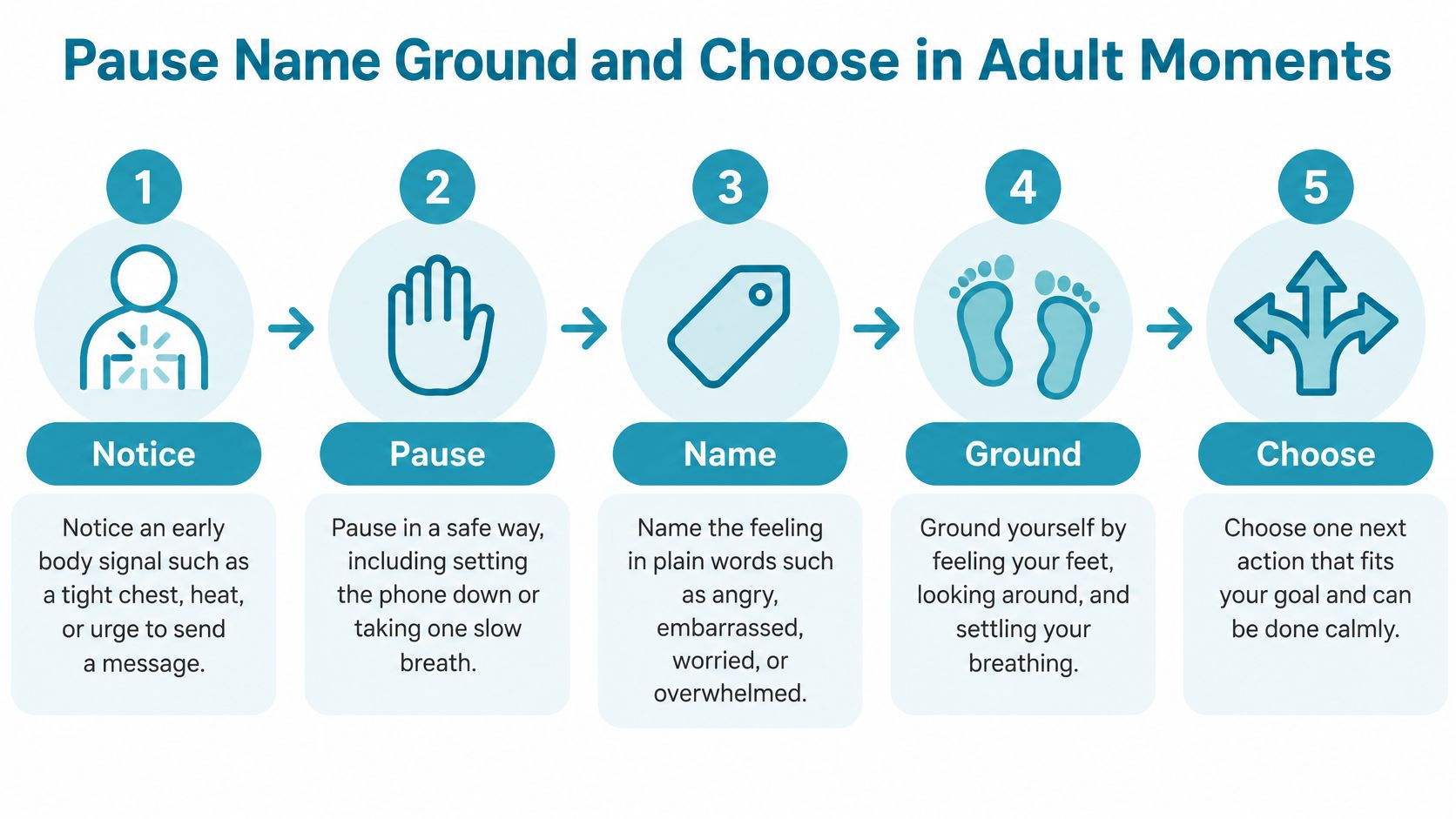
A brief sequence can create room between an emotional urge and an action. It's a practice tool for everyday situations, not an Empire Medical Wellness protocol or a guaranteed way to become calm.
The NHS guidance on anger describes anger as a normal human feeling and recommends support when it becomes difficult to manage or leads to harm. Frequent, intense, or hard-to-control anger deserves attention rather than shame.
A Repeatable Practice
Notice an early signal. A tight chest, facial heat, clenched hands, or an urge to send a message can serve as a cue. Recognizing a signal doesn't require deciding immediately whether the feeling is justified.
Pause safely. Setting down a phone or asking to interrupt a conversation can reduce the opportunity for an impulsive response. Driving and tools require particular care: the person should reach a safe stopping point rather than attempt a distracting exercise while continuing.
Name the emotion. Plain words such as angry, ashamed, afraid, or overwhelmed are enough. Naming describes the experience without declaring it good, bad, or permanent.
Ground in the present. Comfortable slow breathing, feeling the feet against the floor, or noticing nearby sights and physical sensations may provide a concrete focus. Breathing shouldn't be forced, and another grounding method may be preferable if attention to breathing feels uncomfortable.
Choose a goal-consistent action. The next step might be waiting to reply, asking for a break, or returning to one manageable task. Success doesn't require the feeling to disappear first.
Two Hypothetical Adult Scenes
Hypothetical relationship argument: An adult notices clenched hands and an urge to interrupt. A safe pause allows the person to recognize hurt beneath anger, feel contact with the floor, and request a break with a clear plan to return to the conversation.
The pause isn't a way to punish the other person through silence. Its purpose is to support a response that fits the goal of communicating without escalating.
Hypothetical high-pressure deadline: An adult notices shallow breathing and an urge to send an accusatory team message. After setting the phone down and naming overwhelm, the person looks around the room and chooses to ask which task has priority.
The deadline remains. The chosen response addresses the practical problem without requiring complete emotional relief.
Regular sleep, meals, and supportive contact can make practice more feasible. Additional stress-management information may help adults identify routines worth discussing during care.
Skills need repetition and limits. Persistent distress or unsafe impulses call for assessment, not a demand to practice harder. A technique that helps with an ordinary disagreement may be inadequate during severe symptoms or an unsafe situation.
A Between-Visit Log That Is Not a Diagnosis
A personal log becomes useful when it shows where a strong emotion caught you off guard and where a different response entered the sequence. Keep it brief enough that recording an episode does not turn into replaying it.
Optional Log for Strong Emotions Between Visits
| Field | What to record | What it shows |
|---|---|---|
| Trigger or context | What happened, where, and with whom | Separates the event from the reaction |
| Emotion and intensity | The emotion's name and an optional personal rating from 0 to 10 | Size of the feeling without a diagnosis |
| Action urge | What the person felt pulled to do | The impulse before any behavior |
| Chosen response | The pause, name, ground, or other step used | Which skill was actually tried |
| Effect on functioning | Work, relationships, or safety afterward | An outcome beyond the mood score |
| Sleep and substances | Hours slept and any alcohol or other substance use that day | Context that can change reactivity |
The intensity rating works like a personal thermometer: it estimates how strong the moment felt, not what condition caused it. A note about how long recovery took adds context. So do medication changes already discussed with the prescriber, because the same week may include both a stressful event and a dosage adjustment.
For medication visits, entries can make a medication-related discussion more concrete by connecting symptoms, response, side effects, and questions for the prescriber. The log remains a personal tool rather than a standardized scale.
Reading Patterns Without Assigning Labels
Look across a week instead of judging one hard moment. Fewer conflicts, a shorter recovery, or a safer response may matter more than a single lower intensity rating. A clinician can also consider whether better control came from flexibility or from avoiding activities that still need to happen.
The urge and chosen-response fields serve different purposes. Someone can still feel pulled to send an angry message while becoming more able to pause, name the emotion, and protect work or safety. That gap between impulse and behavior is often where change first becomes visible.
Tracking boundary: A log describes experiences. Cause and treatment remain questions for assessment.
Where Validated Measures Fit
The Difficulties in Emotion Regulation Scale paper describes the 36-item DERS across six domains and reports DERS-16 total-score Cronbach's alpha of 0.95 alongside a state-based version studied in 484 young adult women. The domains cover nonacceptance of negative emotions, difficulty pursuing goals while distressed, impulse-control problems, limited access to strategies, low emotional awareness, and poor emotional clarity.
Internal consistency means questionnaire items tend to measure a related construct. It does not establish diagnostic accuracy or prove that every finding applies equally to every adult.
Validated measures can supplement a clinician's assessment and organize follow-up. High scores indicate perceived regulation difficulty, not a specific diagnosis or a required medicine. A questionnaire and a personal log both support conversation rather than self-diagnosis.
What Assessment Therapy and Medication Each Do
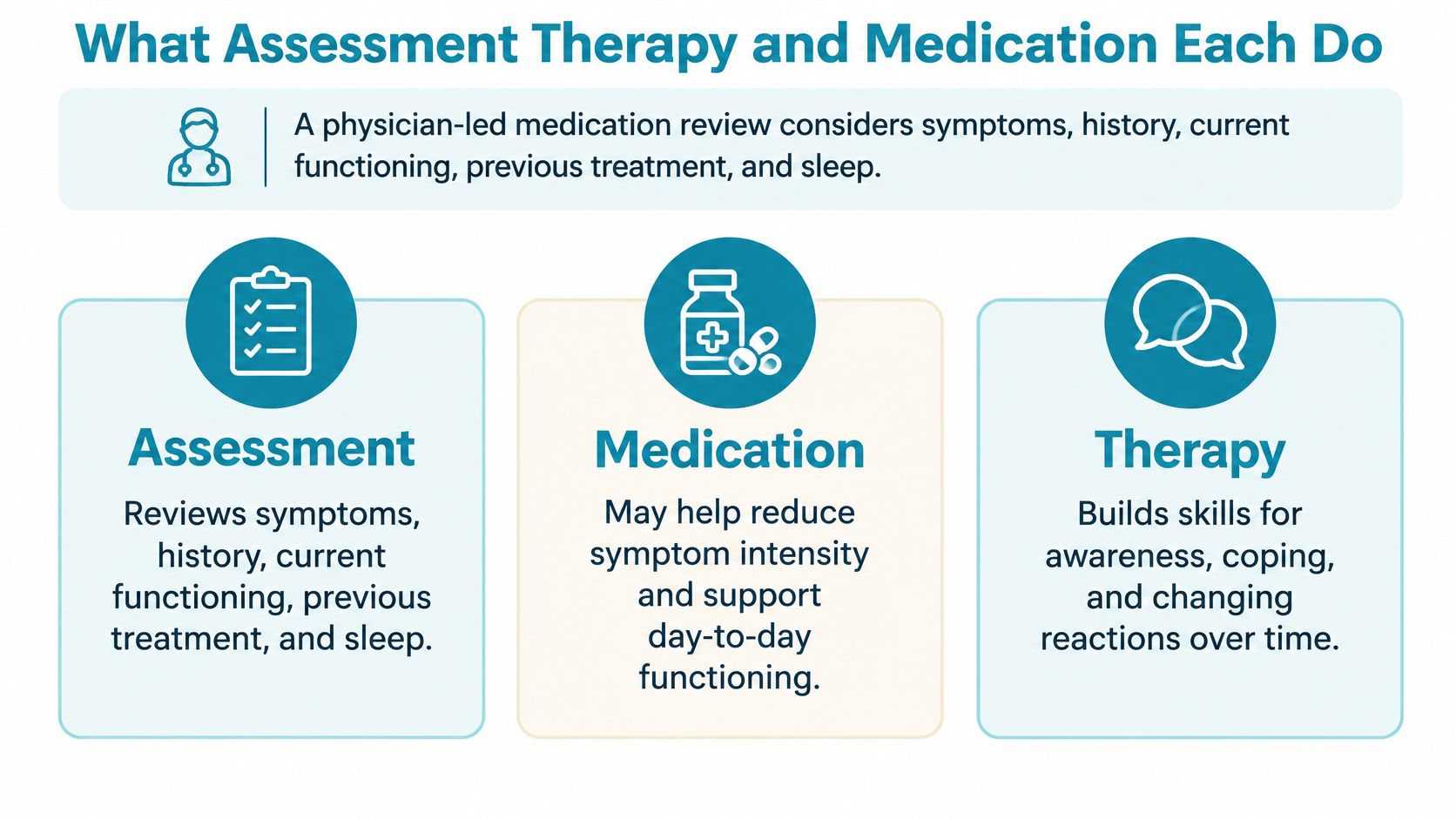
A physician-led review asks what symptoms are occurring, what may explain them, and what treatment goals are realistic. In private-pay outpatient care, the payment model doesn't change the need for careful assessment or establish which treatment is appropriate.
The following describes general clinical tasks, not an undocumented Empire Medical Wellness protocol.
What a Medication Review Typically Includes
| Component | What it typically covers | What it does not do |
|---|---|---|
| Assessment | Symptoms, history, functioning, sleep, substances, and safety | A diagnosis from one emotional episode |
| Reconciliation | Current and past medicines, benefits, side effects, and interaction concerns | A promise that changing a medicine will regulate every feeling |
| Monitoring | Follow-up on response and tolerability | Reader instructions to start, stop, or change a dose |
| Coordination | Contact with a therapist or other clinician when authorized | Proof that psychotherapy or emergency care is provided in the same office |
Medication may be considered for a selected underlying condition after evaluation. It isn't a treatment for every strong emotion. A review should connect the proposed treatment to a defined condition or symptom target rather than assume that emotional intensity alone identifies the right medicine.
Diagnostic clarification also prevents shortcuts. Information about bipolar disorder may support a discussion when relevant, but rapid emotional reactions alone don't establish that diagnosis.
Therapy Builds Skills Through Psychological Care
Dialectical behavior therapy, or DBT, includes emotion-regulation skills among its treatment targets. It's psychological treatment, not another name for medication management.
In a 2025 randomized clinical trial of an online DBT program, 89 adults with chronic pain received the intervention or treatment as usual, and the intervention group showed greater improvement in emotion dysregulation after nine weeks. This was a population-specific online program. It doesn't prove that every DBT format produces the same outcome for every adult.
The NHS Mental Health and Wellbeing Practitioner guide also describes teaching and supporting wellbeing skills within a defined practitioner role. Its role framework is specific to that healthcare setting, not a description of U.S. prescribing responsibilities or Empire services.
Questions for a Physician Discussion
- Most disruptive symptoms: Which difficulties interfere most with daily life, and which point in the emotion sequence appears hardest?
- Medication history: How have current and past medicines affected sleep, mood, side effects, and functioning?
- Safety planning: Which warning signs need attention, and whom should the patient contact?
- Coordination: Would another clinician or therapist be useful, and what authorization would allow communication?
This information doesn't recommend a drug, a dose, or starting, stopping, or changing medication.
Seek Outpatient Care or Crisis Help
If there is immediate danger, call 911. In the United States, people needing crisis support can call or text 988. A scheduled outpatient visit cannot substitute for emergency help.
Outpatient evaluation fits a different set of problems: strong emotions that stay disruptive week after week, recovery that takes far longer than the situation seems to warrant, sleep or substance use that keeps complicating the picture, or a current treatment that is poorly tolerated. An evaluation can also clarify where in the emotion sequence things tend to break down, since the stuck point shapes which kind of help is most likely to work.
Writing a short description of the problem before the visit helps. Note what the episodes cost in daily functioning: missed work, strained conversations, decisions made in the heat of the moment.
Preparing for Outpatient Care
- Describe the pattern: Note what tends to happen before, during, and after difficult episodes.
- Bring treatment information: Include current and past medications, previous treatment, benefits, and side effects.
- Identify practical goals: Examples include fewer conflicts, safer decisions, or improved ability to complete work.
At Empire Medical Wellness, mental health care begins with a review of symptoms, medical history, functioning, previous treatment, and current and past medications. Sleep, substance use, and lifestyle enter the discussion when they affect diagnosis or treatment response. Patients can seek this care on its own, without using the practice's other service areas. Adults weighing outpatient care can review the practice's mental health evaluation and medication management page before deciding.
Sources
The directly linked references above include:
- Gross's foundational review: Review of General Psychology, volume 2, pages 271 to 299.
- Emotion-regulation meta-analysis: Clinical and control-group comparisons across mental disorders.
- DERS paper: Measurement of perceived emotion-regulation difficulties.
- Online DBT trial: Emotion-regulation outcomes in adults with chronic pain.
- NHS anger guidance: Recognizing difficulties and seeking help.
- NHS practitioner guide: Supporting wellbeing skills within a defined clinical role.
This article is educational. It does not replace personal medical advice, a diagnosis, or decisions about starting, stopping, or changing medicine.
Empire Medical Wellness offers adult mental health evaluation, diagnostic clarification, medication review, and ongoing medication management, with therapist coordination when clinically useful and authorized. For adults seeking physician-led outpatient assessment of persistent emotional difficulties, you can request a 50-minute initial evaluation ($350) with Empire Medical Wellness.