
If eating sometimes feels hard to stop, does that mean it's binge eating disorder, or could it be ordinary overeating during a stressful week? That distinction matters, and it can't be made from body size, a blood test, or one difficult meal. Binge eating disorder involves a repeated pattern of loss-of-control eating, meaning a person feels unable to stop eating or control what's eaten during an episode, along with distress about the pattern.
Assessment comes before treatment choices. A clinician asks about frequency, duration, feelings before and after episodes, and related health concerns. The U.S. National Institute of Mental Health statistics on eating disorders report a 1.2% overall prevalence of binge eating disorder, with 1.6% among females and 0.8% among males. Those figures show a common condition, not a rare or shameful one, and they don't describe any one person.
Care usually moves in sequence. First comes careful assessment. Then psychotherapy, guided self-help, or medication may be discussed when clinically appropriate. Weight-management planning, if wanted, follows a separate conversation and is not the same as treating binge eating. The options below explain what each step does, what safety questions to ask, and how to prepare notes for a first appointment. No single option fits every adult, and no option should be started, stopped, or changed without a qualified clinician.
Table of Contents
- 1. Cognitive Behavioral Therapy (CBT), Including Enhanced CBT for Eating Disorders
- 2. Interpersonal Psychotherapy (IPT)
- 3. Guided Self-Help Based on CBT
- 4. Lisdexamfetamine (FDA-Approved for Binge Eating Disorder)
- 5. Other Medications Used for Binge Eating Disorder (Off-Label or Limited Evidence)
- 6. Supporting Weight-Management Care After Binge Eating Treatment
- 7. Medical Evaluation, Monitoring, and Coordinated Care
- How the Main Binge Eating Disorder Care Options Compare
- Preparing for a First Conversation About Care
1. Cognitive Behavioral Therapy (CBT), Including Enhanced CBT for Eating Disorders
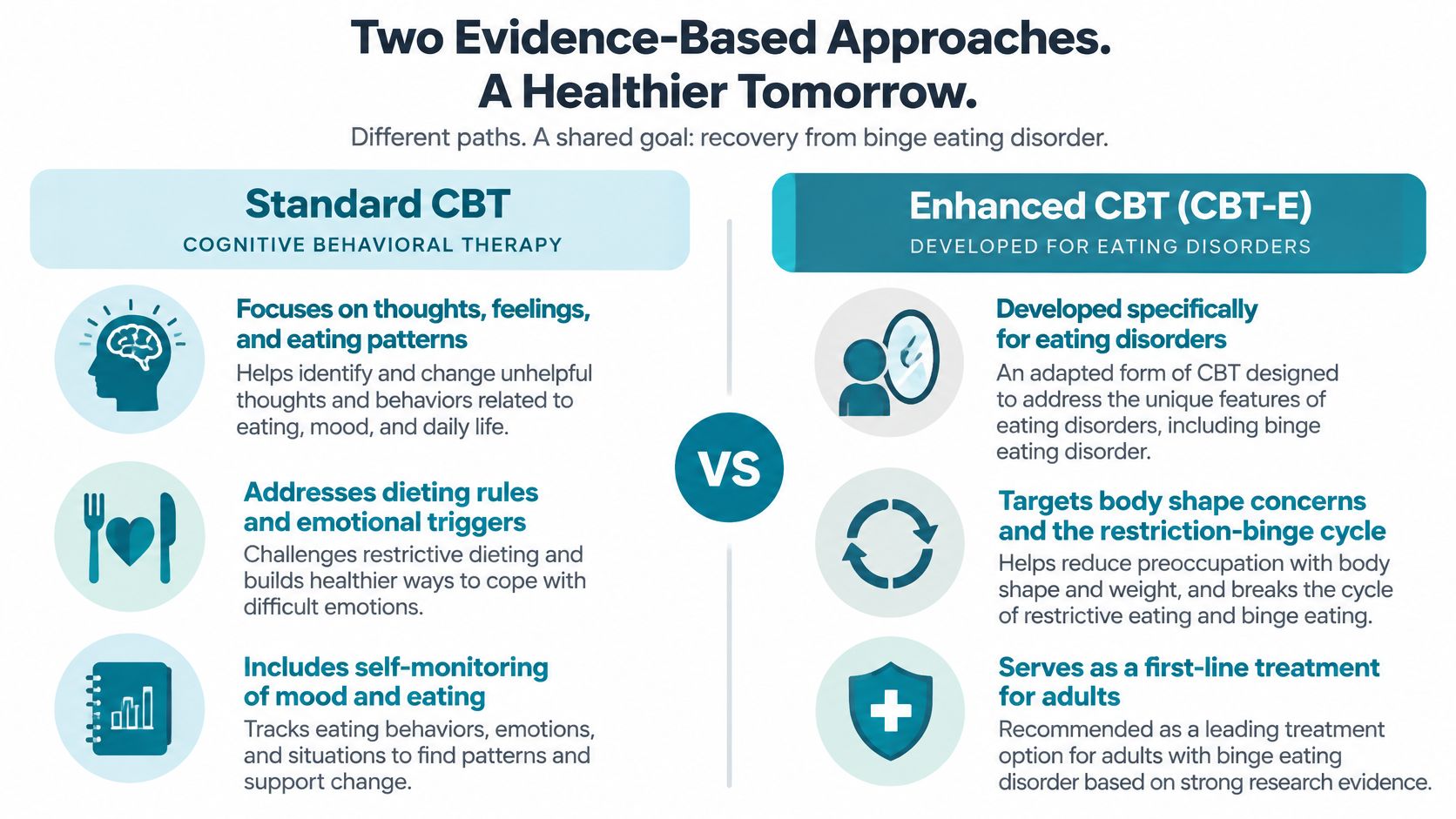
Cognitive behavioral therapy, often called CBT, is a structured form of psychotherapy. Psychotherapy means talk-based treatment with a trained clinician. For binge eating disorder, CBT looks at thoughts, feelings, and eating patterns that keep episodes going. Examples include rigid dieting rules, long gaps without eating, shame after eating, and using food to cope with stress.
Enhanced CBT, or CBT-E, is a version developed for eating disorders. It often addresses regular eating, body-image concerns, perfectionism, and mood intolerance, meaning difficulty tolerating strong emotions without acting on urges. A hypothetical example helps show the difference. A hypothetical adult who skips meals, then eats rapidly at night, might work with a CBT-E clinician on regular meals, evening triggers, and self-critical thoughts, without any promise that episodes will stop.
What to Ask and Track
- Training and protocol: Adults can ask about eating-disorder training and whether a structured, evidence-based protocol is used.
- Simple log: A brief record of episode timing, situation, and feelings can support discussion. It doesn't need calorie counts.
- Measurable goals: Progress is usually gradual. Goals might include fewer episodes, less distress, or more regular meals.
The National Institute of Mental Health overview of eating disorders identifies individual, group, or family psychotherapy as treatment options focused on troubling emotions, thoughts, and eating-related behaviors. Response varies, and full remission, meaning episodes stop, doesn't occur for everyone. Patterns such as assuming one setback means failure can also be explored, and education about catastrophizing and all-or-nothing thinking may help adults name that process during therapy.
Practical rule: A setback is information for the next session, not a reason to restrict food, fast, or purge afterward.
Safety steps are straightforward. Adults should tell the therapist about depression, anxiety, trauma history, substance use, and any thoughts of self-harm. If symptoms worsen or medical concerns appear, the therapist and physician should coordinate care with permission.
2. Interpersonal Psychotherapy (IPT)
Interpersonal psychotherapy, or IPT, starts with relationships rather than food records. It's a time-limited therapy, which means treatment has a planned focus and duration agreed with the clinician. IPT examines how conflict, grief, role changes, and life transitions affect mood and eating.
A job loss, divorce, new caregiving role, or move can change routines and support. For some adults, binge episodes cluster after arguments or loneliness. IPT helps identify one or two relationship problem areas, then builds communication and support skills around them. Food isn't ignored, but it's understood in emotional and social context.

When IPT May Fit
IPT may suit adults who notice a clear link between episodes and relationship stress. It may also appeal to adults who prefer not to use detailed food monitoring. A hypothetical adult whose episodes began after a bereavement might explore grief, changed routines, and reduced social contact with an IPT clinician, while still tracking whether binge frequency changes over time.
The evidence base for IPT is smaller than the evidence base for CBT. Clinicians often describe IPT as a well-supported alternative rather than the strongest option. That distinction should be stated plainly during treatment planning, so expectations stay realistic and progress can be reviewed.
- Recent life events: A short list of transitions, losses, and conflicts helps a first session stay focused.
- Fit and preference: Adults can ask whether IPT, CBT, or another approach best fits history, goals, and availability.
- Mood symptoms: Low mood should be assessed in its own right. Education about depression symptoms and care options can support that separate conversation.
Safety includes honest discussion of mood, safety at home, and support networks. If depression is severe, or if eating symptoms don't improve, a clinician may recommend a different therapy, added medical care, or specialist eating-disorder referral. IPT doesn't involve restrictive dieting, and relationship work should never blame family members or the person seeking care.
3. Guided Self-Help Based on CBT
Guided self-help sits between reading alone and full weekly therapy. An adult works through a structured CBT-based workbook or digital program. A clinician or trained coach provides brief, regular check-ins to review exercises, answer questions, and watch for worsening symptoms.
This format can help when specialist therapy has a waitlist, costs are high, travel is difficult, or privacy concerns make a first step feel hard. It's usually considered for milder symptoms and for adults who can work at a steady pace. Severe, persistent, or medically risky symptoms need direct clinical assessment rather than self-help alone.

What Engagement Data Show
Access doesn't equal completion. A synthesis summarized in research on digital-care uptake and adherence for binge-eating disorder reported 89.7% weighted mean uptake across 44 intervention conditions, while adherence across 14 conditions averaged 41.8%. That gap is practical information. Programs should track session completion and symptom change, not registrations alone, and human support should be evaluated separately from software.
A hypothetical adult using guided self-help might complete one module each week on regular eating and urges. Brief check-ins every few weeks can review what's helping, what's confusing, and whether a higher level of care is needed. No result is guaranteed.
- Evidence-based program: Adults can ask whether the program is CBT-based and studied for binge eating disorder.
- Scheduled time: A regular weekly time for exercises supports follow-through.
- Early review: Low engagement in the first weeks is a reason to adjust support, not a personal failure.
Human check-ins matter because starting a program is easier than staying with it when symptoms, shame, or busy schedules get in the way.
Safety steps include a clear plan for worsening binge episodes, purging, fasting, depression, or thoughts of self-harm. Guided self-help should connect to a clinician who can step care up when needed.
4. Lisdexamfetamine (FDA-Approved for Binge Eating Disorder)
Lisdexamfetamine dimesylate is a prescription stimulant approved by the U.S. Food and Drug Administration (FDA) for treating moderate to severe binge eating disorder in adults. FDA approval applies to a specific use and does not mean the medication is appropriate for every adult with the condition.
The same medication is also approved for attention-deficit/hyperactivity disorder (ADHD). These are separate indications, each with its own labeling considerations.
Safety Review Comes First
Lisdexamfetamine is a controlled substance, so prescribing is regulated because of the risks of misuse and dependence. Its label includes a boxed warning, the FDA's strongest warning format. Before considering it, a prescriber reviews cardiovascular history, blood pressure, psychiatric symptoms, substance-use history, sleep, appetite changes, and other medications.
The American Psychiatric Association eating disorders guideline says adults who prefer medication, or have not responded adequately to psychotherapy alone, may be treated with an antidepressant or lisdexamfetamine. This is a conditional recommendation for clinician-guided care.
Before an appointment, an adult can prepare a full list of prescription medications and supplements, along with relevant substance-use history. The discussion should cover the current prescribing information and how the clinician will monitor binge frequency, side effects, sleep, mood, and blood pressure. Medication should not be started, stopped, or changed without a qualified clinician.
For example, an adult already discussing assessment and therapy with a clinician might ask whether medication could be added. The prescriber can explain potential benefits, risks, alternatives, and follow-up. If benefits are unclear or side effects are troubling, the treatment plan can be reassessed. Lisdexamfetamine is one possible care option, not a measure of effort or a substitute for an individualized treatment plan.
5. Other Medications Used for Binge Eating Disorder (Off-Label or Limited Evidence)
Not every medication discussed for binge eating disorder is FDA-approved for that use. Off-label use means a clinician prescribes an approved medication for a condition, population, or purpose not listed in its FDA approval. Off-label prescribing can be legitimate, but the reason, evidence limits, risks, and alternatives should be explained clearly.
Certain antidepressants and anticonvulsants are examples sometimes discussed based on limited research or co-occurring conditions. Antidepressants treat conditions such as depression and anxiety. Anticonvulsants are medications first developed for seizures and also used for some other conditions. Evidence for binge eating disorder varies by drug, and limited evidence shouldn't be presented as proven benefit.
Separate Weight-Management Drugs From Binge Eating Treatment
Anti-obesity medications have their own FDA-approved indications for weight management. Those indications generally aren't the same as an approved indication for binge eating disorder. A drug that affects appetite or weight shouldn't automatically be described as a binge eating treatment. That distinction protects adults from unrealistic expectations and from care that focuses on weight while missing loss-of-control eating.
For context on a medication often asked about for weight, education on metformin and weight loss belongs in a weight-management discussion, not as evidence that metformin treats binge eating disorder. Any named drug requires current label verification by the prescriber.
- Approval status: Adults can ask directly whether a drug is FDA-approved for binge eating disorder or used off-label.
- Evidence and limits: Discussion should state what's known, what's uncertain, and which population was studied.
- Monitoring: The plan should name target symptoms, side effects to watch for, and when treatment will be reviewed.
A hypothetical example is an adult with binge eating disorder and depression. A clinician might discuss treating depression on its own merits, while separately tracking binge episodes and therapy response. Improvement in one condition shouldn't be assumed to prove improvement in the other. Compounded medication shouldn't be promoted for this condition, and no medication choice fits every adult.
6. Supporting Weight-Management Care After Binge Eating Treatment
How can weight-management care support recovery without making eating symptoms harder to manage? Binge eating disorder and weight concerns can overlap, but they are different issues. People of any body size can have binge eating disorder, and seeking weight-management care does not by itself mean someone has loss-of-control eating.
The NIDDK guidance on binge eating disorder treatment describes treatment for the eating disorder as a distinct part of care. For some people, addressing binge eating before starting a weight-management program may help reduce the risk of a restrictive approach intensifying hunger, food preoccupation, or shame.
A Safer Order of Conversations
A clinician can first help clarify eating patterns and discuss care for binge episodes. Health concerns, such as blood pressure, diabetes risk, sleep, or joint pain, can be considered separately. If an adult wants weight-management support, the clinician and patient can then discuss goals and methods that do not treat fasting or purging as compensation for an episode.
For example, an adult might work with an eating-disorder-trained clinician on regular meals and patterns associated with binge episodes. If symptoms become more stable, the person could discuss nutrition, activity, sleep, and medication options for weight management with a physician. This is a possible sequence, not a promise that episodes will stop.
- Distinct goals: Ask how treatment for binge eating and weight-management goals will remain compatible.
- No compensation: A plan should not use calorie restriction, fasting, or purging in response to an episode.
- Trained nutrition support: An eating-disorder-trained dietitian may help when nutrition care is needed.
- Maintenance planning: Follow-up can support long-term care after weight changes. Learn more about weight-loss maintenance after medication.
Safety check: If a weight-management plan increases food preoccupation, secret eating, or loss of control, tell the care team promptly.
Body size alone cannot establish or rule out binge eating disorder. Care should consider overall health while keeping eating symptoms in view.
7. Medical Evaluation, Monitoring, and Coordinated Care
Medical evaluation gives every other option a safe foundation. Diagnosis is based on pattern, not appearance and not laboratory results. Blood tests can assess associated health concerns, but they don't diagnose binge eating disorder and no set of lab markers confirms it.
The NIDDK definition and facts page for binge eating disorder provides federal background on the condition. Diagnostic descriptions in StatPearls on binge eating disorder define an episode as eating within a discrete period, typically two hours, an amount clearly larger than what an average person would eat in similar circumstances, with a sense of lacking control. Episodes must cause marked distress and occur on average at least once a week for three months.

What Coordinated Care Includes
A physician can clarify the pattern, screen medical and psychiatric factors, review medications, and identify an appropriate level of care. An eating-disorder-trained therapist can provide psychotherapy. A dietitian trained in eating disorders may support nutrition care. With permission, clinicians coordinate so advice doesn't conflict.
Empire Medical Wellness provides private, physician-led care in obesity medicine, addiction medicine, and mental health, and patients may seek any one service independently. That structure doesn't make the practice a specialist eating-disorder program. Specialist eating-disorder care may be appropriate, and referral should be discussed openly. General education on what type of doctor to see for weight loss can also help adults separate weight care from eating-disorder assessment.
- Prepare notes: The worksheet below helps organize timing, feelings, and questions without calorie targets.
- Bring medication history: Current medications, supplements, and substance-use history affect safety decisions.
- Ask about referral: Adults can ask whether eating-disorder specialty care is recommended.
- Urgent help: Adults with thoughts of harming themselves can call or text 988 in the United States or go to the nearest emergency department.
Monitoring continues after the first visit. Binge frequency, distress, mood, sleep, medical markers relevant to other conditions, and treatment burden can all be reviewed. If a lower-intensity approach isn't helping, care should change rather than continue.
How the Main Binge Eating Disorder Care Options Compare
| Item | Evidence Level | Regulatory Status | Usual Format |
|---|---|---|---|
| Cognitive Behavioral Therapy (CBT), Including Enhanced CBT for Eating Disorders | Strong; first-line psychological treatment with extensive study in adults | Psychotherapy; no FDA approval status | Structured weekly sessions over several months, with self-monitoring and exercises |
| Interpersonal Psychotherapy (IPT) | Moderate; supported by research and guidelines, with less evidence than CBT | Psychotherapy; no FDA approval status | Time-limited, structured therapy sessions focused on relationships and life events |
| Guided Self-Help Based on CBT | Moderate; recognized in guidance, generally less intensive than full CBT | No FDA approval status | CBT-based workbook or digital program with brief regular check-ins |
| Lisdexamfetamine (FDA-Approved for Binge Eating Disorder) | Strong for its approved use in adults with moderate to severe binge eating disorder | FDA-approved for this use in adults; Schedule II controlled substance with a boxed warning | Prescription medication with clinician monitoring |
| Other Medications Used for Binge Eating Disorder (Off-Label or Limited Evidence) | Limited to mixed; use is individualized | Not FDA-approved for binge eating disorder; may be prescribed off-label | Prescription medication, selected and monitored by a clinician |
| Supporting Weight-Management Care After Binge Eating Treatment | Consensus-based; guidance supports sequencing, with limited direct comparison studies | Individualized clinical care; no specific regulatory status | Coordinated care with a clinician and possibly a registered dietitian |
| Medical Evaluation, Monitoring, and Coordinated Care | Strong for the diagnostic approach described in NIDDK guidance | Clinical assessment and monitoring; no specific regulatory status | Clinical visits, symptom review, and medical tests as appropriate |
Preparing for a First Conversation About Care
Binge eating disorder care starts with assessment, not with a ranked list of cures. A clinician first clarifies loss-of-control eating, frequency, duration, distress, and related health concerns. Body size doesn't make the diagnosis. Blood tests don't make the diagnosis. That careful first step protects adults from being steered only toward weight loss when binge eating needs treatment, and from being overlooked because appearance doesn't match a stereotype.
Psychotherapy is often central after assessment. CBT and CBT-E focus on thoughts, feelings, regular eating, and triggers. IPT focuses more on relationships, grief, and life transitions. Guided self-help based on CBT can be a lower-intensity step for some adults, especially when access is limited, provided symptoms are monitored and care can be stepped up.
Medication is a separate, clinician-guided decision. Lisdexamfetamine has a specific FDA-approved role for some adults and requires careful safety review because it's a stimulant and a controlled substance. Other medications may be discussed off-label or for co-occurring conditions, with evidence limits stated clearly. Anti-obesity medication shouldn't be called a proven binge eating treatment unless its label and evidence support that claim.
Weight-management planning, when wanted, works best as its own later conversation. Some adults need binge eating treatment before a weight program. Any later plan should avoid restrictive dieting, fasting, purging, and shame-based targets. It should also include follow-up if eating symptoms return.
Nonjudgmental Appointment-Preparation Worksheet
- Pattern notes: When do episodes usually happen? What happened earlier that day?
- Feelings and context: What feelings, conflicts, sleep problems, or long gaps without eating came before an urge?
- Afterward: What feelings followed, without judgment and without listing calories?
- Health background: What medical conditions, mental-health concerns, medications, supplements, and substance-use history should a clinician know?
- Support and access: What therapy, nutrition, or specialist support is already in place? What cost, travel, or privacy barriers exist?
- Questions to discuss: Does the pattern fit binge eating disorder? Which level of care fits now? Is specialist eating-disorder care appropriate? How will progress and safety be monitored?
There's no promised trick that stops an episode once an urge hits. The worksheet has a narrower job. It helps an adult describe patterns clearly, ask better questions, and leave with next steps that fit medical needs and personal preferences. Specialist eating-disorder care may help and shouldn't be viewed as a last resort only for a crisis.
This article is educational and isn't personal medical advice. Adults who are distressed by recurrent loss-of-control eating can discuss assessment with a qualified physician or eating-disorder-trained clinician, and can learn more about Empire Medical Wellness at its website before deciding whether its physician-led evaluation model fits their broader care needs.
Empire Medical Wellness offers private, physician-led outpatient care for adults across obesity medicine, addiction medicine, and mental health evaluation and medication management, with each service available on its own. For adults sorting out eating patterns, weight concerns, and related medical questions, a careful evaluation can clarify next steps and whether outside eating-disorder specialty care should be part of the plan. Visit Empire Medical Wellness to learn more about the practice and its approach to individualized care.