
Panic disorder means recurrent, unexpected panic attacks followed by at least one month of worry about more attacks, worry about their consequences, or a behavior change such as avoidance. One panic attack isn't the same diagnosis.
What happens between episodes may be as important to an evaluation as what happens during them. An adult may describe a racing heart clearly but overlook the appointments, errands, or travel that fear has gradually displaced. A careful assessment considers both the sudden surge and its effect on everyday life.
By Empire Medical Wellness Editorial Team
Table of Contents
- Panic Attack Versus Panic Disorder, and How Common It Is
- What a Physician Reviews Before Naming Panic Disorder
- How Clinical Evidence Informs Treatment Choices
- A Panic Episode Log to Bring to Follow-Up
- Follow-Up When Attacks or Avoidance Continue
- Consider Physician-Led Outpatient Mental Health Care
Panic Attack Versus Panic Disorder, and How Common It Is
A panic attack is a sudden wave of intense fear or discomfort, sometimes accompanied by a feeling of losing control. The National Institute of Mental Health's revised-2025 guide, Panic Disorder: When Fear Overwhelms, describes symptoms including a racing or pounding heart, sweating, trembling, difficulty breathing, dizziness, chest pain, nausea, chills, and tingling or numbness.
Panic disorder describes a recurring pattern and its aftermath, not the intensity of one episode. Unexpected attacks and continuing concern or avoidance distinguish it from an isolated attack. The comparison below organizes information for a clinical discussion, not a self-diagnosis.
Panic attack compared with panic disorder
| Feature | Panic attack | Panic disorder |
|---|---|---|
| What it is | A sudden wave of intense fear or discomfort | Recurrent unexpected panic attacks plus ongoing concern or behavior change |
| Trigger | May occur with no clear danger, and may be a single episode | Attacks are unexpected rather than limited to one known trigger |
| Time course | A brief surge; one episode does not establish the diagnosis | At least one month of worry about more attacks or their consequences, or maladaptive change such as avoidance |
| Body symptoms | Racing heart, sweating, trembling, breathing difficulty, dizziness, chest pain, nausea, chills, or tingling | The same kinds of attack symptoms can occur; the repeating pattern and aftermath define the disorder |
| Chest pain or severe symptoms | New or severe symptoms need medical assessment and aren't labeled anxiety from symptoms alone | The same urgent rule applies; medical or substance-related causes are also considered |
The table reflects NIMH's distinction between an attack and a disorder. Its central point is that symptoms alone don't establish the diagnosis. A clinician also needs the timing, circumstances, and consequences of the episodes.
The word unexpected can cause confusion. It means an attack isn't explained solely by an obvious feared situation. It doesn't mean that a person must have been completely relaxed beforehand, or that every detail surrounding an episode has to be mysterious.
Fear that occurs only around a known trigger deserves attention, too. It doesn't establish panic disorder by itself. A physician considers whether another anxiety presentation, a medical condition, or a medication or substance effect better explains the pattern.
Why the time between episodes matters
The immediate physical experience may dominate an adult's account. A pounding heart or difficulty breathing is understandably memorable. Yet a clinician also needs to know whether fear continues after the physical surge has passed.
Anticipatory anxiety means worry about an episode before it happens. Avoidance means changing activities to prevent a feared experience. These terms describe what a person experiences or does; they aren't judgments about courage, motivation, or character.
An adult might still attend work while giving up travel or shopping alone. Another might continue every usual activity but spend considerable time worrying about another attack. Those different patterns call for careful description rather than assumptions based on outward appearance.
Practical distinction: The attack is an episode. The diagnostic assessment considers the larger pattern, including what happens afterward.
An isolated attack can still justify evaluation. Not meeting the definition of panic disorder doesn't make the experience trivial, imaginary, or undeserving of care. The purpose of diagnostic clarification is to identify the appropriate explanation and next steps, not to rank whose distress matters.
How common panic disorder is
In National Comorbidity Survey Replication diagnostic interviews, as reported on NIMH's panic disorder statistics page, 2.7% of U.S. adults had panic disorder in the previous 12 months, and 4.7% had experienced it at some point in life. The same page reports lifetime prevalence of 2.3% among adolescents ages 13–18, including 2.6% among females and 2.0% among males.
For broader context, NIMH estimates that 31.1% of U.S. adults experience any anxiety disorder during their lifetime. That broader category isn't interchangeable with panic disorder, and these figures shouldn't be added together.
These are population benchmarks based on structured diagnostic interviews. They aren't a current symptom score, a prediction for an individual, or a way to determine whether a particular episode was panic. The adolescent estimates also describe adolescents, not adults seeking an evaluation.
The useful conclusion is narrower: panic disorder is a recognized anxiety condition, but an attack and a disorder remain different clinical concepts. An accurate personal assessment requires more information than either a prevalence figure or a symptom checklist can provide.
What a Physician Reviews Before Naming Panic Disorder
New chest pain, severe breathing difficulty, fainting, or other new or dangerous symptoms require urgent medical assessment. Symptoms shouldn't be labeled anxiety because they resemble a panic attack. For a life-threatening emergency, call 911.
The American Psychiatric Association's panic disorder practice guideline describes panic disorder as generally managed in outpatient care, with the condition alone rarely requiring hospitalization. That doesn't make every panic-like episode medically routine. The physician must consider safety and possible medical or substance-related explanations.

The history extends beyond the episode
A thorough review considers symptoms, medical history, current functioning, previous treatment, and current and past medications. Sleep, substance use, and lifestyle also matter when they affect diagnosis or treatment response. Pregnancy plans and other medicines belong in the discussion before a prescribing decision.
Useful history includes:
- Episode pattern: Whether attacks seem unexpected or consistently follow a recognizable situation.
- Changes afterward: Whether fear has altered errands, appointments, travel, or other activities.
- Daily functioning: How symptoms affect work, school, relationships, and ordinary responsibilities.
- Previous care: What was tried, what seemed helpful, and which adverse effects or concerns arose.
These are illustrative assessment topics, not a mandatory three-question screen. They don't document a fixed practice routine, and answers to them alone don't establish a diagnosis.
Adults may encounter several anxiety-related terms while researching symptoms. Empire's information about generalized anxiety disorder addresses a related topic, but a page title or familiar description can't substitute for diagnostic assessment.
Preparing for the appointment
At Empire Medical Wellness, the first mental-health appointment is 50 minutes. It focuses on symptoms, medical and treatment history, current medications, daily functioning, and goals. The patient receives an explanation of the clinical assessment, treatment options, and recommended follow-up.
A completed episode log can make the history easier to review. A current list of medicines and health conditions is also useful, along with notes about prior treatment and any earlier medical assessment of similar symptoms.
The aim isn't to arrive with a polished medical explanation. Plain descriptions such as pounding heart, shaky hands, or leaving a store are useful. It's also appropriate to distinguish what is known from what remains uncertain, including whether an episode had a clear trigger.
How Clinical Evidence Informs Treatment Choices
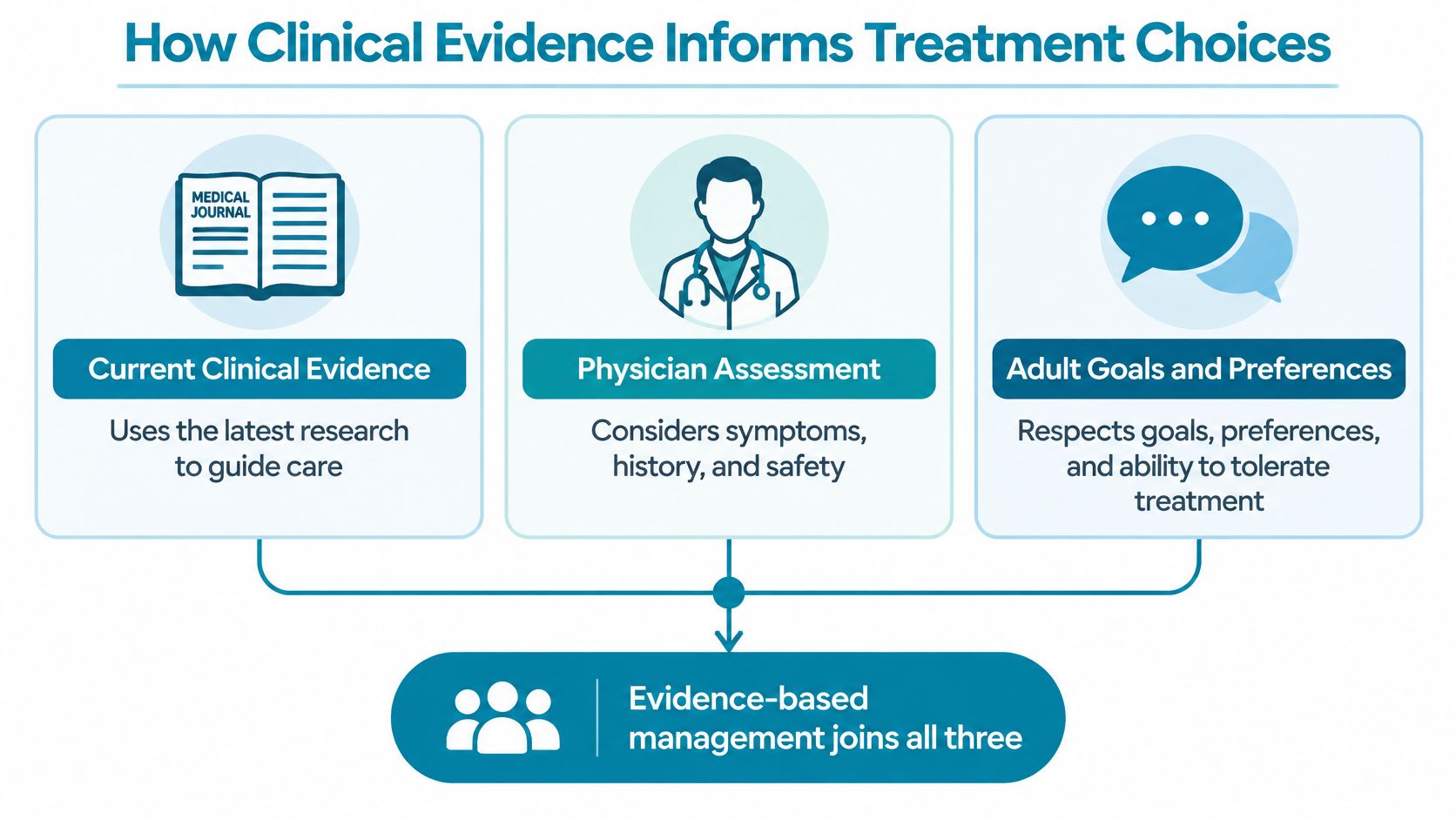
Evidence-based management combines clinical evidence, the physician's assessment, and the adult's goals, preferences, and ability to tolerate treatment. It isn't a guarantee or a single treatment sequence that fits everyone.
A peer-reviewed treatment review available through NIH's PubMed Central summarized a meta-analysis of 53 pharmacotherapy studies involving 7,725 patients and 43 cognitive behavioral therapy studies involving 1,811 patients. Medication and cognitive behavioral therapy both outperformed placebo and showed broadly similar effects on anxiety, agoraphobia, depression, and quality of life.
The same review describes important limits: approximately 45% of patients receiving an SSRI in controlled trials didn't become panic-free, while roughly 40% remained resistant to combined medication and CBT in one cited estimate. Those findings belong beside the benefits, not in fine print.
What the treatment terms mean
Cognitive behavioral therapy, or CBT, is a structured psychotherapy approach. Components supported in the review include cognitive restructuring and interoceptive exposure.
- Cognitive restructuring: Examining frightening interpretations of bodily sensations and testing whether those interpretations fit the evidence.
- Interoceptive exposure: Deliberately and safely reproducing feared bodily sensations within treatment so that catastrophic predictions can be tested.
Interoceptive exposure isn't an instruction to provoke symptoms without appropriate assessment or guidance. The clinical purpose is learning, not proving that someone can endure distress.
Pharmacotherapy means treatment with medication. SSRI stands for selective serotonin reuptake inhibitor, a medication class discussed in the review. A class name alone doesn't determine which medicine is appropriate for a particular adult.
Benefit, durability, and individual decisions
The review also reported an advantage from adding medication to CBT immediately after treatment, with Hedges' g = 0.59 for severity and an odds ratio for response of 1.95, but that advantage wasn't maintained at six-month follow-up. These are study-level effect measures, not an individual's chance of recovery.
The review is useful context, but it isn't a current prescribing protocol. Its findings support monitoring attacks, avoidance, adverse effects, and functioning rather than assuming that an initial choice will fully resolve symptoms.
Treatment success needs a practical definition, such as less avoidance or improved daily functioning, not only a lower symptom count.
Empire's anxiety medication information describes the physician-led medication discussion. Psychotherapy remains a treatment option to discuss; this article doesn't imply that Empire provides in-house CBT.
FDA note: This article doesn't identify a particular medicine as an FDA-approved or off-label treatment for panic disorder. Any medicine-specific discussion should identify the proposed use, distinguish approved from off-label use, and refer to the current FDA prescribing label. No dosing or medication-change instructions are provided here.
A Panic Episode Log to Bring to Follow-Up
An episode log is a memory aid for a clinician, not a diagnostic test. A short entry written after an episode can preserve details that are difficult to recall during an appointment. Ordinary words are preferable to guessed medical terminology.
The following fields can be copied into a notebook or document. Each entry should describe what happened without deciding in advance that the cause was panic.
Panic episode log fields
| Field | What to record | How it helps follow-up |
|---|---|---|
| Date and time | When the episode started | Shows frequency without relying on memory alone |
| Setting | Where the person was and what the person was doing | Gives context without assuming a trigger |
| Unexpected or expected | Whether it began without a clear cue | Helps distinguish unexpected attacks from fear tied to one situation |
| Sensations | Main body symptoms in ordinary words | Supports review of medical and panic-like symptoms |
| Peak duration | About how long the worst part lasted | Distinguishes a surge from worry lasting the rest of the day |
| Immediate response | What happened next | Shows coping and whether urgent care was needed |
| Afterward | Any avoided place, travel, work, or task | Tracks behavior change between visits |
An uncertain detail can remain uncertain. An approximate duration is more useful than a falsely precise number, and an entry can state that no clear cue was noticed without claiming that no cue existed.
A hypothetical completed entry
The following example is hypothetical. It illustrates documentation only and doesn't describe an Empire patient or establish a diagnosis.
| Date and time | Setting | Unexpected or expected | Sensations | Peak duration | Immediate response | Afterward |
|---|---|---|---|---|---|---|
| Date and approximate time recorded afterward | Grocery store while shopping | Felt unexpected; no clear cue noticed | Racing heart | Uncertain | Left the store | Skipped that store the following week |
The entry captures two different things: the physical surge and the later decision to avoid the store. Neither detail proves panic disorder. Together, they give the physician more to assess than a statement that an episode was frightening.
Notes about missed work, changed travel, or an unfinished task can sit beneath the entry. Treatment concerns can also be recorded separately, including a possible adverse effect, uncertainty about instructions, or difficulty following the agreed plan.
Empire's psychiatric medication management worksheet provides another appointment-preparation resource. The episode log should remain brief enough to use consistently rather than becoming a demanding recordkeeping project.
Safety comes first: Urgent medical care takes priority over completing a log when an episode includes severe chest pain, severe breathing trouble, fainting, or another dangerous symptom.
The log must never be used to decide that chest pain is anxiety. Its purpose is to support a later clinical conversation after immediate safety needs have been addressed.
Follow-Up When Attacks or Avoidance Continue
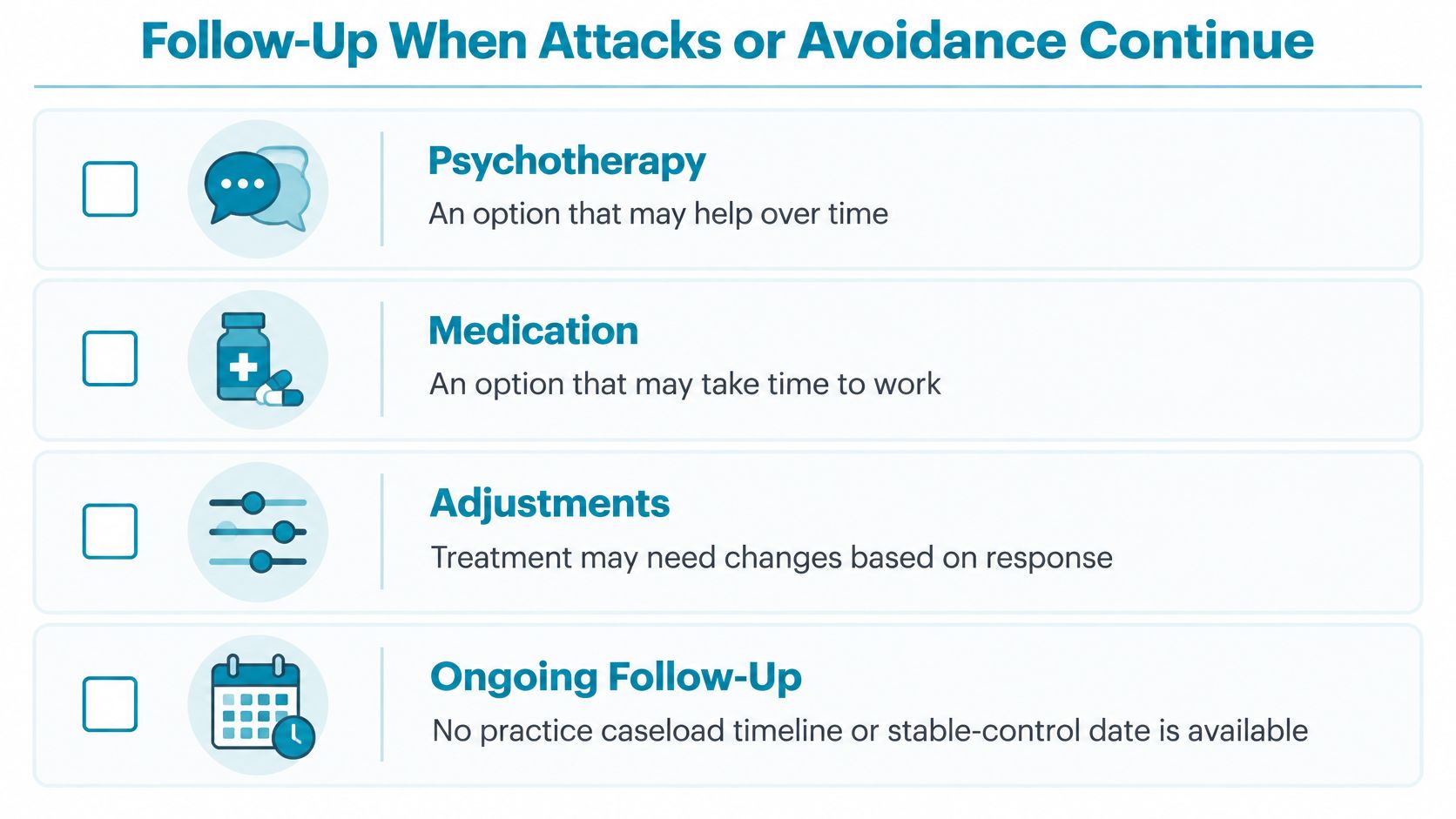
Psychotherapy and medication can take time, and treatment may need adjustment. There's no fixed recovery calendar that applies to every adult, and no Empire caseload-based timeline or stable-control date is available. Follow-up is more useful when it examines observable changes.
Continued unexpected attacks, renewed avoidance, or ongoing difficulty with work, travel, and daily tasks may indicate incomplete response after a treatment trial discussed with the clinician. An isolated later attack isn't automatically a relapse of panic disorder. The surrounding pattern still matters.
Follow functioning as well as symptoms
A functional goal describes something the person wants to do, rather than only a symptom the person wants to eliminate. A hypothetical milestone might be attending a previously avoided appointment. That's an example of a discussion target, not a promised outcome or recovery deadline.
The NICE guideline on panic disorder management supports review and stepped care, including attention to coexisting depression or substance misuse. Stepped care means reviewing needs and response, then considering an appropriate next level or type of care rather than continuing an ineffective plan without reassessment.
Depression and alcohol or other substance use are separate clinical issues, not other names for panic disorder. When they affect safety or treatment response, they may need their own assessment or authorized coordination. Likewise, persistent place-related avoidance may warrant a distinct discussion; Empire's agoraphobia information addresses that concern.
Questions to bring to a follow-up visit
| Question | What it clarifies |
|---|---|
| Is the pattern consistent with panic disorder, or with an isolated attack? | The diagnosis being considered |
| Which medical causes have been checked, and is any further evaluation needed? | Whether physical causes were considered |
| Which measures will be tracked between visits? | Observable targets such as attacks, avoidance, and daily functioning |
| What benefits and side effects should be watched for with this option? | Informed decisions about any medicine |
| What would count as incomplete response, and when will reassessment occur? | Follow-up without a fixed recovery date |
| Could difficulty following the treatment plan be affecting response? | Barriers, unclear instructions, or tolerability concerns |
| How should depression or alcohol or other substance use be handled if it affects symptoms? | Separate issues that may need their own assessment |
| What is the plan if an attack feels like an emergency? | When urgent assessment is needed rather than routine follow-up |
Medication selection and adjustment depend on individual needs, response, and adverse effects. A follow-up discussion is the place to clarify those issues with the prescriber, not to improvise dose changes.
Digital reminders or tracking tools may help organize observations, but a log or app doesn't replace assessment, safety evaluation, or clinician-guided treatment. For suicidal distress in the United States, call or text 988. For a life-threatening emergency, call 911.
Consider Physician-Led Outpatient Mental Health Care
Adults seeking diagnostic clarification for panic-like symptoms can pursue focused mental-health care independently. They don't need care in another service area to discuss anxiety, previous treatment, or medication concerns.
Empire Medical Wellness provides private, physician-led outpatient evaluation and medication management. During a secure telehealth visit, the physician assesses whether medication is appropriate and explains options, monitoring, and follow-up. An appointment doesn't guarantee a prescription, and these services shouldn't be confused with in-house psychotherapy or emergency care.
Access and payment
Telemedicine is available for adults physically located in New York, New Jersey, Connecticut, Pennsylvania, or Virginia, with in-person appointments also available. Current standard fees are $350 for a 50-minute initial evaluation and $225 for a 25-minute follow-up.
Empire doesn't bill insurance directly. An itemized receipt is available through the patient portal, but reimbursement isn't guaranteed. The practice's adult mental-health information describes the relevant service area.
Sources
The supporting references are linked at the relevant claims above:
- National Institute of Mental Health: The revised-2025 patient guide and panic disorder prevalence estimates.
- American Psychiatric Association: Practice guidance on evaluation and outpatient management.
- Peer-reviewed treatment review available through PubMed Central: Evidence comparing medication, CBT, and combined treatment.
- NICE: Recommendations on follow-up, stepped care, and coexisting conditions.
This article is educational and isn't personal medical advice, a diagnosis, or a recommendation to start, stop, or change medication.
Empire Medical Wellness offers physician-led outpatient mental-health evaluation and medication management for adults seeking clarification of panic-like symptoms and thoughtful follow-up. Visit Empire Medical Wellness to review care information and appointment options. Any treatment decision requires an individual assessment; this article remains educational, not personal medical advice.