
A hypothetical worker sends an email with a typo and immediately predicts losing the job. Catastrophizing means assuming the worst outcome and underestimating the ability to cope. It's a thinking pattern, not a diagnosis or a character flaw.
The mistake may need correction. It doesn't, by itself, establish what will happen next. A useful response separates the observable problem from the feared outcome, then identifies a manageable action without demanding optimism.
Cognitive behavioral therapy, or CBT, examines connections among thoughts, emotions, and behavior. Its tools include checking evidence and developing more balanced interpretations. The resources below offer self-help options, a reusable worksheet, a pain-related questionnaire, and an overview of professional care.
These seven resources are educational options, not endorsements, guaranteed therapy, or Empire Medical Wellness recommendations. No Empire clinician ranks them. The NHS materials come from the United Kingdom, but the care-seeking guidance below is intended for U.S. adults.
By Empire Medical Wellness Editorial Team
Table of Contents
- 1. NHS Every Mind Matters Reframing Unhelpful Thoughts
- 2. NHS Every Mind Matters Tackling Your Worries
- 3. Cambridge University Hospitals Techniques to Distract Yourself From Unhelpful Thoughts
- 4. Mind Over Mood and a Reusable Thought Record
- 5. Feeling Good and Naming a Thinking Pattern
- 6. Pain Catastrophizing Scale
- 7. NIMH Psychotherapies and Professional Evaluation
- How the seven resources differ in format, access, and best use
- Choosing Your Next Step Without Dismissing Real Concerns
1. NHS Every Mind Matters Reframing Unhelpful Thoughts
The free NHS guide to reframing unhelpful thoughts explains how to notice a thought, examine it, and consider another interpretation. The method treats a prediction as something to test rather than a fact.
Reframing doesn't mean replacing an upsetting thought with a cheerful statement. A balanced alternative should acknowledge what happened, what remains uncertain, and what action is available.
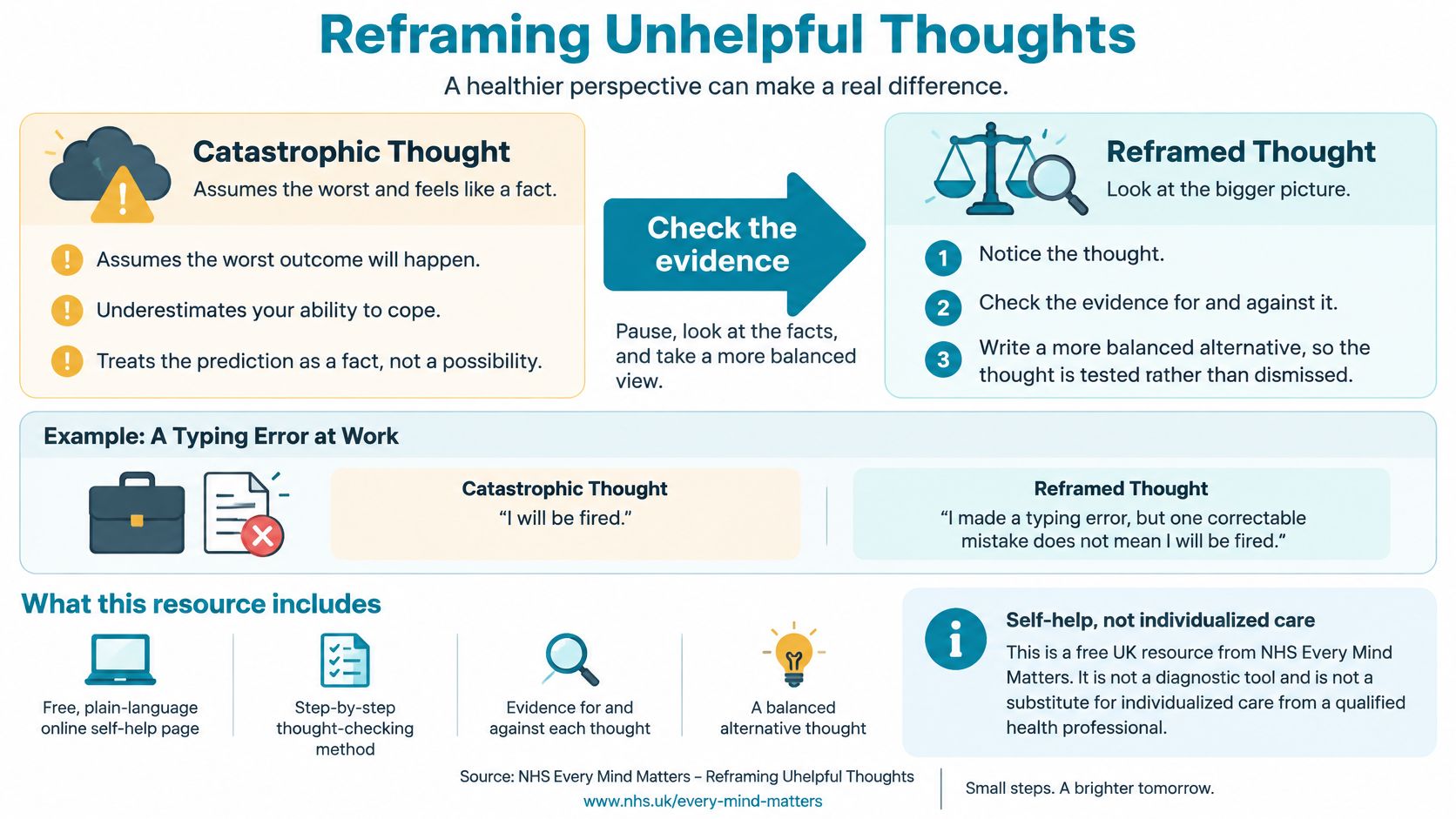
A worked hypothetical example
A person notices a typo after sending a work email. The catastrophic prediction is “One typo means I will be fired.”
- Evidence supporting concern: The message contains an error, and accuracy matters at work.
- Evidence against certainty: The error is correctable. No dismissal notice or disciplinary feedback has occurred.
- Balanced alternative: “A typo needs correction; it does not establish that outcome.”
- Concrete action: Send a concise correction if the mistake changes the meaning or could cause confusion.
The example demonstrates a worksheet, not a documented patient response. If there were actual disciplinary warnings, those would belong in the evidence too.
Practical rule: Balanced thinking leaves room for real consequences without treating the worst possible consequence as certain.
This page is particularly useful when a specific prediction can be written down. It cannot determine workplace risk, diagnose a condition, or replace individualized care. When the difficulty is repeatedly replaying the same event, the practice's explanation of rumination offers related background.
2. NHS Every Mind Matters Tackling Your Worries
Some worries contain a practical problem. Others concern an outcome that cannot currently be controlled. The NHS guide to tackling worries helps readers distinguish between them and consider a planned response.
This distinction matters because thinking longer doesn't always produce more useful information. A written plan can clarify when an action is available and when the remaining difficulty is uncertainty.

Separate the problem from the prediction
In a hypothetical situation, an adult is waiting for a medical test result. Scheduling a follow-up call is actionable; repeatedly predicting a frightening result doesn't reveal the result.
A practical written response might include:
- The actual problem: The result hasn't arrived, and the expected communication process is unclear.
- The available action: Contact the medical office about how results will be communicated.
- The unresolved uncertainty: The result cannot be established through worry.
- The return point: After making the plan, return attention to an ordinary activity rather than repeatedly checking.
A short, defined period for writing worries may offer structure. It shouldn't become a requirement to suppress every thought outside that period.
This resource cannot establish whether a symptom is medically serious. New, severe, or changing symptoms deserve appropriate medical assessment rather than automatic labeling as catastrophizing.
Worry alone also doesn't establish an anxiety diagnosis. The practice's page on generalized anxiety disorder provides context for a condition that requires broader assessment.
3. Cambridge University Hospitals Techniques to Distract Yourself From Unhelpful Thoughts
Evidence checking can become difficult when a person keeps circling the same prediction. A temporary attention shift offers a different task before returning to the problem.
The Cambridge University Hospitals leaflet on redirecting attention describes distraction techniques for unhelpful thoughts. This free patient resource is best understood as an option for a pause, not a method for proving that a concern is false.
A pause with a return plan
In a hypothetical example, an adult spends an evening rereading a brief message and predicting rejection. The person puts the phone aside, folds laundry while noticing the physical task, and then returns to a written thought check.
The task doesn't resolve the relationship question. It creates an opportunity to respond deliberately rather than continue rereading.
Redirecting attention is different from deciding that a real problem doesn't matter.
A useful distinction is whether the pause supports re-engagement. Returning to a needed conversation, completing a routine task, or resuming a valued activity differs from indefinitely postponing everything uncomfortable.
- Choose a concrete activity: Sorting a drawer, washing dishes, or describing nearby objects provides a specific focus.
- Name the return task: Resume evidence checking or take an already identified practical action.
- Notice avoidance: Repeatedly escaping the same necessary task is a reason to reconsider the approach.
The practice's stress-management overview offers related context. Neither distraction nor general stress-management information substitutes for assessment when distress persistently disrupts daily life.
4. Mind Over Mood and a Reusable Thought Record
Mind Over Mood, by Dennis Greenberger and Christine Padesky, is a CBT workbook organized around structured exercises. It may suit readers who prefer writing to just reading advice.
A workbook offers a format, not individualized judgment. Its usefulness shouldn't be confused with a guarantee that independent reading will provide the same care as working with a trained professional.

A short thought-record template
The following editorial template adapts the evidence-checking approach into a reusable writing exercise. A notebook or blank document is sufficient.
- Situation: Describe the observable event without interpreting another person's intentions.
- Prediction: Record the feared outcome and any assumption that coping would be impossible.
- Emotion: Name the feeling, such as fear, shame, sadness, or frustration.
- Evidence: Separate facts supporting the prediction from facts that limit or contradict it.
- Balanced alternative: Write a statement that includes uncertainty and realistic coping options.
- Next action: Identify a concrete response to the actual problem.
- Review: Note whether the exercise helped with action, attention, or avoidance.
In a hypothetical presentation example, the prediction is complete failure. The record distinguishes an unfinished slide from a conclusion about the entire presentation; the next action is revising that slide and rehearsing the opening.
A completed record can also support a clinical conversation. Persistent low mood deserves attention separately from the worksheet, and the practice's depression overview provides relevant background without establishing a diagnosis.
5. Feeling Good and Naming a Thinking Pattern
Feeling Good: The New Mood Therapy, by David D. Burns, introduces readers to cognitive therapy and common thinking errors. These are often called cognitive distortions, meaning interpretations that leave out relevant information or treat an assumption as established fact.
Naming a pattern can give a reader a starting point. The label is less useful if it becomes another criticism.
Use the label, then examine the thought
In a hypothetical example, an adult predicts that an upcoming meeting will end in humiliation. The person identifies fortune telling: treating a prediction about the future as certain.
The next step is not declaring the thought distorted. It is examining what supports the prediction, what remains unknown, and what preparation would help.
- Check past outcomes: Distinguish actual previous difficulties from feared outcomes that never occurred.
- Consider alternatives: The meeting could be uncomfortable, ordinary, constructive, or mixed.
- Include coping: Preparation, clarification, and follow-up remain possible even if the meeting goes poorly.
A useful boundary: A thinking-pattern label should describe a thought, not define the person having it.
A reader doesn't need to settle on the perfect label before taking a sensible action. When labeling becomes repetitive self-monitoring, returning to the actual problem may be more useful.
The book is an educational resource, not a personal treatment plan. A library copy may help a reader assess whether the style fits before purchasing. No comparative claim about this book outperforming other resources or professional treatment is warranted here.
6. Pain Catastrophizing Scale
The Pain Catastrophizing Scale, or PCS, is a pain-specific questionnaire, not a general test for every form of worry. A systematic review published in Pain and Therapy describes a validated 13-item self-report instrument, with responses from 0 to 4 and total scores from 0 to 52, covering rumination, magnification, and helplessness.
Those dimensions describe repeatedly focusing on pain, perceiving it as especially threatening, and feeling unable to cope. They provide vocabulary for discussion, not a verdict about someone's character or the reality of symptoms.
What a response pattern can clarify
In a hypothetical example, a person notices that helplessness best describes the answers. That observation could prompt a conversation about practical support and coping rather than a demand to stop worrying.
The scale belongs in its pain-related context. It shouldn't be repurposed as a diagnostic test for workplace worry, depression, or an anxiety disorder.
- Use context: Interpretation depends on language, clinical circumstances, and changes over time.
- Avoid self-diagnosis: A total score isn't a stand-alone diagnosis or universal cutoff.
- Preserve symptom validation: Concern about pain doesn't mean the pain is imagined.
The questionnaire cannot determine the cause of pain or replace medical assessment. It also cannot establish whether a feared medical outcome is accurate.
For an adult seeking mental-health evaluation, existing questionnaire responses may be useful background. Completing the PCS isn't necessary to justify asking for help, and a score should never be required before taking a new or changing symptom seriously.
7. NIMH Psychotherapies and Professional Evaluation
The National Institute of Mental Health's Psychotherapies overview is an educational starting point for understanding professional treatment. Unlike a worksheet, psychotherapy involves a trained professional who considers the person's needs and adjusts care accordingly.
The American Psychological Association's explanation of CBT describes examining unhelpful assumptions and changing patterns that contribute to functional difficulties. This explains an approach, not a guarantee of results or a recommendation for a particular individual.

When self-help isn't enough
In a hypothetical example, an adult understands the worksheet but continues missing work and avoiding important conversations. That ongoing interference warrants professional evaluation rather than treating incomplete improvement as a personal failure.
Useful discussion aids include:
- Frequency: How often worst-case predictions occur.
- Time spent stuck: Whether disengaging remains difficult.
- Avoidance: Which responsibilities or relationships are being postponed.
- Valued activities: Whether ordinary, meaningful activities are becoming easier to resume.
These observations aren't validated diagnostic thresholds or Empire outcome measures. They help describe what is happening.
Trusted support may also be useful. Before joining an online group, adults can examine privacy rules, moderation, and whether members discourage appropriate care; no preferred network or comparative engagement ranking is established here.
Catastrophizing alone doesn't establish trauma-related illness. The practice's PTSD overview addresses that separate topic.
In the United States, anyone needing crisis support can call or text 988. Immediate danger requires 911.
How the seven resources differ in format, access, and best use
| Item | Format | Access | Best used for | Key limitation |
|---|---|---|---|---|
| NHS Every Mind Matters: Reframing Unhelpful Thoughts | Step-by-step CBT self-help page | Free online; UK NHS resource | Checking evidence for and against a specific thought and writing a balanced alternative | General self-help; not individualized care or a diagnostic tool |
| NHS Every Mind Matters: Tackling Your Worries | CBT-based self-help page | Free online; UK NHS resource | Separating actionable worries from what cannot be controlled | May not be enough for persistent or disruptive worry |
| Cambridge University Hospitals: Techniques to Distract Yourself From Unhelpful Thoughts | Patient information leaflet | Online through a UK hospital trust | Temporarily redirecting attention before returning to a structured thought check | Distraction alone does not test a thought and may become avoidance |
| Mind Over Mood: Change the Way You Feel by Changing the Way You Think | CBT workbook with worksheets | Book; can be used independently or between appointments | Practicing thought records and other structured CBT exercises | Requires consistent practice; evidence for the workbook alone is limited |
| Feeling Good: The New Mood Therapy | Cognitive therapy self-help book | Available through libraries and bookstores | Learning to identify and test common thinking distortions | Not individualized treatment; some exercises may be difficult without guidance |
| Pain Catastrophizing Scale | 13-item self-report questionnaire | Can be completed at home | Organizing pain-related catastrophic thinking for discussion with a clinician | Not diagnostic; developed for pain-related concerns |
| NIMH: Psychotherapies | Educational overview of psychotherapy | Free online; U.S. government resource | Understanding therapy options and when professional support may help | General information; not a practical worksheet or individualized recommendation |
Choosing Your Next Step Without Dismissing Real Concerns
A useful next step is modest: select a specific thought, complete a thought record, and identify an action that fits the actual problem. The action might be correcting an error, arranging a conversation, or seeking an appropriate assessment.
The record doesn't need to end with confidence or relief. A balanced conclusion can acknowledge that an outcome is uncertain and that support would be needed if the situation became difficult.
Judge usefulness by daily life
Repeatedly completing worksheets isn't necessarily progress if ordinary activities remain on hold. More useful observations include whether a person spends less time stuck, avoids fewer necessary tasks, and returns more readily to meaningful activities.
- Continue thoughtfully: A resource may remain useful when it supports practical action without becoming another rigid task.
- Seek evaluation: Persistent interference with sleep, work, relationships, or routine activities warrants professional attention.
- Respect real risk: New information, genuine threats, and changing symptoms deserve assessment, not automatic reframing.
Catastrophizing is a thinking pattern, not a diagnosis. Reasonable concern and unhelpful threat amplification can coexist, and these resources cannot reliably distinguish every situation without context.
No book, leaflet, questionnaire, or worksheet guarantees improvement. A person doesn't have to exhaust self-help options before seeking care, and needing help doesn't represent a failure to use the tools correctly.
Sources
The linked NHS and Cambridge University Hospitals pages provide the public self-help resources. The Pain and Therapy review supports the questionnaire description, and the American Psychological Association explains the CBT approach. The books and NIMH overview are educational resources rather than evidence of individual outcomes.
Empire Medical Wellness offers physician-led adult mental-health evaluation, diagnostic clarification, medication review, and ongoing medication management. The practice doesn't provide psychotherapy, but coordination with a patient's therapist is possible when useful and authorized; adults considering evaluation for persistent catastrophic thinking can visit Empire Medical Wellness. This article is educational and isn't personal medical advice.