Could more protein help preserve muscle during weight loss without causing substantially more weight loss on its own? Sometimes, but protein doesn't bypass energy balance: its potential value is as part of an overall calorie deficit, where it may support fullness and help preserve lean tissue. The right amount depends on individual factors, including body size, age, activity, kidney health, and how weight is being assessed.
Byline: Empire Medical Wellness Editorial Team
Published: October 22, 2026
Updated: October 22, 2026
Table of Contents
- What a High Protein Diet for Weight Loss Actually Means
- What the Clinical Evidence Actually Shows
- How Higher Protein Influences Satiety, Metabolism, and Muscle
- Personalizing a Protein Target During Weight Loss
- A Balanced Day of Higher-Protein Eating
- Benefits, Risks, and When to Seek Medical Input
- Monitoring Progress and Knowing When to Consult a Clinician
- Key Takeaways and Next Steps
What a High Protein Diet for Weight Loss Actually Means
What does "high protein" mean when the goal is losing weight? The term has no single clinical definition. In practice, a high protein diet for weight loss describes an eating pattern that supplies more protein than a person's usual baseline while staying inside an overall calorie plan. Protein does not override energy balance; within a deficit, its job is supporting fullness and helping preserve lean tissue.
One widely used benchmark is the adult Recommended Dietary Allowance (RDA) of 0.8 grams of protein per kilogram of body weight per day, set to cover the needs of nearly all healthy adults, per the National Academies' overview of dietary reference intakes. That figure works like a floor rather than a ceiling: it marks adequacy for the general population, and weight-loss research often tests intakes above it. A study might, for example, compare the standard reference with 1.2 to 1.4 grams per kilogram per day, or compare diets by protein's share of total calories.
Targets also appear in two easily confused units: grams per kilogram and percentage of calories. They are not interchangeable. Converting between them requires knowing total calorie intake and which body weight entered the calculation. For someone carrying substantially more weight, choosing among current, goal, or adjusted weight is a clinical planning question that a generic formula cannot settle.
Food selection matters as much as the number. A protein-forward pattern can draw on beans, tofu, fish, eggs, poultry, dairy, or lean meat alongside vegetables and whole grains. One resource on unlocking keto power shows how protein fits inside a structured low-carbohydrate pattern, though higher-protein eating does not require keto or cutting out whole food groups.
Age, kidney health, and activity level all shift what "high" should mean for a given person, so no general definition can set a personal target or predict a specific amount of weight loss.
What the Clinical Evidence Actually Shows
The evidence points to a careful conclusion: higher protein can offer modest additional scale-weight loss in some calorie-restricted programs, while its more consistent practical role may be helping preserve lean tissue. Lean tissue includes muscle and other nonfat tissue, so a change in lean mass isn't identical to a measured change in muscle alone.
A systematic review of longer-term studies reported average weight loss of 6.3 kilograms in groups assigned higher-protein diets and 5.0 kilograms in standard-protein groups, an average difference of approximately 1.3 kilograms. The size of the difference varied between trials, and these findings don't show that protein alone caused the loss. (Systematic review of longer-term higher-protein weight-loss studies) A separate review of energy-restricted trials found a modest average advantage for higher-protein diets in weight and fat-mass reduction, with uncertainty around the size of those effects. (Review of energy-restricted higher-protein diets)
The muscle-preservation evidence is clinically relevant because the scale doesn't distinguish fat from lean tissue. A 2024 systematic review and meta-analysis of 47 studies involving 3,218 adults with overweight or obesity concluded that increased protein intake was more effective for maintaining muscle mass during weight loss than diets without an increase. (2024 systematic review and meta-analysis on protein and muscle during weight loss)
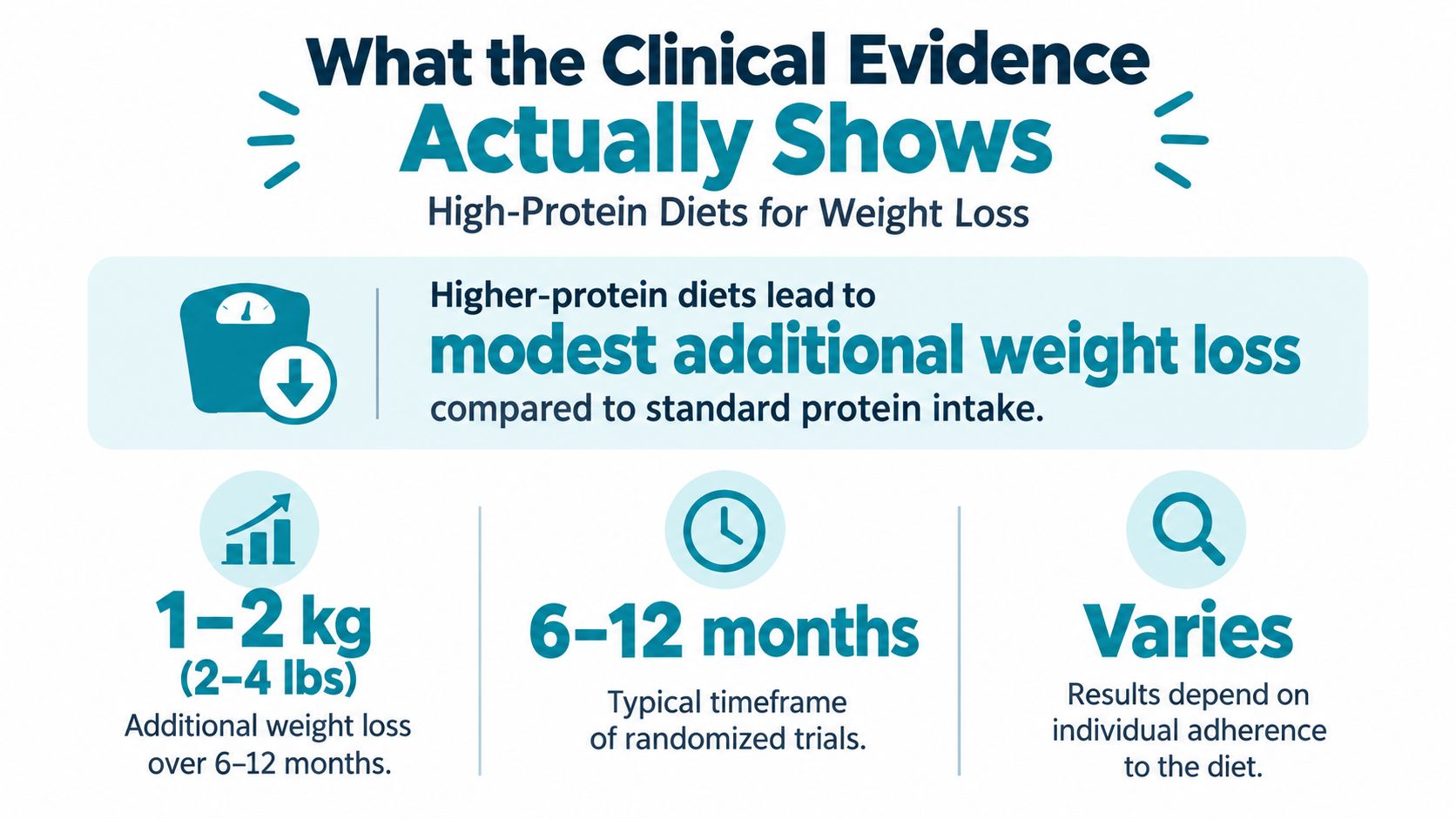
The infographic illustrates a general comparison, not an expected result for any individual. Differences between diets can depend on calorie intake, adherence, food choices, and activity. A higher-protein plan can still fail to support weight reduction if it doesn't create a sustainable energy deficit.
Evidence in brief: Protein is better understood as one tool for body-composition planning than as a stand-alone fat-loss trigger.
Readers seeking a clearer explanation of the energy-balance component can review this overview of calorie-deficit diets. The central point is that protein may support a weight-management plan, but it doesn't remove the need for an overall approach that can be maintained.
How Higher Protein Influences Satiety, Metabolism, and Muscle
Protein can contribute to fullness after meals, which may make a calorie deficit more manageable for some people. That effect varies. A person may feel satisfied with a meal built around fish, beans, vegetables, and whole grains, while another may find a different combination easier to maintain.
A controlled trial among women following comparable energy-restricted diets compared protein intakes of approximately 1.4 grams per kilogram per day and 0.8 grams per kilogram per day. The higher-protein group lost about 1.5 kilograms of lean body mass, compared with about 2.8 kilograms in the lower-protein group, and reported a smaller decline in satiety. Those figures describe that trial's groups, not a forecast for individuals. (Controlled trial of protein intake during calorie-restricted weight loss)

Muscle needs protein's building blocks, called amino acids. During a sustained calorie deficit, the body draws on stored energy, and some loss of lean tissue may occur. Adequate protein may help reduce that loss, but protein alone can't fully prevent it. Resistance activity provides a separate signal for muscles to work and adapt, making it a useful partner to nutrition planning.
Protein also takes energy to digest and process. This is sometimes called the thermic effect of food. That effect isn't a shortcut around total energy intake, and it shouldn't be treated as a meaningful promise of independent weight loss. The practical priorities remain a sustainable calorie plan, food quality, and habits that support muscle.
The evidence doesn't show that increasing protein will produce a larger reduction in scale weight when calorie intake and adherence are similar. A review of the body's energy use and metabolism can help put that distinction in context.
Personalizing a Protein Target During Weight Loss
How much protein does a person need while losing weight? No single figure fits every adult. The purpose of raising protein during a calorie deficit is protecting lean tissue, and the right amount depends on age, health, and how the calculation itself is done.
A sensible starting point is the reference intake described earlier, 0.8 grams per kilogram per day, which was designed as a baseline for generally healthy adults rather than a weight-loss prescription. Research on dieting populations has mostly examined higher intakes. Evidence syntheses have associated intake above approximately 1.05 grams per kilogram per day with better lean-mass retention during weight-loss interventions, though that association describes study groups, not a universal goal. (Evidence synthesis on protein and lean-mass retention)
Age shifts the picture. In older adults, approximately 1.3 grams per kilogram per day may more consistently support lean-mass retention during weight loss or resistance training. That figure isn't automatically right for every older person. Frailty, activity level, health conditions, food access, and eating preferences all shape what is practical. (Clinical review of protein planning in older adults)
The right starting point differs across common situations:
| Situation | Typical range studied | Clinical note |
|---|---|---|
| Adults using the standard reference | 0.8 g/kg/day | The reference intake is a baseline for healthy adults, not a weight-loss prescription (as noted earlier). |
| Adults losing weight | Approximately 1.2–1.4 g/kg/day | Higher intakes may help preserve lean tissue, but the right calculation depends on the individual (controlled trial evidence cited above). |
| Older adults where muscle preservation is a concern | Approximately 1.3 g/kg/day has been discussed | Age alone doesn't set the target; health, function, activity, and feasibility matter (older-adult clinical review cited above). |
| Adults with chronic kidney disease | No general target offered here | Kidney status and stage affect dietary planning, so individualized medical guidance is appropriate. (NIDDK guidance for adults with chronic kidney disease) |
| Adults using anti-obesity medication | No universal range offered here | Reduced appetite or food intake can change the planning question; a clinician can help assess overall intake and muscle-preservation needs. |
One subtlety often gets missed.
The weight plugged into a grams-per-kilogram calculation changes the answer. Using current weight, goal weight, or an adjusted figure can produce meaningfully different estimates, especially when body weight is substantially higher. The formula works like a map scale: the same math yields a different result depending on which input you choose. A generic calculator cannot make that judgment.
Resources that explain protein per kilogram for fat loss can help with the arithmetic, but no online formula replaces individualized assessment. Very high targets aren't automatically better. They may crowd out fiber-rich foods or make an eating plan hard to sustain. Medical or qualified-dietitian input is appropriate whenever a health condition, medication, age-related concern, or substantial planned weight reduction changes the calculation.
A Balanced Day of Higher-Protein Eating
A useful template distributes protein across meals without letting protein crowd out vegetables, legumes, or whole grains. This hypothetical example isn't an Empire Medical Wellness protocol, a personal prescription, or a promise of a particular result.

- Breakfast: Eggs with vegetables and a portion of whole-grain toast. This combines a familiar protein source with vegetables and a grain.
- Lunch: Tofu or beans with vegetables and brown rice or another whole grain. This keeps plant protein and fiber-rich foods together.
- Snack: Plain yogurt, if tolerated, with fruit. A snack can be included or omitted based on appetite and the broader meal plan.
- Dinner: Fish or lean poultry with vegetables, a legume side, and a whole grain.
Portions would need to fit the individual's needs and calorie plan. A balanced pattern can draw on seafood, poultry, eggs, beans, peas, lentils, nuts, seeds, and soy products. Those options differ in fiber, saturated fat, sodium, and calorie content, so “high protein” alone doesn't describe a meal's overall nutritional quality. (Dietary Guidelines for Americans)
Some people prefer distributing protein across meals rather than concentrating it at dinner. That can make a daily plan easier to follow, but there is no single schedule that works for everyone. Resistance activity is another part of the plan because dietary protein by itself can't fully prevent lean-tissue loss during a sustained deficit.
Scale movement doesn't measure fat loss directly. Weight can change for reasons other than changes in body fat, and a scale alone can't tell which tissues changed. A broader healthy eating pattern can help keep protein choices in perspective, rather than making one nutrient the entire plan.
Benefits, Risks, and When to Seek Medical Input
Higher protein is best understood as a body-composition tool inside a calorie deficit, and its realistic benefits are modest ones. Within that frame, it may help preserve lean tissue during weight reduction, and the fullness it can provide after meals may make a deficit easier for some people to sustain. Outcomes vary between individuals, and a very high intake is rarely required to see them.
The trade-offs come largely from what protein arrives with and what it displaces. A pattern built around processed meats or foods high in saturated fat and sodium differs meaningfully from one that includes beans, tofu, fish, poultry, low-fat dairy, and minimally processed foods. If protein crowds out vegetables, legumes, and whole grains, the eating pattern loses variety and fiber, much like a budget that funds one category by draining several others.
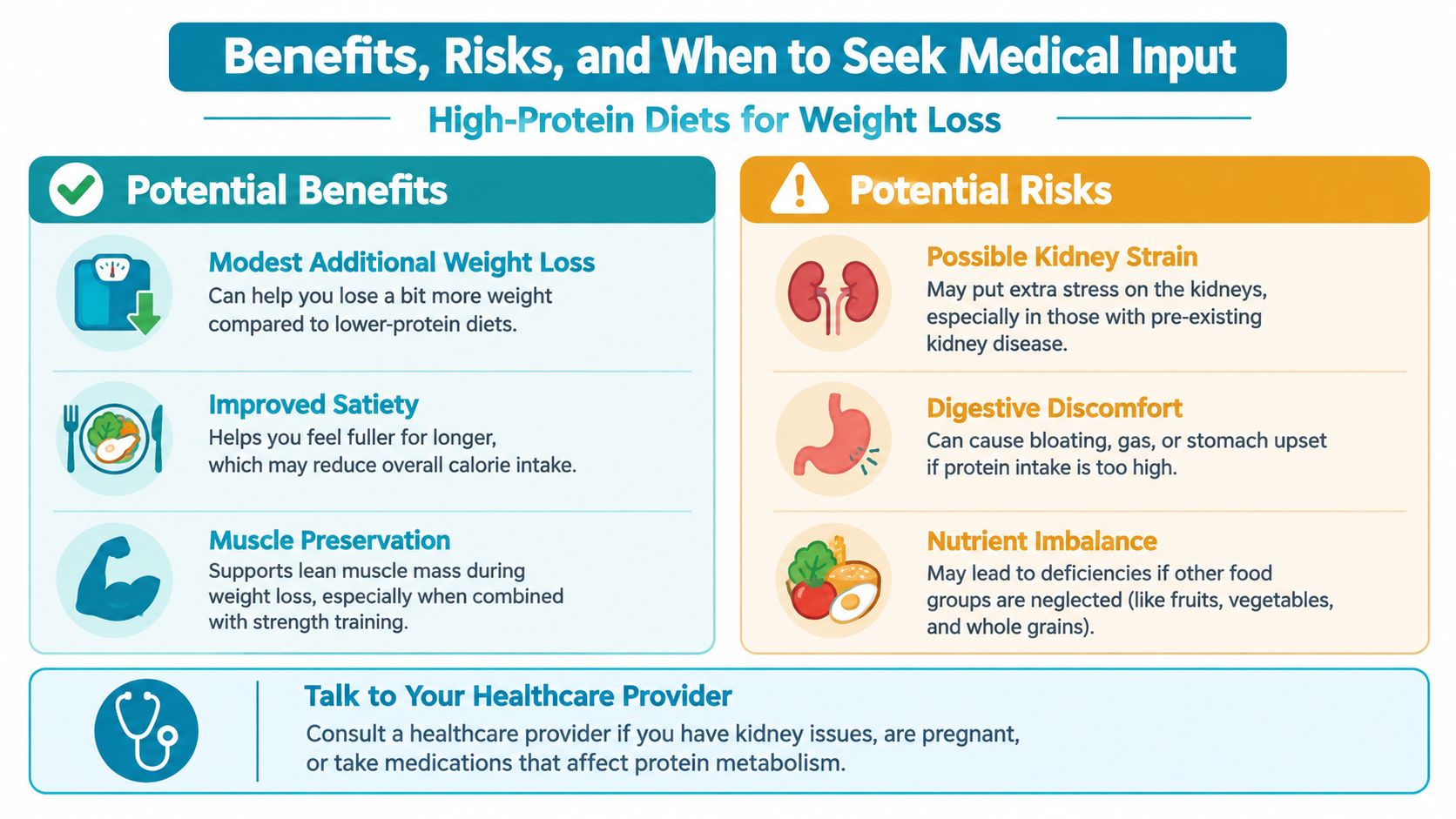
Kidney health deserves individualized attention. Stable kidney function, chronic kidney disease, and dialysis sit at very different points on a spectrum, so dietary needs differ accordingly. NIDDK advises adults with chronic kidney disease to work with a health professional on eating and protein decisions (that guidance is linked in the protein-target table earlier). No single rule serves every reader well here.
Before changing intake: Medical or dietitian guidance is especially relevant when kidney function is reduced, or when age, frailty, diabetes, medication use, or planned substantial weight loss affects nutrition needs.
Some people taking anti-obesity medication find that appetite falls enough to make adequate, good-quality intake harder to maintain; a clinician can help judge whether that is happening. Anyone managing kidney disease or another condition that affects nutrition should treat generic protein targets and supplements with caution rather than assuming they apply. Resistance exercise during weight loss can complement nutrition planning, provided the activity suits the person's health and abilities.
Monitoring Progress and Knowing When to Consult a Clinician
Monitoring should look beyond the scale. Energy, strength, digestive tolerance, and how clothes fit can provide context, while weight trends may offer one limited measure of change. None of these observations alone confirms fat loss or shows whether muscle has been preserved.
A clinician can help decide whether kidney function or blood lipids need review based on medical history and the planned diet. That decision is individual. A general article can't determine which tests are appropriate, interpret results, diagnose a condition, or set a personal protein goal.
Seek individualized guidance before making major changes when there's a personal history of kidney disease, a new symptom after changing eating patterns, pregnancy, use of anti-obesity medication, or a plan for substantial weight reduction. A family history of kidney disease may also be relevant to discuss. Questions about supplements, medication, or changes to a treatment plan belong with a qualified clinician.
For adults considering weight-management care, this guide to what type of doctor to see for weight loss offers a starting point for thinking about professional support. Medical input is especially helpful when decisions about protein intersect with a diagnosed condition or treatment. This article can support an informed conversation, but it can't replace an individual evaluation.
Key Takeaways and Next Steps
Higher protein can modestly support weight reduction and help preserve lean tissue during a calorie deficit, but it isn't a stand-alone fat-loss trigger. The evidence is more consistent for muscle preservation than for dramatic additional scale change. There is no single target for every adult. Age, body size, kidney status, activity, and medication-related appetite changes can all matter.
A practical pattern spreads varied protein foods across meals while keeping vegetables, legumes, and whole grains in the picture. Resistance activity also matters, and very high protein intake isn't automatically better. A clinician or qualified dietitian can help determine whether and how a target should be individualized.
Publication and update date: October 22, 2026.
Sources: National Academies; NIDDK; Dietary Guidelines for Americans; peer-reviewed systematic reviews and clinical research linked above.
This article is educational and isn't personal medical advice.
Empire Medical Wellness provides physician-led outpatient obesity medicine care that may include medical assessment, individualized weight-management planning, medication when clinically appropriate, and ongoing monitoring. Adults physically located in New York, New Jersey, Connecticut, Pennsylvania, or Virginia can visit Empire Medical Wellness to learn about evaluation and long-term planning.