
A healthy diet isn't a temporary restriction designed to change appearance. It's a sustainable pattern of varied, nutrient-dense foods that supports nutritional adequacy, physical function, metabolic health, and mental well-being. For adults seeking physician-led care, the most useful question isn't “Which diet causes the fastest weight loss?” but “Does this pattern provide enough nutrition and remain workable in real life?”
That shift matters because diet quality is a major modifiable influence on health. The Global Burden of Disease Study 201930752-2/fulltext) estimated that dietary risk factors contributed to approximately 7.9 million deaths and 187.7 million disability-adjusted life-years worldwide in 2019. The findings connect dietary patterns with cardiovascular disease, diabetes, and other noncommunicable diseases, while also showing why healthy eating must include both limiting harmful components and regularly consuming protective foods.
Byline: Empire Medical Wellness Editorial Team
Published: October 6, 2026
Updated: October 6, 2026
Table of Contents
- Redefining a Healthy Diet Beyond Weight Loss
- Evidence-Based Benchmarks for Nutritional Adequacy
- Practical Meal Planning and Affordable Food Swaps
- How Diet Interacts With Medical Conditions and Medications
- Building Sustainable Nutrition Habits Over Time
- When to Seek Physician-Led Nutritional and Metabolic Care
- Common Questions About Diet Patterns and Lab Testing
- Sources
Redefining a Healthy Diet Beyond Weight Loss
A healthy diet is a sustainable eating pattern that supplies sufficient vitamins, minerals, fiber, protein, carbohydrates, and fats for the body's needs. Weight may change as part of that pattern, but weight loss isn't the definition of nutritional adequacy, and appearance doesn't reveal whether a person eats well.
Diet culture often reduces healthy eating to calorie restriction. That approach can overlook whether a person is eating enough protein, fiber, iron, calcium, essential fats, and other nutrients. It can also encourage cycles of rigid control, guilt, and abandonment. Adults who have struggled with restrictive diets don't need moral judgment. They need a framework that supports nourishment, flexibility, and repeatability.
What adequacy means in practice
Nutritional adequacy means that meals regularly provide the building blocks required for ordinary body functions. A balanced pattern generally includes vegetables, fruit, whole grains, protein foods, and sources of unsaturated fat. It also leaves room for cultural foods, enjoyable meals, convenience foods, and changing schedules.
The population-level evidence supports this broader view. Diets high in sodium and low in whole grains and fruit were among the leading dietary risks identified in the global analysis linked above. That doesn't mean one meal determines health. It means sustained exposure to dietary patterns can influence health across populations.
Practical rule: A healthy diet is judged by the pattern over time, not by whether one meal was perfect.
Adults may also need different goals at different points. Someone may prioritize nutritional adequacy during a demanding work period, glucose stability after a diabetes diagnosis, or a less restrictive relationship with food while receiving care for an eating disorder. A person pursuing weight management may have calorie-related goals, but those goals should sit within a nutritionally sufficient plan.
A useful starting point is nutrition care at Empire Medical Wellness, alongside guidance from a qualified clinician when medical conditions affect food choices. For readers who want more ideas for making healthy meals you want, the most sustainable options are usually meals that fit personal taste, culture, budget, and available time.
Evidence-Based Benchmarks for Nutritional Adequacy
Public-health guidance gives adults a starting framework, not an individualized prescription. The Dietary Guidelines for Americans describes a healthy pattern as nutrient-dense food choices across major food groups, adjusted to personal calorie needs. It also accounts for variety across vegetables, whole fruit, grains with at least half coming from whole grains, dairy or fortified alternatives, and protein foods such as seafood, legumes, nuts, seeds, eggs, and lean meats.
The WHO healthy diet guidance, updated January 26, 2026 offers population benchmarks, including at least 400 grams of fruit and vegetables daily for adults and children older than 10, or roughly five portions. WHO recommends free sugars below 10% of total energy and sodium below 2,000 milligrams per day, equivalent to less than 5 grams of salt. At a 2,000-calorie intake, that free-sugar threshold is approximately 50 grams, or 12 level teaspoons. WHO notes that moving toward 5% may provide additional health benefits.
A pattern, not a scorecard
The two major guidelines use closely related limits with different wording and thresholds. WHO sets free sugars below 10% of energy and sodium below 2,000 milligrams per day. The Dietary Guidelines set added sugars below 10% of daily calories, saturated fat below 10% of calories from age two onward, and sodium below 2,300 milligrams per day for adults. On a 2,000-calorie pattern, the added-sugar limit equals fewer than 200 calories, or roughly 12 teaspoons. These are population-level reference points, not daily instructions that fit every adult precisely.
Medical history, medications, pregnancy, age, energy needs, food affordability, and cultural preferences can change what is appropriate. Kidney disease may call for clinician-guided decisions about minerals and protein. Diabetes may require carbohydrate choices to align with treatment. Someone receiving care for an eating disorder may need to avoid rigid tracking if it worsens symptoms.
The calorie deficit formula can clarify energy balance, while calorie balance remains only one part of nutritional adequacy. A meal containing dessert, refined grains, or packaged food can still fit within a balanced pattern.
A useful review asks whether the usual diet supplies sufficient variety, fiber, protein, and micronutrient-rich foods while keeping added sugars, saturated fat, and sodium within a reasonable range. The overall pattern matters more than fear of one ingredient.
Practical Meal Planning and Affordable Food Swaps
Healthy eating advice often assumes reliable access to fresh produce, cooking equipment, storage, and spare time. Those assumptions exclude many adults. The World Bank reported that in 2021 more than 3.1 billion people, about 42% of the world's population, couldn't afford a healthy diet. The estimated global average cost was $3.66 per person per day in purchasing-power-parity terms, and by 2022 approximately 2.83 billion people, or 35.4%, still couldn't afford a healthy diet. These figures show why affordability belongs in nutrition counseling.
A practical meal can start with three parts:
- A high-fiber plant food: Vegetables, fruit, beans, lentils, or whole grains.
- A protein source: Eggs, beans, lentils, yogurt, tofu, seafood, poultry, nuts, or seeds.
- A satisfying energy source: Brown rice, oats, potatoes, whole-grain bread, avocado, olive oil, or another culturally familiar option.
Frozen vegetables, canned beans, dried lentils, canned fish, oats, brown rice, eggs, and plain yogurt can provide useful nutrition without requiring premium brands or constant access to fresh foods. Canned items can be rinsed when appropriate, and labels can help compare sodium or added sugar. Organic products and supplements aren't prerequisites for a healthy diet.
Practical Nutritional Swaps for Everyday Meals
| Current Habit | Nutrient-Dense Swap | Primary Benefit |
|---|---|---|
| Sugary beverage at a routine meal | Water, sparkling water, or an unsweetened drink | Reduces free sugar while preserving the drinking routine |
| Refined breakfast cereal | Oats with fruit and plain yogurt | Adds fiber and protein |
| Some processed meat in a familiar dish | Beans, lentils, eggs, or another culturally suitable protein | Increases dietary variety |
| White rice or pasta every day | A portion of brown rice, oats, whole-grain pasta, or another whole grain | Supports whole-grain intake |
| Chips as the regular snack | Fruit with nuts, plain yogurt, or a bean-based snack | Adds fiber, protein, or micronutrients |
| Sour cream in a dip or bowl | Plain yogurt when the flavor and texture work | Offers a practical alternative for some recipes |
A person exploring texture and flavor substitutions may find a useful comparison of Greek yogurt versus sour cream. The best substitution is the one that fits the dish and remains acceptable to the household.
A clearly labeled hypothetical planning example could look like oats and plain yogurt at breakfast, a bean-and-vegetable bowl with a familiar grain at lunch, and a customary dinner with vegetables and a protein source. The point isn't a guaranteed health outcome or weight change. The point is to assess convenience, satisfaction, cultural fit, and repeatability.
The balanced meal approach can serve as a planning reference, but adults shouldn't be expected to follow one universal menu. Household size, food prices, cooking facilities, traditions, allergies, and medical needs all shape a workable plan.
How Diet Interacts With Medical Conditions and Medications
General nutrition guidance becomes more complex when a diagnosed condition or medication affects metabolism, appetite, digestion, or nutrient handling. A healthy diet for one adult may be inappropriate for another if it ignores kidney function, glucose management, lipid levels, gastrointestinal symptoms, or a history of disordered eating.
For adults with diabetes, carbohydrate quality and distribution may matter alongside overall dietary pattern. Foods such as beans, lentils, vegetables, fruit, and whole grains can fit many approaches, but individual carbohydrate needs and medication effects require clinical context. A diet should not be generated from a single glucose result or from a popular rule about avoiding all carbohydrates.
Chronic kidney disease requires particular caution. Depending on kidney function and treatment, clinicians may assess sodium, potassium, phosphorus, protein, fluids, or other factors. That doesn't mean every person with kidney disease must eliminate the same foods. Restrictions should be based on the diagnosed condition, relevant laboratory findings, medications, and professional interpretation.
Mental health also belongs in the conversation. Rigid food rules, fear of eating, binge episodes, compensatory behaviors, or intense guilt may require assessment rather than a stricter meal plan. Nutrition counseling should support safety and adequacy without reinforcing harmful restriction.
Using laboratory results responsibly
Laboratory results inform clinical context. They don't automatically produce a diet. A lipid panel may help a clinician discuss dietary fats and cardiovascular risk, while HbA1c may contribute to diabetes assessment and follow-up. Kidney-related results may influence mineral, protein, or fluid discussions. A single insulin result should not be used to diagnose insulin resistance or dictate a universal eating pattern.
A useful visit worksheet can include:
- Test: The name and date of the result.
- Clinical interpretation: The clinician's explanation of what it means.
- Relevant eating change: One practical adjustment connected to that interpretation.
- Follow-up plan: The measure or conversation that will guide the next review.
Adults seeking a cardiovascular-focused pattern can also review heart-healthy eating guidance. The key boundary remains clear: public-health benchmarks educate the general population, while medical nutrition decisions require individualized assessment.
Building Sustainable Nutrition Habits Over Time
Sustainable nutrition rarely depends on stronger willpower. It depends on whether the plan still works when hunger, stress, fatigue, work schedules, and food access change. A useful routine makes the preferred choice easier and treats a lapse as information, not as a reason to abandon the effort.
Batch-cooking a grain on Sunday, or keeping rinsed canned beans at eye level in the pantry, can remove a decision from a busy weekday. The goal is not to build an ideal menu. It is to make nourishing foods convenient, affordable, and compatible with familiar cultural meals. Public-health guidance offers useful direction, while each person still needs to decide which practical changes fit their preferences, budget, and circumstances.
Making the healthier choice easier
A behavior-change plan can include:
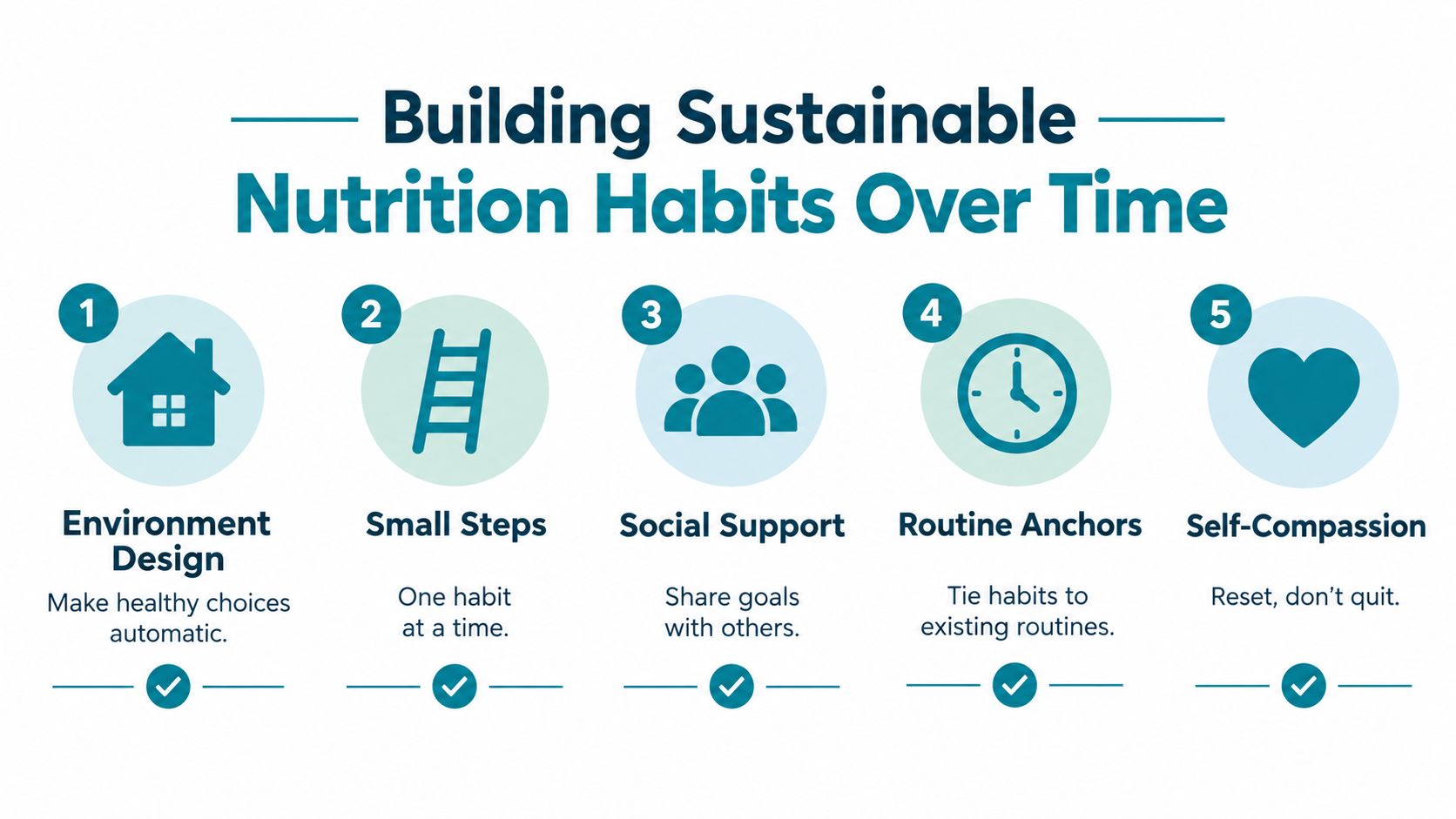
- Environment design: Keep water visible, prepare portable snacks, and store frequently used nutritious ingredients where they are easy to reach.
- Routine anchors: Attach breakfast preparation, grain cooking, or a short grocery list to an existing routine, such as a weekly calendar review.
- Small steps: Change one repeated behavior before adding another. A person might begin with a dependable breakfast, then add vegetables or beans to a familiar lunch.
- Trigger awareness: Notice whether less healthful eating follows skipped meals, stress, social pressure, poor sleep, limited food access, or an impractical schedule.
- Self-compassion: Resume the usual pattern at the next practical opportunity instead of compensating with extreme restriction.
NIDDK's guidance on changing habits for better health supports identifying specific behaviors, anticipating barriers, and choosing changes that can continue. Tracking can focus on convenience, satisfaction, hunger, energy, and repeatability, not only body weight.
A lapse is information about the plan, not proof that the person lacks discipline.
Social support helps some adults maintain a routine. Others benefit more from a simpler grocery list, frozen vegetables, batch-cooked grains, or a reliable breakfast. A workable healthy diet should adapt to ordinary life, including financial limits and cultural preferences, rather than require ordinary life to disappear.
When to Seek Physician-Led Nutritional and Metabolic Care
General guidance may be enough for an adult who wants to improve meal variety, beverage choices, or grocery planning. It may be insufficient when a person has a complex metabolic history, significant medication questions, diagnosed diabetes or kidney disease, repeated difficulty maintaining a plan, or symptoms associated with binge eating disorder or another eating disorder.
Adults considering anti-obesity medication need evaluation rather than a generic online diet. A physician-led assessment may review weight history, relevant health factors, current medications, prior approaches, nutritional goals, and the need for monitoring. Any medication decision must account for clinical appropriateness and the person's broader medical picture.
A thoughtful outpatient evaluation also distinguishes nutritional goals from appearance-based assumptions. It can identify a realistic starting point, clarify what laboratory results do and don't show, and establish follow-up for response, tolerability, and long-term maintenance. No single meal plan or universal protein target is suitable for every adult.
Adults seeking this level of assessment can learn about physician-led obesity medicine care. A consultation doesn't require a promise of a particular treatment. It provides an opportunity to discuss whether individualized medical care is appropriate.
Common Questions About Diet Patterns and Lab Testing
Does every packaged food need to be eliminated?
No. Processing isn't a complete health classification. Frozen vegetables, canned beans, plain yogurt, fortified foods, and whole-grain bread can support a healthy pattern. Greater caution is reasonable with highly processed products that are easy to overconsume or high in sodium, added sugars, saturated fat, or refined carbohydrates. Current evidence links higher ultra-processed food intake with several health outcomes, but definitions and evidence strength vary, so an absolute ban oversimplifies the issue.
Can one insulin result diagnose insulin resistance?
No. Routine insulin testing and a single laboratory result don't automatically diagnose insulin resistance or generate a diet plan. Clinicians interpret laboratory results alongside diagnosed conditions, symptoms, medication use, glucose measures, lipid findings, kidney function, and the broader history.
Is a Mediterranean pattern required?
No. Mediterranean-style eating is one culturally recognizable pattern among several workable approaches. Adults seeking practical background can review this guide to the Mediterranean diet, then adapt the underlying principles to local foods, budget, traditions, and medical needs. Variety and adequacy matter more than adopting a branded label.
Sources
- World Health Organization healthy diet guidance
- Dietary Guidelines for Americans, 2020 to 2025
- National Institute of Diabetes and Digestive and Kidney Diseases habit-change guidance
- Global Burden of Disease dietary-risk analysis30752-2/fulltext)
- World Bank healthy-diet affordability analysis
- CDC food-service and nutrition guidance
Adults who want help translating general nutrition guidance into an individualized obesity-medicine or metabolic-care plan can visit Empire Medical Wellness to learn about its physician-led outpatient services. The practice offers medical and metabolic assessment, individualized planning, monitoring, and long-term maintenance discussions when clinically appropriate. This article is educational information, not personal medical advice.