
What if the hardest part of a calorie deficit isn't understanding the arithmetic, but keeping the plan workable after hunger rises, energy expenditure changes, and early water loss fades? A calorie deficit can reduce body mass when energy intake stays below energy expenditure, but the body doesn't behave like a fixed calculator. The size of the deficit, protein adequacy, activity, medical context, and transition to maintenance all shape what happens next.
This guide explains calorie deficit diets as a physiological tool, not a test of willpower. It also shows where simple formulas help, where they mislead, and when physician-led obesity care may make a safer plan possible.
Table of Contents
- What a Calorie Deficit Actually Is
- The Physiology Behind Negative Energy Balance
- Estimating Energy Needs and Choosing a Deficit
- Meal Patterns That Pair With a Deficit
- A Hypothetical Example of a Sustainable Plan
- Metabolic Adaptation and Weekly Monitoring
- Medical Supervision and Anti-Obesity Medications
- Common Pitfalls and a Clinician Decision Checklist
What a Calorie Deficit Actually Is
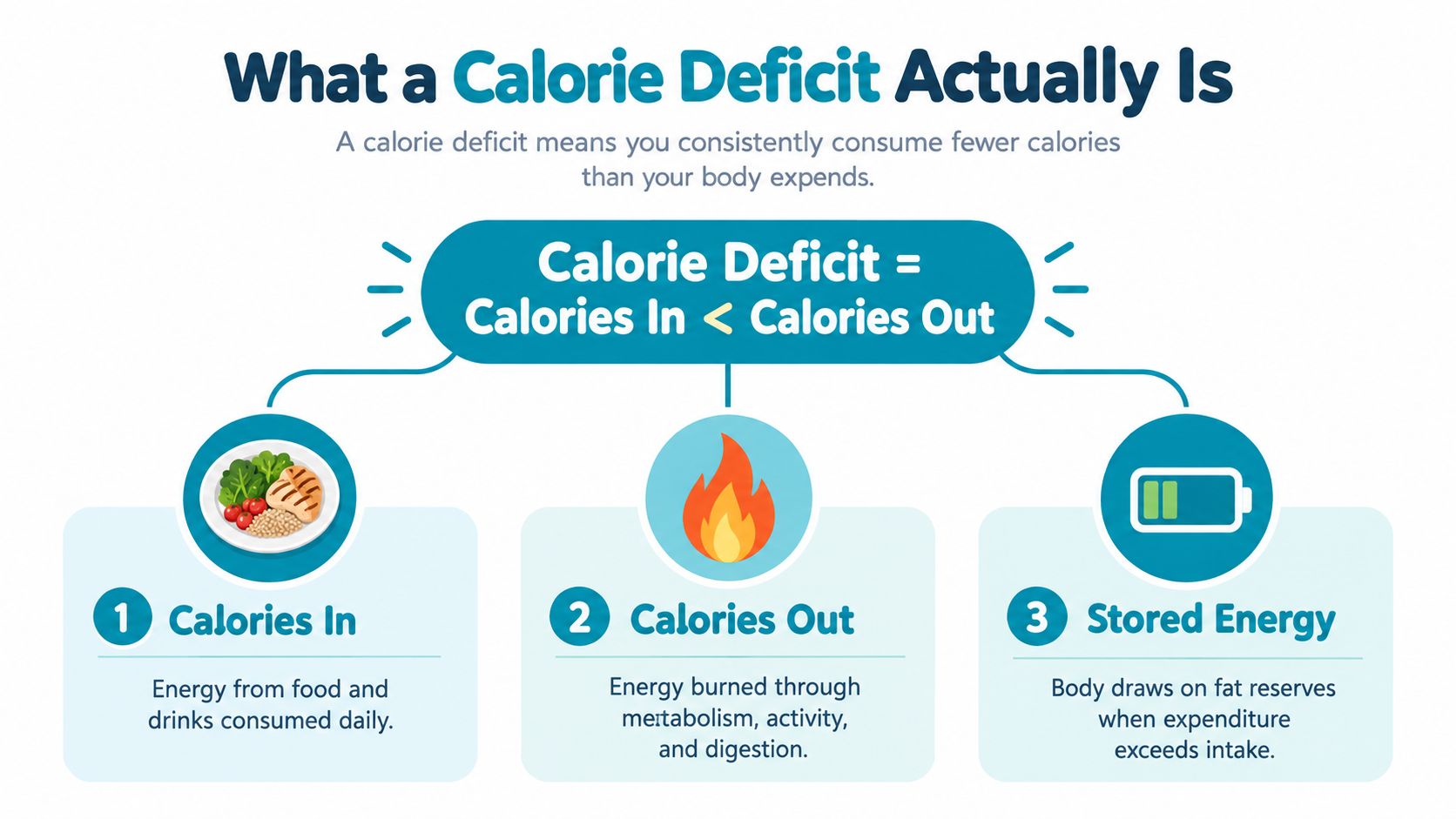
A calorie deficit means consistently consuming fewer calories from food and drinks than your body uses for basic function, movement, and digestion. The gap creates negative energy balance, so the body draws on stored energy and body mass falls over time. This is the core physiological basis of weight loss described in clinical energy-balance research.
Calories describe energy quantity, not food quality. Two meals can contain similar calories while differing substantially in protein, fiber, vitamins, minerals, and how long they keep you satisfied. A deficit is also a sustained pattern, not a single low-calorie meal or one day of eating less.
Restriction isn't the same as treatment
A planned therapeutic deficit is measured, nutritionally adequate, and adjusted as the person's needs change. Under-eating and crash dieting rely on increasingly severe restriction, often without attention to strength, lean mass, medical conditions, or long-term maintenance. Intentional restriction can also become unsafe when it fuels compulsive tracking, fear of food, bingeing, purging, or persistent distress. Anyone with a current or past eating disorder should discuss weight-management goals with an appropriately qualified clinician.
The body's weight change can include fat, water, glycogen, and lean tissue in changing proportions. Early scale movement may not represent fat loss alone, and the pace often slows as the body becomes smaller and adapts. A healthy approach to weight loss therefore focuses on nutrition quality, realistic habits, and health rather than a single scale reading.
For adults considering physician-led obesity care, the practical questions are straightforward: How large a deficit can you sustain, and how will you protect muscle and nutrition while creating it?
The Physiology Behind Negative Energy Balance
Think of energy balance as a household budget. Calories from meals and drinks are deposits. Resting metabolism, digestion, exercise, and everyday movement are withdrawals. When withdrawals exceed deposits, the body uses its savings account, stored energy, to cover the difference.
Energy expenditure has several parts. Resting energy expenditure supports breathing, circulation, brain function, and other basic processes. The thermic effect of food covers the energy required to digest and process what you eat. Activity includes formal exercise and non-exercise movement such as walking, standing, chores, and shifting position.
The body doesn't release stored fat at a fixed, predictable rate. Glycogen, the body's stored carbohydrate, and associated water can change early in a deficit, which can move the scale before fat loss becomes easy to distinguish. Later, fat oxidation generally becomes a larger part of the energy supplied, but lean tissue can also be affected, especially when restriction is aggressive and protein or resistance exercise is inadequate.
Appetite signals change too
Calorie restriction affects biological signals involved in hunger and energy use. Changes involving insulin, leptin, ghrelin, and other systems can increase appetite or reduce expenditure. These responses aren't evidence of weak character. They're part of the body's attempt to restore energy balance.
Clinical perspective: A person can understand the math and still struggle with hunger, fatigue, or plateaus because physiology influences adherence.
Insulin resistance can also affect the broader medical picture, although it doesn't cancel the basic energy-balance principle. Adults who want to understand that connection can review the practice's educational page on insulin resistance.
For a visual explanation of the energy-balance model, this embedded educational video may be useful:
Estimating Energy Needs and Choosing a Deficit
A useful estimate starts with resting energy expenditure, then accounts for activity. The Mifflin-St Jeor equation uses weight, height, age, and sex to estimate resting needs. A clinician or calculator then applies an activity factor to estimate total daily energy expenditure, often called TDEE.
These formulas are starting points, not verdicts. Actual energy needs vary with body composition, movement, medications, illness, sleep, and how accurately intake is recorded. The NIDDK Body Weight Planner is designed to account for changing body size and adaptation when creating a personalized calorie and activity projection.
The arithmetic has limits
The familiar rule that 3,500 calories equals one pound is only an approximation. NIDDK explains that the body adapts over time, so real-world weight loss slows and is less than simple arithmetic predicts. Dynamic models in obesity research have moved clinical thinking away from assuming that one fixed deficit produces the same result indefinitely. One model estimated that a reduction of about 24 calories per day eventually corresponded with about 1 kilogram of weight change, while only about half of that final change appeared in the first year, as described in this peer-reviewed review of weight-loss models.
Clinical reviews commonly describe low-calorie diets as providing about 1,000 to 1,500 calories per day, while many guidelines use a deficit of roughly 500 to 750 calories per day as a starting point. The NHLBI guideline describes a daily deficit of 500 to 1,000 calories within a weight-loss program and associates that range with about 1 to 2 pounds per week, but these are population-level planning figures, not guarantees for an individual (NHLBI guideline).
| Activity level | Approximate activity factor | Starting deficit range |
|---|---|---|
| Mostly sedentary | About 1.3 | A modest reduction below estimated needs |
| Lightly active | About 1.4 to 1.5 | Often a moderate reduction, reassessed with trends |
| Moderately active | About 1.5 to 1.6 | A moderate reduction may be workable |
| Highly active | About 1.6 to 1.7 | The deficit must account for training, recovery, and lean-mass protection |
The activity factors above are estimation categories, not safety guarantees. A calorie deficit formula can clarify the calculation, but it can't determine whether a target is appropriate for pregnancy, an eating-disorder history, significant illness, or medication use. Larger deficits may be used for specific medical purposes, including some pre-operative plans, but those require clinical supervision.
Meal Patterns That Pair With a Deficit
A meal pattern doesn't create fat loss by itself. The deficit creates the energy gap, while the eating pattern determines how tolerable and nutritionally complete that gap feels. Sustainable weight management generally preserves protein, fiber, micronutrients, and lean mass rather than focusing only on the lowest possible calorie number.
A balanced pattern can use familiar portions from vegetables, fruit, minimally processed carbohydrates, protein foods, and unsaturated fats. Mediterranean-style eating emphasizes vegetables, fruit, legumes, whole grains, fish or other protein foods, and unsaturated fats. Lower-carbohydrate approaches change carbohydrate quantity and food selection, while higher-protein plans give protein a larger role in satiety and lean-mass preservation.
Intermittent time-restricted eating changes when a person eats. It can help some adults organize intake, but a time window isn't a guarantee of a deficit. The same applies to keto and other structured approaches. If a pattern causes excessive hunger, poor training, nutritional gaps, or repeated abandonment, its label matters less than its practical failure.
| Pattern | Protein emphasis | Fiber emphasis | Typical satiety | Planning effort | Moderate-deficit fit |
|---|---|---|---|---|---|
| Balanced portion control | Moderate, meal by meal | Usually strong when plants are included | Moderate to high | Moderate | Good when portions are consistent |
| Mediterranean-style | Moderate to high, depending on choices | Strong | Often high | Moderate | Good for flexible, nutrient-dense meals |
| Lower-carbohydrate | Moderate to high if protein foods are included | Variable | Variable | Moderate | Can fit, but fiber needs attention |
| Higher-protein structure | High by design | Depends on plant foods | Often higher | Moderate | Useful when lean-mass preservation is a priority |
| Time-restricted eating | Variable | Variable | Depends on meal quality and timing | Can be high socially | Fits only if it doesn't trigger overeating or distress |
Very low-energy diets providing 800 to 1,200 calories per day receive only weak support in NICE's 2025 evidence review and should involve specialist support rather than a universal prescription (NICE evidence review). A practical balanced meal structure can be more useful than choosing a diet identity.
Higher protein during energy restriction generally preserves more lean mass than lower protein. Reviews commonly discuss 1.2 to 1.6 grams per kilogram per day as a practical range for many adults in intentional weight loss, while 0.8 grams per kilogram per day is better understood as a minimum against deficiency, not necessarily a therapeutic target (systematic review of protein and lean mass). Those figures require individual interpretation, especially with kidney disease or other medical conditions.
A Hypothetical Example of a Sustainable Plan
Hypothetical composite example, not an Empire patient: M. is a 42-year-old office worker with a body mass index of 31. A measured resting energy expenditure is near 1,650 calories, and estimated total daily expenditure is around 2,300 calories. These details are illustrative only and aren't a prescription.
A roughly 500-calorie gap would place the initial illustrative intake near 1,800 calories. A protein target of about 110 to 130 grams could be distributed across meals to support satiety and lean-mass preservation. The exact target would depend on medical history, body composition, kidney function, preferences, and the clinician's assessment.
What the meals might look like
M. might use a flexible pattern rather than eliminate an entire food group.
- Day one: Greek yogurt with berries and oats, a chicken and bean salad with whole-grain bread, cottage cheese with fruit, and salmon or tofu with roasted vegetables and brown rice.
- Day two: Eggs with vegetables and whole-grain toast, lentil soup with a side salad, hummus with vegetables, and lean meat or tempeh with potatoes and greens.
- Day three: A protein-rich smoothie with fruit, a turkey or tofu grain bowl, edamame as a snack, and bean chili with vegetables and avocado.
The plan would include water according to thirst and medical guidance, regular daily movement, and resistance exercise when appropriate. A clinician could review whether the activity plan fits M.’s joints, medications, cardiovascular status, and schedule. The practice's educational material on strength exercise for weight loss discusses why preserving function matters during weight management.
Over four to eight weeks, M. might review the weekly weight trend, hunger, energy, strength, adherence, and relevant laboratory markers. The scenario doesn't promise a specific weight or lab result. Its lesson is narrower: a smaller, protein- and fiber-forward deficit may be easier to repeat than an aggressive plan that repeatedly ends in abandonment.
Metabolic Adaptation and Weekly Monitoring
Weight loss often slows because energy needs change as the body becomes lighter. During restriction, energy expenditure can also fall beyond what tissue loss alone predicts. A review of underfeeding studies describes additional reductions typically around 25 to 75 calories per day, a phenomenon called adaptive thermogenesis (review of dynamic energy-expenditure changes).
Some people unconsciously move less. Resting expenditure and the thermic effect of food can shift, while appetite signals may become stronger. This explains why a plateau doesn't automatically mean that a person has failed or that the original plan was dishonest.
A weekly trend worksheet
Use a consistent record rather than reacting to one morning's weight.
| Measure | Weekly entry |
|---|---|
| Daily weight readings | Record readings under similar conditions |
| Trend weight | Calculate an average from at least seven readings |
| Waist circumference | Measure consistently, if useful and comfortable |
| Calories | Record average daily intake or a structured estimate |
| Protein and fiber | Review adequacy without chasing perfection |
| Hunger and energy | Rate each from 0 to 10 |
| Strength and training | Record completed sessions and performance |
| Sleep and stress | Add a brief note about major changes |
| Adherence | Describe what was workable and what wasn't |
| Contraindications or warning signs | Flag symptoms or medical concerns for review |
If the trend is changing and strength, energy, and nutrition remain acceptable, holding the plan may be reasonable. If the trend is unchanged, first review intake estimates and movement before escalating restriction. If hunger, fatigue, dizziness, weakness, or distress is rising, a clinician may recommend reassessment or a maintenance phase rather than a harsher deficit.
Weekly averages outperform isolated weigh-ins because water, glycogen, sodium, bowel movements, and hormonal changes can obscure short-term fat loss. The worksheet is a monitoring aid, not a diagnosis or a safe-use guarantee.
Medical Supervision and Anti-Obesity Medications
A calorie deficit may move from self-management into medical care when obesity affects health, when a person has relevant comorbidities, during pregnancy, with a current or past eating disorder, or when progress remains difficult despite sustained efforts. A clinician can review weight history, medications, body composition, laboratory data, sleep, activity, and conditions that influence appetite or energy expenditure.
Obesity medicine isn't just a stricter diet. It may include medical and metabolic assessment, individualized weight-management planning, anti-obesity medication when clinically appropriate, monitoring, and long-term maintenance planning. Medication decisions require a clinician who can assess benefits, risks, contraindications, interactions, and the difference between FDA-approved use and off-label use.
FDA-approved anti-obesity medications include therapies that act on appetite signaling, digestion, or reward-related pathways. GLP-1 receptor agonists and GIP/GLP-1 agonists are medication categories used in appropriate clinical settings. Combination therapies use more than one mechanism. These treatments aren't substitutes for adequate nutrition, and extreme restriction can become especially problematic when appetite is reduced.
Medication can support a weight-management plan, but it doesn't remove the need for nutrition, muscle preservation, monitoring, and maintenance planning.
Long-term care also requires a transition plan. Depending on the medication, response, risks, and goals, a clinician may continue treatment, modify it, or discuss what maintenance could look like. “Reverse dieting” isn't a universal medical protocol, and medication changes shouldn't be made without the prescribing clinician. For a related discussion of medication considerations after surgery, readers may find this overview of treating weight regain after gastric bypass useful, while recognizing that surgical history requires individualized care.
NICE guidance emphasizes that low-energy diets should be part of a multicomponent program with long-term support, not a standalone long-term strategy. A maintenance phase should protect function and lean mass, not just celebrate a lower scale number.
Common Pitfalls and a Clinician Decision Checklist
The most common mistakes in calorie deficit diets are correctable planning problems, not character flaws.
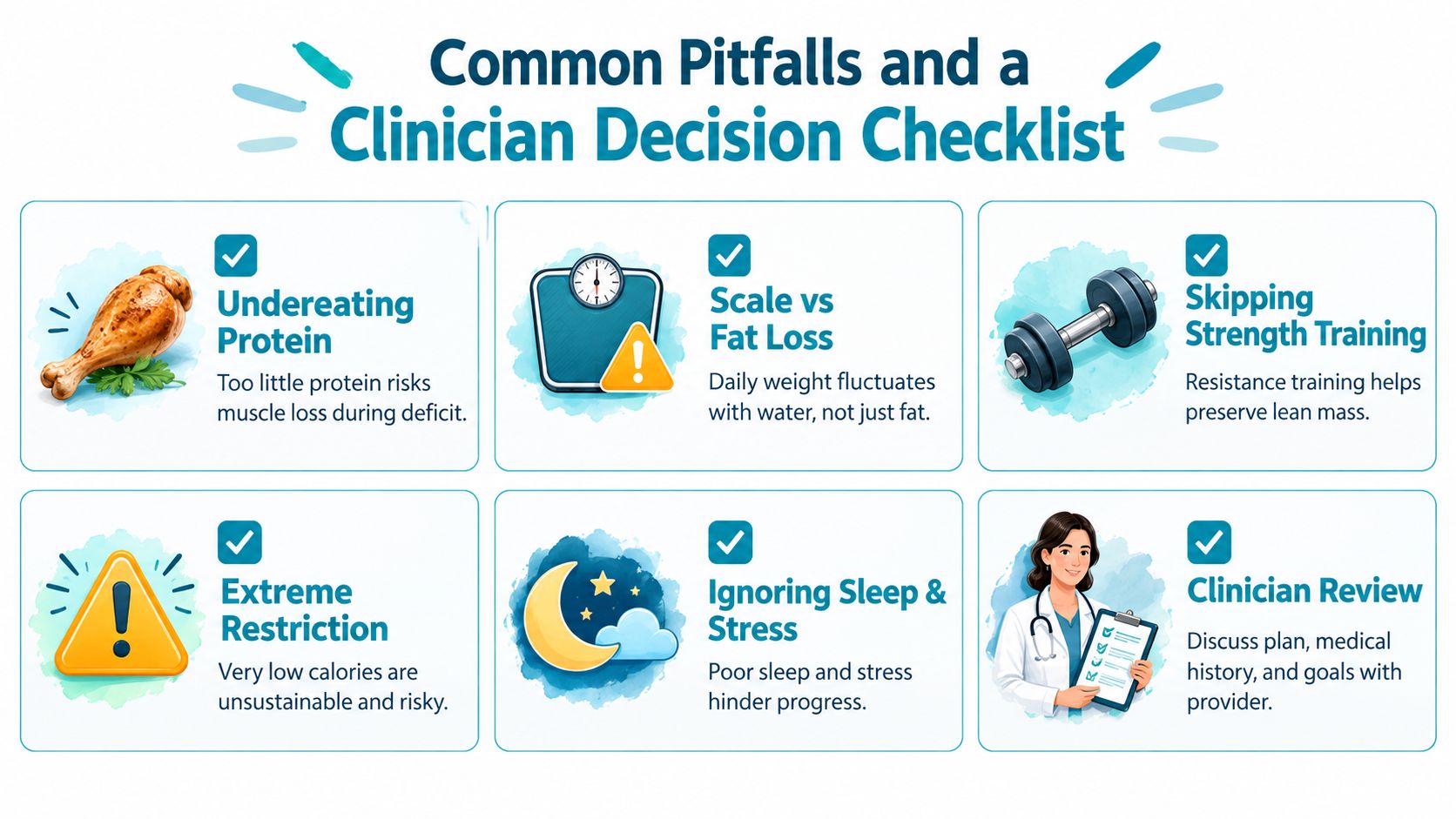
- Protein gets overlooked: Lower intake can increase the risk of lean-mass loss during restriction.
- The scale becomes the diagnosis: Daily weight reflects more than fat, so trend, waist, strength, and function matter.
- Strength training disappears: Resistance exercise is a practical tool for preserving lean tissue when medically appropriate.
- Restriction becomes extreme: A larger deficit can worsen hunger, fatigue, adherence, and adaptation.
- Monitoring stops too soon: A plan needs review during the deficit and again during maintenance.
Clinician decision checklist
Before starting, ask whether the estimated intake is nutritionally adequate, whether protein and fiber are addressed, whether medical conditions or medications change the plan, and whether resistance exercise is appropriate. During the deficit, review the seven-day trend, hunger, energy, strength, sleep, stress, adherence, and relevant cardiometabolic markers.
At maintenance, decide how calorie intake, activity, protein, and follow-up will change. Seek medical review for persistent dizziness, fainting, severe weakness, chest pain, troubling eating-disorder symptoms, or other concerning changes. Routine plateaus deserve assessment, not punishment.
If you want individualized evaluation and monitoring for weight management, Empire Medical Wellness provides physician-led obesity care that can include medical assessment, planning, medication review when clinically appropriate, and maintenance support. Visit Empire Medical Wellness to learn more about the practice and its approach.
Byline: Empire Medical Wellness Editorial Team
Published: September 11, 2026
Updated: September 11, 2026
Sources
- Clinical review of calorie restriction and energy balance
- Review of dynamic models of weight change
- NHLBI clinical guideline for obesity management
- NIDDK Body Weight Planner
- Review of protein intake and lean-mass preservation
This article is educational and isn't personal medical advice.