
Resistance exercise supports strength and lean mass during weight loss, but it doesn't reliably increase total scale weight loss on its own. In a 2024 meta-analysis, adding resistance exercise to dietary weight loss changed total weight loss by only -0.32 kg, while preserving fat-free mass, increasing fat loss, and producing a much larger gain in strength.
That distinction challenges one of the most popular assumptions about lifting. The scale isn't the only measure of progress, and resistance exercise isn't a faster version of cardio. Its clearest role is improving body composition, meaning the balance between fat mass and lean mass, while helping you maintain physical function during weight loss.
For adults considering private, physician-led obesity care, this difference matters. Nutrition, activity, medication when clinically appropriate, and follow-up should fit your health history, preferences, limitations, and long-term goals. A structured plan can help you judge progress by strength, function, waist circumference, recovery, and fat-mass change, not by the scale alone.
Table of Contents
- What Resistance Exercise Does and Does Not Do for Weight Loss
- How Resistance Training Compares With Other Activity for Body Composition
- Designing a Safe and Sustainable Resistance Program
- Sample Routines and Beginner Progression Grid for Different Fitness Levels
- Monitoring Progress and Coordinating With Medical Care
- Safety Tips Modifications and When to Pause or Seek Care
What Resistance Exercise Does and Does Not Do for Weight Loss
Strength training is often judged by the wrong outcome. Its clearest contribution during weight loss is helping preserve lean tissue and improve physical capacity, rather than guaranteeing faster movement on the scale.
Lean mass includes everything in the body that is not fat, such as muscle, bone, organs, and body water. Fat mass is stored body fat. Body composition describes the relationship between these components within total body weight.
A person may lose body fat while retaining more lean mass. The scale can therefore change more slowly, even while clothing fit, strength, waist circumference, and daily function improve. That pattern may represent better-quality weight loss than a scale-only goal.
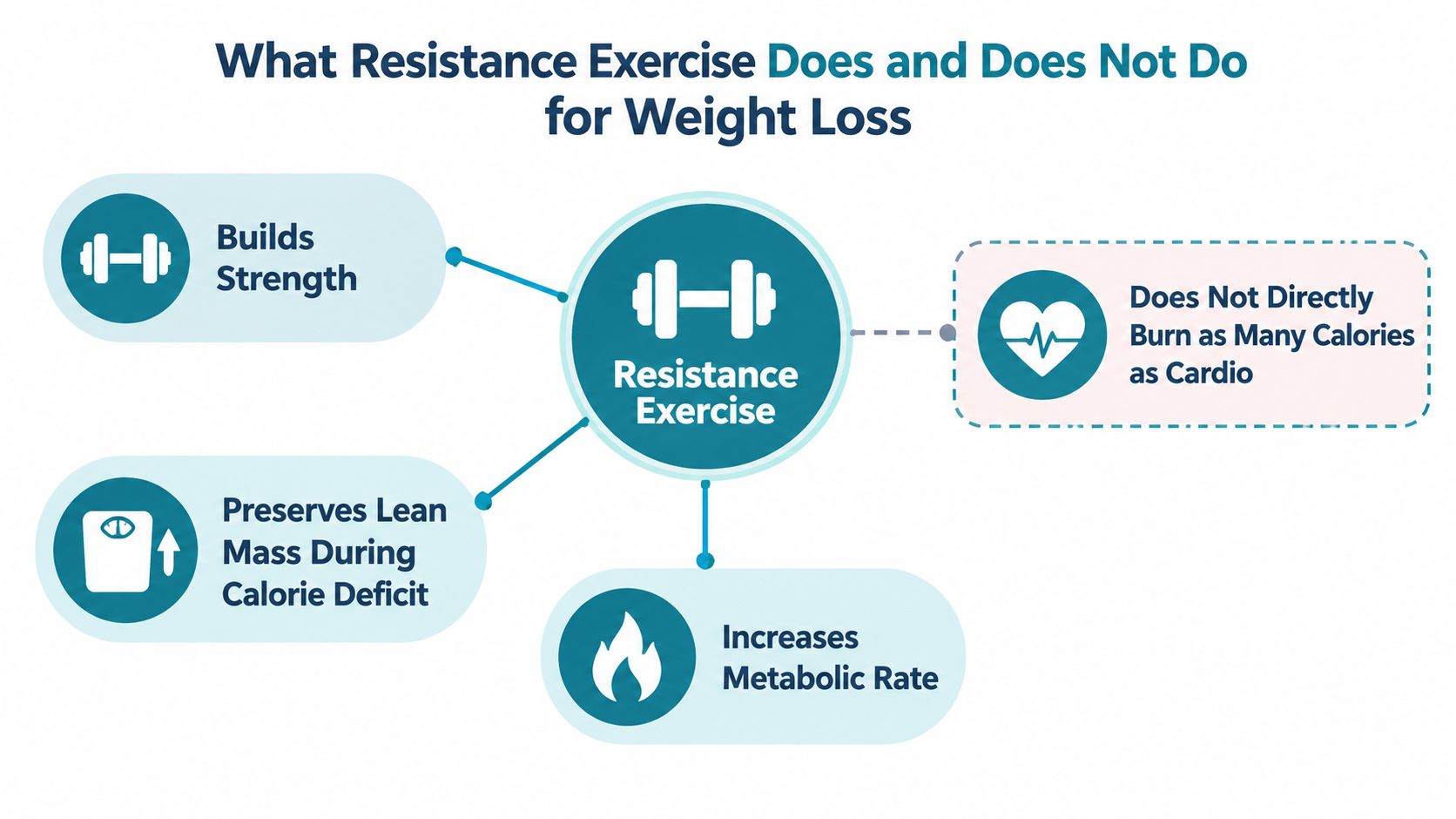
What the evidence supports
Progress is best judged by the outcomes resistance exercise can influence: strength, function, fat mass, and retention of lean tissue. The 2024 systematic review and meta-analysis found that resistance exercise during dietary weight loss did not significantly change total weight loss. The pooled difference was -0.32 kg, with a 95% confidence interval from -1.00 to 0.35 and p=0.35. The full review and meta-analysis are available through the Proceedings of the Nutrition Society.
The same analysis found better preservation of fat-free mass, with a standardized mean difference of 0.40, greater fat-mass loss, with a standardized mean difference of -0.36, and a substantially larger strength gain, with a standardized mean difference of 2.36. These results support a practical conclusion: resistance exercise is often more valuable for body composition and function than for moving the scale quickly.
Practical rule: Judge resistance exercise by strength, function, fat mass, and lean-mass retention, not by scale change alone.
Resistance exercise also forms one part of an activity plan. Aerobic exercise supports cardiovascular fitness and energy expenditure, while daily movement adds further activity. Nutrition matters too, and a calorie-deficit approach should be individualized rather than treated as a single formula.
Why expectations protect safety
Rapidly adding weight, sets, or training days can lead to excessive soreness or injury. Beginners may need modified movements, supervision, or medical guidance before increasing effort, especially when pain, balance limitations, joint symptoms, or other health concerns affect movement.
A highly restrictive nutrition plan can also make training, recovery, and adequate protein harder to maintain. A slower, adjustable approach gives the person and care team more room to respond to symptoms, recovery, and changing goals.
How Resistance Training Compares With Other Activity for Body Composition
Resistance exercise, aerobic activity, and dietary change affect weight management through different pathways. A useful comparison asks which combination supports fat loss, lean-mass preservation, strength, and health for the individual, rather than treating one activity as the universal winner.
A 2022 systematic review and meta-analysis found that supervised resistance-based programs reduced body-fat percentage and whole-body fat mass in people with overweight or obesity. The strongest results appeared when resistance training was paired with caloric restriction. In that analysis, the combination produced a -3.8% change in body-fat percentage and a -5.3 kg change in whole-body fat mass compared with no intervention. Both findings were statistically significant at p<0.001. The review is available through the National Library of Medicine.
A related meta-analysis in healthy adults found that resistance training alone lowered body-fat percentage by 1.46%, body-fat mass by 0.55 kg, and visceral fat by a standardized mean difference of -0.49. Results vary between programs and populations. The practical lesson is to assess body composition separately from total body weight, especially when preserving muscle is a priority. The resistance-training meta-analysis is indexed in PubMed.
Resistance Exercise and Weight Management Evidence Summary
| Outcome | Resistance Alone | Resistance Plus Diet | What It Means for Planning |
|---|---|---|---|
| Total body weight | May not change significantly during dietary weight loss | Diet remains central to total weight change | Use measures beyond the scale |
| Fat-free mass | Helps preserve lean mass during weight loss | Particularly useful when paired with dietary weight loss | Track strength and function alongside weight |
| Fat mass | Can reduce body fat in some populations | Evidence supports greater fat-mass reduction than no intervention | Assess body composition when clinically appropriate |
| Strength | Improves strength substantially compared with dietary weight loss alone | Supports physical function during weight loss | Progress gradually and repeat the plan consistently |
| Metabolic measures | May help, but effects vary by program and population | Exercise added to diet can improve several metabolic measures | Combine modalities when appropriate rather than relying on lifting alone |
The 2025 comparison between aerobic and resistance exercise has a practical implication. Choose aerobic activity when reducing absolute body mass is the main exercise-related priority, while resistance training may be the better fit for maintaining strength and lean tissue during dietary weight loss. Combining them can address different outcomes without requiring either mode to do every job. The 2025 meta-analysis is indexed in PubMed.
Why complexity isn't the main target
The healthy-adult meta-analysis did not show that training volume or specific program components clearly predicted larger effects. More exercises, elaborate equipment, and exhausting sessions are not automatically better.
A repeatable plan with gradual overload is easier to apply. Progressive overload means increasing a challenge over time, such as resistance, repetitions, control, range of motion, or training consistency, when the current level feels manageable. This works like adjusting a dimmer switch rather than flipping a light from off to full brightness.
Metabolic outcomes add another consideration. A 2026 systematic review of 97 studies found that exercise added to diet improved glucose, insulin, insulin resistance, triglycerides, HDL cholesterol, and blood pressure compared with diet alone. It also reported that dietary intervention combined with high-intensity aerobic exercise may offer greater metabolic benefits than resistance training. The review is indexed in PubMed.
Resistance exercise supports strength, function, and body-composition goals, but the appropriate mix depends on the outcome being pursued and the person's capacity. For a broader explanation of how anaerobic activity may fit into an activity plan, see this guide to anaerobic exercise for weight loss.
Designing a Safe and Sustainable Resistance Program
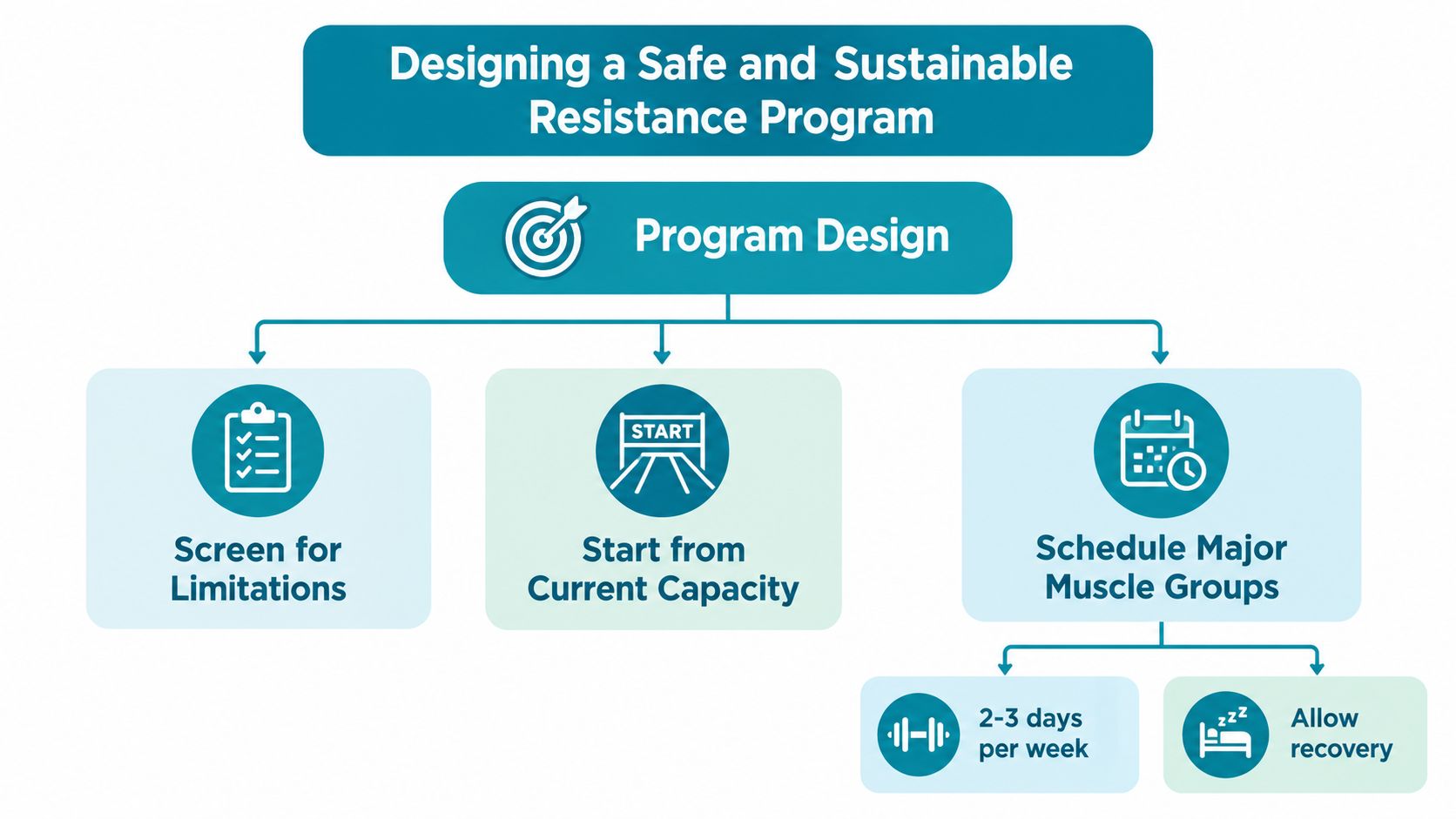
A safe program starts with your current capacity. Joint limitations, balance problems, pain, recent surgery, cardiovascular symptoms, pregnancy, and other medical concerns can change how exercises should be selected. A qualified clinician or exercise professional can help decide whether you need modifications, medical clearance, or closer supervision. Resistance training during weight loss is primarily a way to support function and preserve lean mass while body weight changes.
Start with movement patterns
A balanced routine can be built from a few repeatable patterns. Each exercise should allow controlled technique and a clear way to adjust the challenge.
- Squat pattern: A chair squat or goblet squat trains bending at the knees and hips.
- Hinge pattern: A supported hip hinge or light dumbbell deadlift emphasizes movement through the hips.
- Push pattern: A wall push-up, incline push-up, or chest press develops pushing strength.
- Pull pattern: A resistance-band row or supported dumbbell row develops pulling strength.
- Core stability: A dead bug, modified plank, or carry challenges the trunk to resist unwanted movement.
Body weight, bands, machines, and free weights can all provide resistance. Choose the option that feels stable, fits your surroundings, and can be repeated consistently. The exercise itself is only one part of the plan. The fit between the exercise, your recovery, and your medical needs determines whether the plan can last.
Use frequency as a framework
Major guidance commonly includes resistance training 2 to 3 times per week within a broader activity plan. The WHO guideline summary in NCBI Bookshelf also describes 150 to 300 minutes of moderate-intensity aerobic activity or 75 minutes of vigorous activity, and/or 2 to 3 resistance-training sessions weekly. The guideline summary is available through NCBI Bookshelf.
These ranges provide a planning framework, not a personal prescription. Some adults need a slower start, while others already tolerate more activity. Set a schedule that leaves room for recovery and works with sleep, nutrition, employment, and medical care.
Progress without chasing exhaustion
Intensity describes how challenging an exercise feels. Begin at a level that permits controlled repetitions, steady breathing, and sound form. Avoid breath-holding, sharp pain, and movement that becomes uncontrolled. Rest between sets until breathing and technique have recovered.
Change one variable at a time. Improve consistency first, then add repetitions, then modestly increase resistance. If soreness, fatigue, or joint symptoms stay high, maintain the current level or reduce the challenge.
Plan every session so the next one is still possible. Consistent, controlled work beats maximal effort you cannot repeat.
Adequate nutrition, protein, hydration, and sleep support recovery. Balanced nutrition can be part of a broader weight-management plan, though individual needs vary when medication, chronic disease, or a history of restrictive eating affects the plan.
Sample Routines and Beginner Progression Grid for Different Fitness Levels
A sample routine should demonstrate options, not prescribe a universal workout. The following examples use movement patterns that can be modified with a wall, chair, resistance band, machine, or dumbbell.
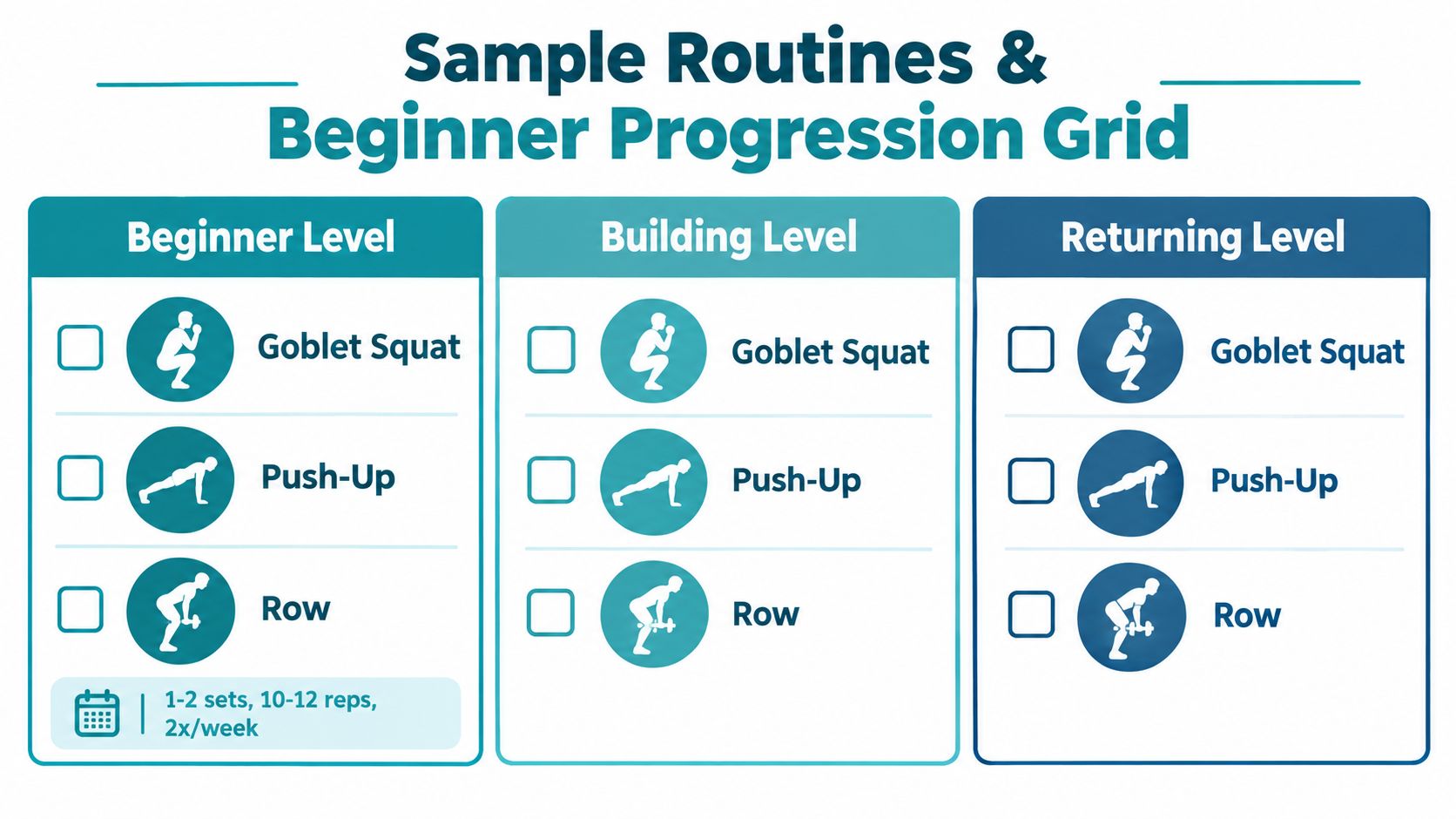
Three starting points
Beginner level: Practice a chair squat, wall push-up, band row, supported hip hinge, and a gentle core-stability movement. Prioritize learning the movement and stopping before technique deteriorates.
Building level: Use a goblet squat, incline or floor push-up as appropriate, a stronger band or dumbbell row, a controlled dumbbell hinge, and a carry or plank variation. Add challenge only when the current version feels stable.
Returning level: Revisit familiar patterns with reduced resistance and conservative volume. Build back gradually instead of assuming previous fitness has returned.
A resource on pelvic floor and core for CrossFit may also help readers understand how trunk control and pelvic-floor considerations can affect exercise modifications. It isn't a substitute for individualized assessment.
Beginner progression grid
| Stage | Frequency | Sets and repetitions | Effort | Recovery | Stop signs |
|---|---|---|---|---|---|
| Starting practice | 2 sessions per week, if appropriate | 1 set of 10 to 12 controlled repetitions for selected movements | Comfortable to moderate, with technique intact | Leave recovery time between sessions | Sharp pain, dizziness, chest discomfort, or loss of control |
| Building consistency | 2 sessions per week, if appropriate | Progress toward 2 sets of 10 to 12 repetitions when the first stage is well tolerated | Moderate, without repeated straining | Keep at least a recovery day between similar sessions when needed | Worsening joint pain, unusual weakness, or symptoms that persist |
| Gradual progression | 2 to 3 sessions per week, if appropriate | Add a small challenge to selected movements, not every variable at once | Challenging but controlled | Keep recovery, sleep, nutrition, and daily activity in balance | Form breakdown, significant pain, faintness, or new concerning symptoms |
The grid reflects a cautious progression, not individualized medical instruction. It also shows why “more” isn't automatically the next step. A person may progress by improving control or consistency rather than adding weight.
A clearly labeled composite example
Hypothetical composite example: An adult loses weight but notices increasing weakness and difficulty with routine tasks. Rather than pursuing a scale-only target, the person adds progressive resistance work, reviews adequate protein and overall nutrition, and slows excessive restriction. Follow-up focuses on function, strength, symptoms, and sustainable habits.
That example doesn't predict an outcome. It illustrates a clinical reasoning principle: weight loss can be evaluated by quality and function, not only by total kilograms or pounds. Adults seeking a broader overview can review strength exercise for weight loss as one part of that discussion.
Monitoring Progress and Coordinating With Medical Care
A resistance program becomes more useful when you monitor what it changes. Track whether movements feel more controlled, whether daily tasks become easier, and whether strength gradually improves. Record the exercise variation, repetitions, resistance used when relevant, perceived effort, symptoms, and recovery.
Waist circumference and body weight can provide context, but single readings can fluctuate. Fat mass and fat-free mass may be assessed through clinical methods when appropriate, although each method has limitations. A trend across time is more informative than one workout or one measurement.

A practical monitoring sequence
- Screen limitations. Note pain, balance concerns, recent procedures, significant fatigue, and symptoms that may require medical review.
- Start from current capacity. Choose variations that allow controlled movement and consistent breathing.
- Train major muscle groups at least twice weekly when appropriate. Adjust the schedule when recovery or medical factors require a different approach.
- Add aerobic activity and daily movement. Walking, cycling, swimming, or another suitable activity can support fitness and energy expenditure.
- Progress gradually. Change one training variable at a time and review the response.
- Pair exercise with nutrition and recovery. Adequate protein, overall nutrition, hydration, and sleep support the ability to continue.
- Review medication response separately. Medication decisions depend on the individual clinical picture. Don't change a medication because of a workout, scale fluctuation, or social-media advice.
If you're using or considering anti-obesity medication, exercise planning should be coordinated with the clinician managing your care. A physician may need to consider appetite, food intake, gastrointestinal symptoms, blood sugar concerns, activity tolerance, and changes in strength or function. The practice's weight-management care information can help you identify topics to discuss during a medical visit.
Routine follow-up is appropriate for questions about stalled progress, persistent fatigue, medication tolerability, nutrition, exercise progression, or long-term maintenance. Seek urgent medical care for severe or new chest pain, fainting, severe shortness of breath, sudden neurological symptoms, or another emergency symptom. Resistance exercise shouldn't be used to explain away symptoms that need prompt evaluation.
Safety Tips Modifications and When to Pause or Seek Care
Most avoidable problems come from progressing too quickly, ignoring recovery, or treating complexity as a requirement. You don't need advanced equipment or an exhausting routine to begin. You need a movement version that fits your current capacity and can be repeated safely.
Use modifications when a standard movement causes discomfort or instability:
- For joint discomfort: Reduce range of motion, use a chair or wall for support, or choose a different movement pattern. Persistent or worsening pain deserves clinical evaluation.
- For limited equipment: Use body weight, bands, household support surfaces, or a machine. Resistance should still allow controlled technique.
- For limited time: Use a small selection of major movement patterns rather than skipping activity entirely. Consistency matters more than elaborate programming.
- For poor recovery: Reduce the challenge, add recovery time, and review sleep, nutrition, hydration, and other contributors.
- For medication concerns: Contact the prescribing clinician rather than independently changing treatment.
Pause the exercise session for sharp pain, dizziness, faintness, chest discomfort, unusual shortness of breath, new weakness, confusion, or loss of coordination. Emergency symptoms call for emergency services, not routine follow-up. Less urgent but persistent symptoms should be discussed with a qualified clinician before progression.
Resistance exercise for weight loss works best as one component of individualized, sustainable obesity care. It can support strength and lean-mass preservation, while aerobic activity, nutrition, medication when clinically appropriate, and follow-up address other parts of the picture.
Empire Medical Wellness provides private, physician-led obesity medicine care that may include medical and metabolic assessment, individualized weight-management planning, medication when clinically appropriate, monitoring, and long-term maintenance planning. Visit Empire Medical Wellness to learn more about the practice and decide whether a physician conversation about your goals and exercise plan would be appropriate. This article is educational and isn't personal medical advice.
Byline: Empire Medical Wellness Editorial Team
Published: September 22, 2026
Updated: September 22, 2026
Sources
- 2024 systematic review and meta-analysis of resistance exercise during dietary weight loss
- 2022 systematic review and meta-analysis of resistance-based exercise across the lifespan
- Meta-analysis of resistance training and body-fat outcomes in healthy adults
- 2025 meta-analysis of resistance exercise during dietary weight loss
- NCBI Bookshelf summary of physical activity guidance